
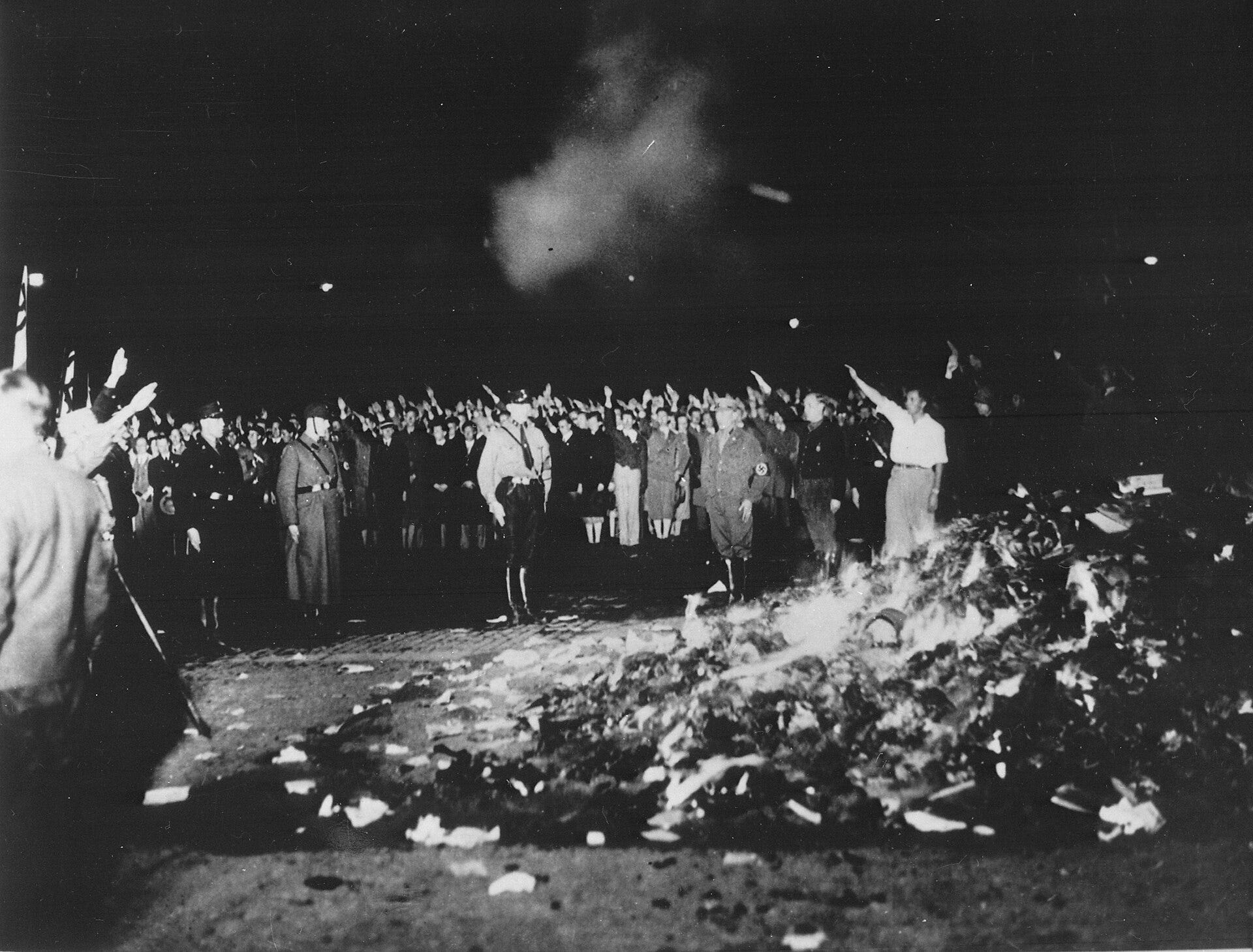
The Institute for Sexual Science was founded in Berlin more than a hundred years ago as a center for LGBTQ+ healthcare and social support. It was also one of the first organizations targeted by the Nazi party. An iconic photograph of a 1933 book burning depicts the destruction of the Institute’s library. As two recent studies make clear, Nazis ransacked the Institute because it threatened their political platform: first, because its ethos of sexual liberation challenged fascists’ idealization of gender-normative heterosexuality, and second, because that ethos had taken root. By the early 1930s, thanks in large part to the Institute and its charismatic founder and director, Dr. Magnus Hirschfeld (1868–1935), Germans were increasingly tolerant of sexual diversity.
The Einstein of Sex: Dr. Magnus Hirschfeld, Visionary of Weimar Berlin, by Daniel Brook, and The Intermediaries: A Weimar Story, by Brandy Schillace (both published by W. W. Norton in 2025), examine Hirschfeld’s work as one of history’s most significant sexual scientists. Brook’s book follows a traditional biographical arc. It begins with Hirschfeld’s childhood in a secular Jewish household in Kohlberg, a Baltic town that was then in Prussia and is today part of Poland. Brook discusses Hirschfeld’s education in prestigious Catholic schools and his decision to follow his father into the medical field. The book traces Hirschfeld’s professional career and personal relationships, concluding with his death in exile in Nice, France, after friends warned him not to return to Germany for fear of Nazi persecution.
Hirschfeld came of age keenly aware of his attraction to other boys, at a time when both antisemitism and homophobia were intensifying. In 1873, the parliament of the newly reunified Germany added what became known as “Paragraph 175” to the German Criminal Code. The law “made consensual sex between men a crime, punishable by up to five years in prison,” Brook explains. Hirschfeld was a child when then law was enacted, but the campaign for its repeal would occupy much of his professional life in the decades to come. He likewise grew amid a resurgence of antisemitism. An 1880 petition, signed by hundreds of thousands of Germans, sought to revoke their country’s religious freedom law, a cornerstone of the emancipation of Jews since the days of Napoleonic rule. The petitioners wanted to define Judaism as “an incurable hereditary condition.” Chancellor Otto von Bismarck quashed the petition, but Brook notes that openly antisemitic candidates defeated their liberal opponents in 1881, giving conservatives their first parliamentary majority.
Science, more than religion, was the terrain for conflicts in Germany over both gay rights and Jewish people’s citizenship. A new field of scientific racism, which emerged in the last quarter of the nineteenth century, argued that Jewishness, blackness, and other markers of difference were immutable—and inferior—inheritances. American eugenicists like Charles Davenport and European antisemites defended their theories of white—or Aryan—superiority with flawed data claiming to prove the racial origins of physical, psychological, and intellectual variations.
The science of sexuality developed during these same decades, as political advocates and physicians like Hirschfeld began to argue for the biological origins of sexual and gender diversity. Schillace’s book is especially effective at explaining how Hirschfeld’s medical approach to queer life intersected with scientific discoveries about the existence and function of hormones. For Hirschfeld, the emergence of endocrinology proved that queerness and gender nonconformity were not neuroses as Sigmund Freud (a frequent critic) would have it but instead functions of human biological variation. He also quickly recognized the utility of hormones for helping “intermediaries,” his term for people whose gender identity did not align with the sex assigned to them at birth.
Schillace attends to the inconsistencies in Hirschfeld’s explanations. His “theory of congenital homosexuality privileged biological processes,” she writes, even leading him to endorse the work of a controversial scientist named Eugen Steinach. Steinach’s work rested on the premise that healthy men were virile, masculine, and aggressive, with healthy women demonstrating complementary traits. In a series of experiments with transplanted gonads in lab animals, placing ovaries in males and testicular tissue in females, Steinach claimed to prove that binary sex differences were biologically determined. In a rare human study, he even theorized that a testicular transplant from a heterosexual to a homosexual man, whose own testicles had been surgically removed due to complications of tuberculosis, could “cure” the latter’s homosexuality. He then asserted that he had located unusual cells in the homosexual man’s excised gonads that more closely resembled material found in ovaries. Subsequent studies disputed these findings. Steinach and Hirschfeld both believed that homosexuality “was a natural, inborn, biological phenomenon—and that sex and gender existed on a spectrum with intermediary forms,” Schillace explains, but while Steinach considered homosexuality a pathological condition, Hirschfeld hoped that scientific data would liberate, not demonize, queer and transgender people.
The Institute for Sexual Science became a global hub for what we would today describe as gender-affirming care. In addition to its extensive library of medical, literary, and sociological studies of sexuality in all its forms, the center included a museum, medical treatment rooms, meeting areas, and a dormitory. Schillace emphasizes the Institute’s importance for Dora Richter, who found refuge there after years of trying to negotiate an existence as a transwoman. Hirschfeld provided Richter with counseling, something he did for many of the Institute’s patients. Between 1923 and 1931 she also underwent several surgical procedures at the Institute to affirm her feminine gender identity—making her the first person in the world to medically transition.
The Intermediaries, differently from The Einstein of Sex, is less a biography of Hirschfeld than a study of how science, politics, and gender shaped both the successes of the Institute for Sexual Science and its ultimate destruction. Schillace painstakingly reconstructs Richter’s otherwise obscured life, illuminating the emotional as well as medical value of Hirschfeld’s trans-affirming vision. She also emphasizes the centrality of conventional gender roles to German fascism and antisemitism. A masculinist faction of the German gay rights movement, which often clashed with Hirschfeld and his allies, denigrated trans and gender nonconforming people as threats to “respectable” homosexual men. Some of the same individuals who worked or received treatment at the Institute became card-carrying Nazis, unmoved by Hitler’s campaigns against their Jewish colleagues and friends. However obvious it might seem in hindsight that these gay men would eventually number among Hitler’s victims, Schillace effectively explains how powerfully their sense of themselves as white, masculine, middle-class men led them to embrace the hyper-masculine ethos of the Nazi party. Brook, by contrast, devotes more space in his book’s later chapters to Hirschfeld’s critique of American racism. Hirschfeld, Brook writes, “grew ever more suspicious of [the United States’] stark racial borderlines” during extensive travels abroad in the 1920s and 1930s: “Just as he had come to see sexual orientation and gender as continua after encountering so many people who didn’t fit neatly into binary categories, now he came to see race as a continuum.” Hirschfeld was keenly aware of the dangerous consequences of racial categories: while he benefitted from his whiteness in the United States, in his home country his family’s Jewish heritage was becoming a death sentence.
Both books demonstrate that Hirschfeld and his allies made a difference. Through his indefatigable publications, lectures, and film, by the early 1900s Hirschfeld was, Brook writes, “winning over the center” of the German public. Schillace interlaces the history of Adolf Hitler’s political ascent with discussions of Hirschfeld’s unrelenting efforts to build international support for queer and trans rights. In 1929, mainstream German politicians voted to overturn Paragraph 175. Hirschfeld celebrated this long-awaited victory despite a disappointing legislative compromise: Paragraph 297, which criminalized male sex work and raised the age of consent for men to 21. The new law outraged many of Hirschfeld’s erstwhile allies. He resigned from the Scientific Humanitarian Committee, an advocacy group devoted to the repeal of Paragraph 175 that he had led for more than thirty years.
The authors of these two outstanding books write with a general audience in mind. Brook is a journalist especially attuned to the details of his main subject’s life. Schillace has a career that spans academic appointments and fiction writing, a background that enables her to write a deeply contextualized narrative. The Intermediaries makes more overt comparisons to today’s debates over trans rights amid rising right-wing authoritarianism, while The Einstein of Sex reminds its readers that racism and anti-LGBTQ animus are two sides of the same fascist coin.
Comments
Nothing yet. Say the first thing.
Sign in to join the conversation.