
In which Rebecca uses her nose to access her memory bank as the natural world unfurls around her.
Dear Reader,
There are sheep in the field behind our house, and when I flung open the bedroom windows on a warm, bright morning recently the scent in the air took me straight back to the lambing shed on the smallholding I grew up on. We’d always kept a few sheep, right from when my parents were given a pair of orphan lambs when I was tiny, and, thanks to a visit from the ram every autumn, come spring there would always be lambs.
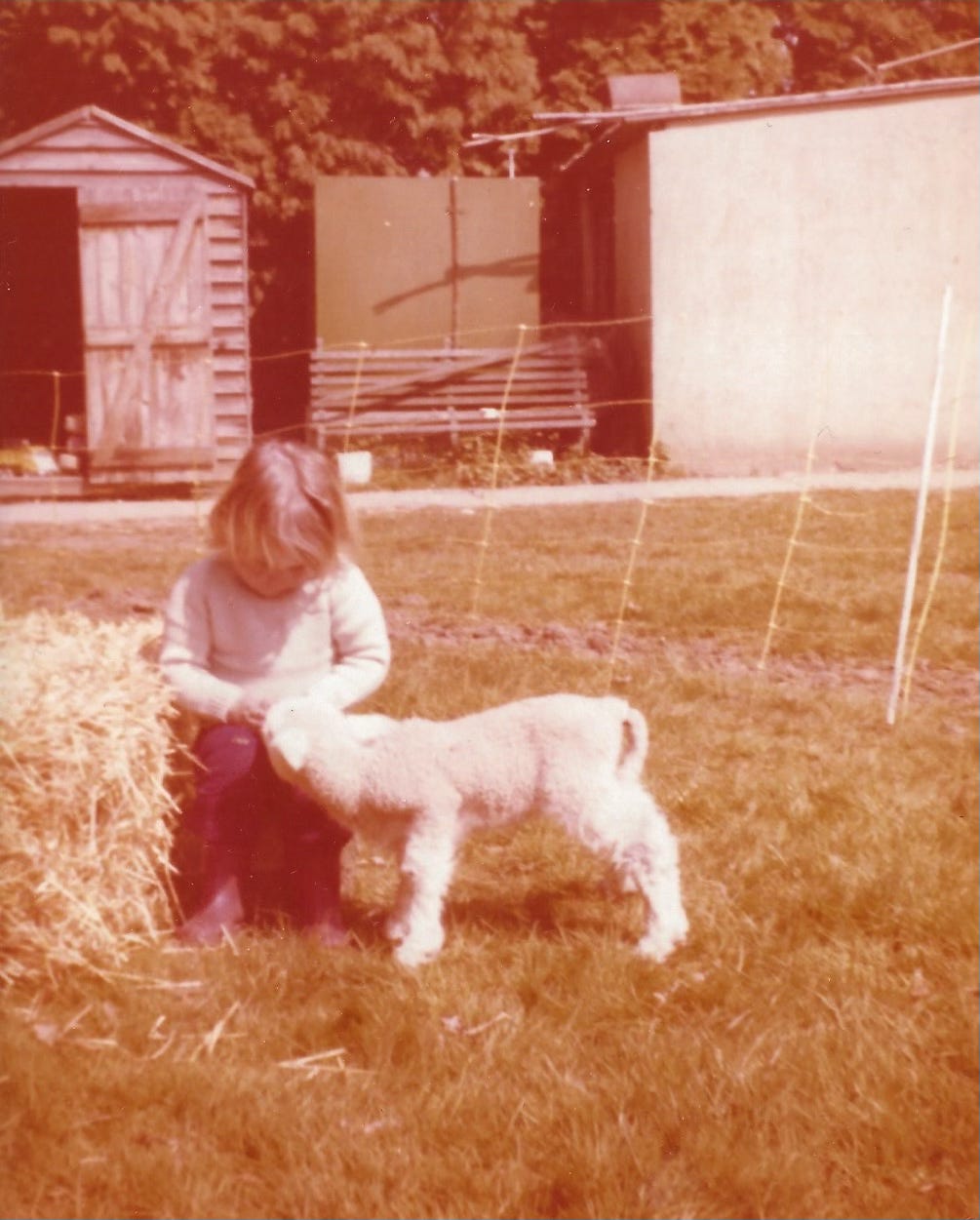
The scent of the lambing shed isn’t an anatomical one, although I don’t doubt there are plenty of pheromones around; it’s a warm smell of lanolin, sweet hay, and an unidentifiable generic springness of green shoots and sunshine. There wasn’t a lamb to be seen from my bedroom window on that morning, but just the scent of sunwarmed sheep was enough to trigger childhood memories of our family pets at my favourite time of the year.
Scent is very closely linked to memory. Here’s how Annabel Streets describes the connection in her terrific book 52 Ways to Walk:
When we inhale, microscopic clusters of scented particles wash over two sets of receptors the size of a thumbprint, located at the top of our nostrils. From here they go to the olfactory bulb in our brain for coding, before whizzing to the amygdala (the emotional ‘seat’ of our brain) and the hippocampus (our brain’s memory bank) to be filed as a sort of sensory scented ‘image’. Smell is the only sense that travels so directly, meaning that smell, emotion and memory are often interwoven and stored as a single file. It’s no wonder a simple sniff can spark a vividly evocative memory.
Taken from 52 Ways to Walk: the surprising science of walking for wellness and joy, one week at a time, by Annabel Streets.
Bloomsbury Publishing, 2023
‘Vivid’ and ‘evocative’ memories can of course be positive or negative. In an edition of her radio programme Life Changing, psychologist Dr Sian Williams focused on a particular everyday scent being the trigger for a powerful and debilitating trauma response in her interviewee.
Smell goes straight to the limbic system in our brain, and that’s about emotions and memory, so it can trigger emotion and memory before our conscious brain has caught up with it. It’s the only sense that does it.
Text taken from A traumatised veteran’s unlikely saviour, an episode of Life Changing broadcast on BBC Radio 4 on October 24, 2025
Nice smells can evoke horrid memories, yet horrid smells can evoke nice ones. The whiff of a diesel engine exhaust – an unappealing niff to most people I know – will always mean holiday to me. Regardless of the time of year, whenever a passing lorry guffs a cloud of diesel fumes anywhere near me my subconscious brain takes me straight to a frosty canal in the north of England, where I’m aboard a narrowboat during one of the trips we’d take as a family every October half-term holiday. I won’t apologise for finding those engine fumes absolutely wonderful.

According to a 2014 study by Rockefeller University, the human nose is able to distinguish more than a trillion smells. That sounds like a lot, but the smells around us are so very diverse that we can recognise when two things we expect would smell the same actually don’t. The flowers on the beautiful Philadelphus in the garden where I grew up had a scent like Domanil strawberries; the one we used to have where I live now – which looked identical – smelt of spearmint.
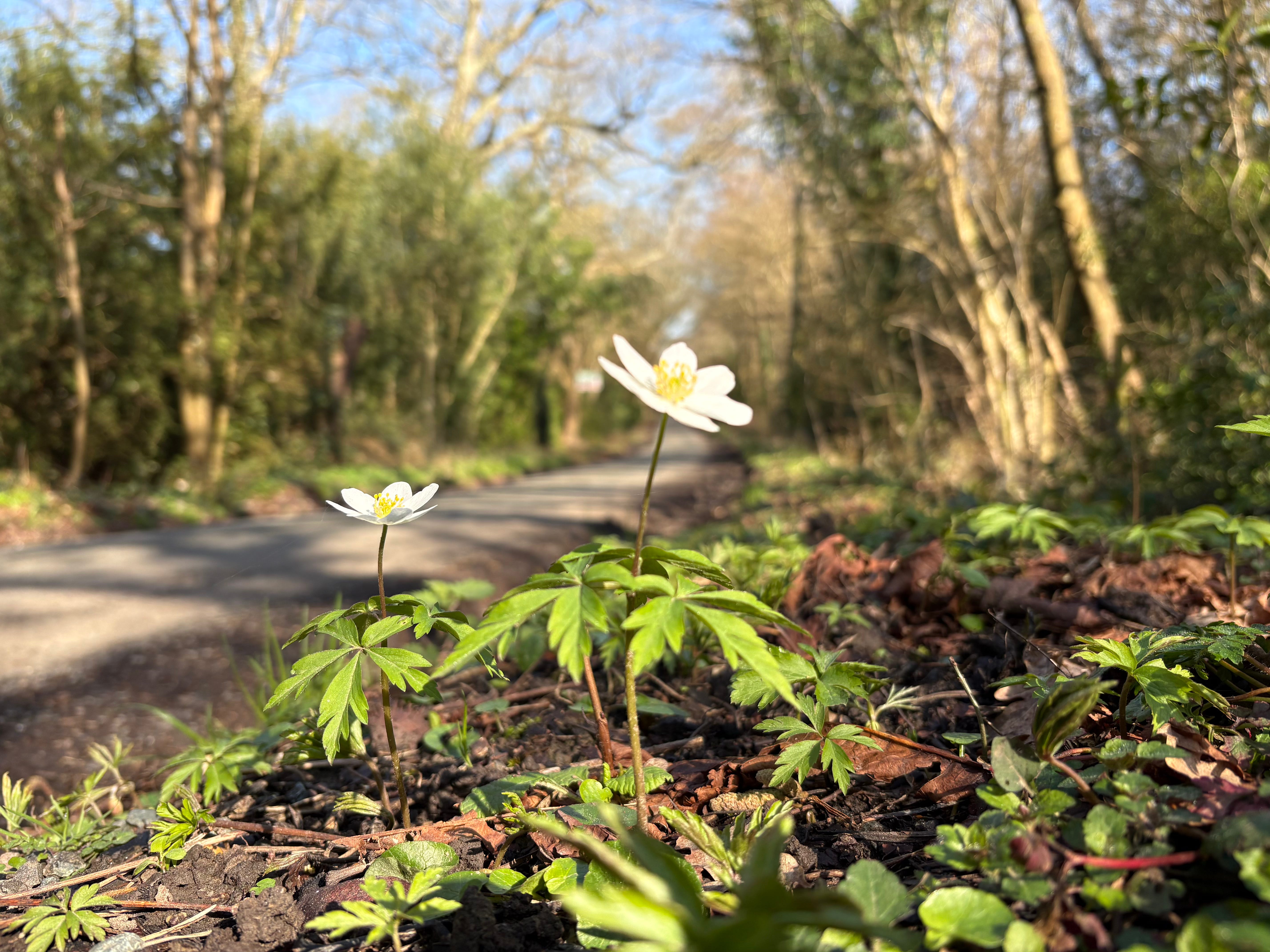
A full picture of spring, of course, is built of all of our senses: the feel of soft fresh grass under our feet; the sound of birds singing and the wind through new leaves; the sight of flower buds bursting into bloom; even the taste of fresh air, but it’s the things which smell that are the most evocative.
During a walk at Bedgebury Pinetum I landed unexpectedly in my archive of scent-soaked memories.
‘I’m at Grandma’s!’ I announced to Jim. He was confused. ‘What do you mean?’
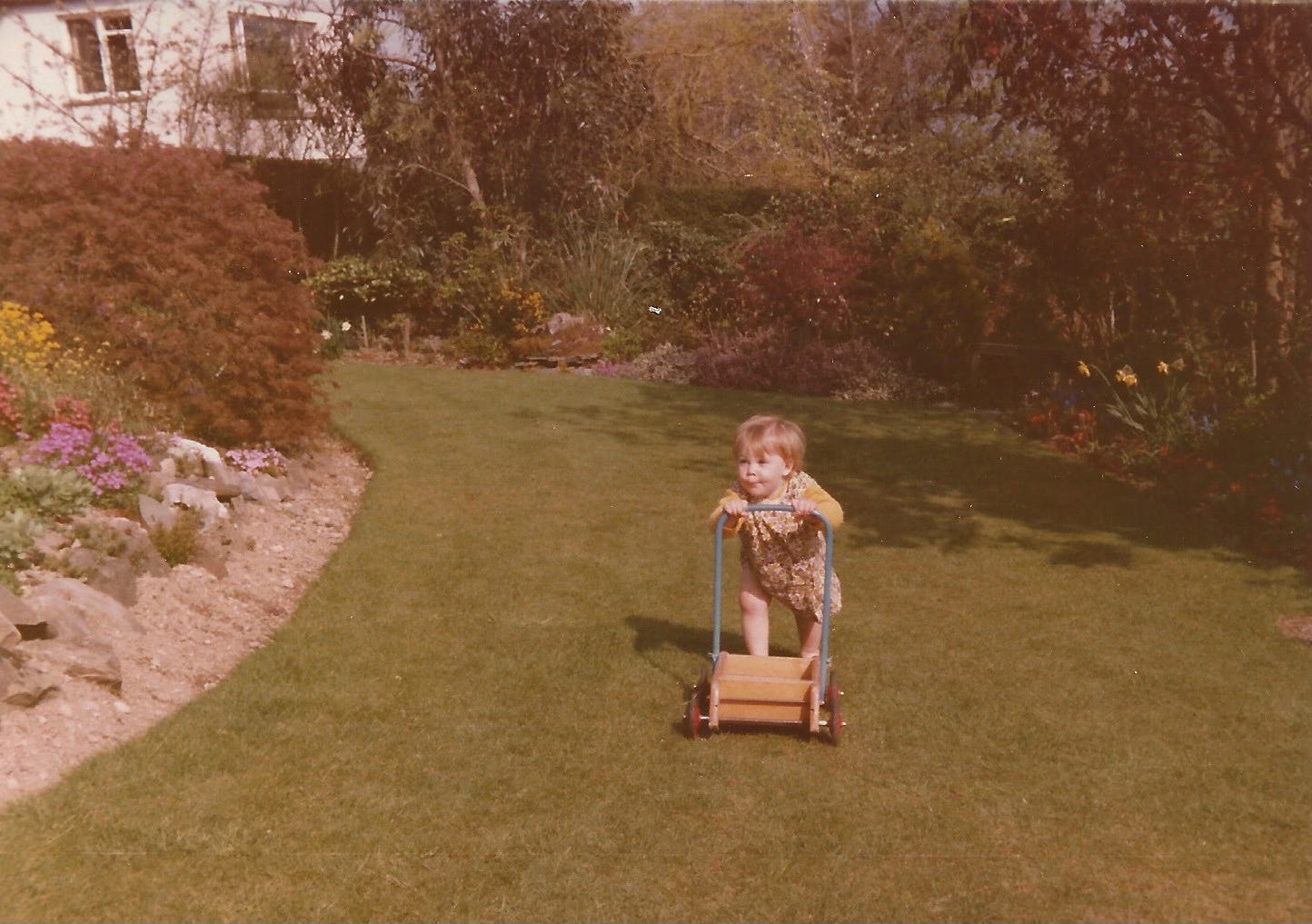
‘You know…. at the top of her garden, not the main bit of garden, but the part where the whirligig washing line was, you know, not the bit at the back with the view of the fells and the lake, with the long meandering slope past the deep red acer and the oak tree, you know, from the acorn which I’d picked up at Brockhole when I was tiny and then planted, or anywhere near the greenhouse, but you know, the sort of oblong bit at the top where Grandma had hung the stainless steel rings from around the coiled elements of her old hob, you know, where the birds would like to perch near the suet-stuffed coconut halves and the other feeders? You know!’
Jim didn’t know. Of course he didn’t. He hadn’t ever been there.
Still, he played along. ‘What’s brought all that back?’
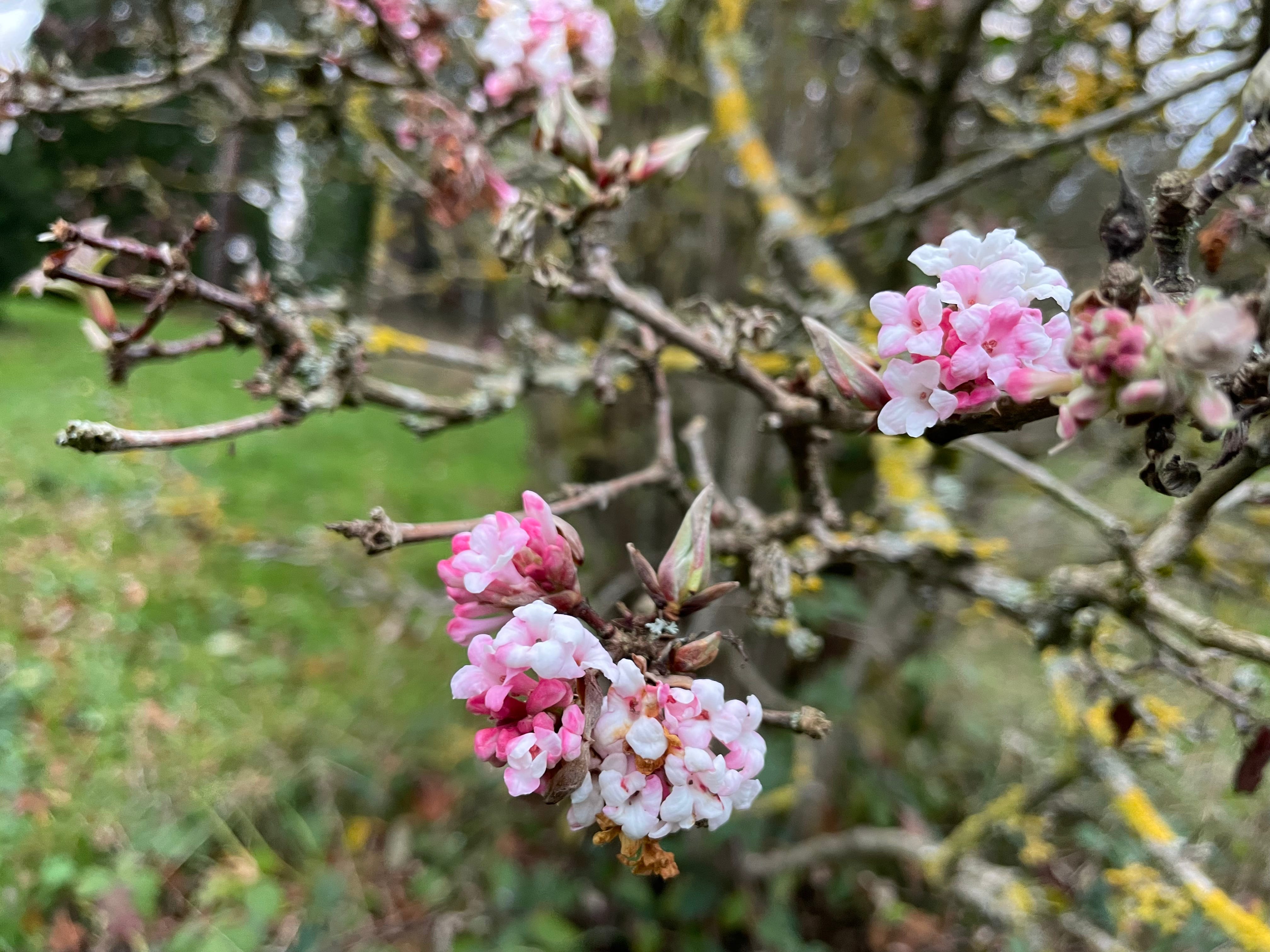
‘Well, from autumn to early spring that bit of garden smelt exactly like this – it was a viburnum, but it’s not any viburnum I’ve come across since. Where is it? It’s definitely here.’
Within a few steps from the path there it was. I snapped this picture and sent it to Mum straight away:
A text conversation followed.
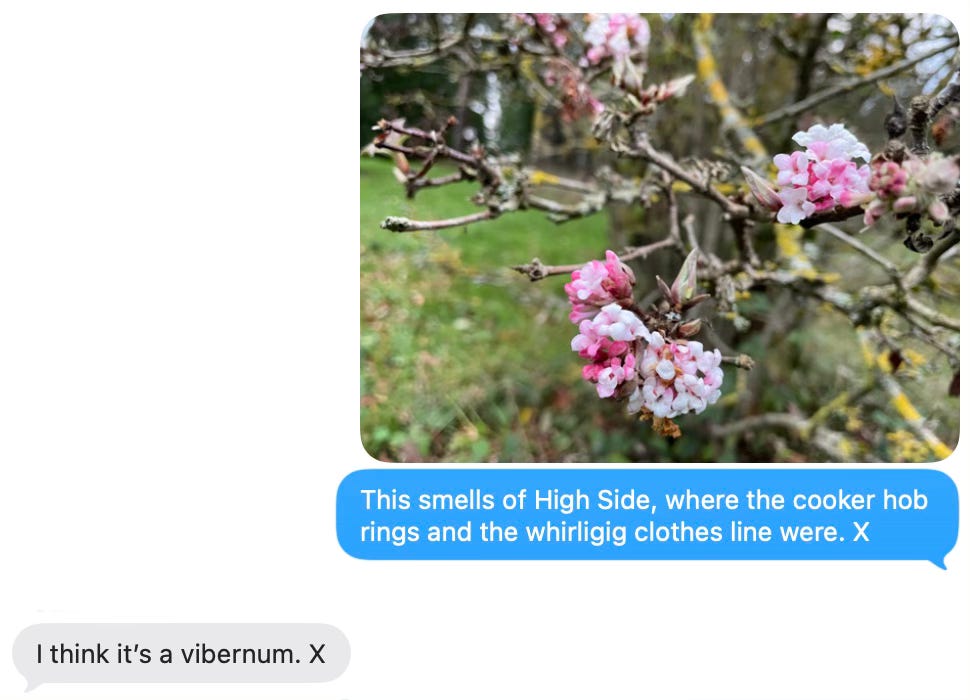
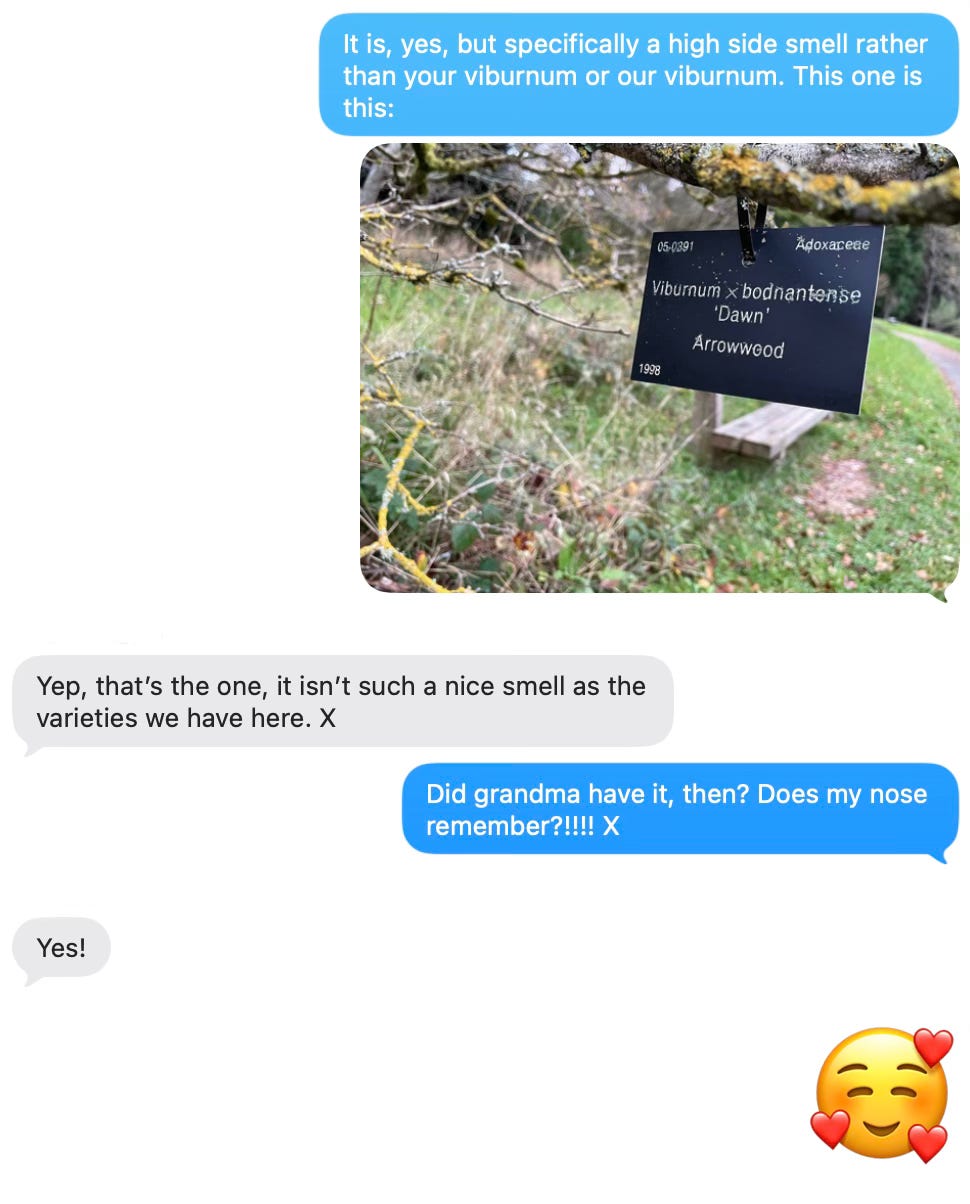
Just as with the strawberries-versus-spearmint scent stand-off between those varieties of Philadelphus, our perceptions of scent and any preferences for one over the other are very subjective. Mum told me in her text that she prefers the scent of the viburnums she has at home, whereas nothing will ever touch Grandma’s Viburnum × bodnantense 'Dawn' in my own olfactory archive. I wonder, though, whether I love the scent for its own sake, or for the memories my remarkable limbic system has made me store alongside it?
🤔
The scent of podded broad beans, the heady aroma of strawberries and sugar bubbling away in the jam kettle and the prickly smell of Mum’s cucumber pickle always prompt memories of summers past, but it’s March now; too early for those. For now I’ve got the smells of soil warming up in the garden, of the first cut of grass, those gorgeous sheep in the sunshine; all layers of the sense most able to unlock my vault of springtime memories.
With love,
Rebecca
If you’ve enjoyed this post, please let me know by clicking the heart. Thank you!
Thank you for reading! If you enjoy ‘Dear Reader, I’m lost’, please share and subscribe for free.
Comments
Nothing yet. Say the first thing.
Sign in to join the conversation.