
Hello and happy August. I hope all the families who rely on stringing together a patchwork of camps and childcare solutions over the summer have a finish line in sight. Today’s post is from my colleague and friend, Mark Swartz, who has been reporting on care issues through his publication Aging in America News. Highly recommend checking this out, and kudos to Mark for identifying an issue that deserves more ink and airtime. Because, even though many of us like to feel invincible, it’s not a matter of IF we’ll need care as we age, only a matter of WHEN.
Mark interviewed Brigid Schulte, who I’m lucky enough to work with at the Better Life Lab at New America, about a poll she and Elliot Haspel did about what Americans think and know about care. TL; DR: Most Americans don’t fully grasp what our country’s care infrastructure looks like and what a looming problem this will continue to be. Some people also think childcare is just babysitting, and others have no idea who pays for it now as is. Interview is below, with some gems in the pull quotes.
As always, thanks for reading!
-Rebecca
Guest post by Mark Swartz, whose Substack is Caring about Care
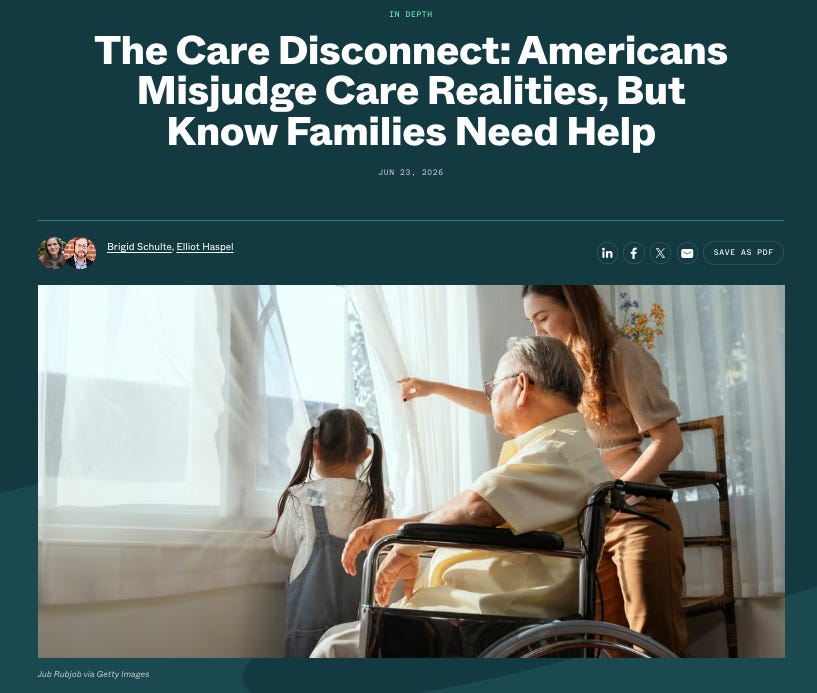
Published by New America’s Better Life Lab, The Care Disconnect: Americans Misjudge Care Realities, But Know Families Need Help reveals current understandings and beliefs about childcare. Partnering with YouGov on the survey of 1,000 U.S. adults 18 years and older, Brigid Schulte and Elliot Haspel found that Americans generally want government and business to play a role in making care more affordable.
Mark’s conversation with Brigid also covered elder care, and, specifically, aging in place, which the report calls home care. You can read that part in Aging in America News.
Mark: How did the survey come about?
Brigid: I like to look at the big picture, and I like to think about lived experience, that personal interior life experience. But we’re all part of these larger systems as well. Elliot Haspel [Fellow, Culture of Care Narrative Change] came to me and said, “I’m really curious. So many people are talking about universal childcare, with the Mamdani race and what’s going on in Vermont and New Mexico. I wonder how many people really understand what that means.” And I really resonated with that, because I remember when we did the New America Care Report back in 2016, we had an event, and at the time it was Hillary Clinton and Donald Trump were running for the presidency. If you remember 2016, people were not talking about childcare. There was this weird sense from the right, from the Trump folks. They were all sort of pointing at us, saying, You all want all children to be in these gigantic centers. It was sort of likening childcare to factory warehousing. And it was just such a dark picture. One of our goals was to try to really make care more a part of the national conversation. And I hope we’ve played a part in that.
Mark: It does feel like it’s become such a big part of the conversation, but I sometimes wonder if that’s because around then is when I started reporting on it.
Brigid: That’s been my theory of change, is the more we have people writing about it and bringing more attention to it, the better. Covid certainly opened it up. And then what our research shows is that genie’s not back in the bottle. It’s fallen off some, but the level of writing about care is much higher than pre-Covid. And so I think all of that is good for momentum. I’d like to think that our coverage has been part of why people are not so surprised by that anymore. But it was the same thing with childcare. People would call in tears, like, “Oh my God, I have to put my baby on a waiting list, and I’m still pregnant, and then I’m already paying for childcare, and it’s more than my mortgage, and I haven’t even given birth yet.”
Mark: What are some ways that research should inform policy?
Brigid: The research is incontrovertible that when you offer families support with flexible workplaces, schedule control and supports like paid leave and childcare, you will have more children. What families need is support. And the main reason people say they’re not having children is because of childcare costs.
“The main reason people say they’re not having children is because of childcare costs.”
Mark: How can the survey inform advocacy?
Brigid: If you don’t really understand how you fit into the system, and how the system does or doesn’t work, how can you expect people to demand change? That’s really what we wanted to do, to establish a baseline of understanding. How much do people really know? Do voters know how much childcare costs or what a care worker makes? We forced them to make guesses.
Mark: What did they come up with?
Brigid: They were all over the map. A lot of people underestimated how much it costs, but a lot of people were just all over the place. And then when we asked them, ‘How confident are you?’ nobody was confident.
Mark: What were their impressions of childcare?
Brigid: A lot of it was crucial for working families, but some said it was babysitting. A lot of people thought that there was screen time and not a lot of education going on in childcare. When we asked where do you get your information, my favorite response, which sort of sums it all up, was just “vibes.”
“A lot of [people] thought [childcare] was crucial for working families, but some said it was babysitting.”
“When we asked where do you get your information [on childcare], my favorite response, which sort of sums it all up, was just ‘vibes.’”
Mark: How does this survey fit into the scope of your career?
Brigid: For my first book, I interviewed Pat Buchanan, who was a rising right wing star and one of the chief architects of killing the Universal Childcare Bill of the 1970s. I asked him, ‘Why did you do that?’ He’d just come back from a trip to the Soviet Union, and he was really afraid that childcare was indoctrination into Communism.
[Edited to add a note from Rebecca: this was one of my favorite chapters in Brigid’s book!]
Mark: It’s amazing how much damage can be traced to one man’s Cold War paranoia.
Brigid: Exactly. I told him that most of the children in this country live in families where all available parents are working. They need some kind of support. And he said, “America, it’s a free country. If you want to work, you go ahead and work. You want me to pay for your kids’ childcare? No way, José.” That is a direct quote.
Mark: What are your big takeaways from this survey?
Brigid: People can’t see that their personal struggles are not unique. We tend to think, ‘Oh my God, I’m failing, or I can’t find childcare, or how do other people do it?’ And they don’t see themselves as part of a larger system that is broken for everybody. But when we asked people, ‘Who should pay for care? Who should be responsible?’ over 80% of the people that we surveyed said that government has a role to play in helping families pay for both childcare and home care. A plurality said there should be public support to pay for home care and childcare for all families, not just the very poor, like we have with Medicaid or with childcare subsidies.
Mark: Do you envision policymakers taking up this issue?
Brigid: Care is not very salient politically, and yet there is that appetite for some kind of collective public solution. Elliot said that it shows that right now the public may not be moved politically by childcare, but it is movable. And so there is a real opening for much more storytelling, much more awareness building and education.
Thank you for reading! If you liked this interview, please consider liking this post or leaving a comment. It helps Substack recommend my work to new readers!
No posts
Comments
Nothing yet. Say the first thing.
Sign in to join the conversation.