
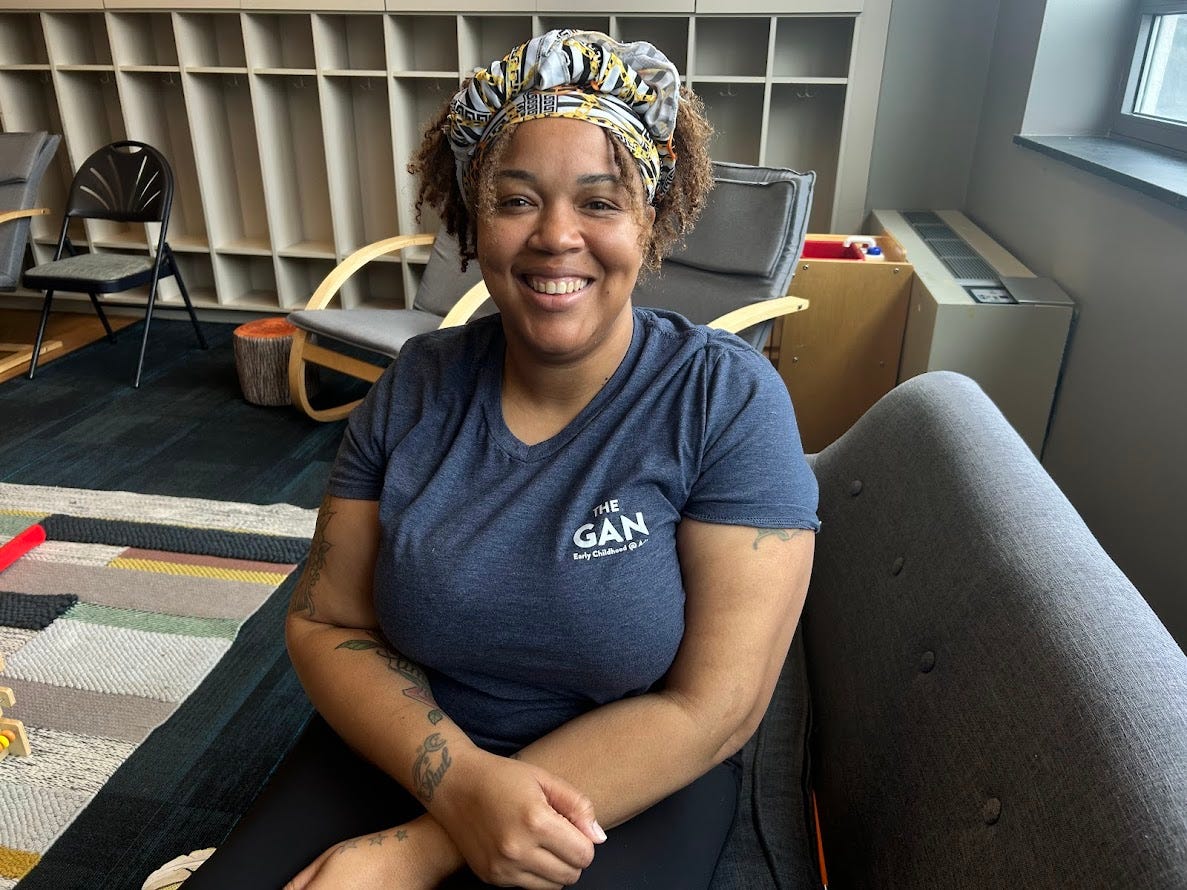
“I love my job,” is one of the first things Ashley Ross says, as she sits down to talk about a looming pay cut that she might be facing. She’s worked at Gan HaYeled Preschool in Northwest D.C. for almost twenty years, and was recently promoted to split her time between a pre-K classroom and as a Teacher Resource Coordinator, where she can work with other educators to solve problems that arise in the classroom or at home. She had a Child Development Associate (CDA) Credential when she began, and along the way she went back to school to earn an Associates Degree, for which she got a pay bump. But the real change for her—and her family—came in 2022, when D.C.’s Pay Equity Program provided funds to allow early childhood educators like Ross to make salaries equivalent to their public school counterparts. Ross’ salary jumped from $43,000 to over $60,000 and is now $67,000. The additional income has allowed Ross to buy her own home and enroll her children in after school activities like boxing and gymnastics.
For child care workers all over the District of Columbia, the D.C. Pay Equity Fund, the $75 million program that allows early child care educators to be paid similar salaries to their D.C. public school counterparts, has been “life-changing” and “shocking” and “gave me room to breathe” as described by educators when explaining what the salary difference did for themselves and their families. The program was unveiled in 2021 and educators began seeing the wage increases in 2022, and were also given access to free or low cost health insurance, through the HealthCare4ChildCare. The Pay Equity program has been lauded as a model program for how early childhood retention could be improved, creating stability for educators who have been traditionally underpaid in this role, primarily women of color, in an industry that has one of the highest turnover rates in the country.
But Ross is one of the over 3,000 early educators who will be drastically impacted should the D.C. Pay Equity program absorb a $60 million budget cut, which Mayor Muriel Bowser has proposed doing in her budget, released this month. It would be a huge mistake, according to advocates.
“We’ve scored a touchdown and now we’re fumbling the ball,” said Jamal Berry of Educare DC, an early childhood center in the District. “States like New Mexico and New York are moving in this direction,” he gestured forward with his hands, “and we are moving backwards.”
“We’ve scored a touchdown and now we’re fumbling the ball.” — Jamal Berry
Without those extra funds, Ross’ salary would drop precariously, to the point that coming to work in D.C. wouldn’t make much economic or logistical sense. She lives over an hour away by car, and with her preschool experience, education and credentials, she could likely find a job in the public school system, with benefits and a stable salary, where she lives in neighboring Prince George’s County, Maryland.
“Yes, everyone loves the Gan,” she said, referring to the preschool. “It’s a special place. But everyone has to live in the real world. They have to pick between the love for their job or their income. Without pay equity, it doesn’t make any sense,” she said. Her partner encourages her to think about the long term, and it’s a hard question for her to ask about what this means for her should she face a dramatic salary cut. “If they cut the money for me, what is the plan?”
“If they cut the money for me, what is the plan?” —Ashley Ross
For the D.C. Pay Equity Program to be fully funded in 2026-2027, it would need $92.4 Million, said Anne Gunderson, a senior policy analyst at D.C. Fiscal Policy Institute. The program has grown more expensive because of its success. While the program had a lower utilization rate in those first few years following the Covid-19 pandemic, it’s since exploded in popularity, more teachers were enrolling, staying in their positions, and going back to school for their associate’s degrees and bachelor’s, with the goal of being able to earn a higher income upon graduation.
A report from Mathematica shows that after the first year of PEF implementation, there was a 7% increase to the workforce, with an 11% increase in 2024, and a 23% return on investment, as measured by quantifying the full social benefits of the program.

LaVonda Butler-Means is one example of that increased utilization. Butler-Means had seen her salary jump from $43,000 to over $50,000 with the D.C. Pay Equity Program, and she’d taken the extra step of enrolling in an accelerated associate’s degree program at Bryant and Stratton College, based out of Buffalo, New York. She took out student loans and she estimates she paid around $26,000 for the program, though she was able to get a small scholarship to help cover some of the expense. Her goal, she explained, had been to stay at the Gan and receive the $10,000 pay bump when she graduates this May. But without D.C. Pay Equity, she would have to find another position.
“There is no way I can go back to make what I was making and sustain life,” she said. If she had to switch jobs, she would leave early education and go into a high school setting, where the jobs and salaries appear more stable, though she knows it’s by no means a lot of money for the amount of work she does on any given day. “I don’t even know why teachers make so much less than anyone else. It doesn’t make any sense,” she said.
“I don’t even know why teachers make so much less than anyone else. It doesn’t make any sense.” —LaVonda Butler-Means
Gunderson anticipates that the impact of gutting the pay equity program would be felt most keenly in the infant and toddler classrooms, which are the most expensive to maintain because of high staffing ratios. “They’re the first to go,” she said. Without a dedicated funding stream for the program, each budget cycle the choices are being made to fund one human services program, or cut another.
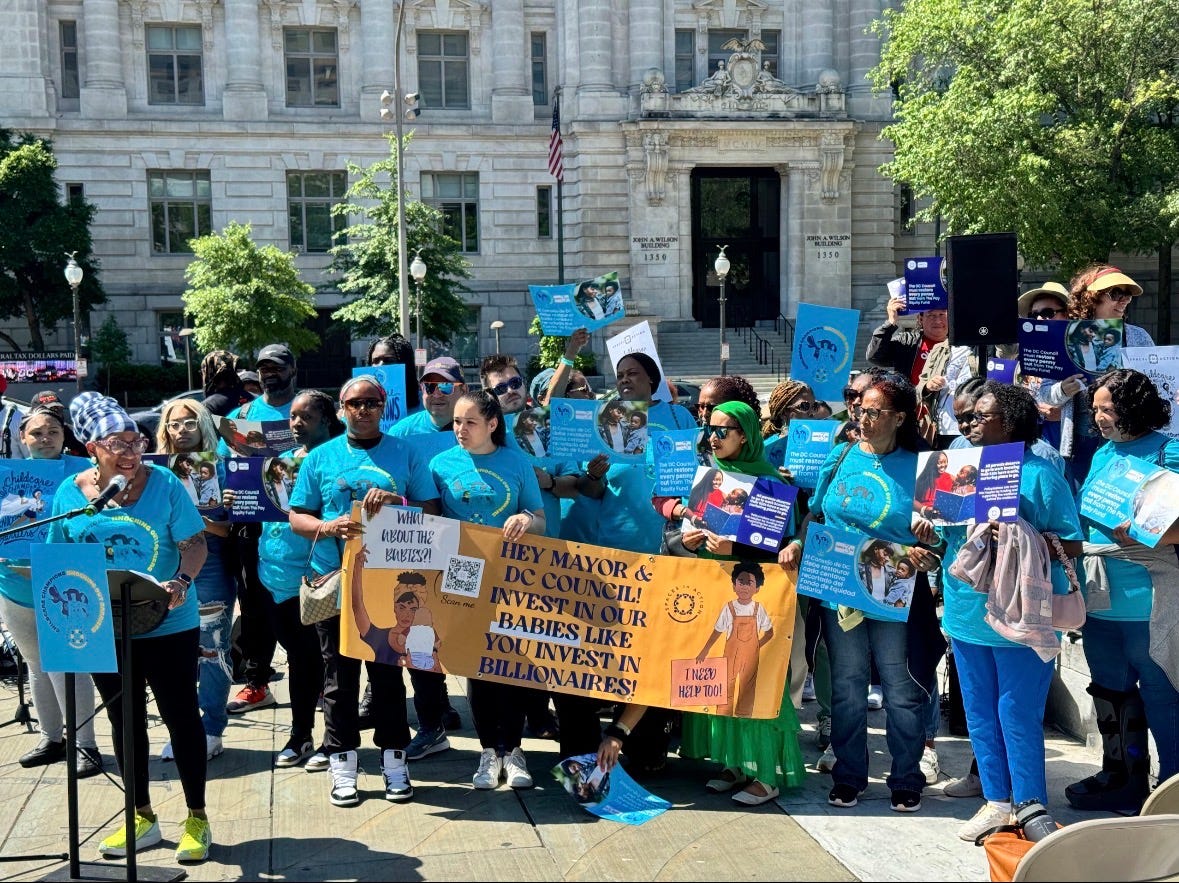
Advocates are gearing up for a fight to save the program. D.C. had its own Day Without Child Care on March 18th, followed by a National Day Without Child Care in May, encouraging child care providers to close or operate on a reduced schedule to show the impact of their services. But as compared to 2024, when advocates were able to turn out support and save funding for the program, it’s been harder to galvanize support for saving the pay equity program.
In 2024, the Gan preschool had offered a late start for all students and staff to give teachers the option to protest the changes for a day without child care. Ashley Ross had been one of the teachers who’d gone down to the Wilson Building, where the D.C. Government meets, to hold up signs advocating for saving the D.C. Pay Equity Program for a Day Without Child Care. This year, individual teams have the option to go if they have sufficient coverage, but it will be up to them to decide and find the time.
When asked if the parents feel some outrage at the cuts and how it could impact the teachers who look after their children, Butler-Means shrugs. “Some take it really seriously,” she said. “Others it doesn’t matter to them as long as their kids have somewhere to go.”
This essay has been adapted from the story published in The 74: Pay Equity Fund for D.C.’s Early Educators Faces Possible Elimination
No posts
Comments
Nothing yet. Say the first thing.
Sign in to join the conversation.