
Under New York’s Estates, Powers and Trusts Law § 5-4.3, when a person is killed by someone else’s negligence, the family may recover pecuniary loss only. Lost wages. Lost future earnings. Funeral costs. Medical bills.
That is the whole list.
No recovery for grief. None for anguish. None for the loss of love, companionship, or comfort. The measure of what your child was worth is the measure of what your child would have earned.

New York and Alabama are the only two states in America that still work this way. Delaware was the third until 1999. Every other state lets a family recover for the human loss of a human being.
It does not just limit what a family recovers at the end of a case. It decides which families get a lawyer at the beginning.
A wrongful death case takes years. Expert physicians billing by the hour. Thousands of pages of records. Depositions, motions, appeals. A firm taking it on contingency fronts every dollar against a recovery that may never come.
So the first question is never was this person wronged. It cannot be. The first question is what is the pecuniary loss.
For a surgeon with two children, that number is enormous, and the phone gets answered.
For a disabled adult who never held a job. For a retiree on Social Security. For a stay-at-home mother. For a child. That number is near zero… and the phone stops getting answered.
Nobody in that room has to hold a prejudiced thought. The statute sorts the dead on its own, by what they earned while alive.
Families hear the case may be real, but the damages aren’t there, and they go home believing they must have been wrong about what happened to the person they loved.
They weren’t. They were hearing a statute read back to them.
New York places no cap on pain and suffering for a person who is injured and survives. Our constitution forbids caps. A patient left disabled by negligence can recover without limit.
The pecuniary-loss rule applies only to the dead.
Put those beside each other.
Same hospital. Same negligence. If the patient survives catastrophically injured ….uncapped exposure. If the patient dies, and had no income…. funeral expenses and some medical bills.
Under New York law, killing a patient can cost an institution less than injuring one.
That is not rhetoric. It is two statutes read side by side, and every hospital risk manager in this state already knows it.
I am not suggesting anyone makes a bedside decision on that basis. I am saying no legal system should ever be built so that death is the cheaper outcome. Ours is. For 178 years it has been.
Here is what gets lost when this is discussed as money changing hands.
If hospitals treat patients correctly, they have no malpractice cases.
That is the entire mechanism. Liability is not a penalty bolted onto medicine from outside — it is the feedback loop. It is how a system that harms people finds out it harmed them, and changes.
A hospital that knows it will be held to account staffs differently, escalates differently, and answers a family’s questions differently, because it knows those questions may be asked again under oath.
Remove that feedback for one group of patients and you have not removed it evenly.
They have removed it exactly where the pressure was already lowest. The patient with no income. No advocate. No family nearby. No one likely to sue.
The disabled patient. The elderly patient. The patient on Medicaid. The patient whose decline gets written up as an expected outcome.
Those are the patients for whom the standard of care is hardest to enforce, and New York’s statute makes them, and only them, the patients for whom an institution faces no real consequence.
That is not a gap. That is a target painted on the people least able to defend themselves.
Wrongful Death: New York Governor Hochul Vetoes Grieving Families Act
And the hospitals are not what they were. Independent community hospitals have been absorbed into vast systems. Northwell Health is now the largest private employer in the state, dozens of facilities under one corporate structure. When one system runs that many ICUs, a rule limiting exposure is not an adjustment to a balance sheet. It is a policy setting applied to every bed at once.
Those systems keep lobbyists in Albany year-round. They commission the actuarial studies. They are in the room for every draft.
The family of a woman who died in one of their beds is in the room once, if ever.
Guess which side has won four times running.
The Grieving Families Act would allow recovery for grief and anguish. Its sponsors wrote that the current law “impacts most harshly on children, seniors, women and people of color, who often have no income or significantly less income, and are traditionally undervalued in our society.”
That is the New York State Legislature describing New York State law.
It has passed both houses four times. In 2022, the Assembly voted 147 to 2 and the Senate 57 to 6. Republicans and Democrats. Upstate and down.
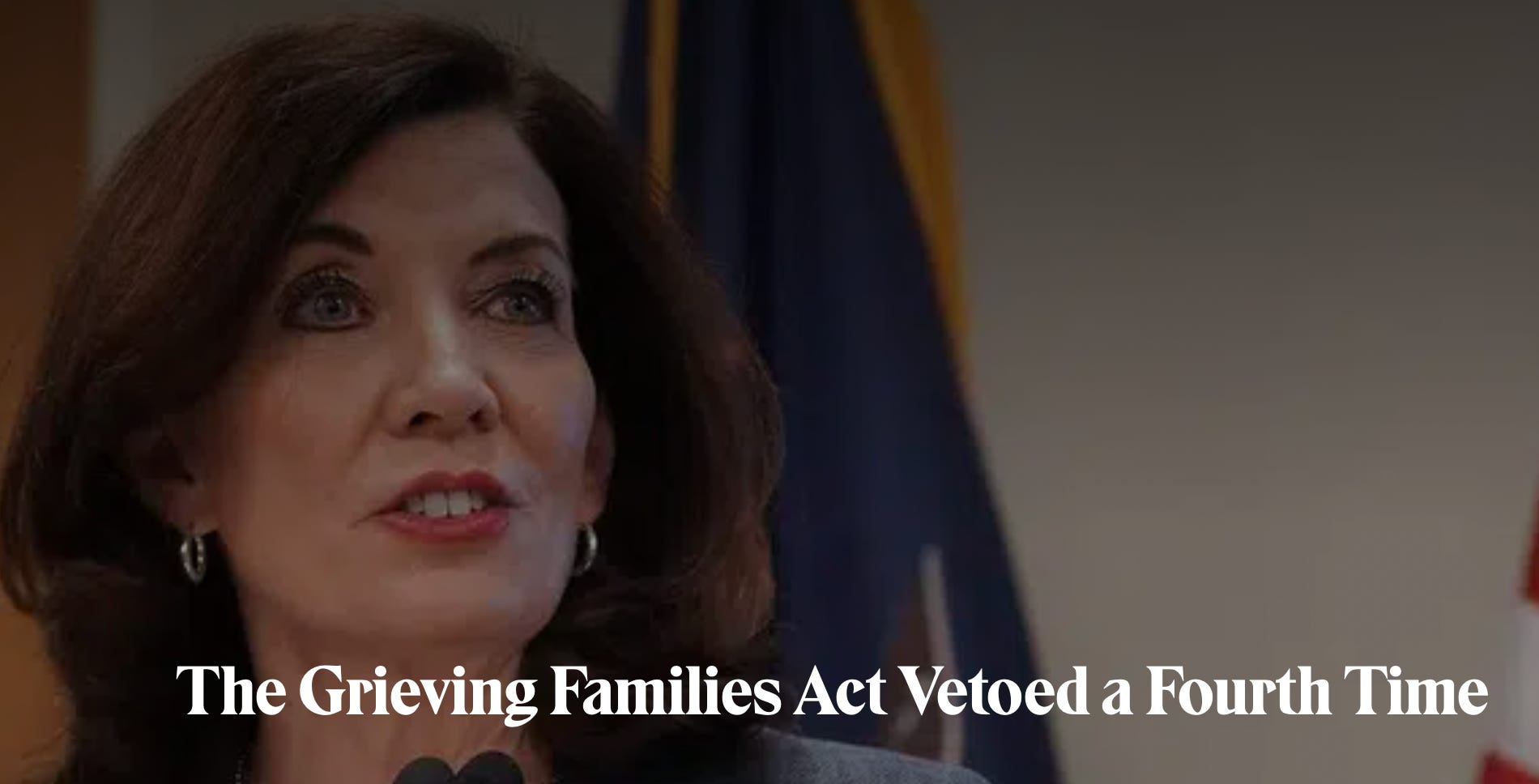
Governor Hochul has vetoed it four times, most recently on December 5, 2025. The stated reason each time: cost to hospitals, insurers, and businesses.
Each veto landed in the dead week around the holidays, disappeared from the news in seventy-two hours, and the session clock ran out before any override.
Four times, no one made enough noise for it to matter.
And the cost argument does not survive the numbers. New York already has among the highest malpractice premiums in the country. It led the nation in total payouts in 2024. All of that is true right now, under the 1847 rule. Whatever that rule has been protecting, it has not been protecting patients or the price of their care.
Pass the Grieving Families Act, whole. Not a study. Not another year of negotiation. It has passed four times. It needs a signature.
If it is vetoed a fifth time, override it. Two-thirds of both houses. The margins have been far above that. What has been missing is the will to use them after the veto lands.
No medical malpractice carve-out. Among the changes sought before signing was an exclusion for malpractice cases — which would carve out the elderly, the disabled, the chronically ill, and people on Medicaid. The families who need it most.
No age limit on whose child counts. Also proposed: limiting grief damages to parents who lost a child under eighteen. There is no birthday on which a mother stops being a mother.
Find your State Senator and Assembly Member at nysenate.gov and nyassembly.gov. State, not federal.
Call, do not email. Ask one question, and write down the answer:
“Will you vote for the Grieving Families Act, and will you vote to override a veto of it?”
Not do you support families. That produces a statement. This produces a yes or a no.
Governor’s office: 518-474-8390.
If they will not answer, that is an answer.
Frederick Douglass said it in Rochester in 1857: power concedes nothing without a demand.
Four times the Legislature made a request. Four times it was refused. What has never been made is a demand.
When there is no accountability, there is no justice for the people we lost, and no protection for the ones still in those beds.
That is what this statute costs. Not in 1847. Right now.
Pass the bill. Override the veto. No carve-out for the hospitals.
The Legislature has done its part four times over. What is left is a signature, and the people who decide who holds the pen.
That part is yours.
I am not asking you to fund a verdict. Nobody can promise you one.
A case that gets proven becomes part of the public record. It creates sworn testimony. It creates a factual account of what happened inside a hospital — the kind of account that exists in almost none of these deaths, because almost none of them are ever examined.
That record is what a legislator can hold up when this bill comes back for a fifth time. Not a statistic. Not a sympathy story. A documented case.
[DONATE] 💵 $5 funds pages of expert record review. 💵 $500 funds a deposition transcript. 💵 $5,000 funds an entire expert report. This fight is won by many hands, not deep pockets.
👉 Donate (tax-deductible) freenowfoundation.app.neoncrm.com/forms/28
Write Danielle’ s name in the memo box.
👉 Donate on GiveSendGo: givesendgo.com/JusticeforDanielle
👉 Danielle’s story: justiceforsweetdanielle.com
Checks: Free Now Foundation, 50 Woodside Plaza, Suite #417, Redwood City, CA 94061 — Memo: Danielle
If you cannot give, share this.

🌸 Five dollars. One coffee. A single stadium crowd giving up one coffee brings the wall down.


Danielle’s Painting by Sasha Latypova
The math only works when the crowd shows up, and the crowd only shows up when someone tells them.
In faith, fierce love, in memory of my sweet Danielle Cathleen Alvarez.
Thank you, for reading my post.
Rebecca Charles Jackson
Mother. Advocate. Voice for Danielle.
Danielle’s story: justiceforsweetdanielle.com
N.Y. EPTL §§ 5-4.1, 5-4.3, 11-3.3 · N.Y. Const. art. I, § 16 · Grieving Families Act S4423 (2025) and predecessor bills, with sponsor memoranda · American Bar Association, A Decade of Changes to Wrongful Death Statutes across the United States (2024) · Governor’s veto messages, 2023, 2024, and December 5, 2025 · Medical Society of the State of New York on liability premiums · public reporting on 2024 malpractice payouts and New York’s absence of statutory damages caps
No posts
Comments
Nothing yet. Say the first thing.
Sign in to join the conversation.