
This week, during the heatwave, the Year Tens didn’t come in.
Not all of them. But enough. And the honest answer — the one that doesn’t appear in any attendance report — is that by the time children reach us at fourteen and fifteen, so many of them have been so poorly served by school for so long that they simply don’t have the bandwidth to turn up. But the disengagement isn’t laziness. It isn’t attitude. It is the entirely rational endpoint of years of accumulated, unaddressed failure.
The system calls this Emotionally Based School Avoidance. I want to talk about that name. Because I think it is one of the most consequential pieces of mislabelling in the education system — and what it protects is not the children.
A 2023 peer-reviewed study found that 92.1% of children with significant school absence were neurodivergent, with 83.4% being autistic — and that 94.3% of school attendance problems were underpinned by significant emotional distress, whether anxiety, depression, self-harm, or suicidality. This is not a story about a small subset of unusually fragile children. This is a story about neurodivergent children, in an environment not designed for them, responding in the only ways available.
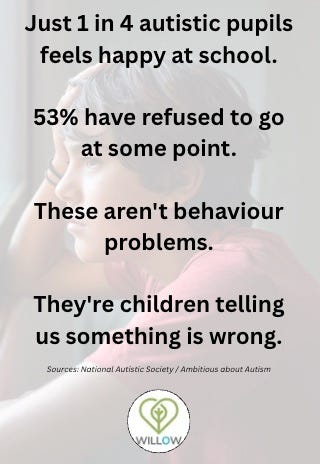
One in five children in England is now persistently absent — missing ten percent or more of school sessions. Before the pandemic that figure was one in ten. Over a quarter of autistic children are persistently absent — around 51,000 pupils. Children with an EHC plan have a severe absence rate more than three times higher than children with no identified SEND. And just one in four autistic children reports feeling happy at school.
We call it Emotionally Based School Avoidance — EBSA. And the name, I want to argue, is doing a great deal of work. Not all of it helpful, or honest.
Three words. Three problems.
Emotionally based. The implication is that the cause lives inside the child’s emotional world — a fragility, an inability to regulate. The child’s emotions are the problem.
But there is another way to read a child who cannot face school without breaking down at the gate, without physical symptoms so severe parents have taken them to A&E assuming appendicitis, without the kind of terror that does not distinguish itself from genuine threat. That reading is not that something is wrong with the child’s emotions. It is that the child’s emotions are working exactly as they should — reading an environment that is genuinely not safe for them, and responding accordingly.
Avoidance. In clinical language, avoidance is a symptom — something the anxious person does that perpetuates rather than resolves their anxiety. The avoidant child needs, by this logic, to face the feared thing. To return. To build tolerance. But what if the feared thing is genuinely fearful? What if the child is not avoiding school — what if the child is escaping a place where they have been failed, bullied, overwhelmed, unheard, or systematically misunderstood, day after day, year after year? Avoidance implies irrationality. It suggests the child has got something wrong about the situation they are in. That assumption is almost never examined.
School. This is the most telling word of all. School, in this formulation, is the fixed point — the destination, the norm, the thing around which everything else is organised. The child avoids it. The school does not feature in its own sentence as an agent. The school is not doing anything to the child. The school simply exists, as background, as given.
The school is grammatically absent from its own sentence.
Who the term can’t see
Let me tell you about the children this term, EBSA, is not supposed to be about.
It is not supposed to be about the child who explodes. Who pushes back, argues, is rude, gets excluded. That child is not coded as struggling — that child is coded as a behaviour problem. The response is sanctions. The intervention is punishment. The inquiry, if there is one, is into the child’s conduct, not the school’s provision.
It is not supposed to be about the child who masks so completely that the school sees nothing wrong — who holds it together all day, every day, and comes home and falls apart at 3:15pm. That child, by the school’s reckoning, is fine. The parent watching the aftermath is not believed when they say otherwise.
It is not supposed to be about the Year Ten who simply doesn’t come in when the heat tips over into unbearable, because the accumulated weight of years of not being seen, not being heard, not being served — means there is nothing left in the tank. Not fear. Not defiance. Just depletion.
All of these children are in the same situation. The system has a name for one of them. For the others, it has sanctions, suspensions, or silence.
The solution that isn’t
Here’s the irony. The system’s answer to school absence is school attendance. In fact, it’s actively promoted by central government as a strategy to get kids back into education. But the answer to attendance struggles is not simply attendance. That would be like expecting someone with a broken leg to get up and walk.
Graduated return. Reintegration plans. Anxiety mapping. Desensitisation programmes. All of it is directed at getting the child back through the door. None of it asks what they are returning to.
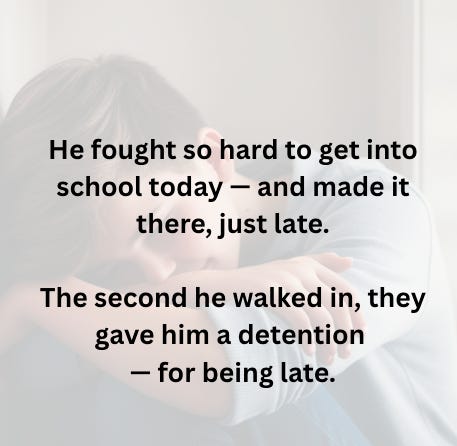
If the cause of absence is located inside the child’s emotional architecture, the treatment must be directed at the child’s emotions. The child must learn to tolerate their anxiety. The school, meanwhile, does not change.
But if the problem is genuinely environmental — if the child is responding rationally to an environment that is poorly lit, impossibly loud, socially relentless, academically narrow, and designed for a neuro-average nervous system — then no amount of work on the child’s emotional regulation will resolve it. You cannot therapy a child into comfort in an environment that is genuinely uncomfortable. You cannot build resilience to a system that is genuinely failing them.
The EBSA frame sets up a treatment that cannot succeed, because it has misidentified the cause. And when the treatment doesn’t work — when the graduated return collapses, when the anxiety deepens, when the child is still not in school six months later — the conclusion the system reaches is not that the frame was wrong. It is that the child is more seriously disordered than previously thought.
The burden falls on the child. Again.
What the right question would ask
If we asked the right question — not what is wrong with this child, but what is this child’s nervous system responding to, the inquiry would look entirely different.
It would look at the school. At the sensory environment, the social dynamics, the academic diet, the adults in the building, the culture around difference and difficulty. It would ask whether this child’s particular profile has ever been genuinely accommodated, or whether they have simply been expected to accommodate themselves to a system built for someone else.
In thirty-five years of working with neurodivergent children, I have met very few who wanted to be at home. Almost all of them wanted to be in school. They wanted friends, routine, the ordinary texture of childhood. What they could not sustain was the cost of getting it.
A note on what honest language would do
I am not arguing for no language. I am arguing for honest language. Some local authorities already use persistent school non-attendance — an attempt to avoid locating the problem inside the child. It is a step. But it still says nothing about why.
What if we called it what it is? School-induced distress. Environmentally driven non-attendance. Something that puts the institution back in its own sentence. Something that requires schools to ask what they are doing — not just what the child is failing to do.
Words are not neutral. The words we choose to describe a child’s experience determine what we look at, what we treat, and who we ask to change. EBSA tells the child: your emotions are the problem, your avoidance is the symptom, your return is the goal.
The canary, once again, is being sent back into the mine.
If you recognise this — the Sunday evenings, the locked bedroom door, the school that says they’re fine — Willow is there when the professionals aren’t. Find us at squarepegkids.com.
Rebecca Briggs is a specialist teacher and parent coach with 35 years of experience working with neurodivergent children and their families. She is neurodivergent herself and the mother of two neurodivergent sons. She is the founder of Willow, an AI parenting companion for neurodivergent families, and is currently writing her second book on the systemic failures behind the childhood mental health crisis. The Willow Schools pilot launches September 2026. She spoke at the South West Paediatric Mental Health Network Conference in June 2026.
If Willow sounds like something you need right now, drop WILLOW in the comments and I’ll send you the link.
Rewired publishes every Friday at 9am. If someone sent you this, you can subscribe here — it’s free.
No posts
Comments
Nothing yet. Say the first thing.
Sign in to join the conversation.