
Introduction
Modern economic life is extraordinarily effective at producing wealth, coordinating activity, and managing complexity. Yet many increasingly experience it as curiously shallow: efficient but impersonal, productive yet lacking depth. We optimise processes, measure performance, and model behaviour with remarkable precision, but remain less certain whether our institutions still serve recognisably human ends. The central question is no longer merely whether markets function, but whether they remain human.
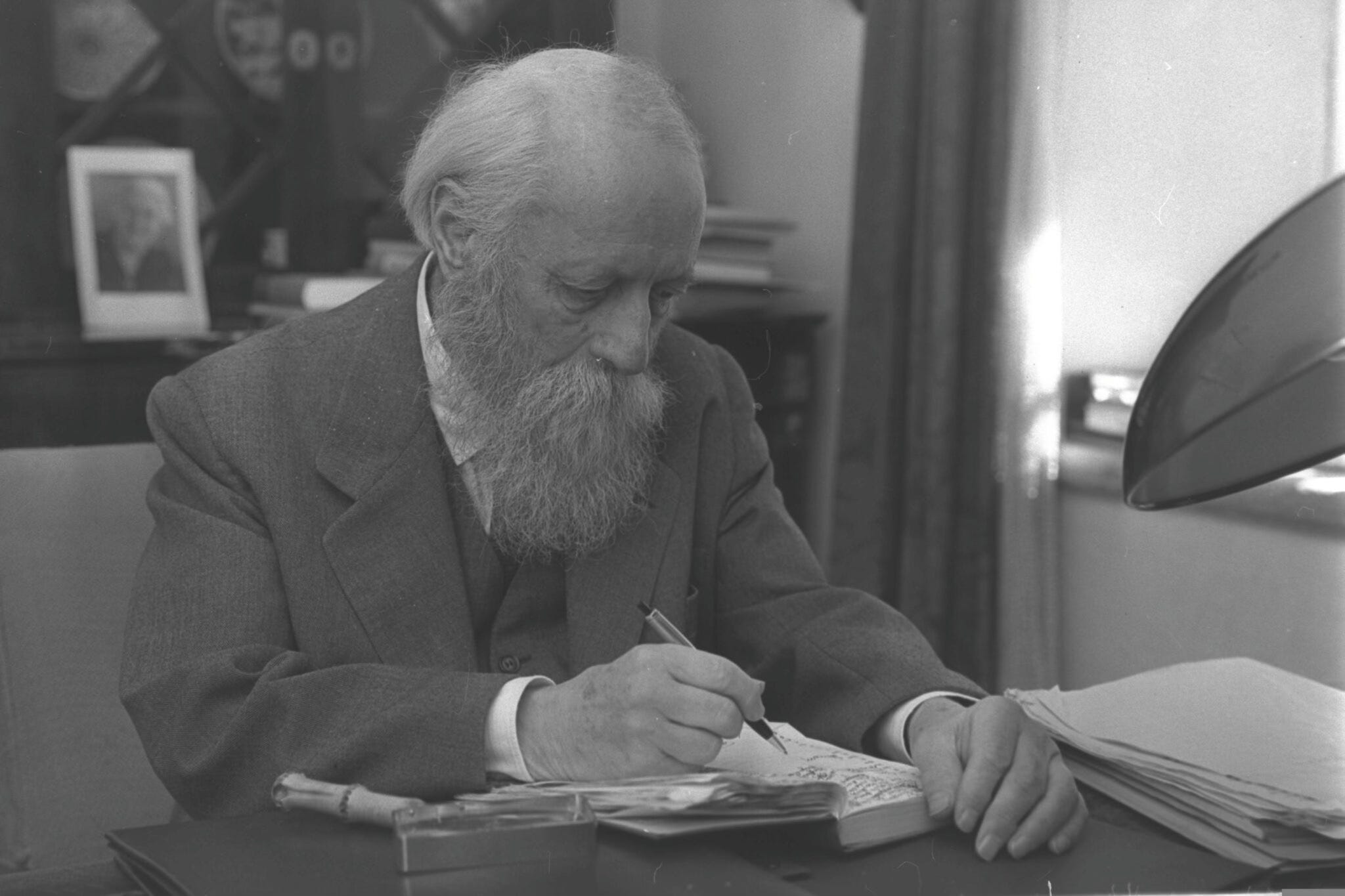
Martin Buber confronts this tension. Best known for his philosophy of dialogue and the distinction between I–Itand I–Thou relations, Buber offers not an economic theory in the conventional sense but a moral anthropology with direct relevance for economic and organisational life. Although widely studied in philosophy, theology, and Jewish thought, he remains relatively unfamiliar to many political economists and management scholars, whose traditions have been shaped more by rational choice theory, institutional economics, and behavioural models than by dialogical philosophy. Yet his work speaks directly to enduring concerns in political economy and management: trust, leadership responsibility, organisational culture, and the moral foundations of cooperation. His central insight is deceptively simple: human beings do not merely interact; they encounter. And the quality of these encounters quietly shapes the moral fabric of markets and institutions.
Dialogue, Instrumentality, and Economic Life
Modern economic analysis often relies upon a stylised image of the individual as rational, self-interested, and utility-maximising. While analytically useful, this abstraction risks hardening into a generalisation; individuals begin to appear as utility-maximising units navigating incentives rather than as relational beings embedded in moral communities. The language of efficiency, optimisation, and performance subtly reshapes how we perceive one another in economic settings.
Buber’s thought challenges this reduction of human existence at its foundations. For him, the human being is fundamentally a being-in-relation. Fulfilment does not arise solely from optimisation or accumulation, but from encounter — from meeting others as persons rather than instruments. In the I–Thou relation, the other is recognised in their irreducible uniqueness. By contrast, the I–It mode treats the world as a field of use, where people become roles, functions, or categories: employee, consumer, stakeholder, or competitor.
However, instrumental or transactional relations are not inherently problematic. Economic life necessarily depends on abstraction, categorisation, and coordination. No firm, market, or institution could function without them. The difficulty arises when the I–It stance becomes a dominant logic, extending into domains that previously relied on trust, recognition, and responsibility. When relationships become exclusively transactional, social life grows efficient yet morally shallow. Trust becomes legalistic, cooperation becomes conditional, and responsibility becomes diffused across systems.
At the heart of Buber’s philosophy lies the idea of dialogue. Dialogue, in his sense, is not merely conversation but a mode of being characterised by presence, openness, and mutual acknowledgement. To enter into dialogue is to recognise that the other is not an object to be managed but a person whose existence places a moral claim upon us. This insight carries significant institutional implications. Much of modern organisational life is structured precisely to reduce the need for personal judgement that is replaced by procedures, metrics, and formal hierarchies. These mechanisms enable scale and predictability, yet they also risk dissolving moral agency. Individuals begin to act as functionaries rather than as responsible and accountable persons, and institutions, however efficient, lose their capacity to generate meaning, or, in Buberian terms, their soul.
Buber’s realism is often overlooked. He did not reject the necessity of structures and bureaucracy. He explicitly acknowledged that the I–It world is indispensable for practical life. Economic coordination requires classification, measurement, and strategic calculation. The problem is not the existence of instrumental relations, but their totalisation. When persons are seen only as inputs, outputs, or data points, the moral texture of economic life becomes increasingly fragile. Dialogue then functions as a hidden infrastructure of social order: the web of mutual recognition that sustains legitimacy beyond contracts, performance measurement, and incentives.
Buber, Organisations, and the Age of Systems
A frequent criticism of Buber’s philosophy is that it appears too idealistic for modern economic and organisational settings. Firms operate through hierarchy, standardisation, and contractual exchange. Managers cannot treat every interaction as a unique existential encounter without undermining efficiency and consistency. From this perspective, dialogical ethics seems better suited to intimate life than to large-scale, complex institutions.
Yet this critique misreads Buber’s position. He does not call for the abolition of roles, markets, or organisational hierarchies. Rather, he insists that even within functional settings, persons must not be reduced entirely to objects of use. Dialogue is not continuous emotional intimacy nor the rejection of professional distance; it is a moral orientation grounded in recognition. A leader who recognises employees as persons rather than mere inputs is already operating within a dialogical horizon, even while making strategic and economically rational decisions.
This perspective becomes especially relevant in an age increasingly shaped by technological mediation, algorithmic management, and data-driven governance. Systems can process information, simulate dialogue, and optimise decisions with extraordinary efficiency. However, in Buber’s philosophical terms, such interactions remain closer to the I–It mode than to I–Thou. They analyse, categorise, and respond, but they do not encounter in the existential sense that Buber describes.
This distinction is not a rejection of technology or analytical systems. Rather, it clarifies their limits. Artificial and systemic rationality operate through pattern recognition and functional response. It can support reflection and coordination, but it cannot reciprocate presence or responsibility as people can. Buber’s dialogue presupposes lived encounter, moral attentiveness, and the recognition of the other as a Thou. Informational exchange, however sophisticated, is not identical to existential meeting.
Paradoxically, this contrast strengthens Buber’s relevance for contemporary political economy and management. As economic life becomes increasingly mediated by systems, the risk grows that relationships subtly shift toward instrumental modes of engagement. Language becomes transactional, identity becomes functional, and responsibility becomes procedural. Institutions then compensate for declining trust through increased regulation, surveillance, and formalisation, which may enhance control while weakening moral engagement.
Buber also warned against what may be described as a spirit of opportunism: the tendency to convert every relationship into a strategy for gain. Contemporary economic discourse increasingly frames relationships as investments, time as monetised capital, and personal interaction as a resource to be optimised. While instrumental reason remains indispensable, its unchecked expansion into domains that have previously depended on trust, loyalty, and recognition risks hollowing out the moral fabric of social life. When everything becomes transactional, cooperation becomes more fragile and legitimacy more difficult to sustain.
Conclusion
Buber offers no technical blueprint for reforming markets or institutions. Instead, he provides a moral orientation. Economic life will always involve calculation, abstraction, and exchange. The challenge is not to eliminate instrumental rationality, but to prevent it from becoming total. Markets can coordinate interests, but only persons can recognise persons.
A more human economy would not reject efficiency, scale, or technological systems. Rather, it would re-embed them within a broader moral ecology grounded in recognition and responsibility. Work would be understood not merely as a contractual function but as participation in a shared social world. Leadership would involve not only strategic competence but attentiveness to the human reality behind organisational roles.
In an era defined by automation, algorithmic governance, and increasingly impersonal interaction, Buber’s insistence on dialogue becomes more, not less, urgent. The more abstract our systems become, the more deliberate we must be in preserving genuine encounter within them. Economic life will always require the language of incentives and performance, but its moral sustainability depends upon something deeper: the capacity to recognise the other not merely as an It within a system, but as a Thou within a shared human world.
Selected Bibliography
Buber, M. (1937). I and Thou. Edinburgh: T&T Clark.
Buber, M. (1947). Between Man and Man. London: Routledge & Kegan Paul.
Buber, M. (1965). The Knowledge of Man. New York: Harper & Row.
Friedman, M. (1988). Martin Buber: The Life of Dialogue. Chicago: University of Chicago Press.
Avnon, D. (1998). Martin Buber: The Hidden Dialogue. Lanham: Rowman & Littlefield.
Schilpp, P.A. and Friedman, M. (eds.) (1967)The Philosophy of Martin Buber. La Salle, IL: Open Court.
Storr, V.H. and Choi, G. (2019). Do Markets Corrupt Our Morals? London: Palgrave Macmillan.
Comments
Nothing yet. Say the first thing.
Sign in to join the conversation.