
Six weeks after Biden’s unexpected decision to abandon his re-election campaign, the move continues to resonate as a rare victory for democracy. While the President has spent over a half century as an admirable public servant, his approval ratings were in the mid-30s while his chances of re-election seemed slimmer with each public appearance. At a time when two-thirds of Americans want to see new options, the decision of many Democrats to defy their unpopular incumbent was a virtually unprecedented departure from the status quo.
Following that, the time seemed ripe for an innovative presidential nomination process to lend legitimacy to a new candidate. This was a historic chance for Democrats to appear modern, and well, democratic.
"We will be navigating uncharted waters in the days ahead," said former President Obama after Biden’s exit from the race. "But I have extraordinary confidence that the leaders of our party will be able to create a process from which an outstanding nominee emerges."
But there would be no vote. Twenty-seven minutes after Biden posted his statement on stepping down, the party had the President’s account post an endorsement of Vice President Kamala Harris. Six minutes after that, Harris’s campaign posted a donation link. And five days later, Obama endorsed Harris.
Nominee by committee
The Democratic Party skipped over the nomination process because its leaders deemed a second nomination cycle too risky. A couple days before Biden’s decision, the Association of State Democratic Committees (ASDC) - a generally unknown apparatus whose mission is to “elect Democrats at all levels of office” - convened to discuss party strategy.
They decided that if Biden stayed, they would endorse him. If Biden dropped out, they would move quickly to coalesce the party around Kamala Harris. All states and territories voted unanimously. “There is a real need to unify,” said ASDC’s President Ken Martin. “Time is not on our side. We can’t have internal conversations over a month that focuses us inward.”
But to quote the Democrats, yes we can. The ASDC’s decision reminds us that parties do not operate as democracies. They are agents of self-preservation, consensus-seeking and stability. And they can gravely damage the democratic process. As one prominent Democratic donor lamented, Harris “was nobody’s choice.”
A similar story unfolded in Houston, Texas, where Congresswoman Sheila Jackson Lee recently passed away after almost 30 years representing Texas’ 18th District. The local Democratic committee decided to leave the choice of nominee in the hands of its 88 precinct chairs. The party applauded itself for being transparent by scheduling public Zoom calls with the candidates. “None of that's required,” they pointed out, when they could have just let Houstonians vote.
Historical grip
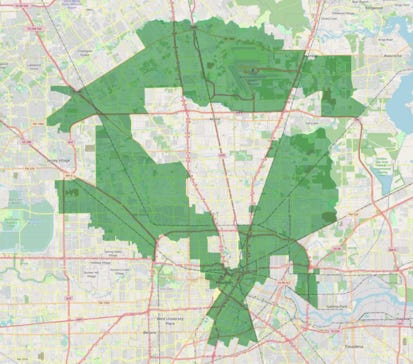
All of this led me to do a bit of research. We know, of course, that parties operate in undemocratic ways. Case in point, Republicans “shredded” Jackson Lee’s district into this:
But what you might not know is that for 80% of U.S. history, parties have been de facto nominating candidates without direct input from the electorate.
Quick history lesson: after George Washington stepped down from two extremely popular terms, a newborn American democracy had to devise a system for nominating replacements. The Constitution places guidelines on the election process for presidents but says nothing about how political parties nominate candidates. In fact, there is no mention of political parties at all.
The first solution was for each party’s Congressional representatives to nominate candidates, since Congress was the only place party leaders met regularly. Putting aside the absence of voter input, this meant the legislative branch was effectively choosing the leadership of the executive branch. Swiftly criticized, that practice collapsed after 30 years.
In 1831 and 1832, the first national conventions were held. The National Republicans picked Henry Clay, and the Democrats picked Andrew Jackson for a 2nd term. These conventions were attended by a wide range of “delegates” sent by each state’s party leadership. But exactly how would those delegates choose to vote?
Initially, each party held state conventions and caucuses to select delegates, but delegates could make surprise decisions and were often swayed by influential party members. Caucuses are still held today, Iowa being the “first in the nation” each election year. But the caucus process itself is problematic. To participate requires physically attending a multi-hour meeting (sometimes 4-6 hours or more). Members may also face intimidation or majority influence since participants move to different areas to show their support. The Democratic Party acknowledged this in recent years and reduced the number of delegates awarded by caucuses by almost 80%.
The Progressive Party of the early 1900s worked to make voting more democratic by introducing political primaries. Primaries operate like general elections for the party’s nominee, letting all state party members and sometimes the entire state electorate vote on candidates.
The Election of 1912 showed exactly why primaries were needed. By the turn of the century, roughly 25% of states ran Republican primaries1. Despite Theodore Roosevelt winning most primaries that year, party leadership pushed delegates to vote for Taft instead. Taft got the nomination, leading Roosevelt to run as a candidate of the Bull Moose (Progressive) party.
The problem was Teddy Roosevelt was extremely popular. He had endorsed Taft to succeed him in 1908, who subsequently won in 1909. But he was so unhappy with Taft’s administration that he was seeking an unprecedented 3rd term in 1912. Ultimately, his popularity as the Bull Moose candidate split the Republican electorate in half. Democrat Woodrow Wilson would win by a mile. The election demonstrated the risk of party leaders going against its members, but it would take another 60 years for major reform to arrive.
Deja vu
In 1968, President Lyndon B. Johnson chose not to seek re-election, and his Vice President, Hubert Humphrey, entered the race late. This story might sound familiar. Despite not competing in most primaries and winning exactly zero, Hubert Humphrey secured the Democratic nomination through the support of party leaders and delegates chosen in state conventions.
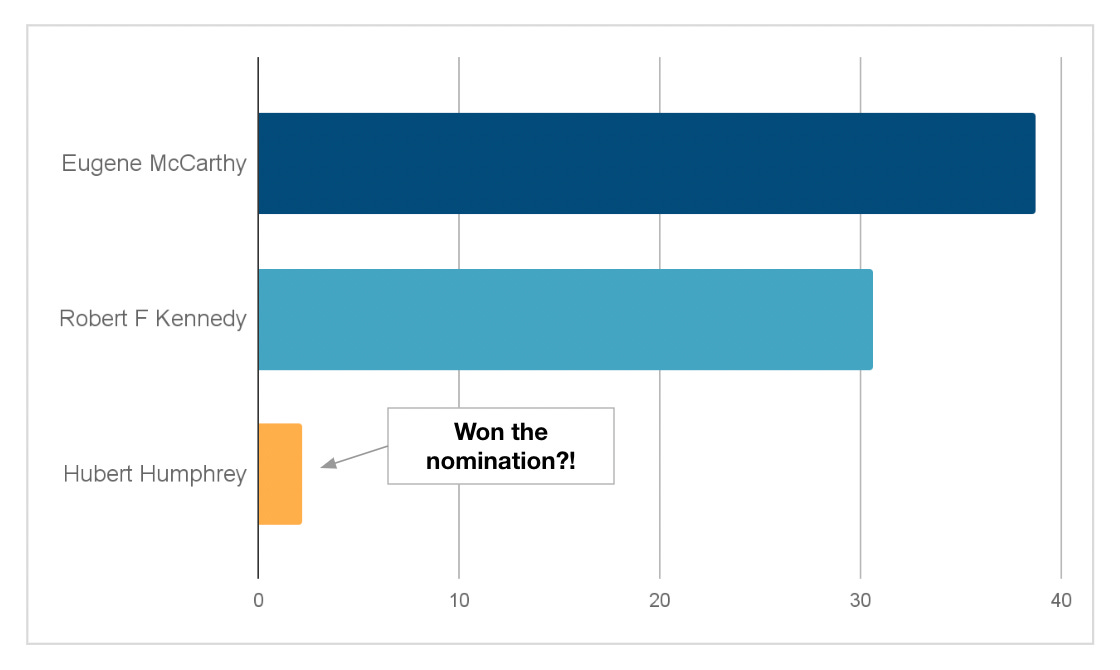
But instead of the moment of unity that the Democratic Party committees achieved for Harris, 1968 saw chaos and violence. The tumultuous political era of the Vietnam War led to widespread protests and anti-war clashes with police because Humphrey was seen as a pro-war candidate. Perhaps the ASDC had this moment in mind when they decided to back Harris unanimously.
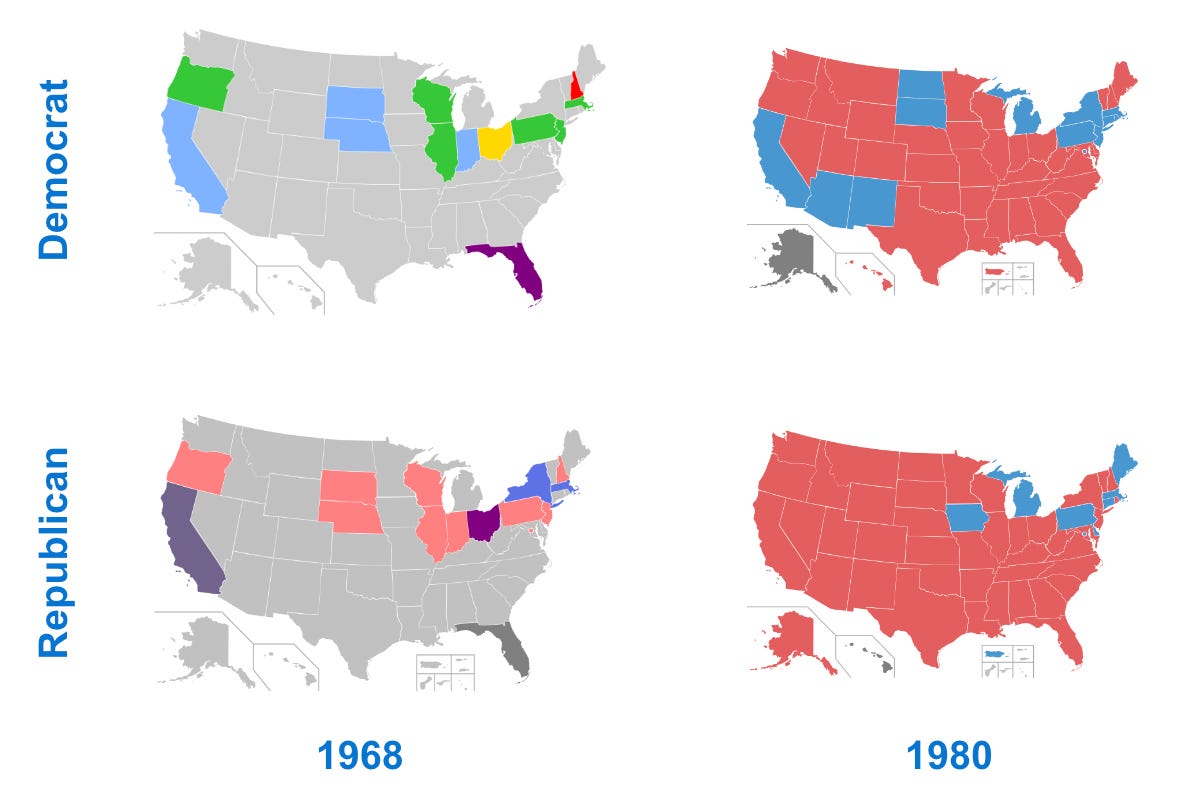
This crisis of confidence in the Democratic Party led to the McGovern-Fraser Commission, which finally mandated that the party’s delegates be selected in a standardized and public manner. An unexpected side effect was that most states adopted primaries in order to comply with the mandate. The Republican Party would more slowly but surely also adopt the primary system. By 1980, less than 50 years ago, primaries finally became dominant enough to give voters more direct control over nominees.
The risk of pre-selection
Despite the reforms mandated by the McGovern-Fraser Commission, the Commission’s spirit was absent in the swift endorsement of Kamala Harris. Instead of embracing a truly democratic nomination process that reflects the diverse voices within the party, Democratic leaders once again opted to pre-select one of its top insiders.
The Democrats might pull off a win with Harris, but history has a way of punishing the party that ignores its voters - especially when they lose. What might a 2nd Trump administration catalyze in the Democratic Party, having failed to produce a candidate that could defeat one of America’s most controversial presidents twice?
A status quo nominee also holds higher risk in this election cycle than most. Americans are feeling the weight of national inertia, in the form of bloated healthcare systems, defense acquisition programs, decaying public infrastructure, and outdated norms around higher education. Both ends of the electorate are looking for bold and innovative risk-takers.
We’ll find out soon enough if this strategy works, or Democrats spend another four years looking inward. Maybe that’s overdue.
Teddy’s Republicans are mostly closely aligned to today’s Democrats.
No posts
Comments
Nothing yet. Say the first thing.
Sign in to join the conversation.