
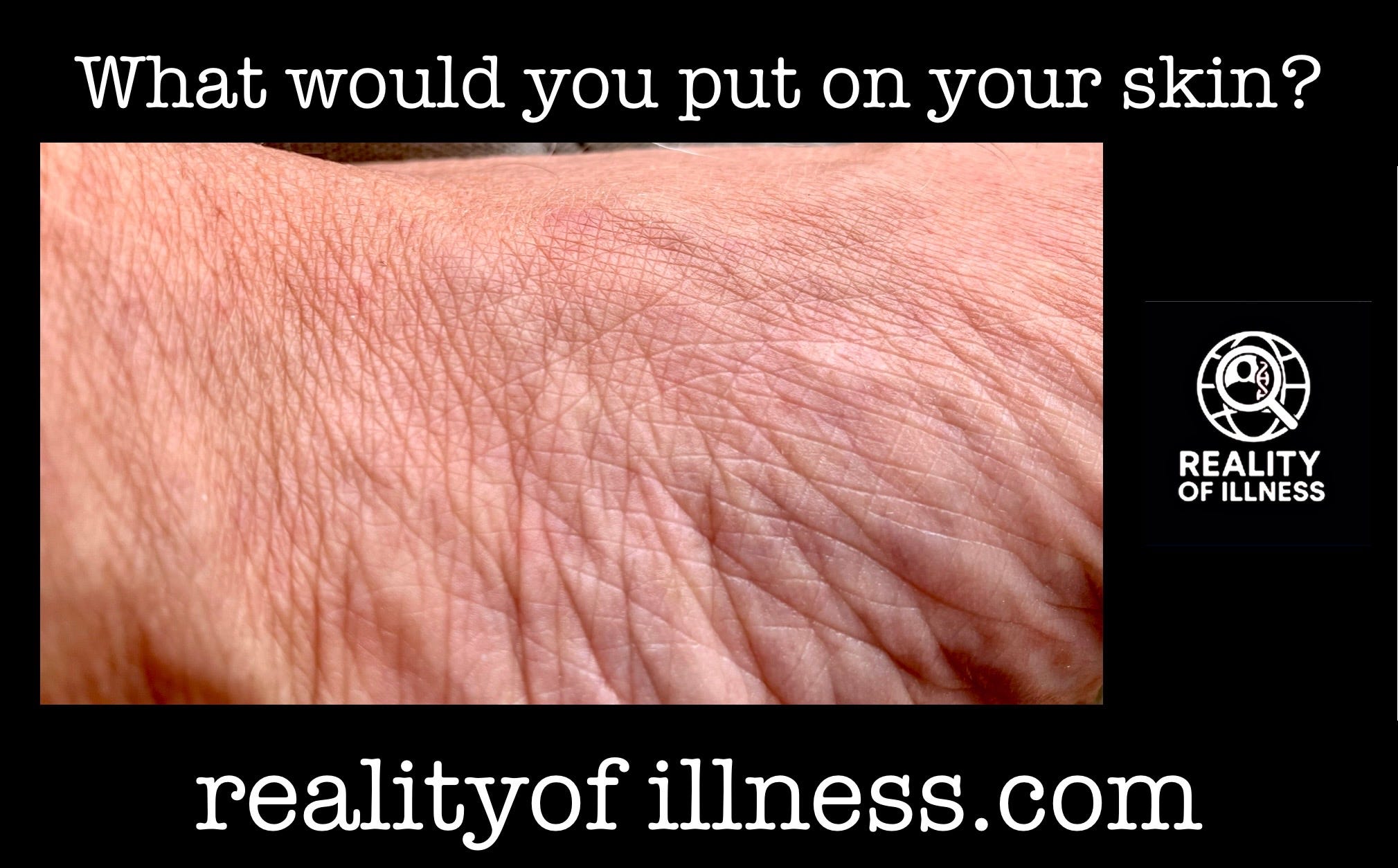
Given the skin is your largest organ what would you personally slather, squirt or rub onto it? Are there certain things you would never ever apply? Further, do you ever give what you do apply a second thought?
Before I commence with my normal banal drivel let me qualify something. I am not a researcher. I read a lot of stuff, I think a lot and I question a very great deal of what I thought I once knew. Then I write ...and am largely ignored but hey ho!
My job (if I even have a job) is to try and get others to do more critical thinking. You alone have to answer anything that makes you wonder or else better guess by doing your own research. I simply perhaps initiate some pondering to get you to question stuff and dig around but hopefully in a good way.
Note: I come at writing this with mounting evidence that suggests sunblock is carcinogenic and causes more skin cancer than it resists and antiperspirants contain aluminium which is very much implicated in causing Alzheimers.
So skin. Here are some things you very likely apply depending on your gender, age, wealth and according to your outlook. Frequency of application will obviously vary but I have suggested some to consider — which are literally off the top of my head (brands mentioned may be UK-centric).
M = male, F = female users
Aerosol or roll-on deodorant/anti-perspirant — daily M,F
Perfume/aftershave/cologne — odd days M,F
Suntan/block cream — summer/holidays M,F
Make up (various) — most days F
Moisturiser — most days mainly F
Shaving foam/gel — likely daily M
Fake tan — mainly F monthly?
Nail polish/varnish and remover plus glue for fake nails — and yes, nails are considered part of your skin along with hair.
Medical or skin type rubs including: Germoline, Sudocrem, Savlon, E45, Vick, Ralgex, Vasolene, sexual lubes or spermicides etc, etc, — as and when M,F
Washing/cleaning type stuff including: soap, shampoo, shower gel, make-up remover, washing up detergent, washing powder, washing conditioner — M,F
Accidental exposure to: white spirit, turpentine, oven cleaner, insecticide, paint stripper, car and furniture polish, car and furniture wax and many more — M,F
And remember during Covid we were all expected to rub our hands in industrial-grade anti-bacterial/antiseptic hand wash cleanser that was likely alcohol-based. Considering this hand gel was strong enough to kill a non-existent virus, goodness only knows what else it contained to play havoc with the normal flora microbes that are quite possibly beneficial to our skins or what havoc it did elsewhere in your body if it was absorbed ...and remember that germs are not our enemy as Mari Arce writes here.
Okay you get the picture.
We have absolutely no idea what these things (all containing mostly industrial chemicals that didn’t exist a century ago) are doing to us with just one exposure yet alone with regular use.
Barrier
Lest we forget our skin is supposed to be a barrier that gives protection. But it didn’t evolve (or wasn’t designed) to be a barrier to industrial chemicals.
And the ‘good old’ internet that never lies and certainly isn’t curated by those who might have an agenda in telling ‘porkies’ says this in response to a question asking if what we apply gets absorbed:
Yes, your skin absorbs certain substances, but it acts as a selective barrier rather than absorbing everything applied to it.
The widely cited claim that skin absorbs 60-70% of all applied chemicals is a myth; most cosmetic ingredients only penetrate the outer layers (stratum corneum) to hydrate or treat the skin, without entering the bloodstream.
However, absorption into the bloodstream does occur under specific conditions:
Small, fat-soluble molecules can pass through the skin barrier, a mechanism utilised by transdermal patches (e.g., nicotine, hormones, or steroid creams).
Lipophilic chemicals like solvents, certain fragrances, phthalates, and some essential oil components can be absorbed, especially if the skin is damaged or covered by occlusive dressings.
Factors influencing absorption include molecular size, polarity, skin thickness (thinner skin on the face absorbs more than palms), and the presence of penetration enhancers.
In summary, while your skin absorbs some chemicals into circulation, the vast majority of skincare products are designed to work on the surface or in the upper epidermis, making systemic absorption of common cosmetics minimal.
Personally, and with good reason, I’m believing less and less of what the internet says.
So we basically have to just assume the company that makes the product it is trying to sell us will have researched and tested it, probably by subjecting some poor laboratory mouse or rat or beagle-dog to enough of it — to prove it was safe. 🤔
Do you trust them on this? I certainly don’t, not as far as I can shit or spit (neither of which I have ever indulged competitively).
Just think of peeling or dicing a hot chilli pepper and then touching your eyes or your genitals and you’ll realise how potent things on our skin can be when they get somewhere they shouldn’t.
So out of blue comes some illness.
Do you ever consider it might be due to the toxic exposure you get from a product you use every day without a second thought? No I thought not. Let alone micro doses in unique combinations with other things that build up over time.
But you’ll hear people along with doctors readily confirm that: ‘It was germs wot made you ill’.
So what does penetrate our skin? We know mosquitoes have a pointy nose straw thing where they drink our blood, so that obviously goes through skin like a hot knife through butter. Mites, ticks and other burrowing critters seem to make short work of this protective barrier. Laughably viruses (which as we know are yet to be proven to exist) can seemingly penetrate skin otherwise we wouldn’t have needed the hand gel.
And what about all the industrial chemical residues like fabric freshener that are in constant contact with our skin via our clothes or occasional contact with stuff we handle or even toilet paper? Do we think about those?
So perhaps wake up and look at a different view of illness and wellbeing this being the terrain perspective presented by experts along with their evidence at Reality of Illness.
No posts
Comments
Nothing yet. Say the first thing.
Sign in to join the conversation.