
I recently asked Dr. Saeed Qureshi Ph.D. who I had spotted on Facebook, for his position on germ theory versus the terrain perspective.
He is shown here as Principal at PharmacoMechanics where this is written about him:
Over 40 years of multidisciplinary laboratory research in pharmacokinetics, biopharmaceutics, drug dissolution, and analytical chemistry related to pharmaceutical characterisation. Expert in bioavailability and bioequivalence studies and regulatory standards (FDA, USP, ICH). Applies chemistry-based scientific principles to critically assess modern medical claims, including those related to viruses and vaccines, as applied to public policy development.
Since he very much dismissed viruses in something he wrote I thought maybe he could be included on the Reality of Illness website database. What ensued was interesting and I think is worthy of disseminating.
Message
I sent him a Facebook message with a view to possibly listing him and asked him to clarify his position since he appeared to doubt germ theory.
He responded by writing and publishing a long Substack piece here:
Please read it but the gist of this is that he doesn’t fully subscribe to the terrain perspective because he maintains that germs can cause or contribute to disease. However he doesn’t regard every aspect of germ theory as established fact because biological systems are variable, meaning a microorganism’s ability to produce disease can depend upon its amount, location, the condition of the host, nutrition, environment, physiology, other microorganisms, and many additional factors — which is a fairly solid terrain perspective.
Our comment exchange after his Substack piece is perhaps the most interesting and illuminating with those comments repeated verbatim here:
I said:
Thank you for this explanation of your position.
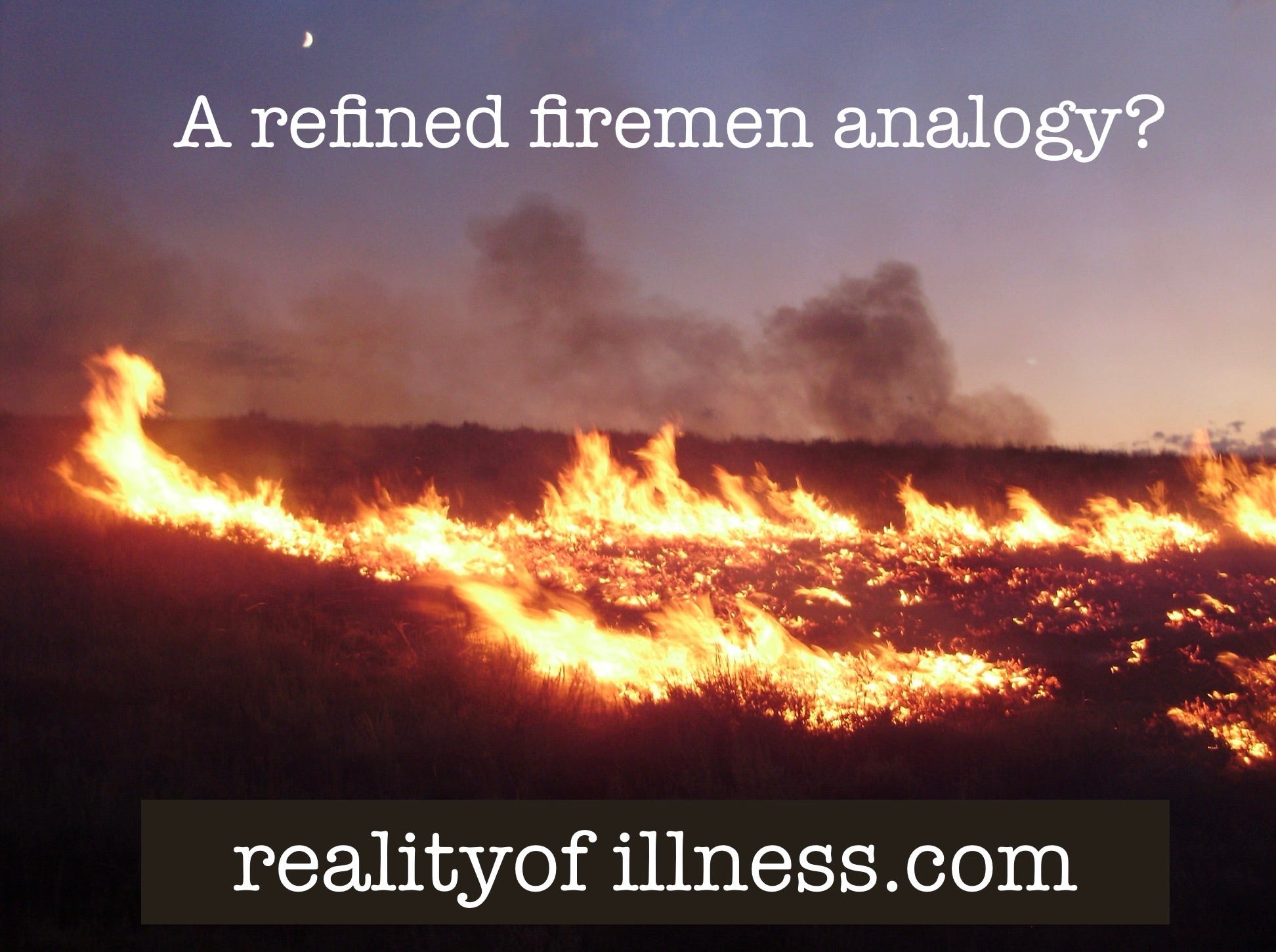
I can see that for instance if sparks (germs) can cause a fire (a disease) then they also need the right conditions (terrain) for flames to take hold.
Soggy grass isn’t going to result in an inferno whereas tinder-dry brushwood certainly would.
An analogy along these lines would account for why some people can have the naughty germs present without having any ill effects while for others it can be problematic.
But I guess the terrain perspective would amount to: ‘There was a problem (too much dry wood)’
So the sparks (ie the germs) were very much able to come along and eliminate all the dry wood. The resulting inferno is what we call an illness illustrated by the flames being a symptom.
When the fire has burned out the problem of the dry wood accumulation is gone along with the sparks.
Pleomorphism would suggest the body conjures up a source of ignition by itself.
He replied:
Thank you. I think your fire analogy is helpful, although I would not place myself in a black-and-white **“germ or no germ”** position. I see potential value in considering both the suspected agent and the condition of the host.
Using your analogy, if there is credible evidence that a particular microorganism is present at an unusual level, together with symptoms consistent with an infection, I would certainly consider the germ-based explanation. If clinically appropriate, that could mean treating the suspected microbial problem—for example, with an appropriate antimicrobial—while also addressing the conditions that may have allowed the problem to develop.
In your fire analogy, one may need to **put out the fire**, but one should also ask **why there was so much dry wood available to burn in the first place**.
Once the immediate illness is addressed, attention should also be given to restoring and maintaining a healthier “terrain”—nutrition, environment, general health, and other relevant factors.
Where I differ from some discussions is the insistence that one must choose exclusively between **germ theory** and **terrain theory**. I do not think that is necessarily useful. Both possibilities can be considered, provided the particular germ, its presence, and its causal role are actually demonstrated rather than merely assumed.
I then said:
I think we are on a similar wavelength.
I guess the terrain position would be the job is done (by the body in combination with the germs) when the fire burns out of its own accord.
Intervention by medical science to deal with the fire and put it out has certainly addressed the illness/symptoms but the unburned dead wood still remains waiting for another source of ignition.
And also what was the patient doing wrong to have accumulated so much dead wood that needed a fire to sort it out?
It is a better analogy than saying we always find firemen (germs) at a fire so they must be the cause of fires.
He responded saying we kind of agreed as here:
Exactly. I completely agree with your thinking and analogy. It reinforces my view that this should not be treated as a black-and-white choice between germ and terrain. Medicine should consider and deal with both, as appropriate.
Unfortunately, conventional medicine tends to focus primarily on the germ and its treatment, often leaving the discussion there. On the other hand, some terrain advocates seem to go to the opposite extreme, dismissing conventional medicine and offering various arguments for almost entirely relying on the terrain approach.
I think both extremes are problematic. Maintaining a healthy “terrain” through nutrition, lifestyle, environment, and general health may work very well under normal or moderately abnormal conditions. But in a genuinely serious acute illness, relying on terrain alone may be neither practical nor effective. The immediate problem may need medical treatment.
Using your analogy, **put out the fire when necessary, but do not stop there. Find out why so much dry wood accumulated and address that problem as well.**
People have a tendency to take from discussions what pleases them and seems to support their own views.
For me, I see someone with a solid pharmaceutical research background having had grave doubts (recently??) about the existence of viruses. This has meant without these ‘little blighters’ as a causative agent his faith is perhaps starting to crumble …but he still has germs to rely on. Except even these being present in both ill people and well people needs a new level of explanation and that explanation is terrain.
Maybe I kid myself but I feel he is halfway there and heading in a good direction. Alternatively, maybe? the terrain perspective can still allow germs a ‘bit part’ in the overall ‘causing illness’ performance.
What do you think?
No posts
Comments
Nothing yet. Say the first thing.
Sign in to join the conversation.