
At 8:47pm on a Wednesday, a patient calls BeYou Medspa in Scottsdale.
She wants a HydraFacial and Botox in the same visit, wants to know if Simone, NP is free Thursday, what is the Deposit Amount, and asks what the whole thing costs. Three questions in one breath — the kind of call that needs someone who actually knows how the practice runs.
Nobody’s at the front desk. The last patient left at 6:15.
She gets all three answers in under 2 minutes and leaves with a confirmed Thursday appointment.
The AI that handled it didn’t guess or work from a script written during onboarding. It read the practice’s live Mangomint calendar, found the provider who performs both treatments, identified a slot with enough time for the combined visit, and booked it. The intake form fired automatically before the call ended.
Nothing about that practice’s system changed to make this possible. Mangomint stayed Mangomint. The team learned nothing new. The AI just plugged in.
⚡ Two Ways to Buy an AI Receptionist this Practice figured out
Version one asks you to move. To get the AI, you take the platform. New EMR. New scheduling system. Migrate three years of patient records. Retrain everyone. Run parallel systems for six weeks. Then the AI answers your first call.
Version two plugs into what you have. Your Aesthetic Record, Mangomint, or Boulevard. Your workflows untouched. One email to grant access, one number forwarded, live within a week.
2 Radically different paths. For a practice that spent months getting its system right, version two isn’t just easier — it’s the only one that makes sense.
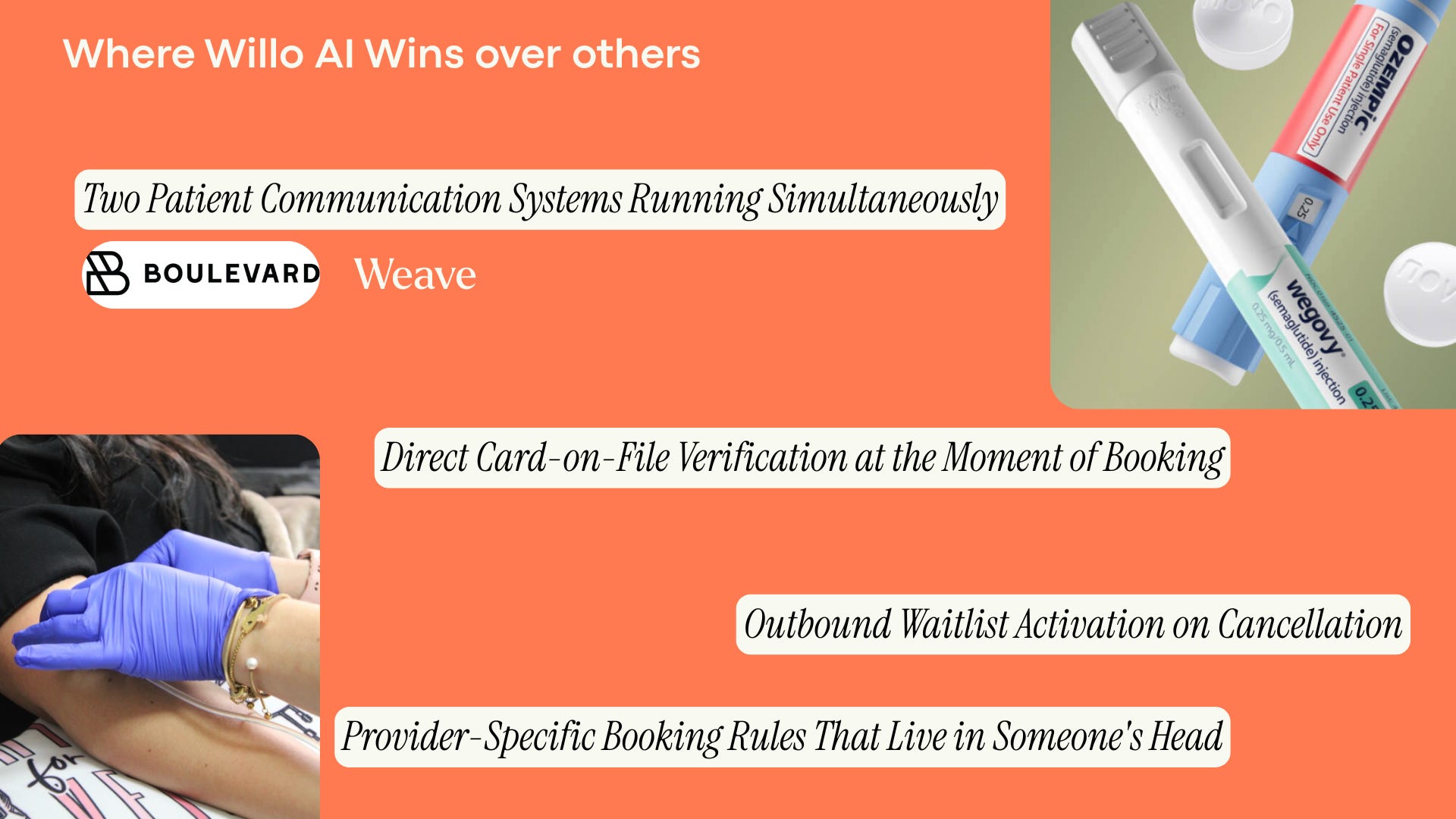
🧠 Why “Plugged In” Changes What the AI Can Do
An AI working from a static setup document knows your services, your hours, your general pricing. It’s frozen at the moment someone configured it. It doesn’t know Dr. Chen blocked Thursday morning last week, or that the 2pm slot always gets moved.
An AI reading your live PMS knows all of it, on every call:
Real availability — every appointment on the books, every block claimed, every provider’s actual schedule.
The right provider for the concern — a patient calls about Sculptra, the AI knows which injector performs it and routes accordingly.
Human-style slot offers — “Are you looking for this week or would next week work better?” Then two or three real options. One question, one decision.
Bookings that land where bookings live — directly in your calendar, flagged as AI-booked so your team sees exactly what came in overnight.
🔬 What a Vertical AI Builder Does That a PMS Add-On Never Will
Here’s the part most practice owners don’t consider until they’re comparing options.
A PMS company’s AI receptionist is a feature. It competes for engineering time against inventory management, payment processing, and reporting dashboards. It ships to a reasonable standard and improves at whatever cadence the broader roadmap allows.
A company that builds only AI receptionists has one product. Every engineering hour goes into making the receptionist better at being a receptionist. That produces things a bolted-on feature never gets to.
Text AI that holds real conversations. Most PMS platforms have SMS — it sends reminders and confirmation links. That’s a notification system, not a receptionist.
Willo AI’s Text AI handles the actual conversation. A patient likes to text. And at 10:40pm texts: “do you do the collagen stuff for cheeks? how much roughly?” She gets a real answer — not a link, not an auto-reply. The AI understands she means collagen biostimulation, explains what the practice offers, answers the pricing question, pulls live availability, and books her. Inside a text thread, at 10:40pm, with nobody on the team involved.
Card on file collected and verified mid-call. One of the most awkward front desk conversations, handled through live API verification during the booking itself. Verified before the appointment confirms. Every patient, every time. No chasing. No one balancing warmth against enforcement.
Pivoting when the treatment isn’t available. A patient asks for something you don’t offer, or a provider who’s fully booked. A generic AI dead-ends politely and loses her. Willo AI knows the full menu, suggests the right alternative, explains why it might suit her better, and converts the call. That requires genuinely understanding treatment relationships in aesthetic practice — not reading a service list.
Notifications that find your team. Every booking, every flagged urgent call, every follow-up — pushed to the owner and the right team member in real time. A PMS add-on surfaces activity inside the PMS. A vertical builder assumes you’re busy and brings it to you.
A daily email that replaces logging in. Bookings made, calls handled, slots filled overnight — in the inbox you’re already checking. No new dashboard.
The whole roadmap points one direction. Willo AI’s algorithms improve continuously because that’s the entire product. A PMS improves its AI when the release cycle allows, alongside everything else.
Willo AI’s algorithms improve continuously because that’s the entire product. A PMS improves its AI when the release cycle allows, alongside everything else.
🔧 Three Systems, Three Practice Personalities
Aesthetic Record practices chose clinical depth. Willo AI inherits that structure — understanding which treatments need specific documentation, which consultations need clinical flagging, how new patients differ from returning ones.
Mangomint practices chose elegance and automation. Willo AI makes the phone experience match the in-clinic one, firing the right automations the moment a booking lands — confirmations, intake forms, reminders.
Boulevard practices chose client experience. Willo AI recognises returning patients, preserves membership structures, respects package logic. The 9pm caller gets the same polished experience as the 10am walk-in.
📋 Setup Is One Email
Create an address — willo@yourpractice.com — add it as a receptionist inside your PMS, send it to Willo AI.
Everything after that happens on our side. Service menu, provider details, scheduling logic pulled from your system. 4,000+ call scenarios configured. Live integration tested end to end before a single real patient calls.
When it’s ready, you forward your existing number. Patients dial the same number. The AI picks up in two seconds.
What This Actually Adds Up To
The value isn’t that fewer calls go to voicemail. It’s what those recovered calls become.
More additional bookings a month — the after-hours callers, the weekend enquiries, the reschedules that used to become no-shows. At a $400 average appointment value, that’s 3X monthly revenue the practice was already generating demand for and simply wasn’t capturing.
Deposits collected on every booking — not inconsistently, not when someone remembers to ask. Every appointment protected by a verified card on file, which means fewer no-shows and fewer empty slots that went dark because nobody enforced the policy.
Cancelled slots refilled before they cost anything — the AI works the waitlist the moment a cancellation comes in, turning a revenue loss into a rebooking opportunity while demand is still high.
Hours returned to your team — no phone tag, no voicemail queue, no morning reconciliation. Time that goes back to the patients already in the building and the in-clinic experience that actually drives retention.
Peace of Mind as an Owner on who the Potential Caller was. Did you miss any revenue? Pass the Non urgent calls.
No posts
Comments
Nothing yet. Say the first thing.
Sign in to join the conversation.