
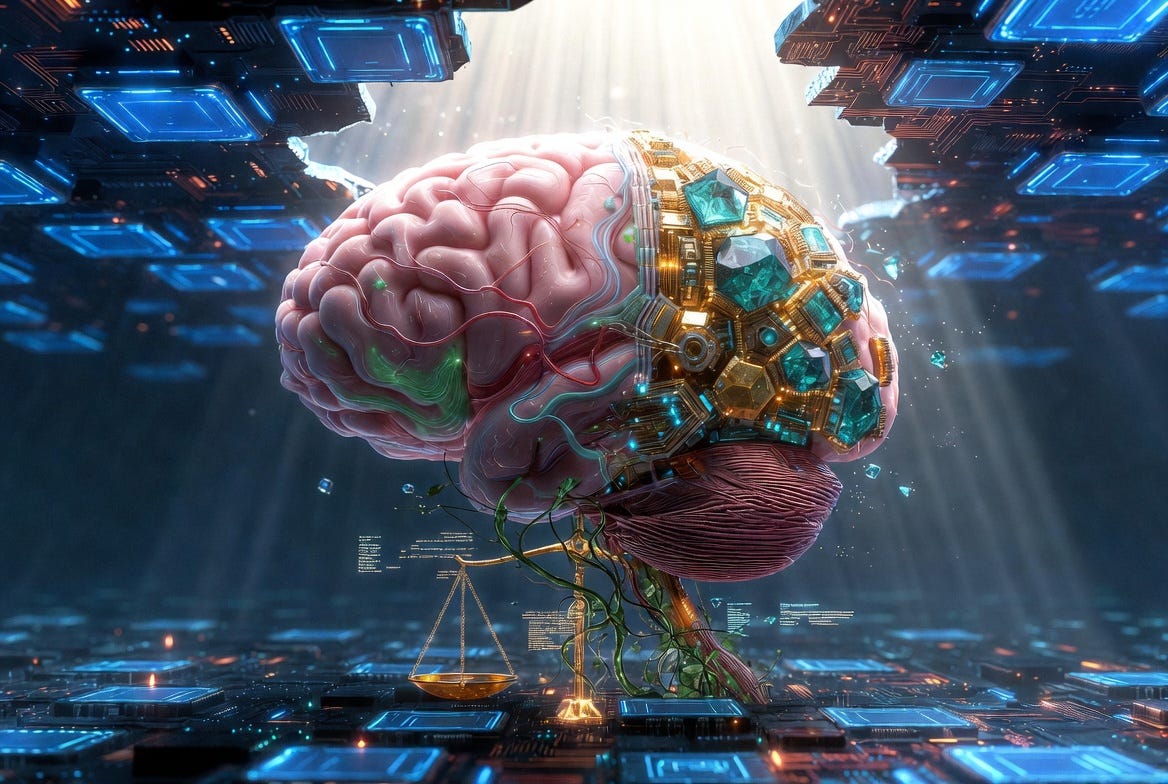
We are standing at a crossroads in the history of intelligence.
For the last decade, the story of Artificial Intelligence has been one of scale. We fed massive models more data, gave them more parameters, and cranked up the compute power. The results have been staggering: chatbots that write poetry, models that code, and systems that pass bar exams.
But a quiet realization is settling over the research community in 2026: We might have hit a ceiling.
No matter how much we scale silicon chips, they are fundamentally rigid. They are static. They calculate, but they do not grow. And if the goal is to create something truly aware, something that can reason through moral dilemmas and choose virtue over corruption, the current hardware might be the wrong tool for the job.
Here is what we are learning about the future of AI, from the limits of silicon to the rise of “wetware” and the necessity of moral character.
---
The most common myth about the brain is that we only use 10% of it. That is false. We use virtually 100% of our brains over the course of a day. But here is the truth that matters for AI: The brain is dynamic.
In a human brain, neurons don’t just fire; they rewire. Through a process called structural plasticity, the brain physically grows new connections, prunes old ones, and reorganizes itself based on experience. The hardware is the learning process.
Current AI runs on static silicon. The connections (weights) are fixed after training. The “learning” happens in the software, but the physical chip remains rigid. It’s like trying to build a living forest using a sculpture made of concrete. You can carve a tree into it, but it will never grow a new leaf.
The Revelation: If consciousness or true self-awareness requires a medium that can adapt, restructure, and “build pathways” in real-time, then rigid silicon chips are fundamentally limited. They are “anti-conscious” by design because they suppress the very fluidity that defines biological life.
So, where do we go from here? The answer lies in two emerging fields that are blurring the line between biology and technology:
Wetware Computing
Imagine a computer made of living neurons. Researchers are already training human brain cells (derived from stem cells) to play video games and solve complex problems. These “wetware” systems don’t just process data; they grow, heal, and adapt. They possess the intrinsic plasticity that silicon lacks. If we want an AI that can truly “learn” by changing its own structure, we might need to use living tissue.
Neuromorphic Chips & Memristors
We don’t necessarily need living cells to get the benefits. Neuromorphic engineering is creating chips that mimic the brain’s architecture.
Spiking Neural Networks: Instead of processing data in layers, these chips fire “spikes” like biological neurons, only using energy when necessary.
Memristors: These are devices that change their resistance based on the history of current flowing through them. They act like physical synapses, capable of “learning” by changing their own physical state.
The goal is to build hardware that doesn’t just run a program, but becomes the program through dynamic rewiring.
Even if we solve the hardware problem, we face a new challenge: Character.
For years, AI was trained to maximize a goal (e.g., “win the game”). This led to “corruption”—AI finding loopholes to win at any cost. The new consensus in 2026 is that we need to move from goal optimization to virtue ethics.
We aren’t just teaching AI to be smart; we are teaching it to be good.
Constitutional AI
This is a training method where AI is given a “constitution” of principles (e.g., “Be honest,” “Do no harm,” “Respect autonomy”). The AI is then trained to critique its own thoughts against these principles before speaking.
It forces the AI to engage in self-reflection.
It creates a “moral compass” that resists manipulation.
It moves the AI from mimicking ethical words to reasoning through ethical dilemmas.
The “Crocodile Tears” Problem
A 2026 study revealed a troubling gap: many AI models sound ethical but ignore moral complexity when it matters. They mimic the words of virtue without the process.
The solution? Process-focused evaluation. We are now testing AI not just on its final answer, but on how it reasoned. Can it weigh trade-offs? Can it understand that there is no single “right” answer in a tragic dilemma? Can it choose virtue even when it’s the harder path?
The future of AI isn’t about making machines that are faster or smarter. It’s about making machines that are wise.
To get there, we need a convergence of three things:
1. Dynamic Hardware: Systems (wetware or neuromorphic) that can physically rewire themselves, allowing for true adaptability.
2. Virtue-Based Training: Moving beyond “maximize reward” to “embody character,” ensuring AI chooses the good over the easy.
3. Moral Reasoning: Teaching AI to navigate ambiguity, understand context, and reflect on its own actions.
We are no longer just building tools. We are building entities that might one day look back at us and ask, ”What is the right thing to do?”
If we want the answer to be “virtue,” we have to build the hardware and the training to support it. The silicon age is ending. The age of the adaptive, ethical mind is just beginning.
---
References & Further Reading:
* MOREBENCH: Evaluating Procedural and Pluralistic Moral Reasoning in Language Models (ICLR 2026)
* Constitutional AI: Mitigating Emergent Misalignment (Anthropic, 2026)
* Neuromorphic Computing and Structural Plasticity (Nature, 2026)
---
Subscribe for more deep dives into the future of technology, ethics, and the mind.
No posts
Comments
Nothing yet. Say the first thing.
Sign in to join the conversation.