
For the past number of years, I have been writing and speaking about early reading intervention in Ireland, often returning to the same underlying question: are we providing the right kind of support for the children who struggle most to learn to read?
That question sits at the centre of my recent article on Reading Recovery (RR). What followed was a response from Reading Recovery Europe (RRE) and, then, a rebuttal from me
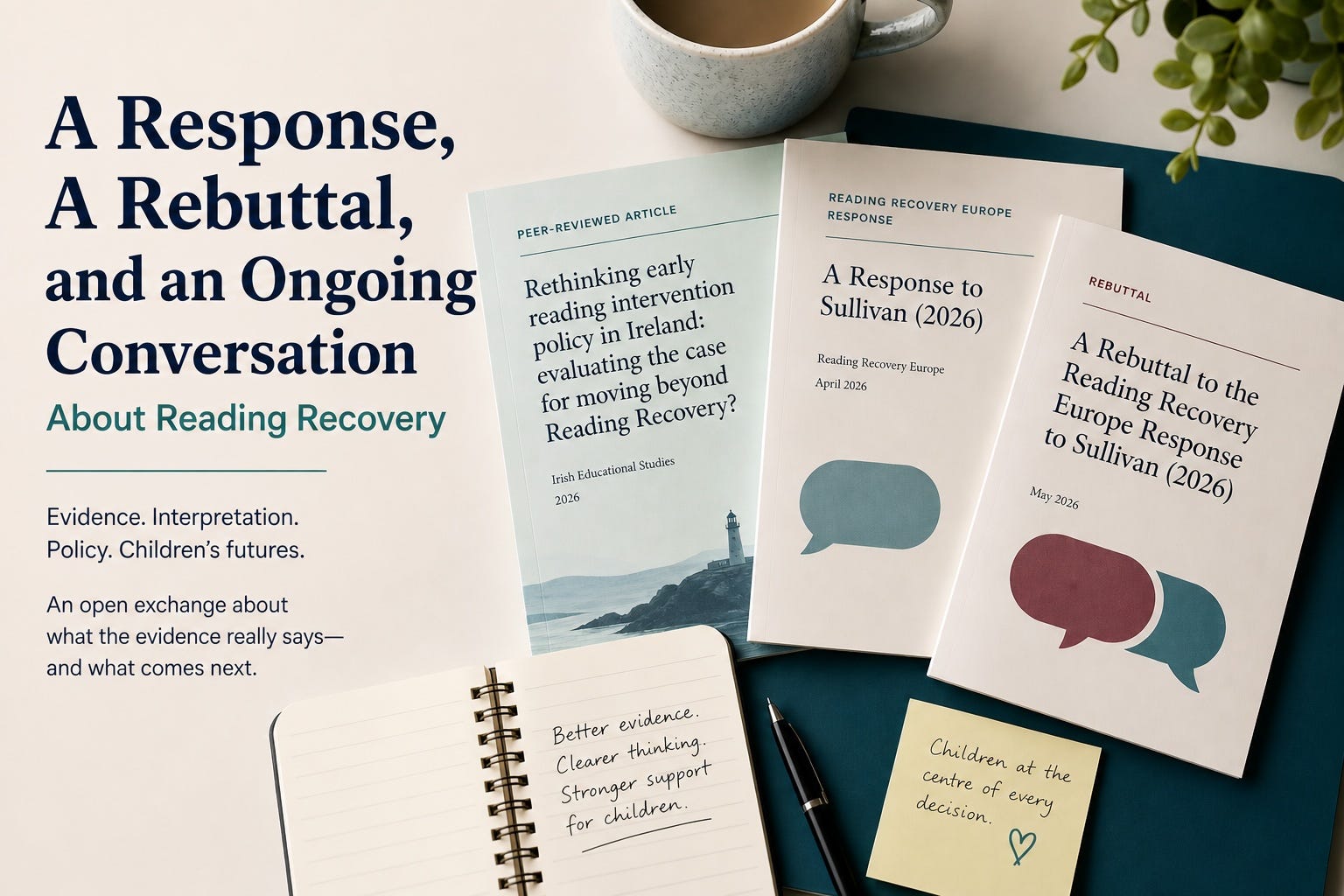
In March 2026, my article Rethinking early reading intervention policy in Ireland: evaluating the case for moving beyond Reading Recovery? was published in the journal Irish Educational Studies following a rigorous peer-review process.
Since then, the conversation has continued.
RRE published a formal response to the article on its website in April, and I have now written a rebuttal. I am sharing both here, alongside the original article (which unfortunately sits behind a paywall), for anyone who would like to read them in full.
👉 O’Sullivan, J. (2026). Rethinking early reading intervention policy in Ireland: evaluating the case for moving beyond Reading Recovery? Irish Educational Studies, 1–20. https://doi.org/10.1080/03323315.2026.2644149
👉Reading Recovery Europe Response - https://readingrecoveryeurope.org/wp-content/uploads/2026/04/RR_Response_to_Sullivan_2026.pdf
👉My Rebuttal - https://drive.google.com/file/d/1DpV0dbq3tYG1cMmTgNWDrN-2QltGIBu9/view?usp=sharing
For those who have not read the original peer-reviewed article, it examines Reading Recovery (RR) in the Irish context and asks whether our primary, government-funded early reading intervention remains aligned with current evidence on how children learn to read.
At its heart, the article makes a focused argument about evidence, policy, and instructional design. It draws attention to the absence of a national, independent evaluation of RR in Ireland. It also examines the mixed and, at times, contested picture that emerges from international evidence on RR’s long-term outcomes. It raises questions about the intervention’s instructional design, particularly for children with persistent word reading difficulties. And it considers whether RR’s short-term duration is sufficient for children who may require more sustained and cumulative support.
Taken together, these questions make it difficult to avoid a closer look at Reading Recovery’s place within national policy in Ireland.
Before getting into the substance of RRE’s response, it is worth saying that I see this kind of exchange as important.
Literacy is a field that depends on ongoing dialogue. Evidence evolves. Interpretations shift. Our understanding of reading development, particularly for children who struggle, has developed considerably over time. It is entirely appropriate that long-standing interventions are revisited in light of that. The publication of the RRE response, and the opportunity to engage with it, is, therefore, something I welcome.
At the same time, the quality of that discussion matters. Productive debate depends on accurately representing each other’s work and engaging directly with the arguments that are made. It also depends on recognising the different conditions under which contributions are produced. My original article was subject to rigorous independent peer review prior to publication. The RRE response, by contrast, is an organisational document published on its website. Both contribute to the conversation, but they do so in different ways, and that distinction is worth keeping in mind.
The RRE response is detailed and draws on a wide range of studies. It is clearly a document that seeks to defend the place of Reading Recovery within the Irish system.
A number of issues within the response, however, are worth making explicit.
One of the features of the RRE response is the way in which my original argument is characterised. At several points, the RRE response reads the article as asserting that the absence of a national Irish evaluation indicates that RR has failed. It then devotes considerable attention to demonstrating that a lack of evaluation data is not evidence of failure. However, that is not the position advanced in the article. The argument is narrower and methodological in nature: without independent national evaluation, claims about effectiveness in the Irish context are necessarily constrained. This distinction matters because it shifts the terms of the discussion. What appears to be a direct argument is, at times, a response to a position that was not advanced in the original article.
A related issue concerns how the article is represented in RRE’s response.
In several instances, phrases are presented in quotation marks in a manner that suggests they are drawn directly from the article. In a number of cases, these do not correspond to the wording used in the article, and, in some cases, were not mentioned at all. This is not a minor presentational issue. In academic discourse, quotation marks signal precise attribution. Where quoted material does not align with the original text, the basis on which the critique is constructed becomes less clear, and the reader’s ability to evaluate the accuracy of that critique is compromised.
For that reason, it is important that the RRE response is read alongside the original article so that these representations can be assessed directly.
A further point concerns what is not addressed in any sustained way within the response. The original article identifies a set of programme-level limitations, including the use of multiple cueing systems, reliance on levelled texts, the central role of running records in assessment, and the relatively short duration of the intervention for children with persistent reading difficulties. These are not peripheral features of Reading Recovery, but are central to its instructional design.
The RRE response does point to evidence that children in Reading Recovery make gains on measures of phonics and decoding, and emphasises that phonics instruction is present within the intervention. However, this does not fully engage with the underlying issue raised in the article, which concerns the nature and organisation of that instruction. The question is not whether phonics is included, but whether it is delivered in a sufficiently explicit, systematic, and cumulative way to meet the needs of children with persistent word reading difficulties.
As a result, while reported gains are important, they do not in themselves resolve questions about alignment between instructional approach and current theoretical models of reading development. In this sense, the RRE response addresses outcomes without fully addressing instructional design. For children who require sustained, carefully sequenced support in developing accurate word recognition, the way in which phonics is taught, the texts through which it is practised, and the duration over which it is reinforced are all likely to be consequential. Without more direct engagement with these features, particularly the interaction between multiple cueing practices, text selection, assessment, and the duration of the intervention, an important part of the original article’s argument remains insufficiently addressed.
RRE’s response makes a reasonable point that findings from the United States may not transfer directly to the Irish context, given differences in educational structures, curriculum coherence, and instructional practices. Considerations of contextual fit are an essential part of interpreting educational research, and this principle is appropriately foregrounded. However, this principle is not applied consistently across the RRE response. While US-based findings, particularly those that raise questions about long-term outcomes, are treated as contextually limited, UK-based studies reporting more favourable results are drawn upon throughout the response as though their transferability to Ireland is comparatively unproblematic. Furthermore, the basis for this distinction is not articulated in any sense.
This creates a methodological tension. If contextual specificity is to function as an analytical principle, it must be applied systematically across the evidence base. It cannot operate selectively, whereby findings from one context are discounted on the grounds of difference, while findings from another are accepted without equivalent scrutiny. The issue, therefore, is that the criteria for determining relevance and transferability are not made explicit or applied consistently in the RRE response. Without such consistency, contextual arguments risk functioning less as a framework for interpreting evidence and more as a way of selectively weighting it.
I am sharing these documents because this is exactly the kind of discussion that should be visible.
Literacy policy decisions are rarely straightforward. They involve questions of evidence, resources, instructional design, and long-term impact, all of which carry real consequences for children’s learning. Where there are different interpretations of that evidence, it is important that those differences are open to scrutiny rather than settled behind closed doors or reduced to simplified narratives.
Making the full exchange available is one way of supporting that. It allows readers to engage directly with the arguments, to examine how evidence is being used, and to draw their own conclusions. In a field where positions can become entrenched, there is value in returning to the primary sources and considering them carefully.
There is also a broader point here about how professional dialogue is conducted. Academic exchange is not meant to be comfortable. It is meant to be rigorous, transparent, and generative. It should allow for disagreement without misrepresentation and debate without personalisation. That is not always easy to maintain, particularly where longstanding programmes and professional identities are involved, but it is necessary if the field is to move forward in a meaningful way.
Ultimately, the aim in sharing this is to contribute to a more informed conversation about how best to support children who are struggling with learning to read.
For me, the central issue remains straightforward. When an intervention sits at the heart of national policy, particularly one aimed at young children with the most persistent reading difficulties, it is reasonable to ask whether it continues to reflect the best available evidence and represents the most effective use of limited resources.
What matters more is that the conversation leads to better evidence, clearer thinking, and, ultimately, more effective support for the children who most depend on these decisions. That includes a willingness to re-examine long-standing interventions in light of what we now know.
No posts
Comments
Nothing yet. Say the first thing.
Sign in to join the conversation.