
At ReadOn, we don’t just report the markets. We help you understand what truly drives them, so your next decision isn’t just informed, it’s intelligent.
Join ReadOn's WhatsApp Community
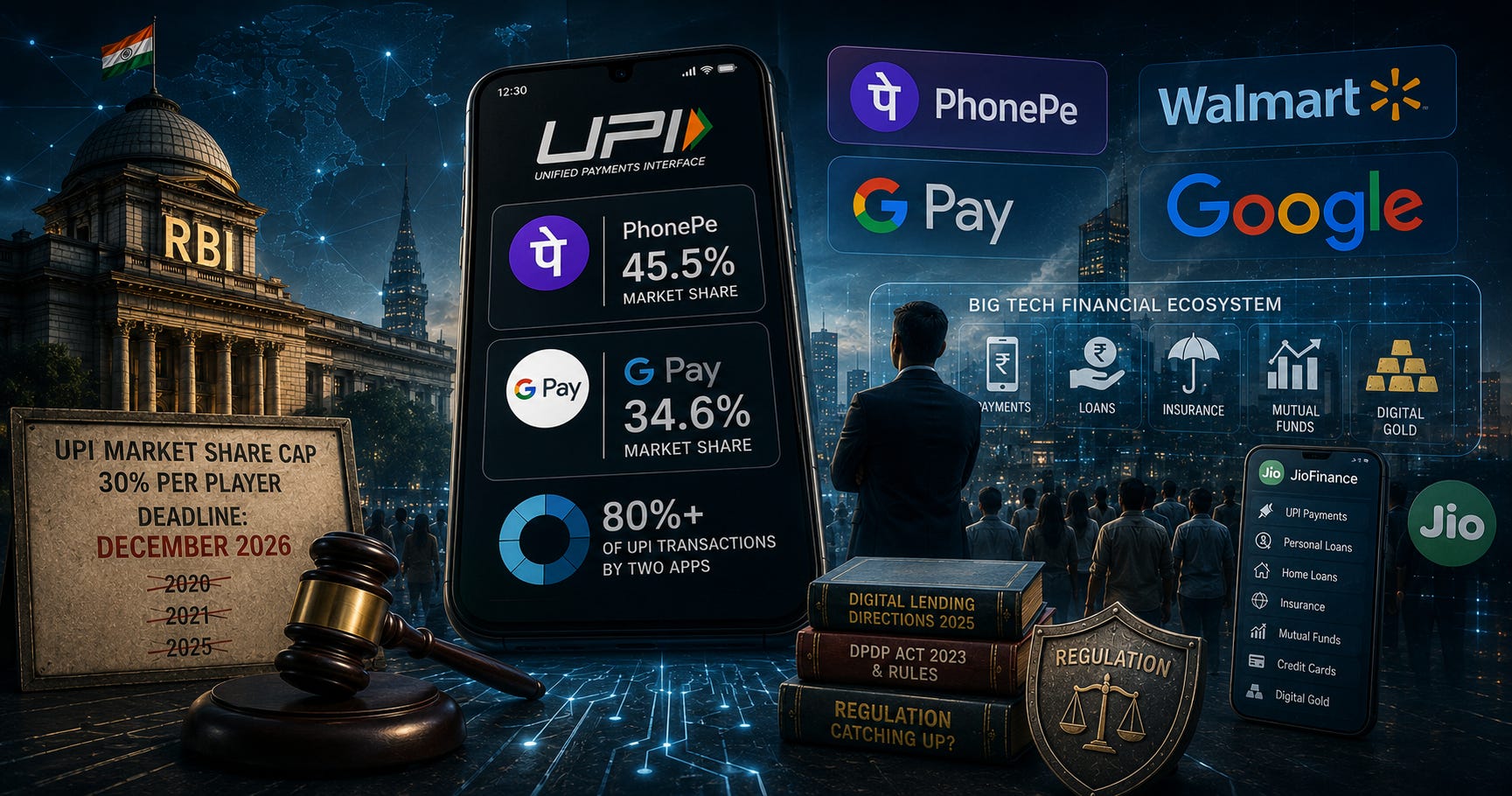
PhonePe controls 45.5% of UPI transaction volume. Google Pay holds another 34.6%. Together, a Walmart subsidiary and an Alphabet company process more than four out of every five UPI transactions in India. The NPCI first proposed a 30% market cap per player back in 2020. That deadline has since slipped to 2021, then 2025, and now December 2026.
Two apps. Over 80% of India’s payments. And the regulator has postponed its market cap deadline three times.
The cap may never land. And that tells you something important about the corner regulators worldwide have been backed into.
How “big” is big tech when it comes to finance? Let’s find out!
When BigTech enters financial services, it never announces itself.
It starts with payments. You’re already on the app. The trust is already there. And processing payments gives a company something more valuable than transaction fees: it gives them data.
Payment data tells you who someone pays, how often, how much, and more. Combine that with social media activity or e-commerce history, and you can build a surprisingly accurate picture of a person’s creditworthiness, even if they’ve never taken a formal loan in their life. That’s the move. Payments are the door. Credit is the real room.
This is exactly the pattern the IMF documented in a technical note this year on BigTech in financial services. The paper covers payments, lending, insurance, asset management, and the rise of what it calls “financial SuperApps.” The paper is aimed at regulators, but worth understanding if you’ve clicked “pay later” in the last six months.
The scale of what’s already happened globally is worthwhile. In China, Alipay and WeChat Pay together command close to 95% of retail mobile payment transaction volume. In Kenya, M-Pesa has an 89.7% share of mobile payments. In Singapore, GrabPay, the payment arm of a ride-hailing company, holds 35% of mobile payment volumes. These companies didn’t start as banks. They started as messaging apps, taxi apps, and e-commerce platforms. Finance came later, almost as an afterthought.
And in India, we’re watching the same movie.
So what actually makes BigTech different from a regular NBFC or a fintech startup? This is what the IMF paper focuses on.
Regular financial regulation is “activity-based.” A regulator sees a licensed entity, checks whether it’s complying with the rules for that specific activity, and moves on. A payment service provider gets checked for payment rules. A lending company gets checked for lending rules. Simple.
The problem is that this framework was built for firms that do one thing. BigTech does many things inside the same ecosystem. And those things feed each other in ways the rules weren’t designed to catch.
Take lending. In some emerging markets, up to 80% of BigTech’s total financial revenues come from consumer credit. But the credit business only works because the payments business generated the data. And the payments business only stays dominant because the lending product creates a dependency. One feeds the other. The licensed entity looks small. The group as a whole is enormous.
The IMF calls this the “cumulative effect” problem. Each service, taken alone, may not look systemic. But combined within a single platform, they generate what the paper describes as critical dependencies with little direct substitutability. What this means is, once your payments, loans, insurance, and investments are all inside one app, leaving that app is not a casual decision.
Alipay’s SuperApp hosts over 1 million restaurants, 40,000 supermarkets, 1 million taxis, and 300 hospitals in China. If you want to switch apps, you’re not switching apps. You’re rebuilding your life.
Sound far-fetched for India? Look at what JioFinance is building. UPI payments, personal loans, home loans, insurance, mutual funds, credit cards, and a digital gold product. It’s an all in one app. Jio has over 500 million subscribers on its telecom network. The distribution moat already exists. The financial layer is being stacked on top of it.
There’s one product category that sits at the centre of all of this. BNPL, or Buy Now Pay Later.
BNPL looks like a feature. It’s actually a credit product that slips through regulatory gaps because it was never formally classified as one. No affordability checks. No credit bureau reporting in most cases. No usury limits in many jurisdictions. In the US, BNPL loan originations grew 26% in a single year between 2022 and 2023, driven largely by BigTech embedding it at checkout.
India caught the same fever. The BNPL market crossed ₹50,000 crore in outstanding volume in 2025-26. PhonePe and Google Pay integrated it directly at checkout. The RBI issued Digital Lending Directions in May 2025, finally classifying BNPL as a lending product requiring oversight.
The classification clarified the rules. The ₹50,000 crore was already outstanding before the ink dried.
Here’s what’s changing globally, and what India is doing about it.
Brazil moved fastest. In July 2023, the Central Bank of Brazil introduced a new conglomerate regulation that recognises payment-led financial groups as distinct from bank-led ones. It creates tiered prudential requirements based on size and complexity, fully implemented by January 2025. Mercado Libre, one of Latin America’s largest tech conglomerates, now has to hold its financial operations to standards that track the actual scale of its business, not just its narrowest licensed entity.
Europe is closing in on BNPL. The UK’s FCA begins regulating BNPL in July 2026. The EU’s revised Consumer Credit Directive comes into force by November 2026, mandating affordability checks and standardised disclosures across all member states.
India is threading a more complex needle. The RBI’s Digital Lending Directions 2025 consolidate earlier circulars, require explicit borrower consent at every stage, ban dark patterns in loan apps, and mandate that data be stored within Indian jurisdiction. Alongside that, the DPDP Act 2023 and its Rules, finalised in late 2025, give India its first comprehensive data protection law. The compliance deadline for financial institutions is May 2027.
That’s meaningful progress. But the IMF’s core warning still applies. No global financial standards exist specifically for BigTech as conglomerates. The Joint Forum’s Principles for Financial Conglomerates, the closest thing to an international framework, were last updated in 2012. Before the smartphone era. Before UPI. Before the SuperApp existed as a concept.
Turns out, the regulatory playbook is running on technology that’s a decade behind the business models it’s supposed to govern.
India is the most consequential test case in the world for what happens when digital payments scale faster than digital regulation.
The UPI cap expires in December 2026 with no enforcement plan in sight. JioFinance is adding financial products by the quarter. The fintech sector is valued at $44 billion and growing at nearly 17% a year. And two foreign-owned tech platforms still run the country’s most-used payment rail.
The IMF’s prescription is clear. Activity-based regulation isn’t enough. What’s needed is group-level supervision that sees the whole conglomerate, not just the licensed slice. Brazil did it. The EU is doing it. India has the building blocks, the RBI, SEBI, IRDAI, and now the DPDP Rules, but coordination between them remains fragmented.
At what point does an app that holds your payments, your loans, your insurance, and your investments stop being a tech company and start being a bank? And who in India gets to make that call?
Because if no one does, the market will make it by default. And we already know what the market has chosen.
Until next time, ReadOn!
No posts
Comments
Nothing yet. Say the first thing.
Sign in to join the conversation.