
At ReadOn, we don’t just report the markets. We help you understand what truly drives them, so your next decision isn’t just informed, it’s intelligent.
Join ReadOn's WhatsApp Community
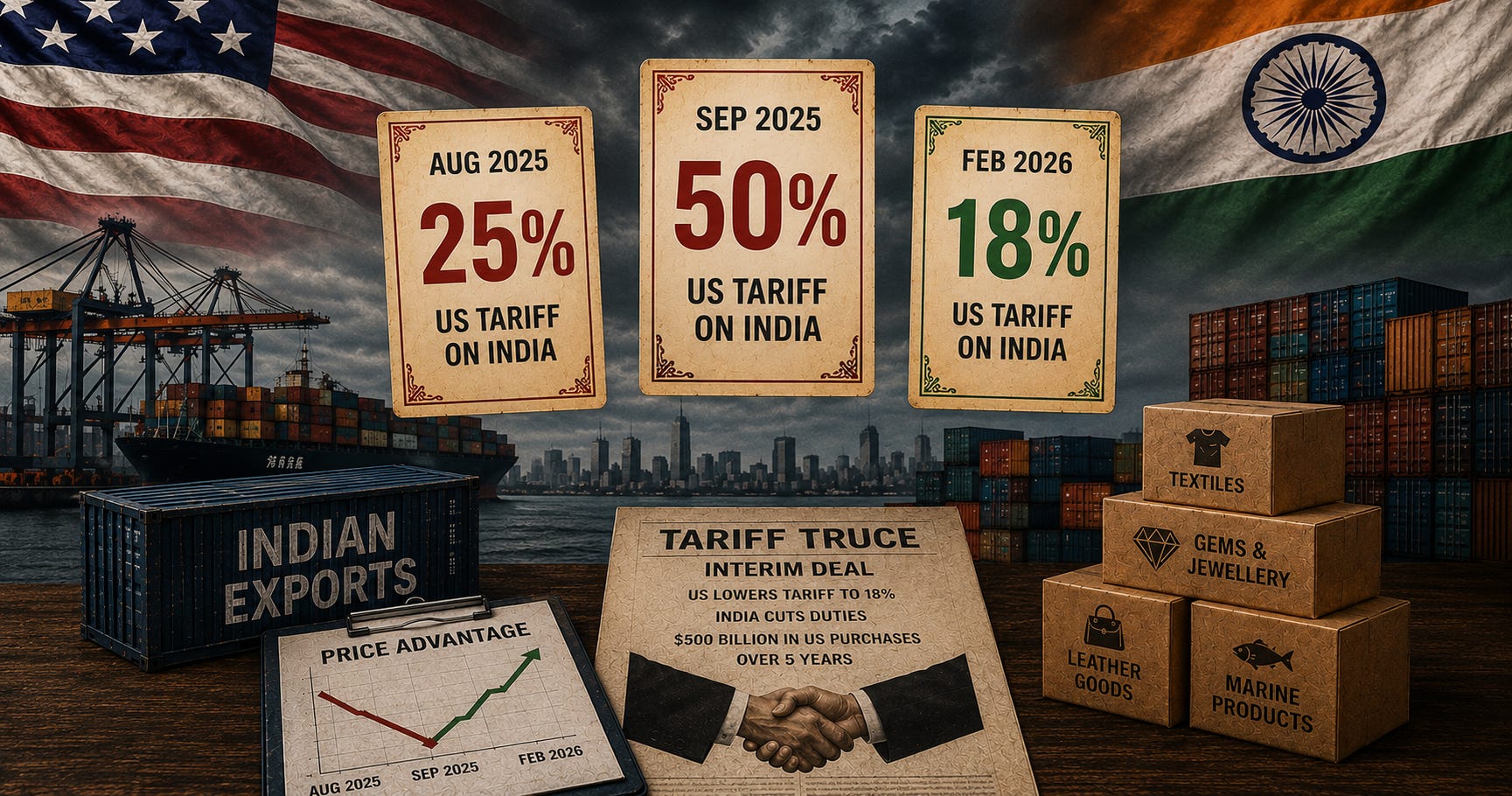
Between August 2025 and February 2026, the US tariff on Indian goods went from 25% to 50% and back down to 18%. Three different numbers, three different headlines, one country caught in the middle. Indian exporters spent that window watching their US price advantage vanish, then partially return, based on decisions made thousands of miles away over Russian oil purchases.
A new IMF working paper by JaeBin Ahn, Lorenzo Rotunno and Michele Ruta found something strange. When the US hiked tariffs across the board in 2025, the price American businesses actually paid for imports often didn’t move the way you’d expect. Exporters didn’t cut their prices to absorb the tariff. And yet, at the level of an entire product category, import prices fell anyway.
That’s more of a mechanism than a contradiction. And it has a catch that should worry anyone hoping India’s new tariff deal turns into real export gains.
Start with the basics. The IMF economists studied US Census import data at the most granular level possible. They looked at a specific exporter selling a specific product. At that level, tariffs behave exactly the way textbooks predict. When a tariff goes up, the price the American buyer pays (duty included) rises almost one-for-one. The exporter’s own price, before the tariff is added, barely moves at all. The paper estimates that an 8 percentage point tariff increase, similar to what the US imposed on average between February and December 2025, cuts import volumes from that exporter by about 3.6%. That means full pass-through, no discount, less buying.
But zoom out to the product level, meaning “all sneakers” or “all shrimp” regardless of which country sold them, and the picture flips. Prices for the product as a whole fall significantly as tariffs rise. The paper’s estimate: an 8 percentage point tariff hike is associated with roughly a 5% decline in before-tariff import prices at the product level.
The gap between those two findings is the whole story. If no individual exporter is cutting prices, how does the average price for the product fall?
The answer is reallocation. American importers didn’t ask their existing supplier for a discount. They found a new, cheaper supplier instead. The IMF paper shows that around 65% of the product-level price decline comes from this extensive margin of cheaper new entrants and pricier suppliers exiting, not existing suppliers quietly cutting their rates.
The paper asks a difficult question. When importers switch to a cheaper source, are they finding a genuinely more efficient supplier, or are they just accepting a worse product?
To answer this, the authors build what economists call an “appeal-adjusted” price index, based on work by Redding and Weinstein, which strips out price differences that are really just quality differences in disguise. A variety that commands a high price despite modest sales has low appeal. A variety that sells a lot despite being cheap and unremarkable might just be cheap and unremarkable.
The result was that when you adjust for appeal, the tariff-driven price decline shrinks by roughly half. In other words, about half of the apparent “savings” American importers found by switching suppliers wasn’t efficiency. It was buyers settling for lower-quality varieties because the good ones got too expensive. And once you adjust for that quality gap, the paper finds duty-inclusive prices actually rise significantly with tariffs, just less than one-for-one. The tariff was partly paid for in quality instead of cash.
This isn’t a one-off. The same appeal-erosion pattern shows up when the authors re-run the analysis on the 2018-19 US-China tariff war, where the effect was even larger. Quality downgrading, it turns out, is what tariffs do when exporters refuse to budge on price.
There’s real-world evidence backing this up. The IMF paper cites factory-inspection data from QIMA showing that as apparel supply chains shifted away from China to dodge tariffs, failure rates rose at newer destinations like India and Cambodia, both of which run higher defect rates than China itself. Separately, a May 2026 Lumafield survey of over 200 US and Canadian quality leaders found 62% believe tariffs and trade barriers have made it harder to maintain product quality, and 54% said suppliers had actively downgraded quality to absorb tariff costs.
India lived through this exact experiment in real time. The reciprocal tariff hit 25% in August 2025, then Washington added a 25 percentage point penalty over India’s continued Russian oil purchases, pushing the total to a punishing 50%, among the highest rates the US applied to any trading partner. That hit textiles, gems and jewellery, leather goods, and marine products the hardest, categories that together make up a large share of India’s roughly $87 billion in annual exports to the US.
Then, on February 2, 2026, the two countries struck an interim deal. The US dropped the reciprocal rate to 18%, and the Russia-linked penalty was scrapped entirely. India, in turn, agreed to cut its own tariffs on US industrial and farm goods and committed to $500 billion in US purchases over five years. Commerce minister Piyush Goyal was quick to point out that India now sits at a lower tariff rate than China, Vietnam, Bangladesh, or Pakistan on the same US shelf.
That’s genuinely good news for Indian exporters chasing US market share. But the IMF paper suggests a less comfortable follow-up question. On what basis is India winning that share back? If the answer is “we’re the cheap option because the expensive one from elsewhere got tariffed out,” that’s the exact pattern the paper describes as quality-driven reallocation, not a real competitiveness upgrade. The apparel failure-rate data cited above isn’t hypothetical. It names India directly as one of the destinations picking up volume with a track record of more defects, not fewer.
Tariffs were sold, on both sides of this trade war, as a tool to punish or protect. What the IMF paper actually finds is more structural. Tariffs mostly don’t get paid in cash. They get paid in the hard-to-measure currency of product quality, supplier reliability, and buyer trust, especially when someone downstream is willing to switch suppliers rather than eat the cost.
India now has a cheaper door into the American market than it’s had in over a year. The real test isn’t whether Indian exporters can walk through that door. It’s whether the products they carry through it are good enough that, the next time tariffs move, and they will move again, American buyers stay because they want to, not because it’s still the cheapest available option.
Until then, ReadOn!
No posts
Comments
Nothing yet. Say the first thing.
Sign in to join the conversation.