
At ReadOn, we don’t just report the markets. We help you understand what truly drives them, so your next decision isn’t just informed, it’s intelligent.
Join ReadOn's WhatsApp Community
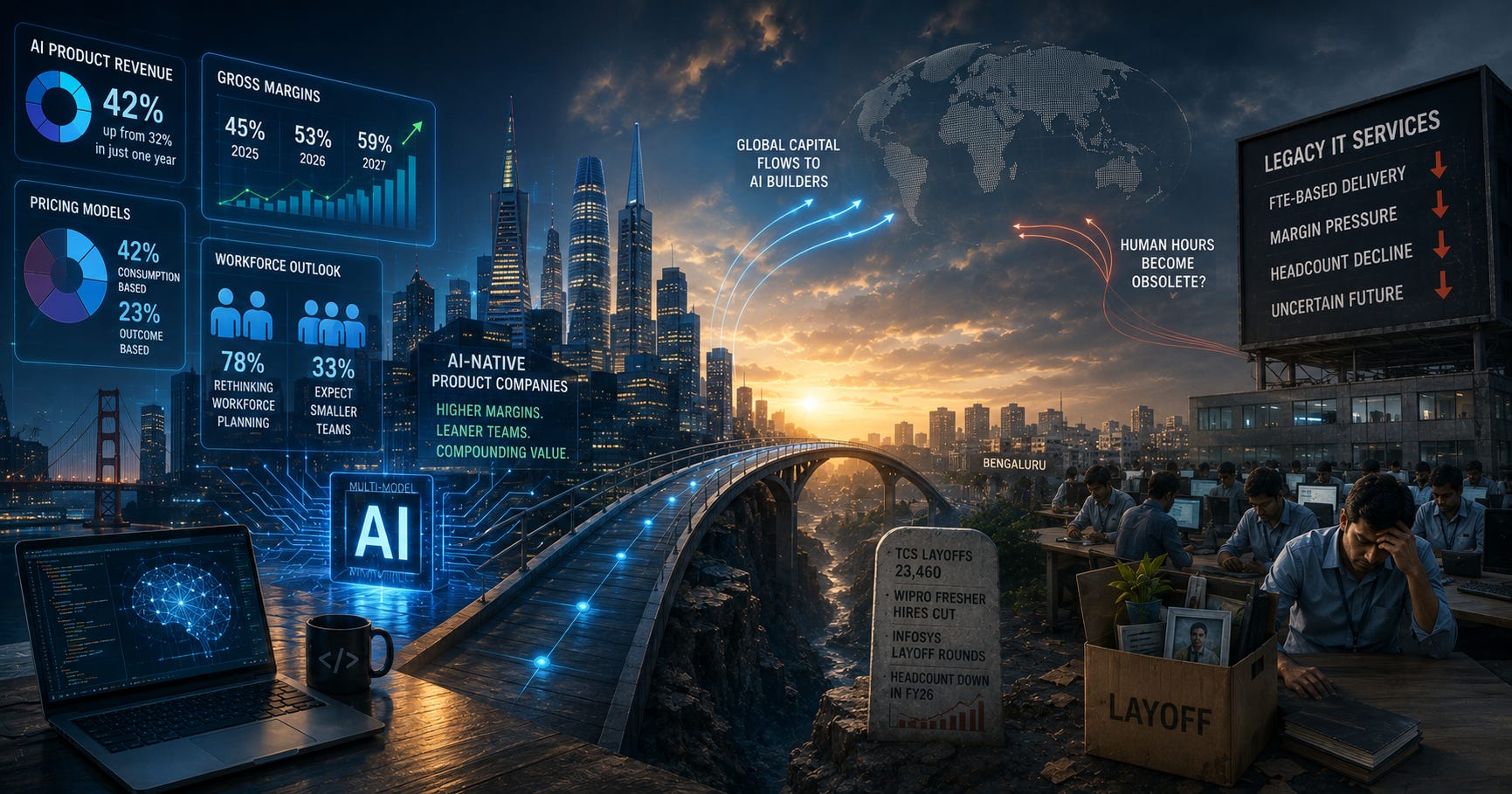
AI products now make up 42% of revenue at the software companies building them, up from 32% just a year ago.
That’s one source growing to capture nearly half of an industry’s income in twelve months.
For the last three years, the AI conversation has been about capability. Can it write code, can it draft a memo, can it hold a conversation without falling apart. ICONIQ Capital’s new “State of AI” report, based on a survey of 300+ software executives across two waves (December 2025 and May 2026), says the conversation has moved on. Boards don’t want the AI strategy slide anymore. They want the AI P&L.
Here’s the twist, though. This report is a US and Europe story (87% North America). And if you flip it around and look at India, specifically at the IT services industry that has spent two decades selling human hours to exactly these kinds of companies, the same data reads like a warning label.
Let’s get into it!
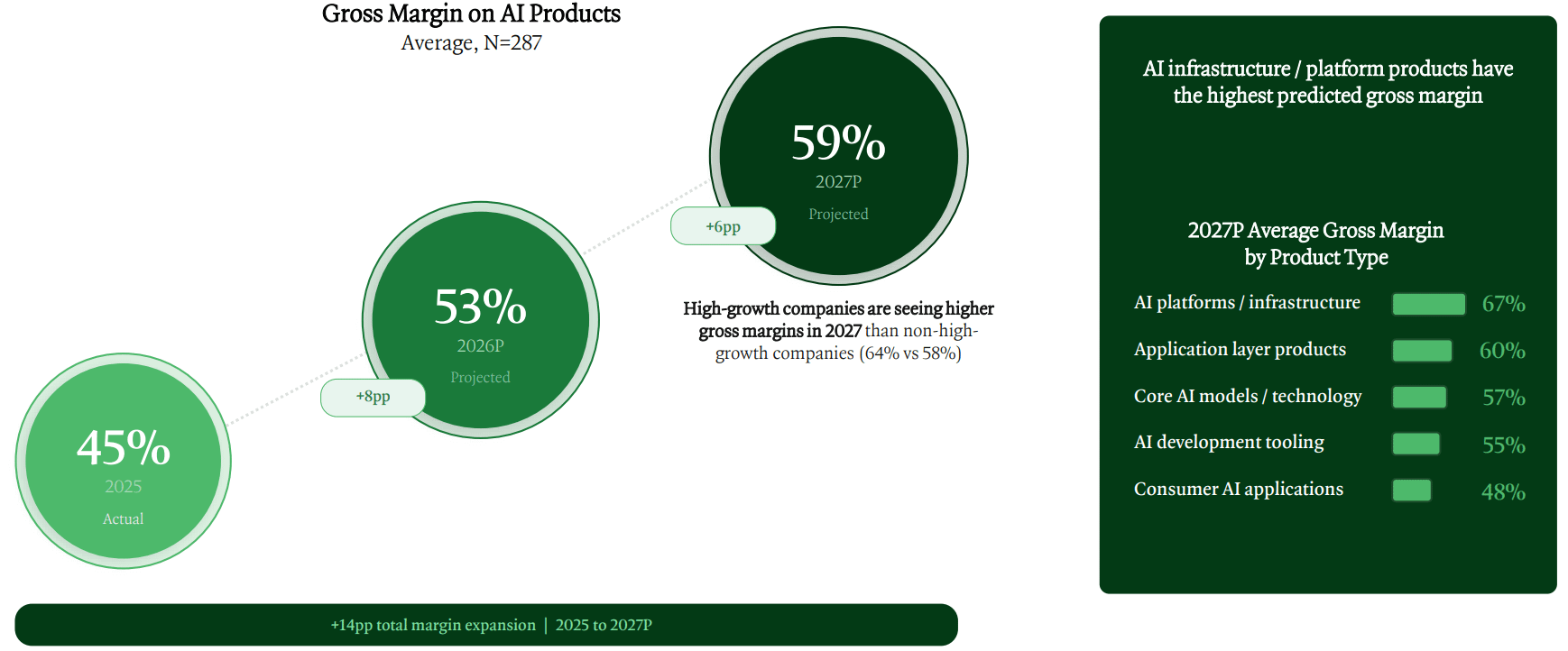
ICONIQ’s headline number is margin. Gross margins on AI products went from 45% in 2025 to a projected 53% in 2026, and 59% by 2027. That’s a 14 percentage point jump in two years, for products that were supposedly still “experimental” not long ago.
Four shifts are driving this.
One, builders have converged on the application layer. Nearly two-thirds are building horizontal or vertical AI apps, and the fastest-growing use cases are financial services and healthcare, both high-complexity, high-regulation domains. Turns out a product wedged deep into a real workflow is harder to rip out than a general-purpose model sitting one layer above it.
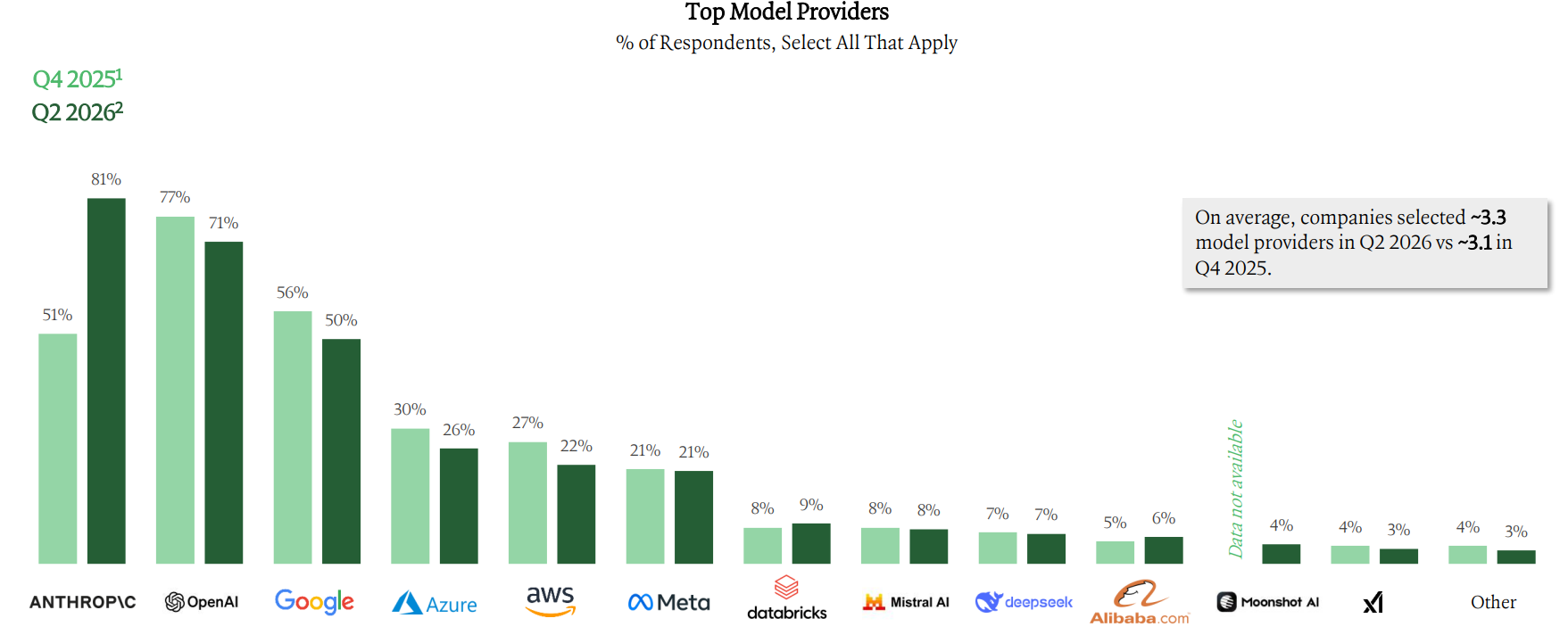
Two, multi-model is the default now. The average company runs about 3.3 model providers. And here’s the fun bit for an Indian reader who mostly hears about OpenAI. Anthropic went from being used by 51% of respondents to 81% in six months, overtaking everyone else as the most-cited provider.
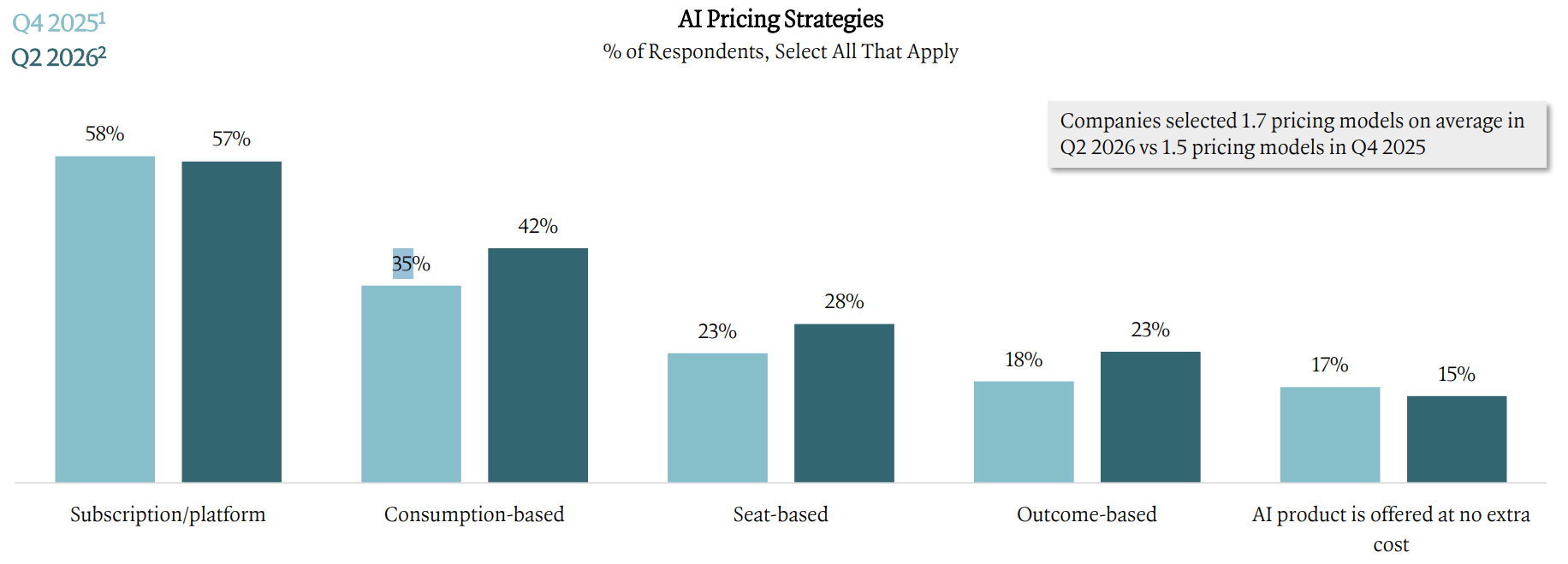
Three, pricing is being rebuilt around actual usage. Consumption-based pricing rose from 35% to 42%, outcome-based pricing from 18% to 23%. Companies are blending 1.7 pricing models on average, up from 1.5. Translation: fewer flat subscriptions, more “pay for what the AI actually does for you.”
Four, and this is the one that matters most for India, org charts are shrinking. 78% of companies are rethinking workforce planning. 45% expect a different mix of roles. 33% expect smaller teams outright.
Think about what it costs to run an AI product. As it scales from a beta to general availability to full production, talent’s share of the cost pie shrinks, and model inference’s share grows. Makes sense. Once the product works, you need fewer engineers babysitting it and more compute to run it for more customers.
One striking illustration from the report: a workflow one builder had budgeted at $0.10 per run drifted to $1.50 or more once AI agents started retrying and self-correcting on complex tasks. Inference costs, it turns out, are the sneaky line item that blows every budget.
So how are companies clawing margin back? Mostly by reducing inference costs and getting smarter about routing, not by cutting corners on the product. Two-thirds of respondents report improved unit economics on a per-query basis over the last year.
There’s a neat case study in the report about Ramp, the fintech, which hit 99% internal AI adoption not by mandating tool use, but by removing setup friction. Employees shared over 350 reusable, version-controlled workflows company-wide. Every person who figured out a good prompt made the next person’s job easier. Compounding, but for productivity instead of interest.
Now here’s the part ICONIQ’s deck doesn’t spell out, because it’s not looking at India. But you can see it forming in the same data.
Remember that finding, AI absorbs entry-level capacity, 33% of companies planning smaller teams? That’s the demand side. The supply side of that same trade is sitting in Bengaluru, Pune, and Chennai.
TCS cut roughly 23,460 jobs in FY26, even as revenue rose, its first real headcount contraction in years. Wipro slashed its fresher hiring guidance to 7,500-8,000, down sharply from earlier plans, with roughly 200 recruits publicly stuck waiting more than seven months for onboarding. Infosys has run four consecutive rounds of “performance-based” layoffs, each round trimming headcount while the company insists there’s no mass layoff underway.
Across the top five Indian IT firms, TCS, Infosys, Wipro, HCLTech, and Tech Mahindra, net headcount actually fell in FY26. That reverses two straight years of hiring growth.
It’s not that clients stopped needing work done. It’s that the work changed shape. Nasscom’s own review of the sector describes providers “re-engineering revenue models, moving away from FTE delivery to outcome-based, risk-sharing constructs as AI-driven productivity materialises.” Read that sentence again slowly. That’s the exact same outcome-based pricing shift ICONIQ measured on the buyer’s side of the table, just showing up as a threat instead of an opportunity when you’re the one selling hours instead of outcomes.
The bench model, IT services’ old safety net of keeping people on payroll between projects, made sense when a project needed ten analysts and a six-month ramp. It stops making sense when an AI agent can do a chunk of that work for the price of a few API calls. Wipro and TCS aren’t laying off because business is bad. FY26 sector revenue actually crossed $315 billion, up 6.1%. They’re laying off because revenue no longer needs to scale with bodies.
So you’ve got two economies sitting on either end of the same trade. In San Francisco, AI-native builders are watching margins expand toward 59% and hiring fewer, more senior people to run leaner, flatter teams. In Bengaluru, the firms that used to supply the human labour behind enterprise software are watching their oldest business model of selling hours get repriced out of existence.
But before you write off Indian IT entirely, one more number is worth sitting with. Deloitte’s India findings from its State of AI in the Enterprise report show 40% of Indian respondents reporting significant or full AI usage, against a global average of roughly 28%. Indian enterprises aren’t behind on adopting AI. If anything, they’re ahead of the curve as users of it.
The opportunity hasn’t disappeared. It’s moved. Away from selling engineers by the hour, toward actually building the products ICONIQ is describing margins for.
The question is whether India’s IT giants can make that leap fast enough, from FTE factory to product builder, before the bench they used to run on gets priced out from under them entirely. Or whether the next TCS-sized company to dominate this “builder’s economy” simply won’t be Indian at all.
Until next time, ReadOn!
No posts
Comments
Nothing yet. Say the first thing.
Sign in to join the conversation.