
“Don’t be afraid to answer the questions. You will find endless resources inside yourself. Writing is the act of burning through the fog in your mind.”
- Natalie Goldberg, Writing Down the Bones
For as long as I have been a writer, why do I still struggle to write?
Not to say I don’t have a practice. Anyone who identifies as a writer has one. It’s just that mine has not been very consistent over time. I would prefer to write first thing in the morning, but I am not always awake early enough. I also tend to be an optimizer, trying to squeeze in a short meditation, some journaling, maybe take the dog for a walk...and then it’s the evening and I am too tired to open up my laptop. Deadlines and group accountability help a lot, but then I am dependent on others and only external structures.
I’ve come to learn that these behaviors, while healthy, are also a way to avoid the discomfort I feel with the unknowingness of writing. I don’t know what exactly I am going to put down on a page. It can be great or garbage. That can feel scary to me. Psychologist Stephen Hayes refers to this as “experiential avoidance”, defined as “the process of trying to avoid your own experiences (thoughts, feelings, memories, bodily sensations, behavioral predispositions) even when doing so causes long-term behavioral difficulties (like not going to a party because you’re a social phobic, or not exercising because you feel too depressed to get out of bed).”1 Skipping one writing session because I anticipate the discomfort can create a vicious cycle and teach my mind to associate writing with a negative experience.
As a systems coach, I see a form of writer’s block occur in schools. For example, they will reach out with a request to help them develop a bank of reading interventions at the intermediate grades. I will listen, take notes, and then ask questions about their current practices.
· “What program are you currently using as your core ELA resource?”
· “How much time do teachers have to collaborate monthly?”
· “What data are you looking at to assess the effectiveness of Tier 1 instruction?”
Too often, I get silence or unproductive rationales. These are also avoidance strategies. I know this because I engaged in similar behaviors as a principal. Leaders feel overwhelmed by the prospect of a multiyear effort to shift core literacy instruction in every classroom for the better.
What has helped teams is to apply strategies and ideas from improvement science. This domain within organizational leadership has been applied to many professional fields, including healthcare and business. Anthony Bryk and colleagues brought this work to education through their seminal book Learning to Improve: How Schools Can Get Better at Getting Better2 (Harvard, 2015). In a nutshell, improvement science is about finding root causes for challenges and engaging in brief experiments to learn quickly. Think action research, but through several short cycles of inquiry.
In the rest of this article, I share three tools – fishbone analysis, process map, driver diagram – and how I applied them to help me improve my writing practice. Readers can use my example as a guide for supporting writers in their classrooms or to understand their schoolwide literacy initiatives from a systems level.
Improvement science is guided by three questions:
What specifically am I trying to accomplish?
What change might I introduce and why?
How will I know if it’s an improvement?
When working with a team, which is often the case, the pronoun “I” is replaced with a “we”.
In my situation, I was trying to create a more natural and sustainable writing practice. I had the answer to #1. #2 was a bit trickier. I didn’t know what change to introduce because I didn’t know what barriers were preventing me from achieving #1.
A fishbone analysis, also known as a cause-and-effect analysis, can help to dig up the root causes of our challenges. It’s important to be honest with oneself when engaging in this initial improvement step. As a systems coach, I will often collect data, such as student and teacher voice data, to ensure that what is identified as a barrier is based in objective reality.
Below is my fishbone analysis, sketched in a two-page layout in my bullet journal.
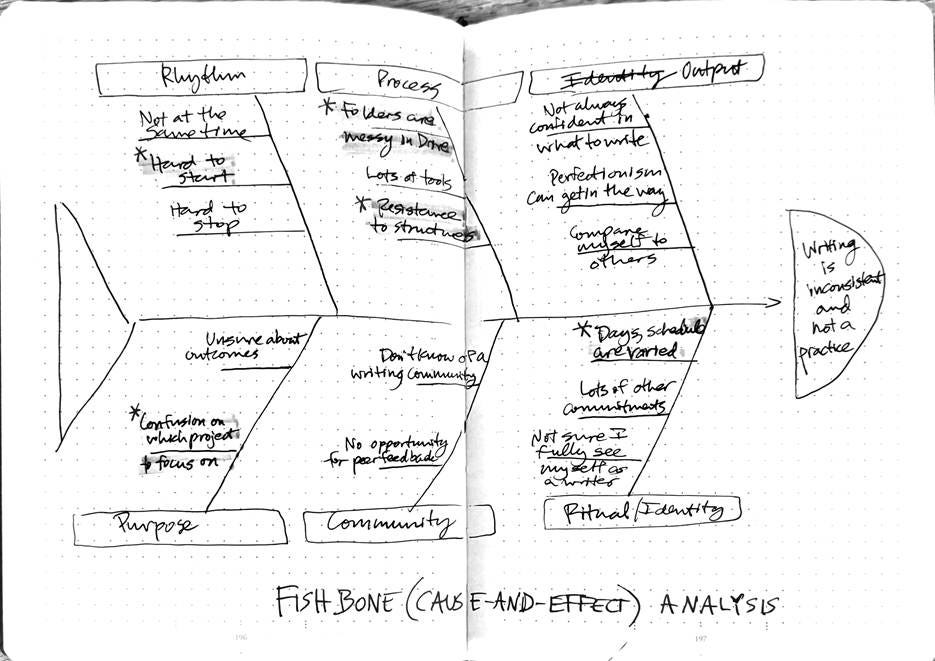
At the head of the fishbone is my problem I am trying to solve: “Writing is inconsistent and not a practice”. The major bones are categories in which specific factors within my writing practice are organized. After listing several factors that are likely contributing to my challenge, I put an asterisk next to the ones I felt were most salient.
Rhythm: It’s hard to start writing.
Purpose: I am sometimes confused on which writing project to focus on.
Process: My folders in Google Drive are messy, yet I can be resistant to structures.
Ritual/Identity: My schedule as a systems coach varies from day to day.
Other factors, such as “Perfectionism can get in the way”, became symptoms of some of these deeper issues.
A process map reveals what’s working and what’s not within the part of your system you’ve targeted. Below is my process map for what I believe was my ideal state for my writing practice.
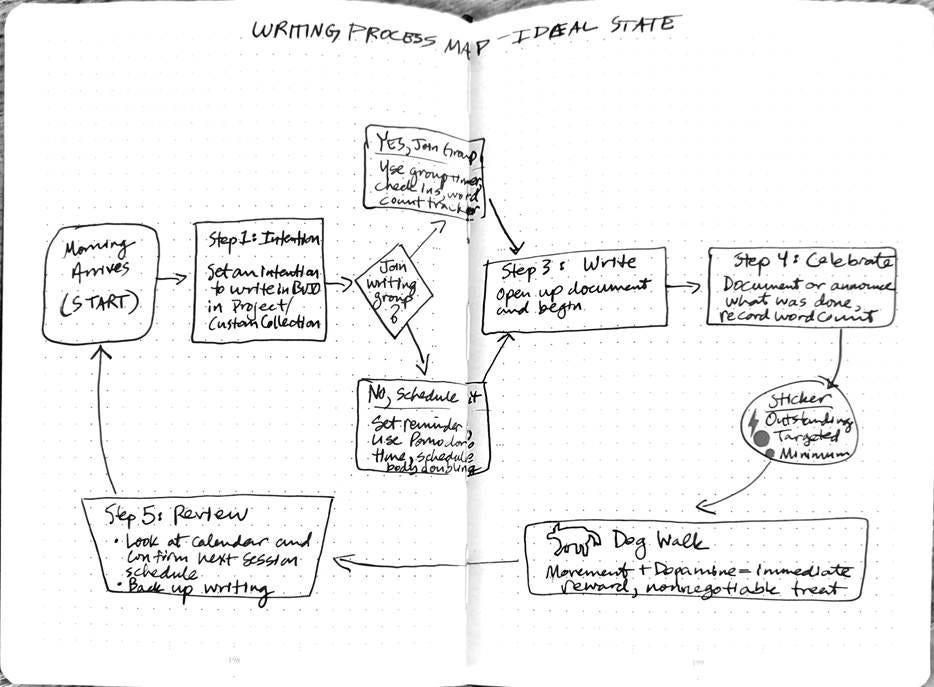
Mapping out this process revealed a clear pattern: when I wait until the morning to engage in my writing, it is already too late. My defenses were up. In response, I decided to “start” my writing practice the night before through an evening review in my bullet journal. I would look at my calendar and confirm the specific time I would be writing. Instead of fighting with my schedule, I worked around it. In addition, I recognized the need for positive reinforcement for my efforts. So, after each writing session, I would give myself a sticker in my daily writing log based on the number of words written. (No one is above stickers.)
A driver diagram ensures your improvement work is actually connected to the bigger problem you are trying to solve. My driver diagram looks like the flip of my fishbone analysis.
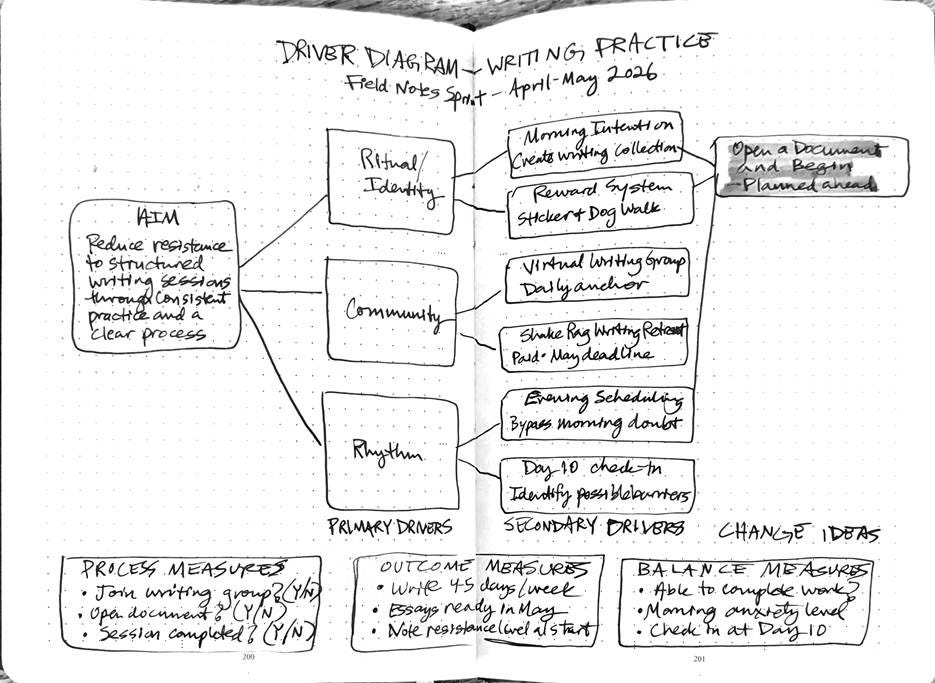
Instead of the problem at the head, I am now describing the aim of my efforts: to reduce my resistance to writing through a more clear and consistent process. Three major categories of my writing practice serve as the primary drivers. Secondary drivers, including my reward system and evening ritual, are connected to my first change idea: have my current writing document open and ready on my computer when I wake up. In effect, I am making it as easy as possible for me to write in the morning. I am removing excuses to not write. Having my current writing up and ready also ensures that I am purposeful in what I will be writing about. No wavering in which project is the priority.
I tried this for 30 days in my writing log. Instead of focusing solely on output (word count), I balanced my assessment with process measures, including whether my document was open, if I was joining a virtual writing group, and if I scheduled and wrote for at least 30 minutes. I also tracked my sense of resistance while writing as a balance measure.
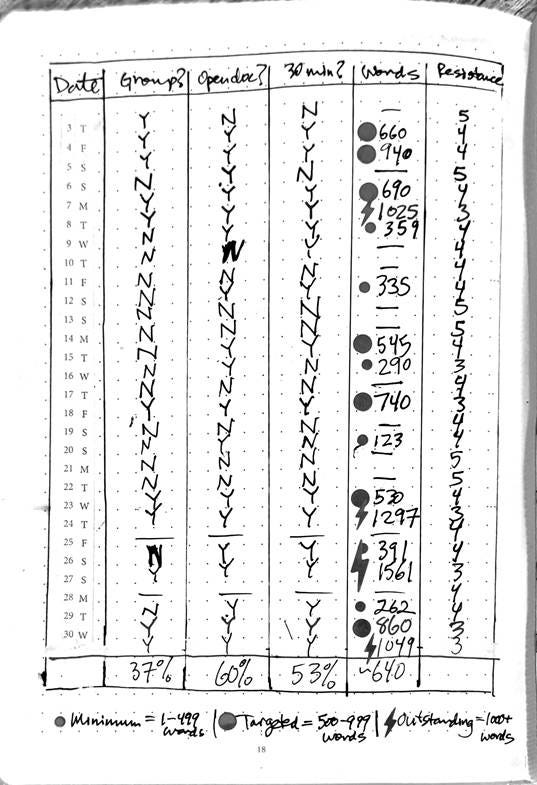
As you can see, I didn’t write every day. However, my consistency and word count improved over time. I recognized that it helped that I had a specific writing project I was working on (a collection of essays).
I treated this entire process through the lens of inquiry. If something didn’t work, I didn’t take it personally. I engaged in my writing with curiosity instead of judgment. There were not good days or bad days; there were just days on which I wrote or didn’t. After this 30-day experiment, I am now finishing up the essay collection and preparing the book proposal. Evening reviews and open documents are still a part of my practice. I took a break from the stickers; the practice feels like more of its own reward.
The same curiosity I brought to my writing practice is available to any team willing to study their own literacy work the same way. What would it look like if your team approached your next literacy challenge with openness instead of judgment? Reply to this email with your thoughts, or share your ideas in the comments. I read every response and do my best to reply to readers.
Enjoyed this post? Share it with a colleague and on social media.
Hayes, S. C. (2025). Get out of your mind and into your life: The new acceptance and commitment therapy. New Harbinger Publications.
Affiliate link with Bookshop.org - support independent bookstores!
Comments
Nothing yet. Say the first thing.
Sign in to join the conversation.