
You know LinkedIn drives B2B leads. You know founder content outperforms company pages by 8x. So why do you still stare at a blank screen every Monday morning, treating content like a second job you can’t start?
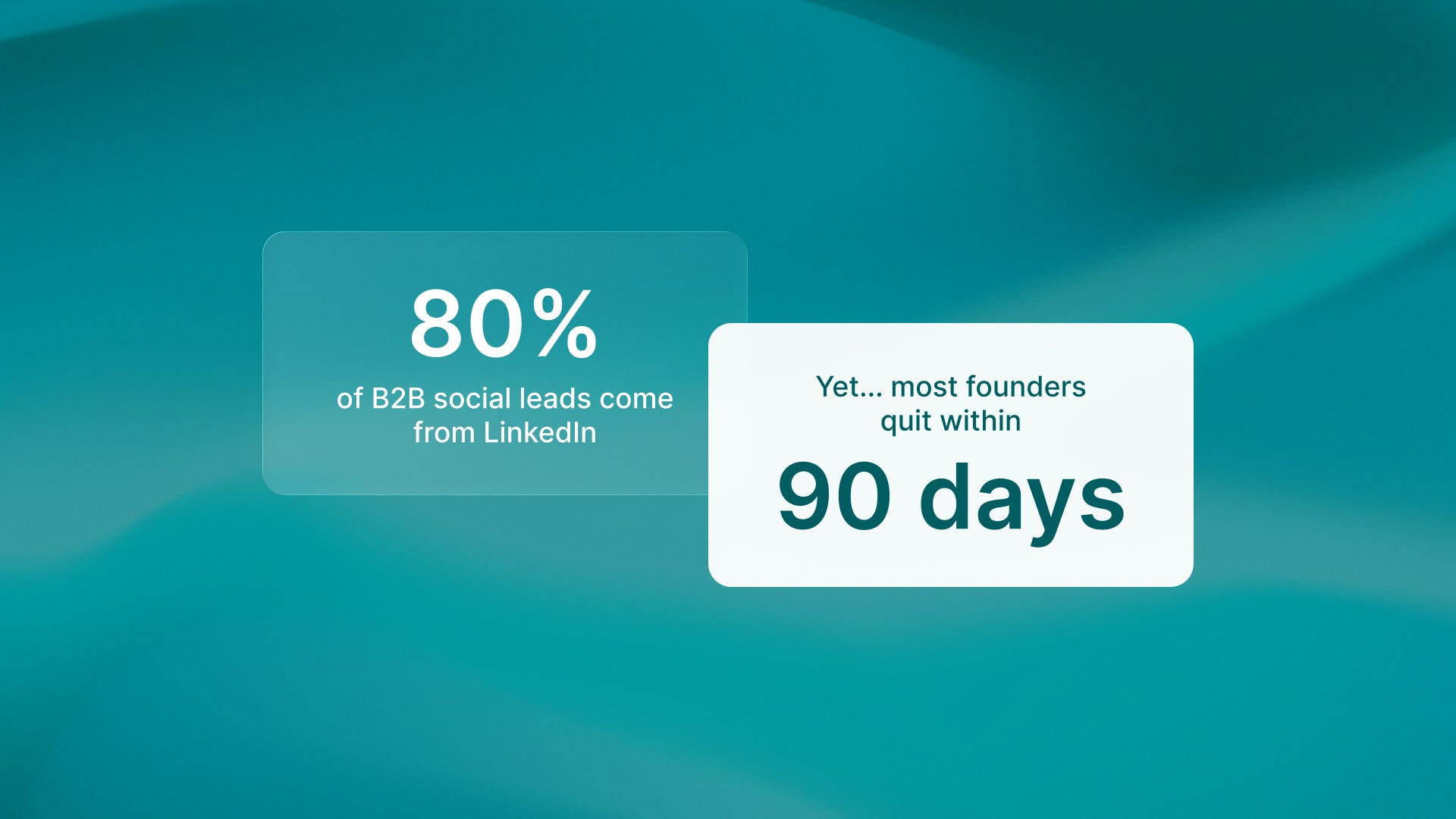
The problem isn’t motivation. It’s infrastructure. 80% of B2B leads from social media come through LinkedIn. Also, personal profiles generate 8x more engagement than company pages. Every founder knows this. But most fail within 90 days. They treat LinkedIn as a creative project driven by inspiration, not a systematic lead generation system.
This guide provides the complete operational framework for how to build a personal brand on LinkedIn. It covers profile optimization that works 24/7. It also covers content batching that makes your day easier. It includes engagement tactics that boost visibility. These tactics help without turning you into a full-time creator.
Most founders treat LinkedIn profiles as static resumes. That’s leaving distribution on the table.
Profiles optimized for search and clarity generate 3-5x more profile views per post. Every post you publish distributes your profile optimization work to new audiences. The infrastructure compounds.
Here’s what LinkedIn profile optimization actually means:
Your headline should state the specific problem you solve, not your job title. “I help B2B SaaS companies get qualified leads through LinkedIn” works better than “CEO at Company X.” It tells prospects exactly what you do. Include your primary keyword naturally.
Open with the problem you solve in the first two sentences. Follow with social proof (specific client results, notable companies worked with). Close with a clear next step (book a call, download a resource). Strategic keyword placement throughout improves search visibility without feeling forced.
Pin your best-performing posts, case studies, or lead magnets in the featured section. This content appears before someone reads your full profile, creating immediate credibility. Update it monthly based on what’s converting.
The mechanism: optimized profiles reduce buyer risk perception. When someone clicks through from a post, they should immediately understand what you do, who you help, and why you’re credible. Clarity drives conversion. LinkedIn personal branding for founders starts with this infrastructure layer, not with posting strategy.
The pattern across high-performing founder profiles: they post 2-3 times per week minimum. They batch content creation in 2-4 hour blocks monthly. They use scheduling tools to remove daily decision fatigue.
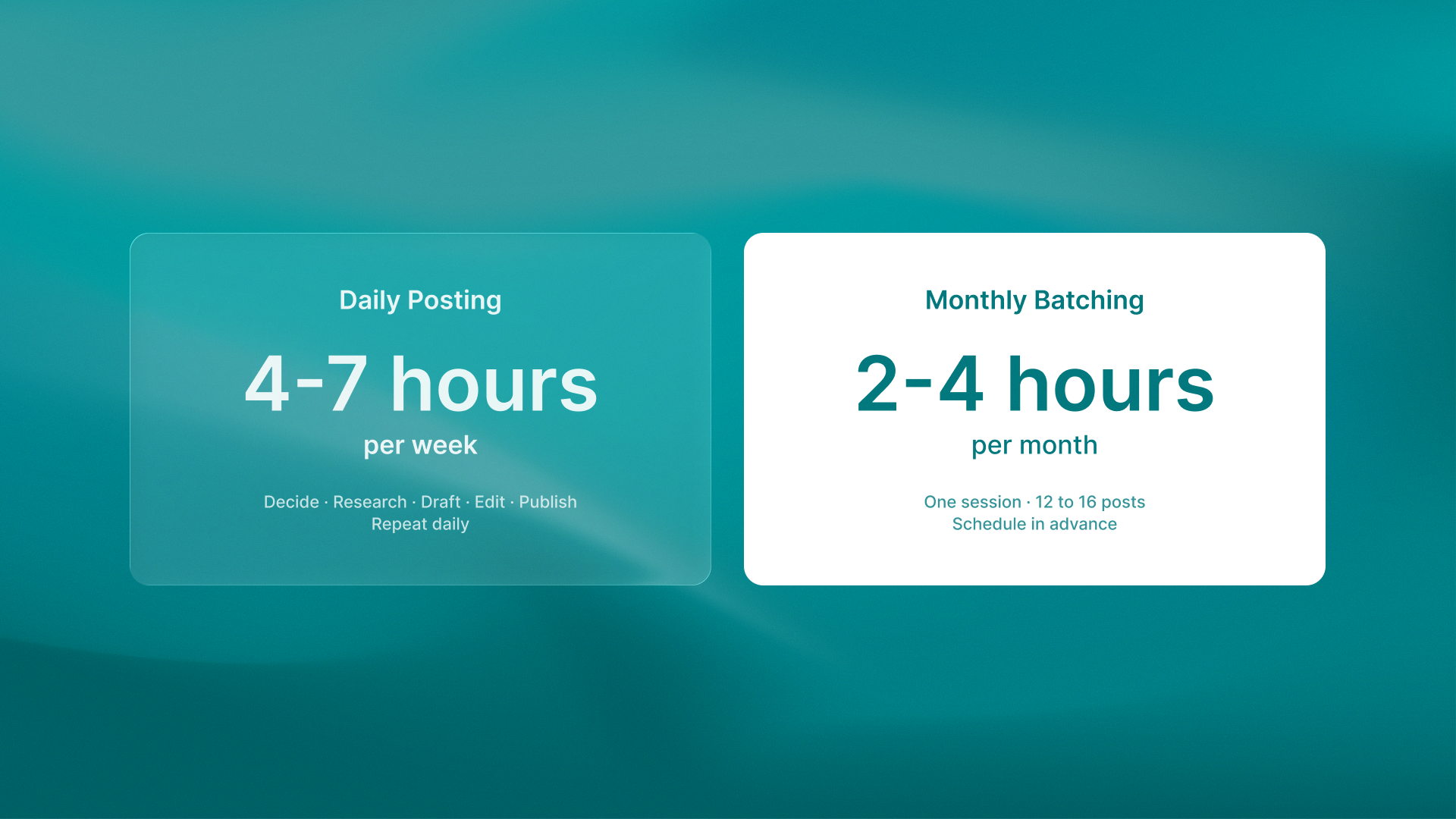
The alternative (attempting daily inspiration-driven posting) has a 90%+ failure rate within 90 days. Here’s why: daily posting creates friction that compounds into overwhelm. You wake up Monday, decide what to write, research the topic, draft the post, edit it, and publish. That’s 45-60 minutes per post. Multiply by 5-7 days per week, and you’ve just added 4-7 hours of content work to your calendar.
Most founders don’t have 4-7 hours. So they skip days. They feel guilty. They post sporadically. They see declining engagement. They quit.
Block 2-4 hours monthly for content batching. In one session, outline 12-16 posts (3-4 weeks of content at 3-4 posts per week). Use proven content frameworks:
Problem-solution posts: Name a specific problem your audience faces, explain why conventional approaches fail, provide your solution framework
Data-driven posts: Share a counterintuitive statistic, explain the mechanism behind it, connect it to operational implications
Case study posts: Describe a client’s before state, explain what changed, quantify the after state with specific metrics
Framework posts: Break down a complex process into 3-5 steps, explain each step with concrete examples
Schedule posts in advance using LinkedIn’s native scheduler or a tool like Buffer. The goal: eliminate the daily decision of “what should I post today.” You’ve already decided. You just show up for engagement.
This isn’t about grinding. It’s about removing friction. QA flow shifted from sporadic to regular posting. It went from 6 to 14 posts each month. Engagement per post doubled, as shown here. Why? Consistency trains the algorithm to prioritize your content. Your LinkedIn content strategy becomes an operational system, not a creative burden.
LinkedIn’s algorithm prioritizes posts that generate engagement velocity in the first 90 minutes. This isn’t speculation. It’s the operational reality of how distribution works on the platform.
Founders who systematically engineer early engagement see 4-6x higher reach than identical posts without this discipline. Here’s the mechanical breakdown:
When you publish, tag 3-5 relevant connections who would genuinely find the content valuable. Not random tags. Not flattery tags. Connections who will engage because the content solves a problem they care about. Each tagged person receives a notification. This increases the likelihood of early engagement.
Before you publish, message 2-3 people in your network and say, “I’m publishing a post about X in 10 minutes. Would you mind dropping a comment if it resonates?” Comments in the first 30 minutes signal to the algorithm that the post is generating conversation. This triggers broader distribution.
Respond to every comment within the first hour after posting. Each response counts as additional engagement. This signals to the algorithm that the post is active. Set a calendar reminder if needed. This hour determines whether your post reaches 500 people or 5,000.
The compounding effect: posts with high engagement velocity get pushed to second-degree connections. Your network’s engagement creates exponential reach. A post that generates 20 comments in the first hour reaches 10-15x more people than a post that generates 20 comments over 24 hours.
This is why 500 engaged followers beat 10,000 dormant followers. Network quality compounds through engagement velocity. Follower count is a vanity metric. Engagement rate in the first 90 minutes is the operational metric that drives distribution. These LinkedIn engagement tactics translate directly to visibility at scale.
Campaigns featuring senior executives lead to 82% of people trusting a company much more. The mechanism: personal brands reduce buyer risk perception.
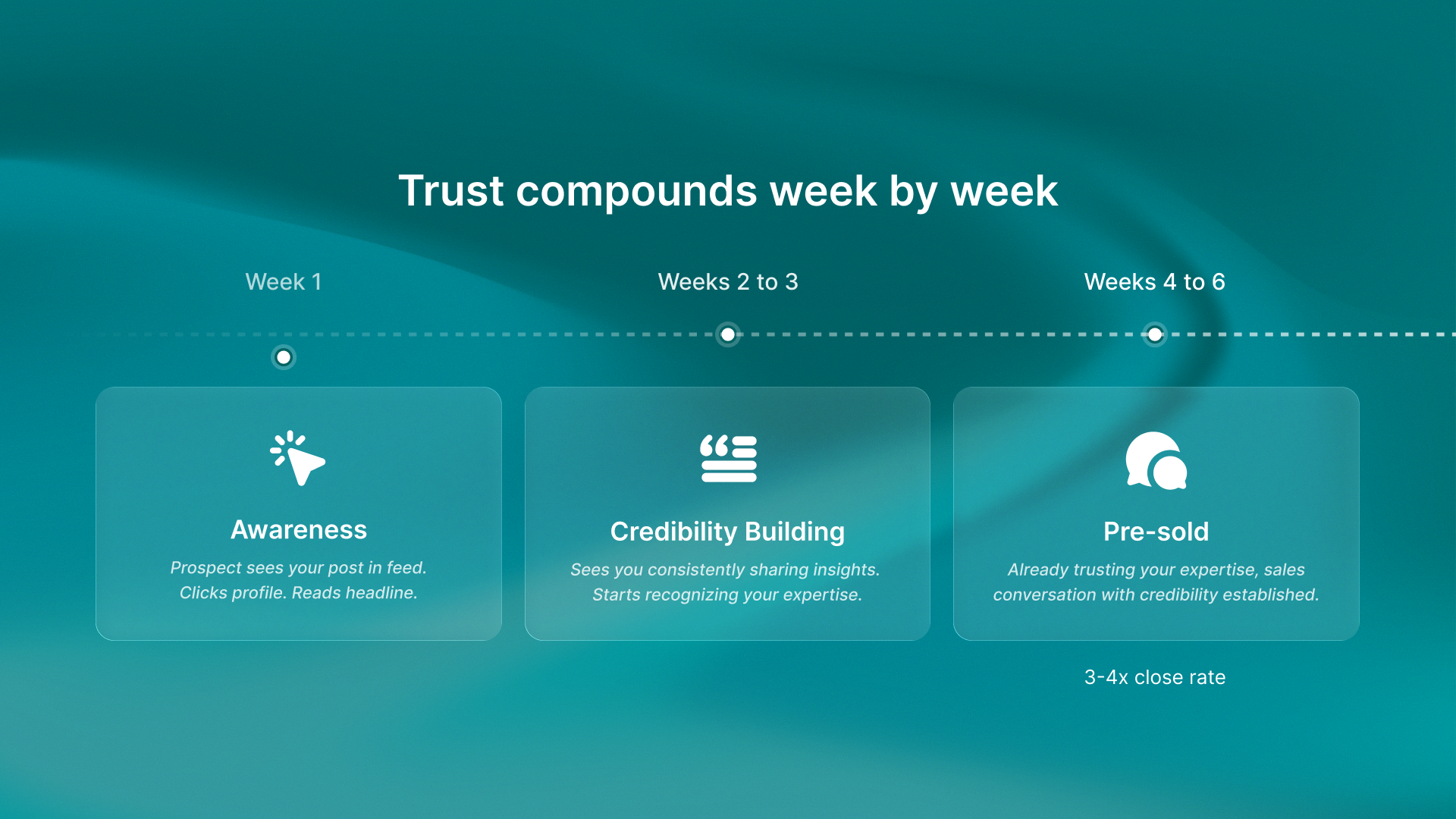
Founders who show up consistently create compounding trust. This shortens sales cycles and increases close rates. When a prospect sees you share insights, reply to comments, and show expertise each week, they trust you sooner in sales talks.
This isn’t about vanity metrics. It’s about operational efficiency. Every hour spent building founder presence compounds into lead generation infrastructure. LinkedIn generates 80% of all B2B social media leads. Executive visibility builds trust faster than company pages.
The data is clear: personal profiles outperform company pages by 8x in engagement. But the real multiplier is trust. A prospect who follows your content for 4-6 weeks before reaching out is 3-4x more likely to close than a cold inbound lead. They’ve already vetted your expertise through your content.
This pattern mirrors what happens when startups establish marketing foundations before hiring specialists. The infrastructure must exist before the execution scales. LinkedIn personal branding creates the foundation that makes all other demand generation more efficient.
Most B2B founders spread effort across LinkedIn, X, Instagram, and Facebook. But LinkedIn dominates B2B lead generation by a 4:1 ratio over all other platforms combined. If you’re investing equal time across four platforms, you’re spending 75% of your effort on channels that generate 20% of your results.
The pattern repeats across sectors:
Beauty brands use TikTok Shop for 8% conversion rates because the platform matches product-market fit
Cult beauty brands build followings through consistent positioning across all touchpoints
The principle holds: concentration on the right platform beats distribution across many. For B2B founders, concentrated LinkedIn execution outperforms multi-platform distribution. The LinkedIn posting schedule consistency matters more than cross-platform presence.
Traditional SEO focused on ranking for keywords. But 89% of B2B buyers now use AI for research while only 16% of brands track AI search performance. Personal brands that show up in AI answer engines gain visibility that competitors miss.
LinkedIn profiles optimized for clarity and expertise appear in AI-generated research summaries. When prospects ask AI tools, “Who are the top experts in [your domain]?” a steady LinkedIn presence helps your profile show up. This creates a compounding advantage: your LinkedIn personal branding work feeds both human network effects and AI search visibility.
The founders who recognize this shift build content that answers specific questions rather than chasing viral engagement. The same systematic approach that drives LinkedIn results also positions you for AI search visibility.
Optimize profile infrastructure using the frameworks above: rewrite your headline to state the exact problem you solve. Restructure your About section to open with client pain points. Close it with social proof. Pin your best-performing content in the Featured section. This work compounds with every post you publish.
Create 12–16 posts in one 2-hour session.
Use the provided content frameworks.
Choose from problem-solution, data-driven, case study, and framework posts.
Schedule them 2-3x weekly using LinkedIn’s native scheduler. Eliminate daily decision fatigue by deciding your content calendar once per month.
Engineer engagement velocity in the first 90 minutes: tag 3–5 relevant connections when you publish. Seed 2–3 comments from your network before posting. Respond to every comment within the first hour. Set calendar reminders to protect this time.
Track qualified leads per post, not vanity metrics like impressions or total followers. Which content formats generate inbound messages? Which posts lead to discovery calls? Double down on what converts. Cut what doesn’t.
This isn’t motivational advice. It’s operational reality. Founders who treat LinkedIn as infrastructure rather than inspiration build compounding lead generation systems. The alternative is another year of knowing you should post without actually posting.
Ready to stop staring at blank screens and start building a systematic LinkedIn presence? Start your free trial and turn content batching into lead generation infrastructure.
No posts
Comments
Nothing yet. Say the first thing.
Sign in to join the conversation.