
A couple winners already this week.
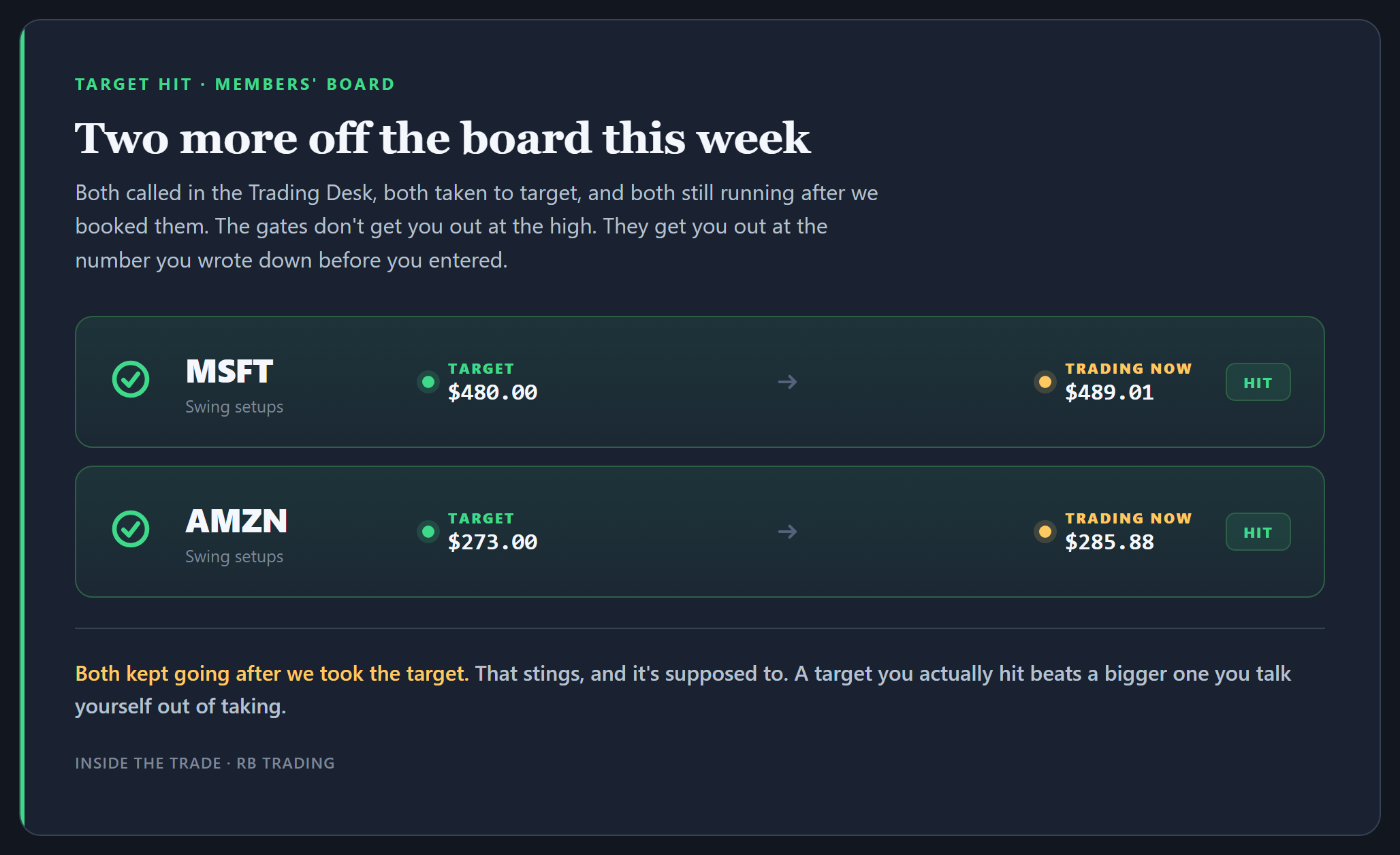
MSFT 0.00%↑ hit its $480 target. It’s trading $489.01 as I write this. AMZN 0.00%↑ hit $273 and it’s at $285.88.
Two more off the board
Both kept running after we booked them. I want to be honest about how that feels, because everyone gets this wrong at the start: watching a stock you just sold keep climbing is worse than taking a loss. A loss is over. This one keeps going, in public, every day, reminding you what you left behind.
You still take the target.
The number was set before entry, when nobody had any money on the line and nobody had an opinion worth protecting. Moving it afterwards isn’t optimisation. It’s just deciding, mid-trade, that the version of you holding a winner has better judgement than the version who planned it. He doesn’t. He’s the same person with more adrenaline.
Moving your target mid trade because the last trade ran another 1R is not a system you can record and repeat. Just don’t.
Three setups cleared all three gates this week and went live on the board.
Three setups live
Names and levels are below for members, but the interesting part is free, because it isn’t the names.
Two of the three are breakouts. You’re buying strength, entering above a level as price leaves it, and the trade is wrong if it comes back through. The third is the opposite. It’s a pullback, waiting for price to come down and tag a zone before you touch it, and it’s wrong if the zone fails to hold.
Same board. Same three gates. Opposite instructions.
That’s the bit that confuses people about systems, and it’s worth slowing down on. A system doesn’t hand you one behaviour. It hands you a way of deciding which behaviour a chart is asking for. Gate 2 is where that decision happens, and it’s why I split entry into “the zone” and “the signal” rather than treating entry as one thing.
Buy a breakout on a chart that wanted a pullback and you’re paying the worst price available. Wait for a pullback on a chart that’s already gone and you’ll watch the whole move from the sidelines, then chase it three days later at exactly the wrong moment.
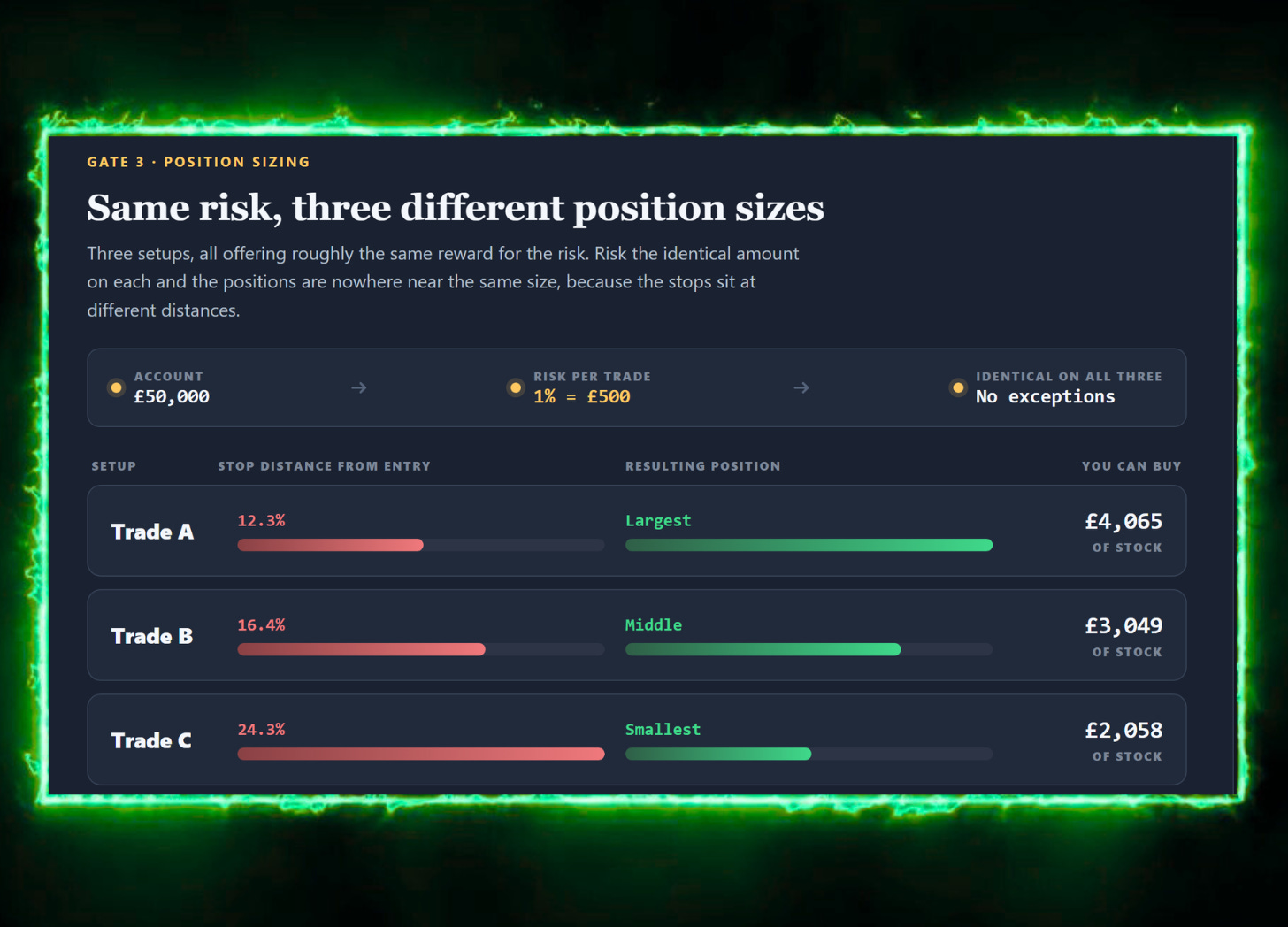
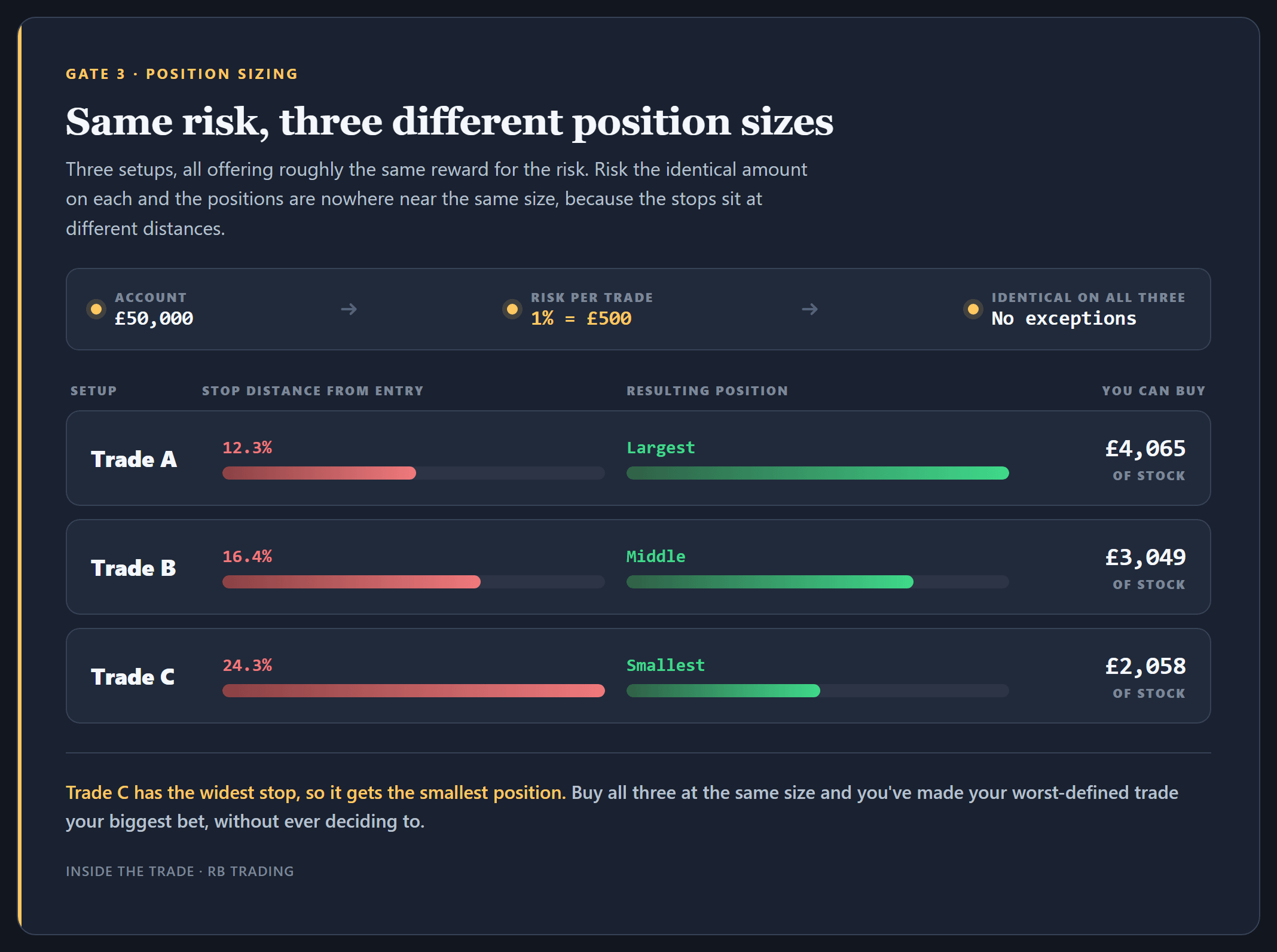
Here’s what nobody looks at on a board like this: the three setups have almost identical reward for the risk. Around 2.1 to 2.5 times what’s being risked, all three.
That isn’t luck. It’s the filter. Anything that didn’t offer roughly that much never made it onto the list, no matter how good the story was.
But the stops are wildly different in percentage terms. One of the three has a stop about twice as far from entry as another, in percentage terms. Same reward ratio, very different distance to being wrong.
Which means the three positions are not the same size. They can’t be. If you’re risking a fixed percentage of the account on each, the one with the widest stop gets the smallest position, and the one with the tightest stop gets the biggest. Run all three at the same position size and you’ve quietly made the widest-stop trade your biggest risk on the board, which is the exact opposite of what you intended.
Most blown accounts I’ve looked at didn’t die from bad entries. They died from correct entries at sizes nobody calculated.
I nearly didn’t take the pullback one.
It had been on the watchlist for a while doing nothing, and there’s a specific kind of boredom that sets in with a chart you’ve been staring at. You start wanting it to do something so you can stop watching it. That’s not analysis, that’s fatigue, and twice this year I’ve entered early purely to end the waiting.
Caught it this time. Waited for the tag.
Comments
Nothing yet. Say the first thing.
Sign in to join the conversation.