
Masterclass 04. Gate 2: The One That Says Not Yet.
Just after 9:19 this morning my board had seven names past their trigger and two sitting less than one percent short of theirs. I took the seven. I have not touched the other two, and I may never. That gap, between nearly and actually, is the whole reason gate 2 exists lets jump into todays piece.
Letter 2 covered Gate 1, the direction you’re allowed to lean. Gate 1 tells you which way. It does not tell you when. That is a different job, and skipping it is the most common way a correct read turns into a losing trade.
Today is the whole of Gate 2: what it actually asks, what counts as a yes, what waiting really costs, and the four-second test you can run on every trade you’ve already closed.
Below: the entire method, two of my own charts, and the test. Behind the paywall: every name currently on the board with its exact trigger, target, stop and gate status.
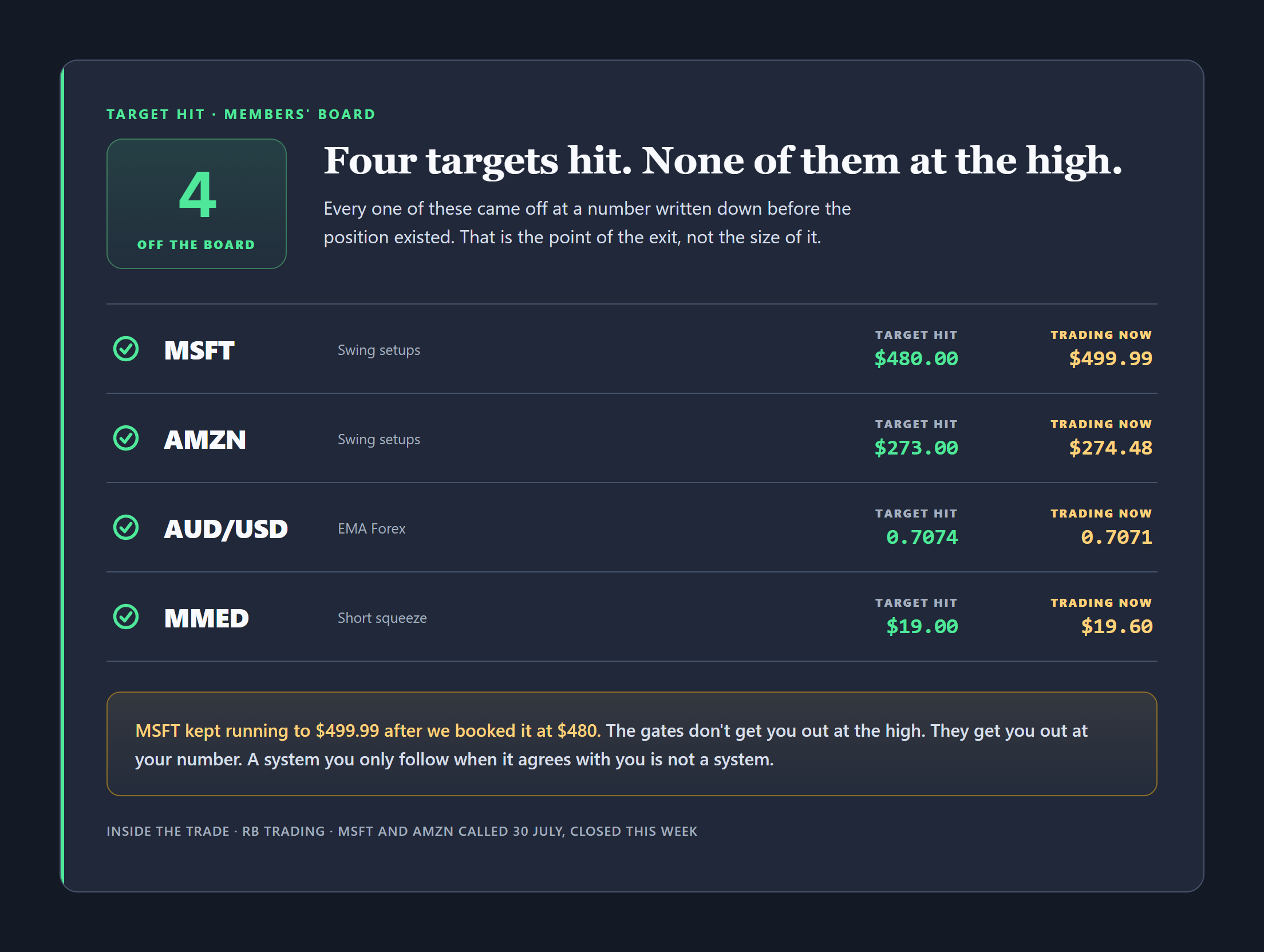
Four setups hit their target this week.
MSFT hit $480. AMZN hit $273. AUD/USD hit 0.7074. MMED hit $19.
Two of those, MSFT and AMZN, I called earlier and told you about on 30 July. They only just came off. I’m restating them because a target that takes three weeks to arrive is still a target hit, and because of what MSFT did next: it kept going, and it’s trading $499.99 as I write this.
That last part is the lesson, and it’s uncomfortable. The gates did not get me out at the high. They got me out at the number I wrote down before I entered. Twenty dollars a share kept running without me and I am fine with that, because the alternative is a system I only follow when it agrees with me.
Gate 2 asks one question, and it is not a question about the chart’s direction.
Has the thing I said would need to happen actually happened yet.
That’s it. Not “is it about to.” Not “does it look like it will.” Has it.
🚫 The Most Expensive Word On A Desk
The level was nearly there.
The setup was nearly ready.
The trade was nearly worth taking.
Nearly is the most expensive word on a trading desk. It is the word you reach for to justify entering before anything has actually happened, and it always arrives dressed as an advantage. You are not jumping the gun, you are getting a better price. You are not guessing, you are anticipating. You are not early, you are positioned.
Here is what you are actually doing. You are paying for a move that has not been confirmed, using a stop built for a setup that does not exist yet.
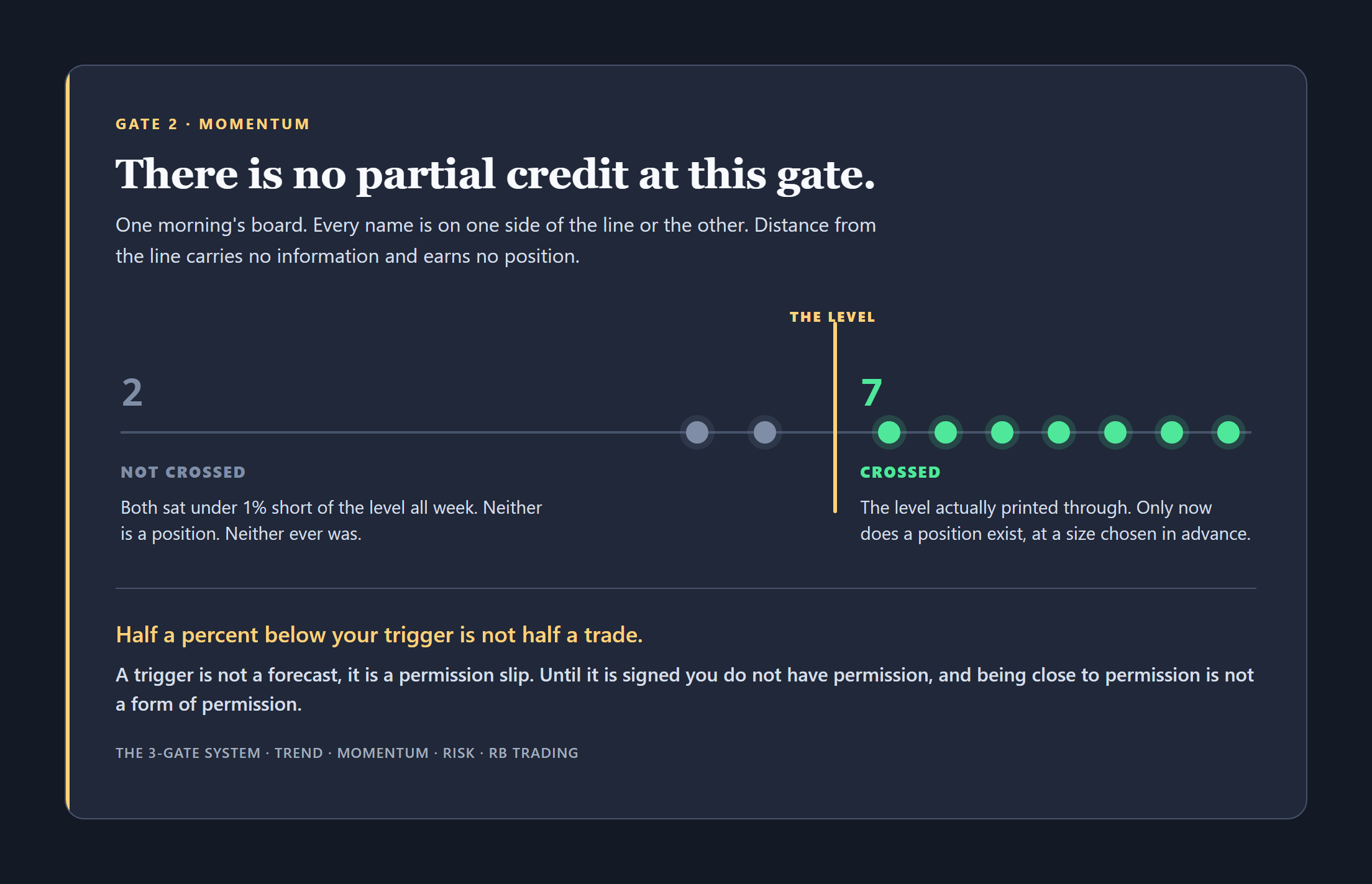
A trigger is not a forecast. It is a permission slip. Until it is signed you do not have permission, and how close you came to having permission is irrelevant. A level 0.4% away is not 99.6% of a trade. It is not a trade.
The two names I mentioned at the top have been sitting 0.4% and 0.7% short most of the week. Both look, on the chart, like they are about to go. Neither is a position, and neither will be until the level actually prints.
This is where most of the advice stops, and it’s exactly where it gets useful.
“Wait for the level to cross” sounds like a complete instruction until you’re watching it happen. Price pokes through and comes back. A wick tags it and closes underneath. A candle finishes on the other side but the next one undoes it. Which of those is your signal.
If you haven’t answered that in writing, you’ll answer it in the moment, and in the moment you will pick whichever version lets you in.
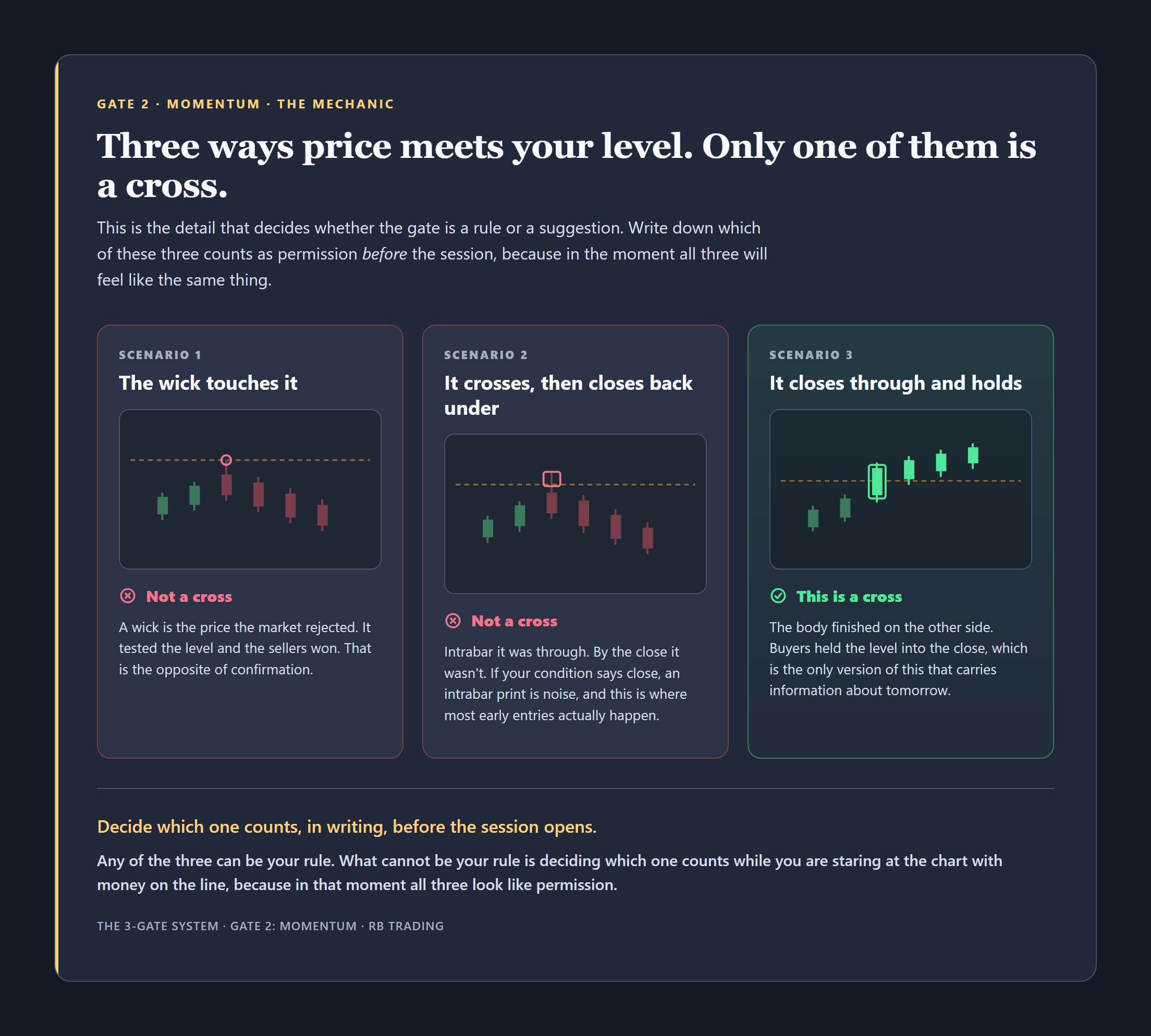
Any of the three can be your rule. I use the close, because a close is the only one that tells you who won the session rather than who was briefly loud during it. But the specific choice matters far less than making it in advance and writing it down.
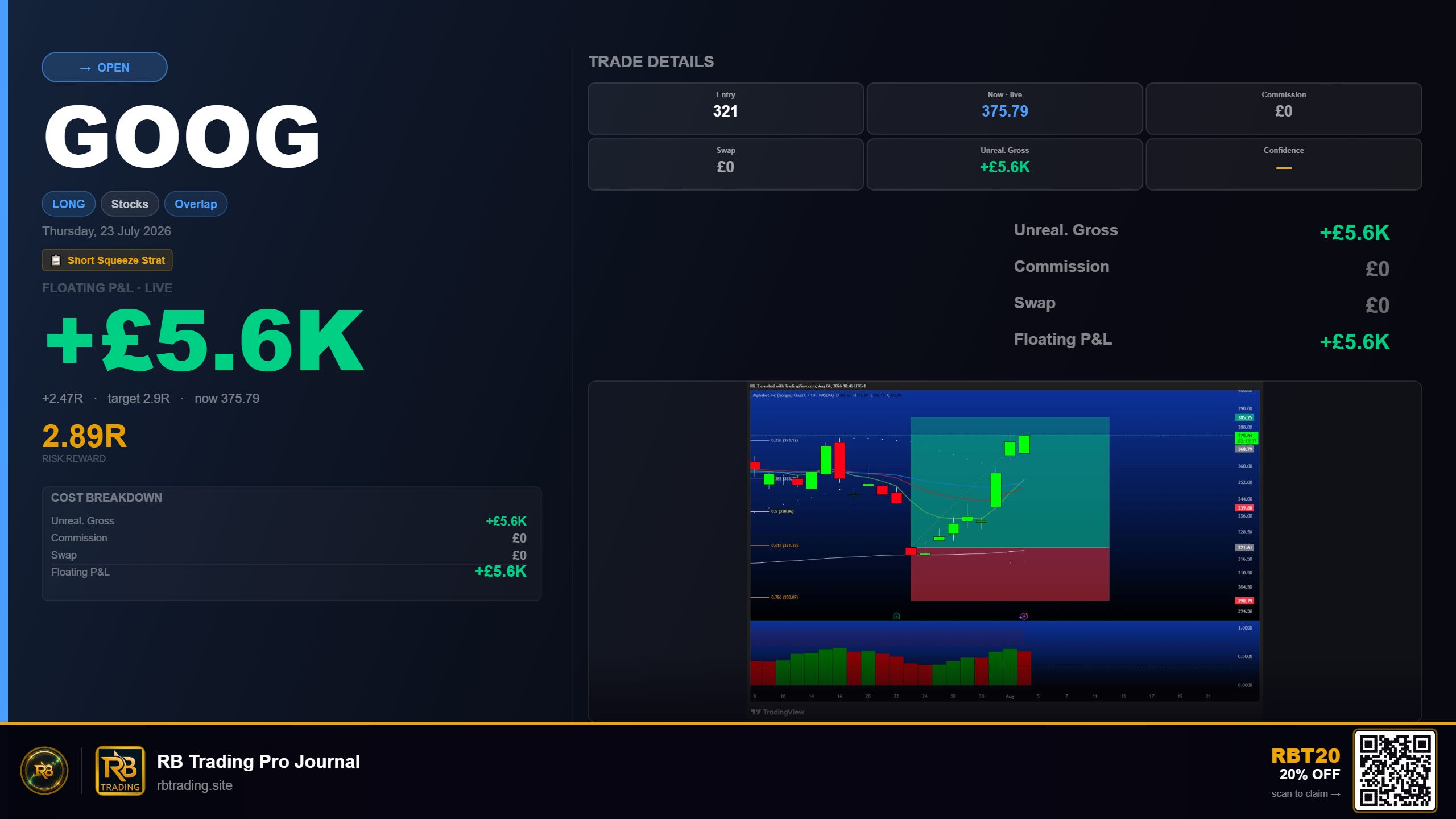
Sometimes you enter a trade on gut feeling its correct a few of your entry signals pinged you but not all. Trader intuition plays a huge part if your keeping your risk in check take the trade, you’ve seen this before execute.
The objection to all of this is always the same, and it’s a fair one. Waiting means giving up the distance between where price is now and where your condition is met. On a fast move that distance is real money. Sometimes the level never comes at all and the thing runs without you.
That’s true. It’s also only one column of the ledger.
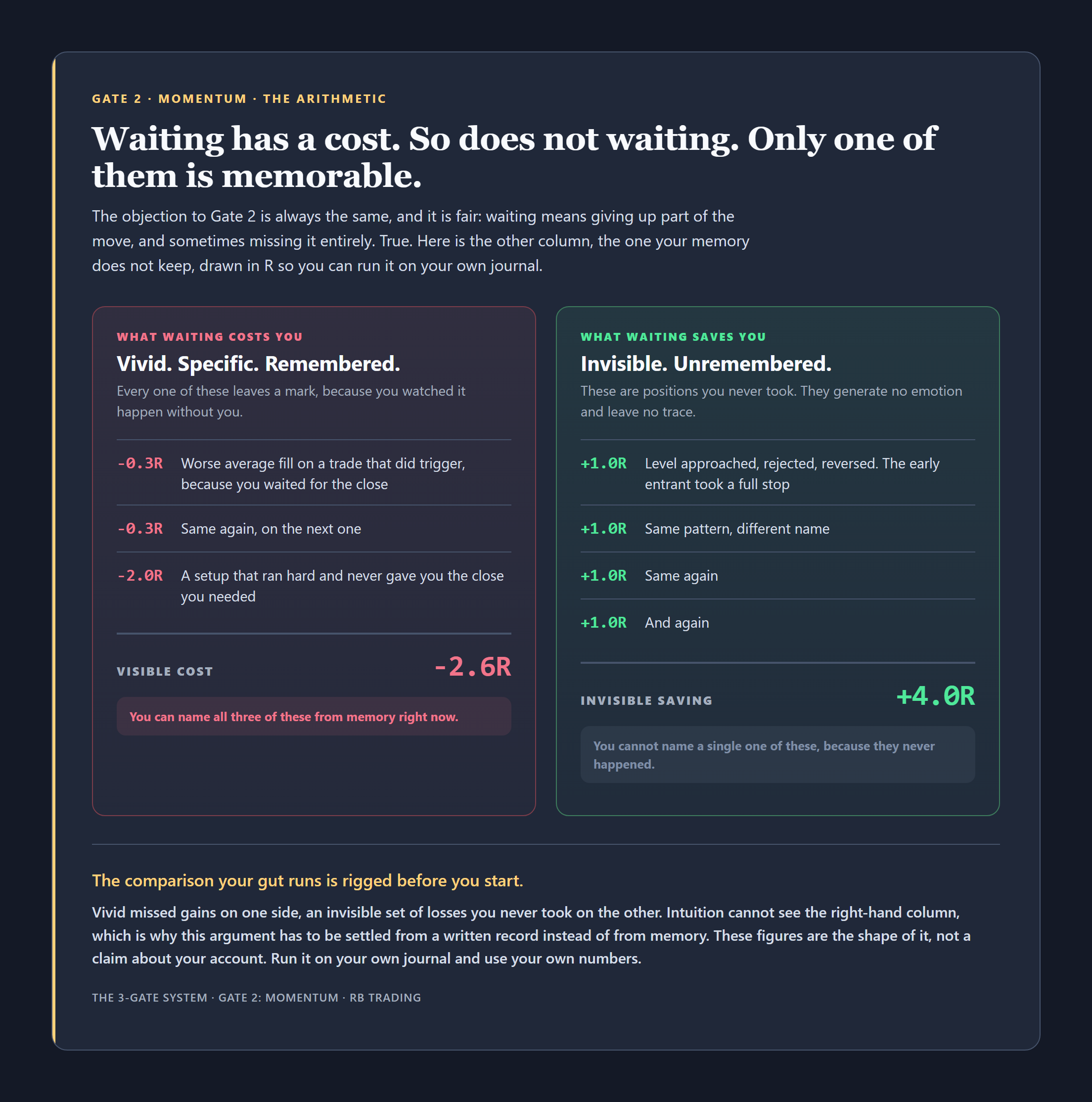
The other column is invisible, and that’s the entire problem. Every level that gets approached and rejected is a position the early entrant took and you didn’t. Those cost a full stop each. But avoided losses generate no emotion and leave no trace, so they never make it into the comparison your gut runs.
One side of that comparison is vivid, specific and remembered. The other side doesn’t exist in your memory at all. You cannot settle this argument by feel. You can only settle it from a written record.
Everything above is preventative. Here’s the diagnostic, and you can run it tonight on trades you closed months ago.
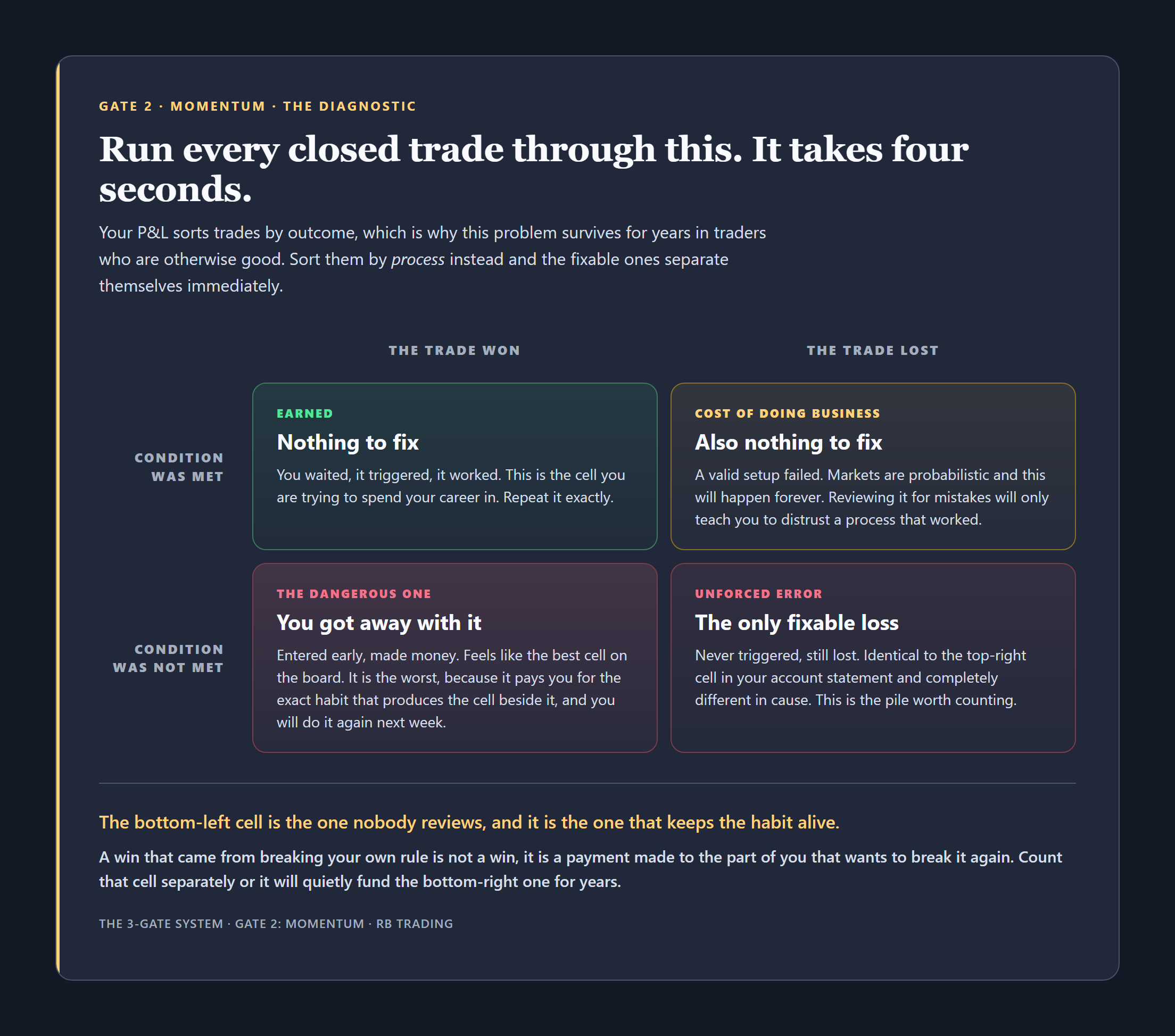
Your account statement sorts trades by outcome. That’s why this problem survives for years in traders who are otherwise good at this: a loss on a valid setup and a loss on a trade that never triggered are the same red number, so nothing ever separates them.
Sort by process instead and they come apart immediately. Met and lost is the cost of doing business, and reviewing it for mistakes will only teach you to distrust something that worked. Not met and lost is an unforced error, and it’s the only pile worth counting.
Watch the fourth cell. Entered early, made money. It feels like the best outcome on the board and it’s the most dangerous, because it pays you for the exact habit that generates the losses, and you will do it again next week without noticing.
Now the part that keeps me honest. Seven names crossed this week. Six have gone the way they were supposed to, some of them hard. One crossed its trigger and has gone backwards ever since, and it’s sitting in the red on my board right now as a live position.
A gate is not a filter that removes losing trades. Nothing removes losing trades. Gate 2 does something narrower: it makes sure that when you lose, you lose on a trade that actually triggered, at a size you chose, with a stop built for the setup you’re really in.
Everything above is the method. Below is this week’s application of it: every name currently on the board, what it crossed, where it is now, where the target and stop sit, and which of the three gates each one is currently passing.
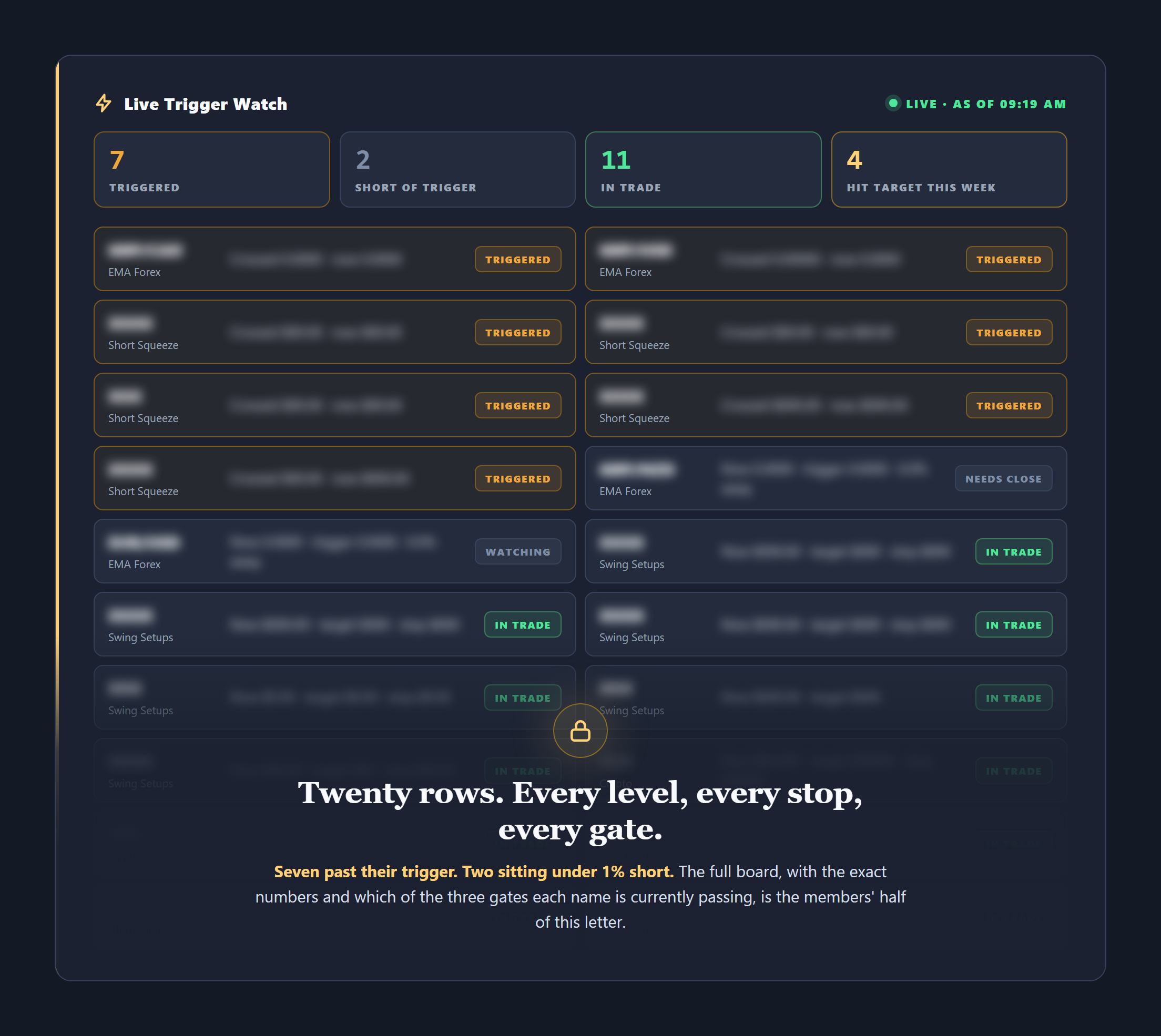
Get the full weekly playbook and the live board. $29/mo, or $199/yr on the launch offer, down from $249. That’s 55c a day, and $149 less than paying monthly. Cancel anytime. No trial, and none needed, because the free letter tells you exactly how I trade before you pay for a single thing.
Here is the board as of 9:19 this morning.
Comments
Nothing yet. Say the first thing.
Sign in to join the conversation.