
A model is a tool. A studio AI is a system. The distance between them is the distance between using ChatGPT and running a practice in which AI has become cognitive infrastructure. Most architects in 2026, three years into daily use, are still on the first side of that line. They may use several models, generate images, summarise documents, and automate isolated tasks. The work is faster, but the practice itself remains structurally unchanged.
The final move of this series is not another tool. It is the crossing from scattered assistance to an organised studio system.
That crossing has a technical vocabulary — retrieval-augmented generation, agents, tool use, orchestration — but its consequence is architectural. A studio system determines what the machine is allowed to know, which parts of the practice it may act upon, when it must stop, and where a human decision remains non-transferable. The stack is technical. Its design is not merely technical.
A frontier model knows a great deal about what was available within its training and whatever current information its tools can retrieve. It does not automatically know the studio.
It does not know which projects belong in your archive and which were abandoned for good reason. It does not know which laterite detail failed after two monsoons, which material photographs were only visual references and which became actual specifications, which client brief was revised after the first meeting, or which code interpretation your consultant finally accepted. It cannot distinguish the studio’s convictions from the residue accumulated in its folders unless the studio makes that distinction explicit.
A consumer chat interface may remember selected details, accept uploaded files, or connect to external services. That is useful, but it is not the same as a governed studio memory. The model still does not possess a reliable understanding of the practice merely because the practice has spoken to it repeatedly.
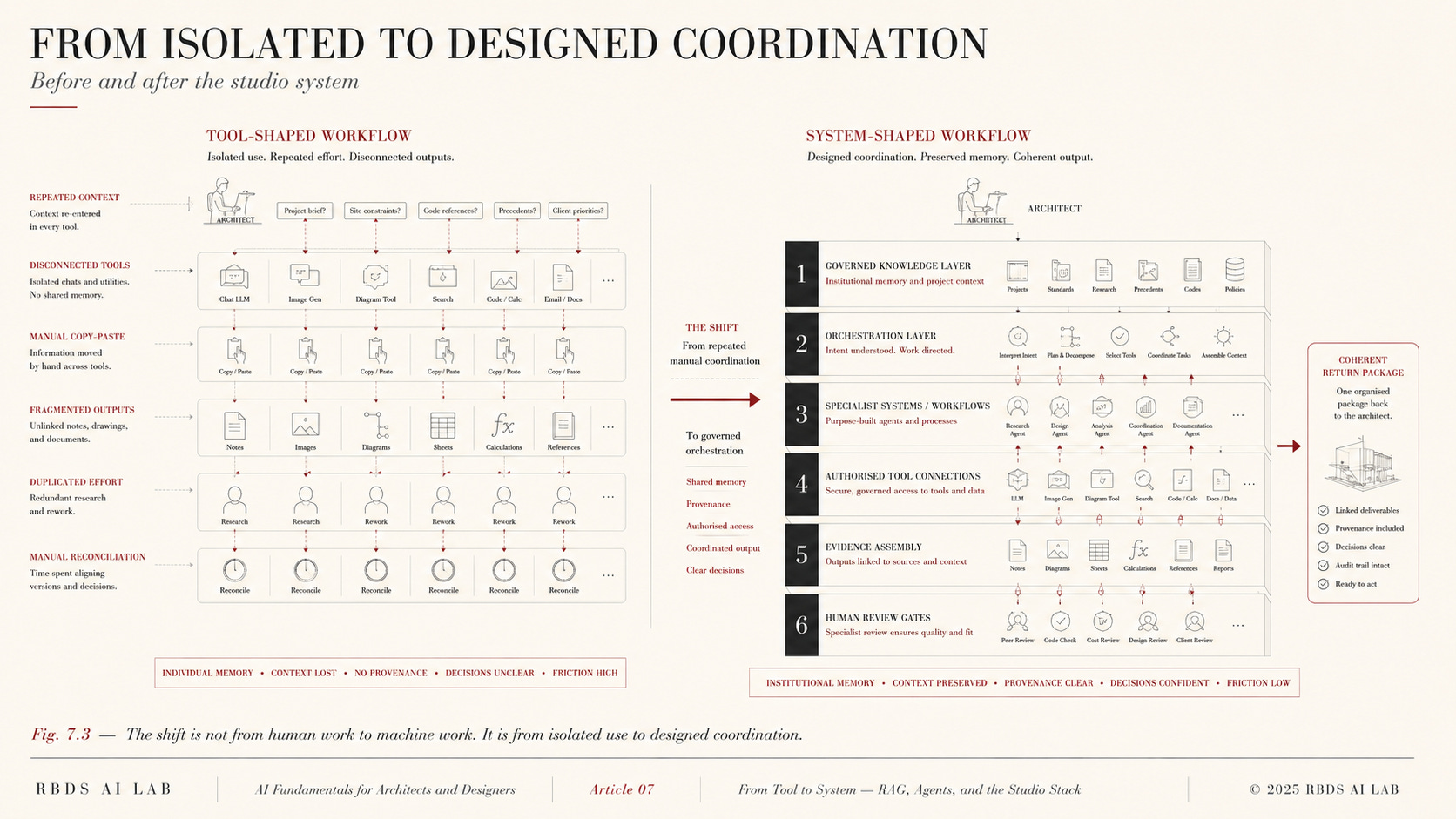
The plateau becomes visible through repetition. The architect keeps pasting the same background into new conversations. The team keeps explaining the studio’s approach from the beginning. One AI account contains useful context that another account cannot see. Outputs improve locally but disappear institutionally. Knowledge moves through individuals, not through the practice.
That is the moment the problem stops being prompting and becomes system design.
Retrieval-Augmented Generation, or RAG, is a way of giving a model relevant external material at the moment it needs to answer. The studio does not attempt to train its entire archive into the model’s weights. It builds a searchable knowledge layer around the model.
When a request arrives, the system searches the archive, retrieves the most relevant material, and places that material into the model’s working context. The model remains largely unchanged. What changes is the evidence it is permitted to think against.
This distinction matters. The model’s general intelligence and the studio’s institutional memory are not the same thing. One is rented intelligence. The other is accumulated practice.
Article 4 introduced embeddings as coordinates of meaning. RAG is one of the principal uses of those coordinates. Textual material — project notes, specifications, debriefs, briefs, research, correspondence — can be divided into retrievable fragments and represented as vectors. Drawings, photographs, and other visual records require an additional layer: extraction, captions, recognised text, metadata, or multimodal indexing. The archive does not become intelligent merely because it has been uploaded. It becomes retrievable because someone has described what each piece of it means.
A query such as find prior projects relevant to a hot-humid coastal site with a hospitality programme and difficult maintenance access is no longer limited to filenames or folder structures. The system can retrieve material through similarity of meaning, provided the archive was prepared with enough discipline to preserve that meaning.
This is where RAG becomes architectural rather than merely computational. Retrieval quality depends on classification. What counts as a precedent? Is an unbuilt competition entry equivalent to a completed project? Should concept images be retrieved beside construction details? Does a material belong to the archive because it was explored, specified, procured, or successfully weathered? The database cannot answer those questions. The architect must.
Article 2 explained why retrieval still matters even as context windows grow. Current frontier systems can accept hundreds of thousands to around a million tokens, depending on the model and product. But capacity is not the same as attention. Research on long-context models has repeatedly shown that relevant information may be used unevenly depending on where it appears and how much irrelevant material surrounds it. A larger window allows more information onto the table. It does not decide what deserves to be on the table.
RAG is therefore not simply a workaround for a small context window. It is the discipline of selecting context before the model spends intelligence on it.
The infrastructure commonly used beneath RAG is a vector database or another retrieval system capable of similarity search. Pinecone, Weaviate, Chroma, Qdrant, and several conventional databases with vector extensions can all perform versions of this work. Some are managed services. Some can be self-hosted. Some are appropriate for production systems; others are useful for prototypes and smaller internal archives.
The product choice is less important than the schema around it.
A badly organised studio archive does not become a good knowledge system when converted into vectors. It becomes a faster way of retrieving badly organised knowledge. Duplicate files remain duplicates. Unverified notes remain unverified. A beautiful image with no recorded provenance remains ambiguous. An outdated code document may still be retrieved with extraordinary confidence.
The operational task is therefore not merely to install a database. It is to decide what enters, how it is tagged, who may access it, how versions are distinguished, what is considered authoritative, and when an item should expire.
Once this is done well, the archive becomes queryable in dimensions closer to architectural judgement — climate, typology, programme, material behaviour, client condition, construction risk, design intent — rather than only by filename and folder.
A model responds. An agent acts through a sequence.
The practical distinction is not that the agent is sentient, independent, or comparable to a human colleague. An agent is a model placed inside a controlled loop. It can interpret a goal, choose among available actions, call tools, inspect results, preserve intermediate state, and decide what step should follow. In a predefined workflow, the sequence is fixed by the designer of the system. In a more agentic system, the model has bounded discretion over the sequence.
Briefed with prepare a preliminary site-intelligence package for this Mysuru plot, a suitably equipped agent might retrieve the brief, inspect location data, call a climate source, find relevant projects in the studio archive, organise unresolved questions, and assemble a draft for review. It may also fail to retrieve the correct regulation, misread an ambiguous source, overstate a conclusion, or continue confidently after a tool has returned incomplete information.
The word agent must therefore be read operationally, not theatrically. It does not mean that responsibility has been delegated. It means that a sequence of machine actions has been permitted.
Reliability has improved rapidly, but it is uneven across tasks, tools, and environments. An agent that summarises project notes is not equivalent to an agent that modifies a drawing, checks statutory compliance, sends client communication, or commits a purchase. The relevant measure is not whether agents are “reliable” in general. It is whether a specific agent is sufficiently bounded, observable, reversible, and supervised for the consequence of the action it has been given.
Verification is not the last step of agentic work. Verification is part of its architecture.
An agent without tools can reason about work but cannot meaningfully enter the work.
Tool use allows a model to call an external function or application: search a project database, read a spreadsheet, query climate information, create a task, inspect a model export, generate an image, draft a document, or write into a project-management system. Each tool is exposed through a defined interface describing what it can do, what information it requires, and what it will return.
This is the bridge between language and infrastructure.
The studio’s existing systems — CAD and BIM environments, cloud storage, spreadsheets, project management, correspondence, specification libraries, image tools, internal templates — do not necessarily need to be replaced. They need selective points of access. The question is not can the AI connect to everything? The better question is what should it be allowed to touch?
Read access is different from write access. Drafting a response is different from sending it. Flagging a possible compliance issue is different from certifying compliance. Producing a suggested material schedule is different from issuing one for procurement. The closer the tool comes to money, liability, authorship, contractual commitment, or irreversible change, the stronger the human gate must become.
The integration is not plumbing after the design. The permissions are the design.
A single agent with a few tools is a useful utility. A studio system emerges when specialised capabilities are organised around the actual structure of practice.
That may take the form of several agents, several workflows, or a hybrid of both. Each component holds a limited mandate, a defined knowledge scope, an approved tool set, and an escalation rule. An orchestrator receives the larger objective, breaks it into parts, routes those parts to the appropriate components, gathers the outputs, and returns the unresolved decisions to the architect.
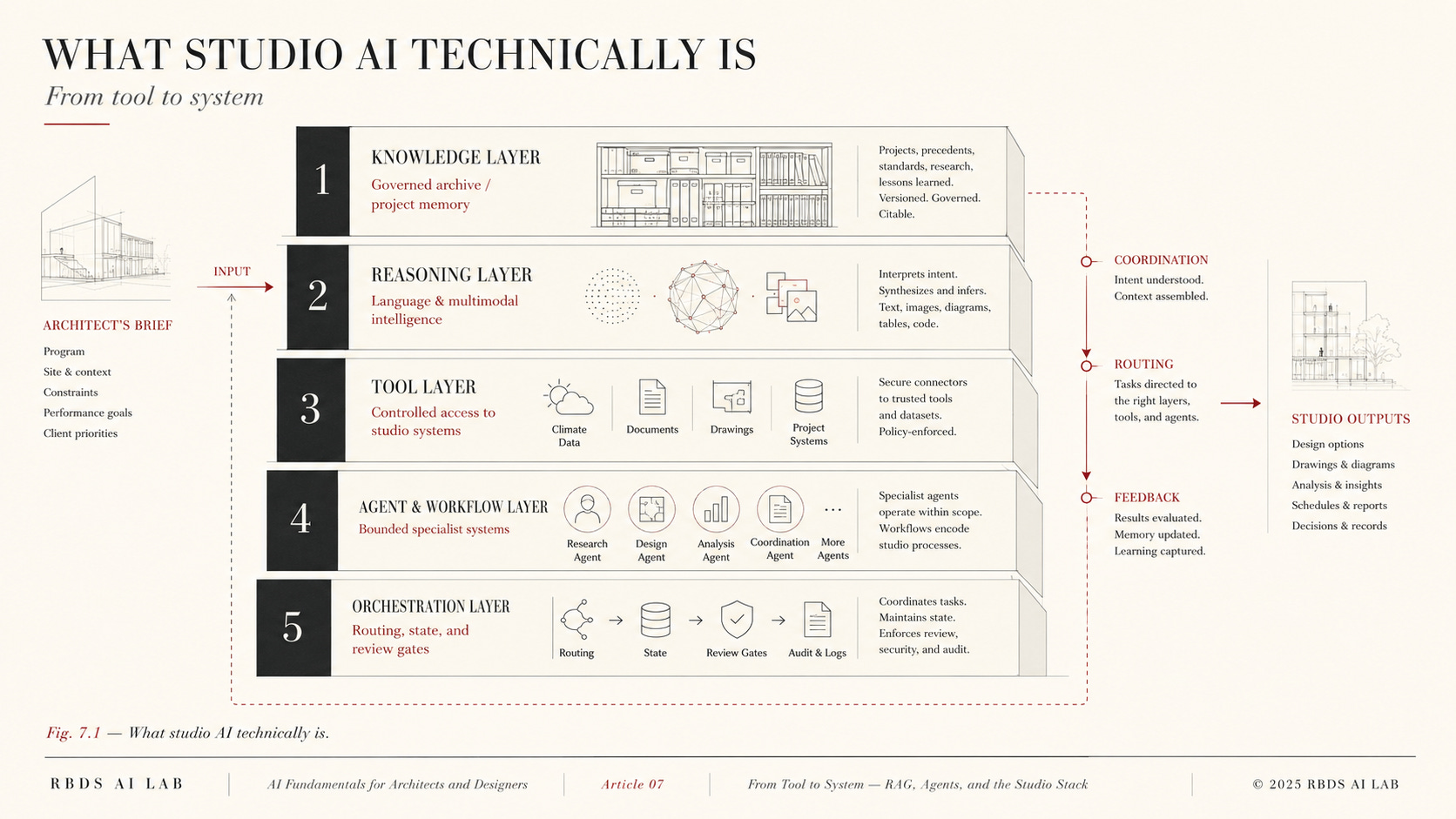
Read down the stack:
A knowledge layer: the governed archive — projects, briefs, research, specifications, precedents, decisions, debriefs, and their metadata.
A reasoning layer: one or more language and multimodal models selected according to task, cost, privacy, context, and reliability.
A tool layer: the authorised connections between reasoning and the studio’s working environment — documents, climate sources, drawings, project systems, visualisation, scheduling, and communication.
An agent and workflow layer: bounded systems for site research, brief decoding, material exploration, documentation support, coordination, and review.
An orchestration layer: the logic that routes work, manages dependencies, preserves state, asks for human decisions, and assembles the result.
This is what studio AI technically is. Not a chat box. A set of layers and the rules between them.
The rules matter more than the diagram.
Consider a twelve-person studio in Bengaluru with ten years of material distributed across drawings, specifications, photographs, meeting notes, captioned details, debriefs, and individual memories. The principal decides to stop treating AI as a collection of personal subscriptions and begins organising it as studio infrastructure.
The first version need not be a grand autonomous machine. It may be deliberately modest:
Knowledge layer: a secured searchable archive containing selected project records, with permissions, project status, provenance, dates, and document authority clearly marked.
Reasoning layer: a small set of current models accessed through approved interfaces, with task-specific selection rather than dependence on one permanent model.
Tool layer: controlled access to climate sources, project documents, internal templates, task management, selected drawing exports, and image-generation systems.
Agent and workflow layer: a Site-Intelligence System that assembles climate, context, open questions, and relevant precedents; a Material-Memory System that retrieves what the studio previously explored, specified, rejected, and learned; a Compliance-Support System that identifies possible areas for professional review without presenting itself as the authority.
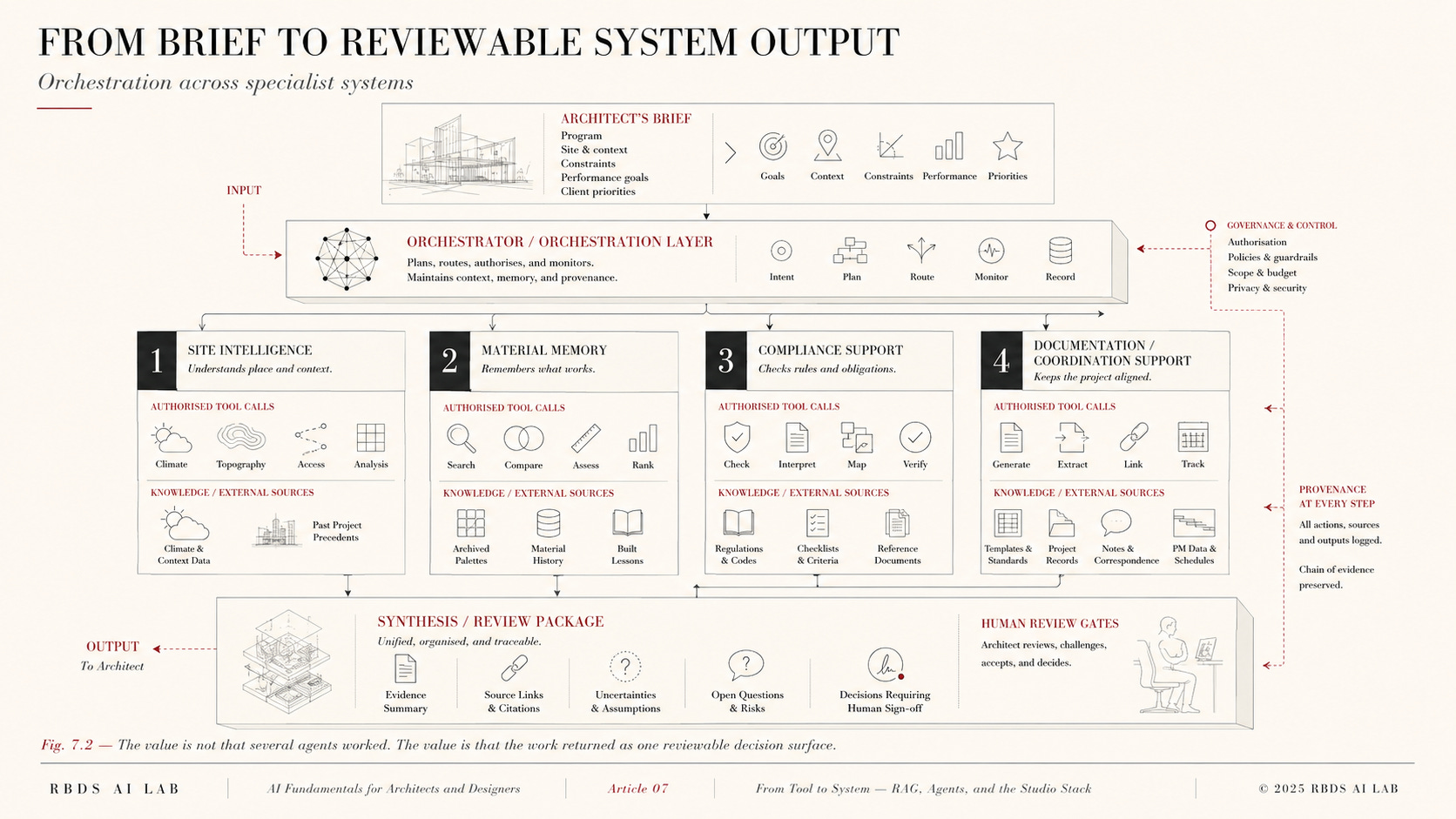
Orchestration layer: a studio interface that reads the project brief, routes tasks, preserves the chain of evidence, and returns one package with sources, uncertainties, and decisions requiring human sign-off.
The cost of such a system varies too widely to reduce honestly to one universal monthly figure. It depends on archive size, model choice, frequency of use, multimodal processing, hosting, security, integrations, and the amount of technical support the studio already possesses. A prototype may be assembled quickly. A dependable studio system takes longer because the difficult work is not making the demonstration run. It is making the system governable when the project, staff, client, model, and archive change.
A junior architect briefs the system on a residential project in Mysuru. The orchestration layer retrieves the current brief and identifies missing inputs. The site-intelligence component assembles climate and context information with source links. The material-memory component finds comparable projects and separates built evidence from conceptual exploration. The compliance-support component produces a list of questions and possible risks for the architect and consultant to verify.
The useful output is not simply speed. It is that the studio begins its discussion from an organised field of evidence rather than from a blank chat window.
The deeper consequence appears on the next project. The reviewed package, the decisions made, the rejected options, and the post-project debrief return to the knowledge layer. The archive becomes more legible because the practice has described what it learned.
This is often called “training the system,” but the phrase should be used carefully. In most studio implementations, the model itself has not been retrained. The studio’s external memory, retrieval policies, prompts, workflows, evaluations, and operating rules have improved. The intelligence is not only in the model. It is in the accumulated correction around it.
Every project can become learning infrastructure — but only if the learning is recorded.
Publicly documented examples of system-grade AI inside architecture and engineering practices remain partial. Buro Happold has described machine-learning work on a drawing assistant and the institutional structures surrounding AI adoption. Firms such as Gensler have publicly discussed proprietary computational and generative tools. These examples demonstrate internal capability, but public disclosure rarely reveals the complete architecture of a firm’s knowledge, retrieval, agents, permissions, and orchestration.
The absence of disclosure should not be confused with the absence of systems. It does mean that invented precision is dangerous. The Bengaluru studio is therefore illustrative, not a disguised case study and not a claim that one canonical stack has already become industry standard.
The architect may not write the database, the integration layer, or the agent framework. That is what technical collaborators are for. But the architect cannot outsource the system’s constitution.
The architect decides what the system may retrieve, what it may infer, what it may generate, what it must cite, what it must verify, and what it must refuse.
The schema of the knowledge layer is a design decision. What counts as a project? What counts as precedent? Which version of the brief is current? Which documents are confidential? Which images are cleared for reuse? Which lessons came from built performance, and which remain aesthetic speculation?
The retrieval policy is a design decision. Should a concept-stage agent see commercial data? Should one client’s material be allowed to influence another client’s project? Should an abandoned proposal remain retrievable? Should the system prefer recent work, completed work, locally relevant work, or critically acclaimed work?
The agent boundary is a design decision. May it only research, or may it write? May it create drafts, or may it send them? May it mark up a drawing, or alter the source file? At what point must it stop and ask a human? What evidence must accompany every recommendation?
The verification protocol is a design decision. What gets checked automatically? What gets reviewed by a junior architect? What requires the project architect, consultant, principal, client, or legal adviser? What happens when the system cannot establish confidence?
The authorship policy is a design decision. Whose judgement does the output represent? How is AI assistance disclosed? What project material may be retained? What is excluded from external model providers? Where does the studio’s name appear, and what responsibility does that name carry?
These are the operational continuation of Article 6’s literacy. Compute, labour, training data, bias, intellectual property, and environmental cost do not disappear when the system becomes useful. They enter the specification.
Less time arranging the prompt. More time defining the retrieval.
Less time operating the tool. More time designing the permissions through which tools may operate.
Less time chasing variation. More time protecting the continuity of the studio’s judgement.
Across seven articles, the same shape has kept reappearing. Article 1 corrected the category: AI is probabilistic, and its outputs must be read accordingly. Article 2 named the working budget: tokens and context, finite and unevenly used. Article 3 opened the diffusion engine. Article 4 placed text and image within computable spaces of meaning. Article 5 examined the methods through which those spaces can be adapted toward a studio. Article 6 named the infrastructure underneath — compute, energy, labour, training data, and structural bias. This article composes those layers into practice.
A studio AI is a knowledge layer that can retrieve the archive without pretending that the archive is neutral. A reasoning layer that works against selected evidence without becoming the authority. A tool layer that reaches into the studio without receiving unlimited permission. An agent and workflow layer that turns bounded goals into reviewable work. An orchestration layer that holds sequence, memory, provenance, uncertainty, and human gates together.
The architect is not displaced by these layers. The architect becomes responsible for their arrangement.
That is what the architect as systems thinker means once it stops being a slogan. Not an architect who becomes a software engineer by imitation. An architect who recognises that the design of practice now includes information, permissions, agents, evidence, memory, and refusal.
The building remains the artefact the public can see.
The system behind it becomes part of what the architect has authored — and therefore part of what the architect must be willing to sign.
The studio stack in this final piece could not stand before the six primitives beneath it. That is not how a syllabus is usually written. It is how a building is drawn: footing before frame, frame before skin.
This series is a small slice of something much larger we have been drawing — the full dependency structure of what it takes to learn AI in architecture and design. Not seven ideas but two hundred, from the first intuition an eleven-year-old needs to the judgment a final-year student is examined on, every idea resting on the ones beneath it, every link carrying a written reason. We call it Talamana, after the old South Indian shastra system of graded measure — because that, precisely, is what it is.
It is coming, and we are not going to explain it here. It is the kind of thing you have to walk. We will announce it on this page when it opens.
One more change worth naming. The deeper essays — the long, worked arguments this series is made of — are moving to a subscription home of their own, where they can be given the room they need. Substack stays, but it becomes the thinner layer: the field notes, the signals, the way in. The substance will live one step deeper, for the readers who want it. When it opens, it opens at rbdsailab.com — that is the page to watch.
The series ends here. The map does not.
Sources
Lewis, Patrick, et al. “Retrieval-Augmented Generation for Knowledge-Intensive NLP Tasks.” NeurIPS, 2020. https://arxiv.org/abs/2005.11401
Liu, Nelson F., et al. “Lost in the Middle: How Language Models Use Long Contexts.” Transactions of the Association for Computational Linguistics, 2024. https://aclanthology.org/2024.tacl-1.9/
Anthropic. “Building Effective Agents.” 2024. https://www.anthropic.com/research/building-effective-agents
Anthropic. “Trustworthy Agents in Practice.” 2026. https://www.anthropic.com/research/trustworthy-agents
Buro Happold. “From Drawing Assistants to Knowledge Partnerships.” 28 May 2025. https://www.burohappold.com/news/driving-innovation-through-machine-learning/
OpenAI. Model documentation. Accessed July 2026. https://developers.openai.com/api/docs/models
Anthropic. Claude model and context-window documentation. Accessed July 2026. https://docs.anthropic.com/en/docs/about-claude/models/overview
Google AI for Developers. Gemini model and long-context documentation. Accessed July 2026. https://ai.google.dev/gemini-api/docs/gemini-3
Qdrant. Cloud pricing and deployment documentation. Accessed July 2026. https://qdrant.tech/pricing/
I’m Sahil Tanveer of the RBDS AI Lab, where we explore the evolving intersection of AI and Architecture through design practice, research, and public dialogue. If today’s post sparked your curiosity, here’s where you can dive deeper:
Read my book – Delirious Architecture: Midjourney for Architects, a 330-page exploration of AI’s role in design → Get it here
Join the conversation – Our WhatsApp Channel AI in Architecture shares mind-bending updates on AI’s impact on design → Follow here
Learn with us – Our online course AI Fundamentals for Lighting Designers is power-packed with 17+hrs of video content through 17 lessons → Enroll Here
Explore free resources – Setup guides, tools, and experiments on our Gumroad
Watch & listen – Our YouTube channel blends education with architectural art
Discover RBDS AI Lab – Visit our website
Speaking & events – I speak at conferences and universities across India and beyond. Past talks here
📩 Enquiries: sahil@rbdsailab.com | Instagram
Comments
Nothing yet. Say the first thing.
Sign in to join the conversation.