
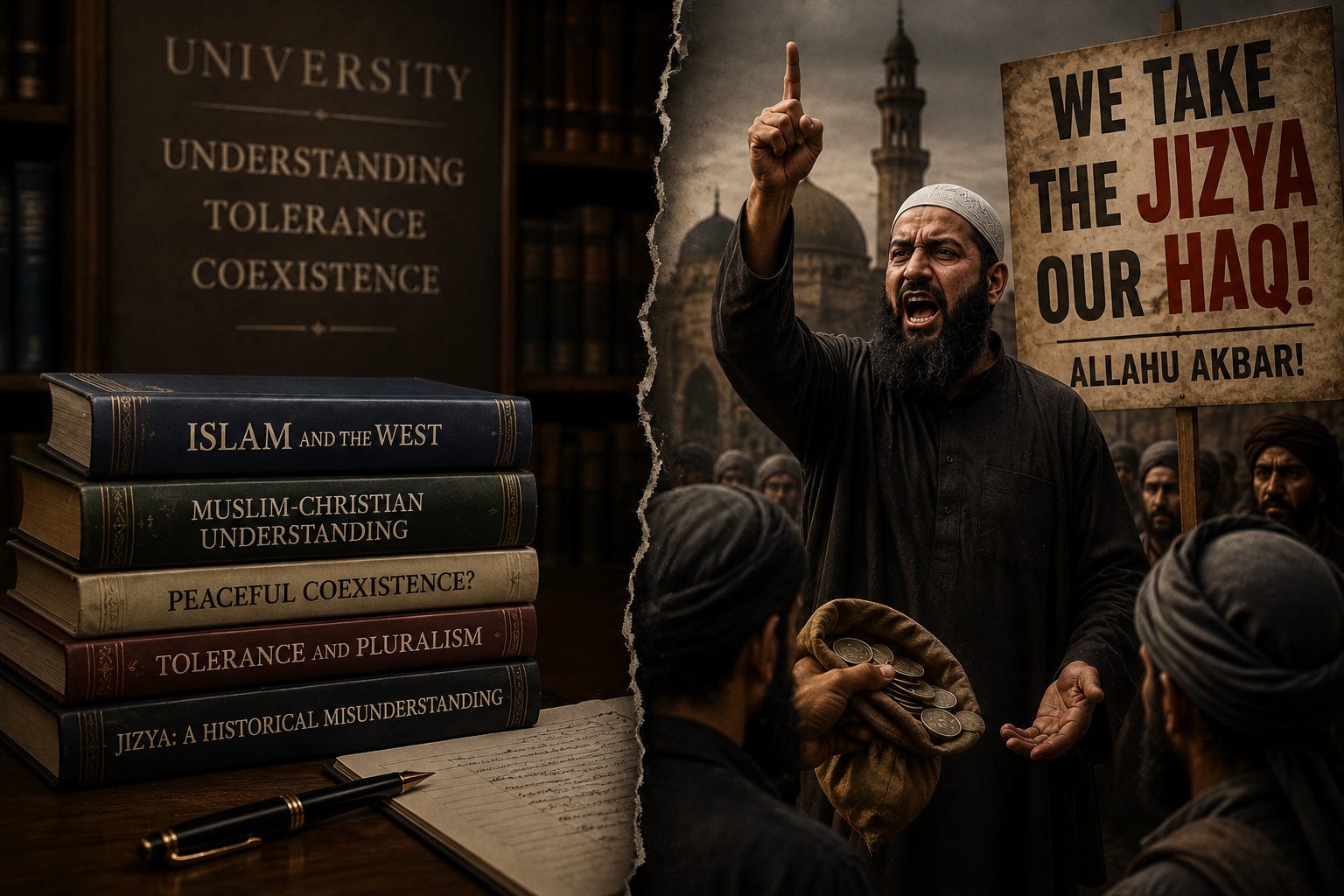
In a recent Substack, we looked at the return of, and explained the doctrinal and historic roots of, jizya.
In this one, we look at how and why Western academics and other elements have completely dissembled the meaning of jizya, causing the people of the West to be oblivious to the sufferings caused by the return of this Islamic institution.
But first, a quick recap: The Arabic word jizya is derived from Koran 9:29:
Fight those among the People of the Book [Christians and Jews] who do not believe in Allah nor the Last Day, nor forbid what Allah and his Messenger have forbidden, nor embrace the religion of truth [Islam], until they pay the jizya with willing submission and feel themselves subdued.
In other words, conquered Christians and Jews were to purchase their lives, which were otherwise forfeit to their Muslim conquerors, with money. As one medieval jurist succinctly put it, “their lives and their possessions are only protected by reason of payment of jizya.”
Incidentally, the Koran’s call for infidels to pay jizya while “feel[ing] themselves subdued” is precisely why one Islamic State editorial urges the Christians of the Congo “to pay the jizyah and remain submissive.”
Payment of jizya was never limited to extorting money from “infidels”; it was also a reminder for them to “know their place.” Some of Islam’s jurists mandated several humiliating rituals at the time of jizya payment. The presiding Muslim official could slap, choke, and/or pull the beard of the paying Christian or Jew — who might also be made to approach the official on all fours.
Although direct European intervention in the nineteenth century brought an end to jizya exactions, today — whether institutionalized as under the Islamic State and its offshoots, or as a “vigilante” rationale to plunder infidels, as in Mali — jizya is back.
That said, there is a reason the perennial institution of shaking down infidels for money is so completely unknown or misunderstood in the West. In keeping with an important theme — how Fake History of Islam undermines the West’s ability to comprehend the dangers of Muhammad’s creed — academics have utterly warped the meaning of jizya.
Consider the words of John Esposito, the late founder of the Prince Alwaleed Center for Muslim-Christian Understanding at Georgetown University:
In many ways, local populations [Christians, Jews, and others] found Muslim rule more flexible and tolerant than that of [Christian] Byzantium and [Zoroastrian] Persia. Religious communities were free to practice their faith to worship and be governed by their religious leaders and laws in such areas as marriage, divorce, and inheritance. In exchange, they were required to pay tribute, a poll tax (jizya) that entitled them to Muslim protection from outside aggression and exempted them from military service. Thus, they were called the “protected ones” (dhimmi). In effect, this often meant lower taxes, greater local autonomy (emphasis added)
Despite the almost gushing tone related to Muslim rule, the idea that jizya was exacted in order to buy “Muslim protection from outside aggression” is an outright lie, as is Esposito’s assertion that jizya was paid to “exempt them [non-Muslims] from military service.”
Even so, these two myths are now widely accepted. In “Nothing ‘Islamic’ About ISIS, Part Two: What the ‘Jizya’ Really Means,” Hesham A. Hassaballa recycles these fabrications on BeliefNet including by quoting Princeton University’s Muslim chaplain, Sohaib Sultan, who concludes: “Thus, jizyah is no more and no less than an exemption tax in lieu of military service and in compensation for the ‘covenant of protection’ (dhimmah) accorded to such citizens by the Islamic state.”
In reality, and as seen via the words of a variety of authoritative Muslims, past and present, jizya was and remains protection money — not from outsiders, as Esposito and others claim, but from surrounding Muslims themselves. Whether it is the first caliphate from over a millennium ago or the latest, the Islamic State, Muslim overlords deem the lives of their “infidel” subjects forfeit unless they ransom it with money. The subjugated infidel is a beast to be milked “until it gives no more milk and until it milks blood,” to quote the memorable words of an early caliph, Suleiman Abdul Malik.
Continue reading below.
If you value unflinching, historically grounded analysis that mainstream outlets soften or ignore, consider upgrading. Paid subscribers get:
Several new, full-length articles every week.
Carefully researched pieces you won’t find elsewhere.
Full access to the complete premium archive
Archive of in-depth writing, research, and commentary — all in one place.
Entry into the subscriber chat
A private space for serious readers and thoughtful discussion.
Comments
Nothing yet. Say the first thing.
Sign in to join the conversation.