
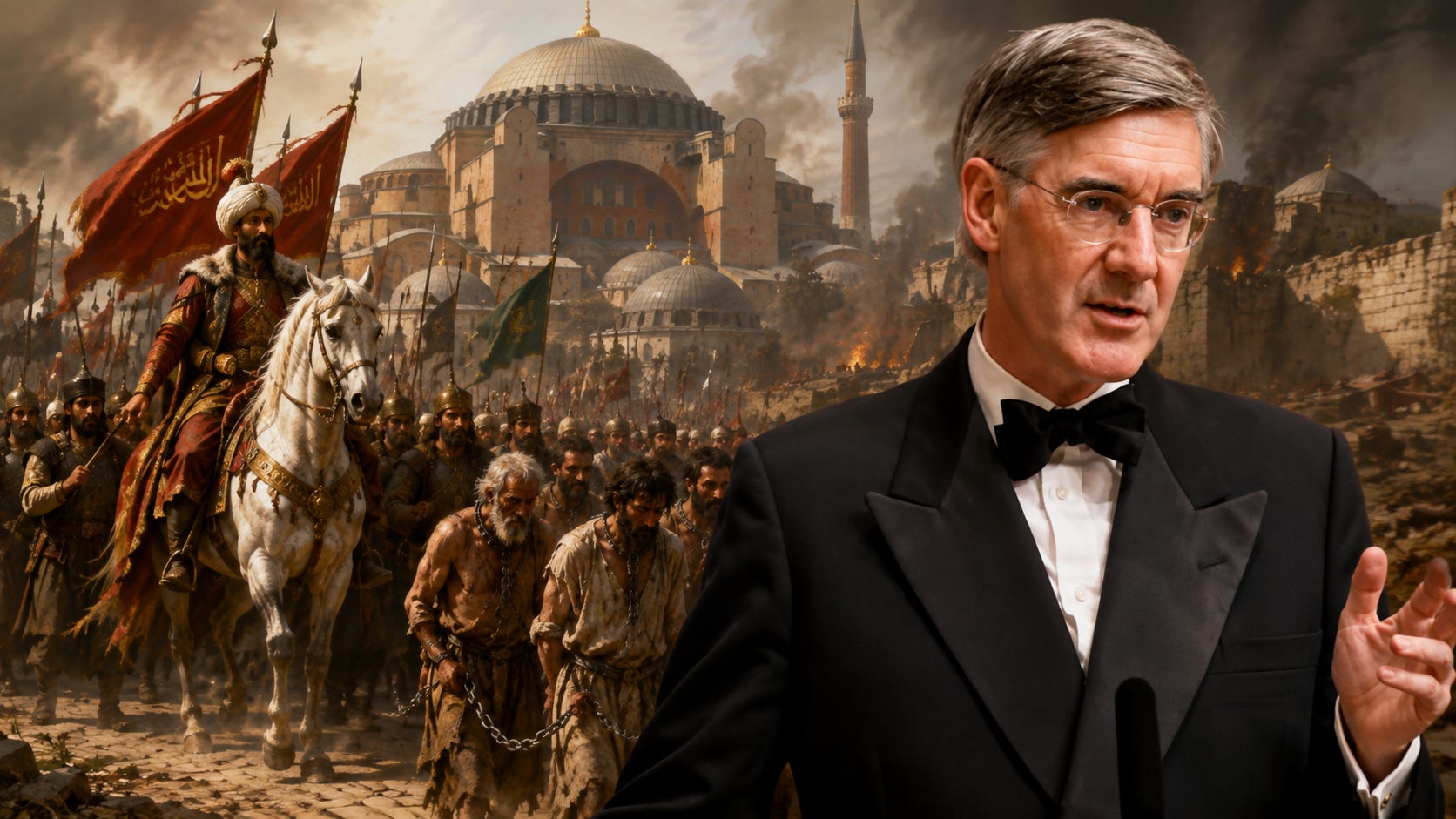
British politician Jacob William Rees-Mogg recently made some outlandish remarks that in many ways betray why formerly “great” Britain has fallen prey to Islam—that is, because its “bright men” believe in and promote fairy tales disguised as “history.”
Mogg appeared in an Oxford Union Debate on Islam, where he argued on the “pro-Islam” side, saying that the West has no right to be suspicious of Islam, or see it as different than any other religion.
As proof of this, Mogg pretended to be a historian—including by making “historical comparisons,” because “they matter,” because “we learn from our history,” he insisted.
He then offered the following comparison (click here to watch rather than read him):
The Christians, in 1204, sacked, pillaged, and destroyed Constantinople. They stole things, they took things; some of them you can still see in Venice today. But in 1453, the 21-year-old Mehmet II took Constantinople—do you know what he did? He wrote down some of the great works of Western literature, scholarship, and philosophy, so they were preserved. He had ancient manuscripts copied for preservation. These are documents that might otherwise have been lost to us, and to Western civilization.
Mogg’s point was that, if Muslims were historically more advanced, civilized, and tolerant than Medieval Christians, then clearly Islam is not inherently backwards, savage, and intolerant. Clearly shifting circumstances—which currently seem favorable to the West, and not to Muslims—explain modern day Muslim angst and frustration. In short, it’s not Islam itself, but all sorts of other factors surrounding it—factors which would no doubt cause modern Western people to behave just like the worst of modern-day Muslims if the former experienced them.
Of course, this entire point crumbles if Mogg’s historical example is false or misleading in any way.
And as it happens, it most certainly is—and not just in one but two ways: 1) it’s engaged in what is known as “lies by omission,” and 2) it is built on a false but widely believed assumption.
In this article, we will deal with the first deception—the many lies by omission.
*****
Mogg’s claims about the Crusader sack of Constantinople in 1204 are accurate.
Note, however, how the transition to Mehmet begins with a “but”—implying that the Muslims behaved more nobly than the crusaders.
Note, too, how, whereas Mogg forthrightly declares that the crusaders “sacked, pillaged, and destroyed Constantinople,” Mehmet merely “took” it.
Here’s Mogg’s assertion again, in all its glory:
The Christians, in 1204, sacked, pillaged, and destroyed Constantinople… But in 1453, the 21-year-old Mehmet II took Constantinople—do you know what he did?
Actually, we do know what Mehmet did, thanks to numerous contemporary and eyewitness accounts—and it wasn’t to write down “some of the great works of Western literature, scholarship, and philosophy, so they were preserved,” as Mogg would mog us into believing.
What follows is a more complete account of Ottoman sultan Mehmet (aka Muhammad) and his relationship with Constantinople. (All quotes are sourced in Chapter 7 of my book, Sword and Scimitar, which centers around Mehmet’s sack of Constantinople in 1453.)
First, the crusades were always about defending Christendom—not attacking Orthodox Christians. As such, the sack of 1204 was an aberration—and treated as such.
Pope Innocent III, far from ordering or applauding the crusaders’ attack on Constantinople, had forbidden them to wage war against Christians, excommunicated them when they first violated that prohibition in Zagrab, and categorically condemned their subsequent sack of the Byzantine capital.
Compare this with Mehmet II: why did he attack Constantinople in the first place? What made it an enemy to the Turks?
The same thing that had made every non-Muslim nation an enemy to Islam: It was an “infidel”—in this case, Christian—kingdom, and therefore in need of subjugating.
That was the sole justification and pretext—the sole “grievance”—that propelled the Turks to besiege it (as their Arab counterparts did eight centuries earlier): the kingdom of Constantinople was peopled by non-Muslims who refused to submit to Islam.
This “comparison”—that, unlike the crusaders, Mehmet attacked Constantinople because his religion commanded him—didn’t seem to interest Mogg.
Nor did Mehmet’s well documented treacherous nature. For example, when he first became sultan, Mehmet “swore by the god of their false prophet, by the prophet whose name he bore,” a bitter Christian contemporary wrote, that “he was their [the Christians’] friend, and would remain for the whole of his life a friend and ally of Constantinople.”
Although the Christians believed him, Mehmet was taking advantage of “the basest arts of dissimulation and deceit,” wrote Edward Gibbon. “Peace was on his lips while war was in his heart.”
No doubt, the Muslims surrounding and manipulating Mogg are engaged in the same tactics.
Mehmet also exhorted his Muslim army with jihadist ideology prior to besieging Constantinople, including by unleashing throngs of preachers who cried throughout the Muslim camp surrounding the Christian kingdom:
Children of Muhammad, be of good heart, for tomorrow we shall have so many Christians in our hands that we will sell them, two slaves for a ducat, and will have such riches that we will all be of gold, and from the beards of the Greeks we will make leads for our dogs, and their families will be our slaves. So be of good heart and be ready to die cheerfully for the love of our [past and present] Muhammad.
“Recall the promises of our Prophet concerning fallen warriors in the Koran,” Mehmet himself exhorted his army: “the man who dies in combat shall be transported bodily to paradise and shall dine with Muhammad in the presence of women, handsome boys, and virgins.”
The mention of “handsome boys” was not just an accurate reference to the Koran’s promise (e.g., 52:24, 56:17, and 76:19); Mehmet II was a notorious pedophile. His enslavement and rape of Jacob Notaras—a 14-year-old nobleman’s son in Constantinople, whom Mehmet forced into becoming his personal catamite until he escaped—was only one of the most infamous. Many other Christian boys were forced into sexual relations with Mehmet, some tortured to death for resisting. Even Vlad III Dracula’s younger brother, “Radu the Fair,” was turned into Mehmet’s sex slave.
Continue reading below.
If you value unflinching, historically grounded analysis that mainstream outlets soften or ignore, consider upgrading. Paid subscribers get:
Several new, full-length articles every week.
Carefully researched pieces you won’t find elsewhere.
Full access to the complete premium archive
Archive of in-depth writing, research, and commentary — all in one place.
Entry into the subscriber chat
A private space for serious readers and thoughtful discussion.
Comments
Nothing yet. Say the first thing.
Sign in to join the conversation.