
There are some places in Crete that do not introduce themselves gently. They stand above you, look down at the sea, and seem to say, if you want to know me, you must climb.
Anopolis is one of those places.
You reach it from Hora Sfakion by a road that twists upwards in great loops, away from the little harbour, away from the easier world of ferries, tavernas and beach tables, up through rock, heat, wind and silence. The Libyan Sea falls away behind you, blue and enormous. The White Mountains gather themselves above. Somewhere between the coast and the plateau, you begin to feel that you are leaving ordinary Crete and entering another country altogether.
That is not just romance. Sfakia has always been a kind of country within a country. Crete is already proud, but Sfakia is Crete made steeper, harder, more private and more stubborn. It has never been easy to govern, and it has never been easy to forget. Anopolis sits high in that landscape, on a fertile plateau above the sea, close to gorges, old mule tracks, ruined settlements, abandoned houses, ancient stones, churches and the paths that once connected mountain villages with the harbours below.
It looks remote. That is misleading. For much of its history, Anopolis was not cut off at all. It was connected in the old Cretan way, through the mountains behind it and the sea below it. It had pastures, terraces, cisterns, churches, ships, shepherds, traders, rebels and saints. It had the ancient port of Phoenix, the place we now know through Loutro and the nearby bay of Finikas. Through that harbour, Anopolis and Araden could speak to the wider Mediterranean.
This is the key to the whole story. Anopolis was not only a mountain village. It was a high place with a sea door.
That sea door was Loutro.
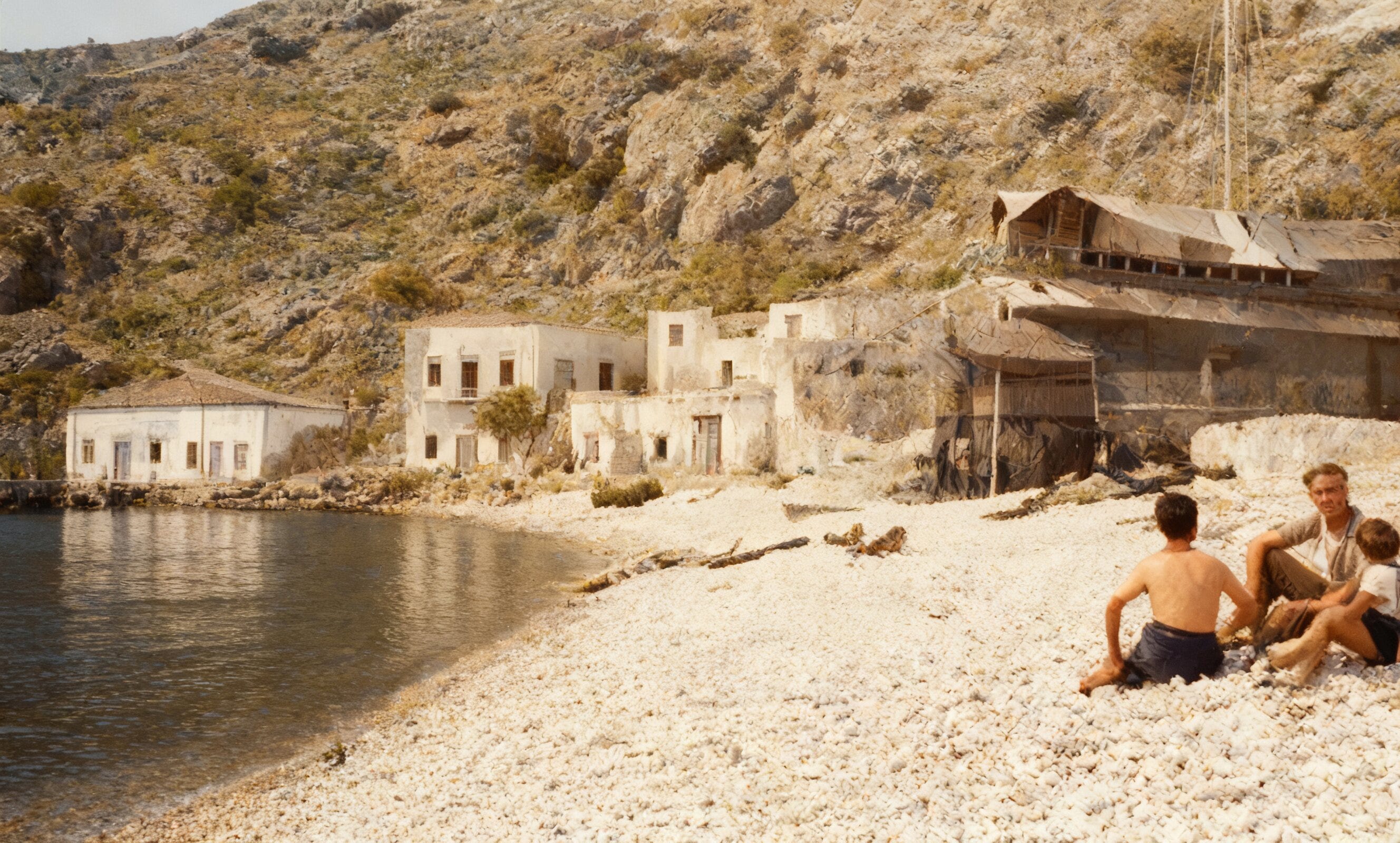
Today, Loutro looks like a peaceful white village tucked into a small harbour, reached by boat or on foot, with no road running through it and no traffic spoiling the water’s edge. People go there to swim, eat, rest, walk, and enjoy the unusual quiet. It is one of those places that seems to have stepped aside from modern Crete. But Loutro is not just a pretty place to relax. It grew out of the complex history of Sfakia. Behind its calm modern face lies ancient Phoenix, Roman harbour life, early Christian worship, Venetian watchfulness, Ottoman tension, Sfakian shipping, Daskalogiannis, mountain resistance, twentieth-century isolation, and the slow arrival of tourism.
Anopolis was the high heart. Loutro was the door to the sea.
Together, they tell a story much larger than either place alone.
The modern village of Anopolis is spread across a mountain plateau west of Hora Sfakion. It is not one neat little cluster of houses, but more a scattering of neighbourhoods and farmsteads, with open ground between them, as if the place needs room to breathe. The White Mountains rise behind it. The sea lies below it. The nearby gorge of Aradena cuts through the land like a wound in the rock.
To understand Anopolis, you must first understand that geography. This is not a soft landscape. It is beautiful, but it is not kind. It gives pasture, but not easily. It gives cultivable pockets, but not broad fields. It offers refuge, but only to people strong enough to live with isolation. It opens to the sea, but only through steep paths and difficult descents. It protects, but it also tests.
This is why Sfakia has always produced a particular kind of history. The mountains made it hard for outside powers to control. The sea made it possible for Sfakians to trade, travel, smuggle, fight, escape and return. The gorges made natural fortresses. The plateau gave enough life to sustain a community. The coast below gave access to the world.
Loutro, ancient Phoenix, was the key. In antiquity and later, it was much more than a beauty spot. It was a sheltered anchorage on a difficult coast, and the maritime doorway of the communities above. Anopolis and nearby Araden, remembered today through Aradena, used this coast. Through the harbour, they could trade with east and west, receive goods, send out produce, move people, and keep contact with other Cretan and Mediterranean centres.
This is the first surprise of Anopolis. It looks like a mountain story, but it is also a sea story. The people above the cliffs were not merely shepherds hidden from the world. They were mountain people with ships.
Ancient Anopolis stood close to the modern village, especially around the hill of Agia Aikaterini, west and southwest of the present settlement. The site looks out across land and sea in a way that immediately explains why people chose it. It had oversight of the plateau, the approaches, the sea routes and the paths down to the harbour. In a dangerous world, visibility was power.
The remains are not spectacular in the tourist sense. There is no grand reconstructed palace, no polished visitor route, no great theatre waiting for postcards. But the traces are there, and if you know what you are looking at, they are powerful. Parts of fortification walls, house foundations, a large cistern, Roman tombs, and the possible foundations of a sanctuary or public building have been identified. Old travellers noticed the walls too. The ancient masonry was once far more visible than it is now, and even today, the place has the feel of a forgotten stronghold.
This matters because Anopolis was not just a village. It was a polis, an ancient city-state, independent enough to mint its own coins. That alone should make us stop and pay attention. Coinage means identity. It means economic activity. It means civic confidence. A city that strikes its own coinage is saying, we exist, we have standing, and we are not merely the hilltop possession of someone else.
Ancient Crete was not one calm island speaking with one voice. It was a land of rival poleis, alliances, local wars, mercenary traditions, treaties, feuds and shifting loyalties. The mountains of western and southern Crete were not empty spaces between important places. They were full of small powers, each with its own territory, gods, pride and memory.
Near Anopolis was Araden, the ancient city remembered today in the name Aradena. This is where the story becomes interesting, and a little tangled, as ancient names often do. Some ancient and later sources treat Anopolis and Araden as closely linked. In practical terms, it is safest to think of them as neighbouring ancient communities, separate but deeply connected, and sometimes rivals.
That rivalry was serious. In the third century BC, Anopolis was apparently occupied by Araden. It was later freed by a citizen of Anopolis named Charmadas, or Charmada, depending on the version. We do not have the full story. We do not know the faces, the arguments, the betrayals, the negotiations or the fighting. But we can feel the shape of it. A mountain city taken by its neighbour, then released through the action of one of its own people. These were not sleepy places. These were communities of pride, ambition and danger.
It may be from this troubled period that the first phase of Anopolis’ walls belongs. That would make sense. A city that has been occupied by a rival does not forget the lesson. It builds, watches, stores water, strengthens its edges, and prepares.
Araden, now remembered through the haunting village of Aradena, deserves to stand beside Anopolis in this story. The ruins of ancient Araden are associated with the area near the present village, and Araden too was an autonomous city. Like Anopolis, it appears among the Cretan cities that were connected to the treaty or alliance with Eumenes II of Pergamon in 183 BC.
That detail sounds dry until you sit with it for a moment. Pergamon was a major Hellenistic kingdom in Asia Minor, involved in the diplomacy and power games of the eastern Mediterranean. For Anopolis, Araden and other Cretan cities to appear in this wider political landscape shows that they were not obscure mountain villages forgotten by the world. They were participants in the international politics of their age.
The old accounts of Araden are fascinating because they suggest a city with a severe, disciplined constitution, sometimes compared with that of Sparta. Whether that comparison is exact or exaggerated, it suits the place. Aradena is not soft. Even today, the village has an almost theatrical power. Stone houses, silence, the deep gorge, the bridge, the wind, the sense of something interrupted. You do not walk there and feel that history has ended cleanly. You feel it has stopped mid-sentence.
There is also a striking tradition that the young people of Araden were organised into groups, and that laws, heroic deeds and civic memories were sung in order to be remembered. Whether every detail can be proven or not, the idea is deeply Cretan. Law remembered through song. Courage preserved through rhythm. A community teaching itself who it is by singing its own story.
It is impossible not to think of the later Sfakian songs, the mountain songs that carry memory in their bones. Crete has often kept its history not only in books and inscriptions, but in voices. A song can survive where a document burns. A verse can cross centuries in the mouth of a shepherd.
The gorge of Aradena is one of the great natural dramas of western Crete. It runs from the southern slopes of the White Mountains down towards the sea, ending near Marmara beach, west of Loutro. It is deep, steep, wild and spectacular. The modern bridge crosses it in a single bold line, and from it the drop is enough to make even confident people step carefully.
But the gorge was not simply scenery. In older times, gorges were routes, barriers, hiding places, grazing zones, and escape corridors. They shaped how people moved and how enemies failed to move. In Sfakia, the landscape itself was always part of the defence system. A man who knew the gorge had an advantage over a soldier who did not. A shepherd path might save a life. A hidden descent might move a family, a flock, a rebel band or an escaped soldier.
The path through Aradena Gorge today is walked for pleasure, challenge and beauty. But like so many Cretan walks, it carries older footsteps. The stones have known bare feet, sandals, boots, hooves, hunger, fear and determination. It is not a theme park gorge. It is part of the living anatomy of Sfakia.
To understand Anopolis properly, you have to look down from the mountain to the sea. Below the plateau lies Loutro, and just west of it, the small bay of Finikas. This was ancient Phoenix, the harbour of Anopolis and Araden.
That changes the whole story.
Anopolis was not simply a mountain city hidden above the cliffs. It had a sea door. Through Phoenix, the people of Anopolis could trade, travel, receive news, send out goods and remain in touch with the wider Mediterranean. The mountains gave them safety, but the harbour gave them reach.
This mattered because the south coast of Sfakia is not generous with harbours. It is a coast of cliffs, hard rock, sudden weather, exposed bays and steep paths. There are beautiful places everywhere, but beauty is not the same as shelter. For sailors, a safe anchorage could mean the difference between life and death. Phoenix offered protection on a difficult shore. It allowed ships to stop, cargoes to move, and the high villages to keep one foot in the sea.
The old name Phoenix survives in Finikas. The modern name Loutro comes from the Greek word for bath, because ancient baths were found in the area. Even that little detail tells us something. This was not merely a rough landing place where fishermen dragged up boats. It was a lived-in harbour, used across centuries, shaped by trade, travel, defence, faith and the needs of the people above it.
In Hellenistic and Roman times, Phoenix was important because it served the ancient cities of Anopolis and Araden. It was their window on the sea. In the early Christian period, the harbour still had life and importance. Remains of a large basilica have been recorded in the area, a reminder that this little coast was not only practical, but sacred. People did not merely load boats there. They prayed there, buried their dead there, baptised their children there, and made a Christian settlement out of an older harbour.
There is also a possible biblical echo. Phoenix has often been identified with the harbour mentioned in the Acts of the Apostles, where the ship carrying Saint Paul hoped to spend the winter before a storm drove it away. That identification has been debated, so it should not be pushed too hard. But even the possibility is interesting. It tells us that Phoenix was remembered as the kind of harbour sailors might seek when the season turned dangerous.
Later, the coastline itself changed. Western Crete was lifted by a great geological movement in late antiquity, and the harbours around Loutro were affected by the rising land. That is a wonderful thought, if you stop for a moment. History here was not shaped only by kings, rebels, bishops, merchants and soldiers. It was shaped by stone itself. The land rose. The sea shifted. A harbour could become less useful, while another part of the bay continued to matter.
That is Crete all over. Even the earth takes part in the story.
Anopolis seems to have flourished not only in the Hellenistic age, but also in the Roman and Byzantine periods. That is important because many people think of ancient Cretan cities as rising in the Classical or Hellenistic world and then fading under Rome. The truth is more varied. Some places declined, others shifted, and some adapted well.
Under Rome, Crete became part of a wider imperial order. Gortyn became the great capital. Roads, trade, law, taxation and Christianity gradually reshaped the island. In southern Crete, ports remained important, especially where they offered safe anchorage along difficult coasts. Phoenix, below Anopolis and Araden, developed in Roman times and later became important in the early Christian period.
The area around Loutro preserves traces of this long life, including remains connected with early Christian worship and settlement. The old harbour was not a footnote. It was the maritime face of the highland communities above it. Through it came goods, people, ideas and danger.
Byzantine Anopolis is more difficult to see in detail, but the many churches of the region give a strong clue that the area remained alive and meaningful. Churches in Crete are often the best evidence of continuity. They stand where houses have gone, where walls have fallen, where names have shifted. They tell us that people still prayed, buried their dead, marked feast days, painted saints, remembered donors, and placed Christian meaning over older landscapes.
In the Byzantine period, Anopolis and the surrounding Sfakian country were part of a Christian mountain world that had to survive invasion, piracy, shifting imperial control and, in the ninth and tenth centuries, the Arab period on Crete. We should not imagine a smooth story. Crete was repeatedly shaken. Coastal areas suffered especially from raids and insecurity. Mountain communities were better placed to endure, though never untouched.
When Nikephoros Phokas reconquered Crete for Byzantium in 961, the island was drawn firmly back into the Byzantine Christian world. In such a landscape, high villages, churches and local lineages mattered greatly. Faith and place became almost inseparable. A chapel was not just a chapel. It was a claim that the community remained.
After the Fourth Crusade, Crete eventually passed into Venetian hands. The Venetians held the island for more than four centuries, from the early thirteenth century until the Ottoman conquest in the seventeenth century. Their rule transformed Crete, especially its cities, ports and fertile plains. But the mountains remained another matter.
Sfakia was never easy for Venice. It was too high, too difficult, too proud, and too full of people who did not take kindly to outside control. Venetian rule brought taxes, feudal rights, Latin authority and attempts to organise the island under a foreign system. In many parts of Crete, this produced revolt after revolt. In Sfakia, resistance was almost a habit of life.
Anopolis became a revolutionary centre against the Venetians. It was destroyed in 1365 after a rebellion. That date should be remembered. It tells us that long before the Ottoman period, Anopolis had already become one of the places where Crete’s mountain resistance took shape.
We often speak of Sfakia as though its defiance began with the Turks, but the roots go deeper. Venetian Crete was not simply a romantic age of harbours, fountains, walls and culture. It was also an age of rebellion, punishment, forced compromise and local pride. The mountain villages did not merely endure Venetian power. They challenged it.
Loutro too remained valuable because of its position. A sheltered harbour on the south coast was never a small thing. The Venetians understood such places well. They fortified harbours, watched sea routes, feared piracy, taxed trade and tried to keep control of the coast. Loutro was small compared with Chania, Rethymno or Candia, but small does not mean unimportant. In Sfakia, small places could carry large consequences.
There are remains of fortifications around Loutro, reminders of later centuries when the harbour still needed watching. Pirates, rebels, smugglers, traders, soldiers and local families all belonged, at different times, to this narrow edge between mountain and sea. Loutro was not a sleepy postcard village then. It was a useful harbour in a difficult region, and usefulness always attracts attention.
When the Ottomans conquered Crete in the seventeenth century after the long siege of Candia, most of the island entered a new and often harsh world. Ottoman power settled into the cities, plains and administrative centres. But Sfakia remained exceptional.
It is often said that the Ottomans never really inhabited Sfakia and that it was the only free place in Crete during the Turkish occupation. That statement needs a little care, because Ottoman authority certainly affected Sfakia, and Sfakians still had to deal with taxes, negotiations, punishment and military pressure. But the deeper truth is clear enough. The Ottomans did not settle and control Sfakia as they controlled other parts of Crete.
The terrain made direct rule difficult. The people made it more difficult still. Sfakia became a semi-autonomous mountain society, armed, proud and dangerous to provoke. It had its own internal order, its own powerful families, its own habits of negotiation and revenge, and its own connection with the sea.
Anopolis was central to this world. Its people had boats. Their commercial fleet used Loutro. Sfakian ships traded, travelled and brought wealth into a region that looked poor from the outside. This is another part of the story that must not be missed. The mountain men of Sfakia were not simply poor rebels with rifles. Some were merchants, shipowners and men of the wider world.
Out of that world came Ioannis Vlachos, better known as Daskalogiannis.
Daskalogiannis was born in Anopolis, probably in the early eighteenth century. His real name was Ioannis Vlachos. The nickname Daskalogiannis means John the Teacher, or Teacher John, and it speaks of education, status and respect. He was not an ignorant mountain fighter. He was educated, wealthy, connected and ambitious. He owned merchant ships. He understood the sea. He knew people beyond Crete.
That is what makes his story so powerful and so painful. Daskalogiannis was not merely reacting in anger. He believed he saw a chance. In the wider world, Russia was moving against the Ottoman Empire. Catherine the Great’s agents encouraged Greek revolt. The Orlov revolt in the Peloponnese raised hopes that the Orthodox peoples under Ottoman rule might be helped by Russia. In Crete, Daskalogiannis believed that Sfakia could rise and that outside support would come.
It was a fatal hope.
In 1770, he led the Sfakian revolt against Ottoman rule. Anopolis stood at the heart of it. By that time, the village is said to have had more than 500 men able to take part in war. Think about that for a moment. This was not a tiny hamlet sending a symbolic handful. It was a serious mountain community with fighting strength.
But Daskalogiannis also shows why Loutro and Phoenix matter so much. He was a man of Anopolis, but he was not only a mountain man. He was a shipowner. That could not have happened if Anopolis had been merely a remote village looking inward. It happened because Anopolis looked down to the sea. Loutro was the opening.
Through that harbour came money, information, ambition and dangerous ideas. Ships brought not only goods, but news. They brought rumours of Russian plans, Orthodox hopes, wars far away, promises, possibilities, and the belief that Crete might not have to suffer under Ottoman rule forever. Daskalogiannis’ revolt was born in the mountains, but it was also born from the sea.
That is one of the most important points to make. The revolution of Daskalogiannis was not the act of an isolated mountain village that knew nothing of the world. It was the act of a Sfakian society that had ships, contacts and confidence. Anopolis gave the men. Loutro gave the horizon.
The revolt began with courage, but courage was not enough. The promised Russian help did not arrive in the way the Sfakians needed. The Ottomans responded with force. Sfakia was invaded and punished. Villages were destroyed. Anopolis was completely levelled. Families were ruined. Survivors fled to other places. Daskalogiannis eventually surrendered, believing perhaps that he might save his people from further suffering.
His end was appalling. He was taken to Heraklion and executed in 1771. Tradition says he was flayed alive in public. Whether every detail of the later retellings is exact or shaped by grief, the meaning is beyond doubt. The Ottomans wanted to make an example of him. Instead, they made him immortal in Cretan memory.
Daskalogiannis is not remembered because he succeeded. He is remembered because he dared. He stands in that long line of Cretan figures whose defeat became a form of victory because it nourished the next act of resistance. His statue in Anopolis is not just a monument to one man. It is a monument to the dangerous hope of a small people who believed they were not made to kneel.
This is where the story comes right into the present. Anopolis does not leave Daskalogiannis safely locked in the eighteenth century. In June 2026, the people of Sfakia once again gathered in Anopolis to honour the anniversary of his revolution. The commemoration marked 256 years since the rising of 1770, and it took place in the very village that gave him to Crete.
There was the familiar rhythm of public memory. A church service, official honours, wreaths, speeches, local people, visitors, the name of Daskalogiannis spoken again under the same mountain sky. These things can sound formal when listed, but on the ground, they are not merely formal. In a village like Anopolis, they are part of how a community keeps hold of itself.
That matters. It would be easy for Daskalogiannis to become only a statue in the square, or a schoolbook name, or the name of Chania airport. But in Sfakia, memory still has feet. It still walks to church. It still stands in the sun. It still lays flowers. It still listens to the story again, because the story is not finished while people are willing to remember it.
There is something moving about that. More than two and a half centuries have passed since the revolt of 1770. The Ottoman Empire has vanished. Crete has become part of Greece. The old sailing world has gone. Roads now climb where mule tracks once struggled. Visitors arrive with phones, cameras and walking boots. Yet Anopolis still treats the rising as part of its own living breath.
The village was burned for that rebellion. Families were broken by it. Daskalogiannis himself paid with his life. Yet the anniversary is not kept as a celebration of defeat. It is kept as a celebration of refusal.
That is very Sfakian. The point is not that the rising succeeded. It did not. The point is that Anopolis dared to rise at all.
There is a hard truth here. Romantic resistance always has a price, and in Crete the price was usually paid by villages, families, women, children, old people, animals, fields and churches. The story of Anopolis should never be told as if rebellion were simply glorious. It was glorious, yes, but it was also ruinous.
After 1770, Anopolis was shattered. Many survivors left. Some went to other parts of Crete. Some went into the wider Greek world. The community had to rebuild not only houses, but confidence, kinship and daily life. A burned village is not rebuilt in a week. You need seed, animals, tools, roof timbers, labour, courage and time. You need people who are willing to return to a place where grief is still warm in the stones.
That Anopolis returned at all is part of its greatness.
The same pattern repeated during the great Cretan revolts of the nineteenth century. In 1866, Crete rose again against Ottoman rule, and the struggle spread across the island. Arkadi became the great symbol of sacrifice, but many other places paid heavily too. In 1867, Anopolis was destroyed again. Once more, the mountain stronghold became a target. Once more, people suffered because their village stood where it stood, and because it meant what it meant.
Sfakia’s geography gave protection, but it also attracted punishment. When an empire cannot fully control a place, it often tries to break it.
After those hard centuries, Loutro slipped into a quieter life, though not an empty one. Into the nineteenth and early twentieth centuries, it remained a small coastal settlement tied to fishing, boats, local movement, and the villages above. It did not become a large port. It did not grow into a town. It stayed small partly because the landscape allowed little else. There was no easy road down to it. The mountains pressed behind it. The sea opened in front of it. Everything had to come by boat, on foot, or by animal track.
For much of the twentieth century, that isolation was simply normal. People in such places lived with limits that visitors later came to find charming. Goods arrived by boat. Families depended on the sea, the weather and the paths. The outside world came slowly. Modern Crete changed rapidly after the Second World War, especially along the north coast, where roads, airports, hotels and package tourism transformed fishing villages into resorts. Loutro did not follow that path, because it could not. The very thing that once made it difficult also protected it.
No road reached it.
That single fact shaped modern Loutro more than almost anything else. While much of coastal Crete entered the age of cars, coaches, concrete and fast development, Loutro remained a boat village. You arrived from Hora Sfakion by ferry or small boat, or you walked in along the coast. You left the same way. There was no traffic along the waterfront, no line of rental cars, no buses unloading at the beach. The village stayed human in scale because the land would not easily allow it to become anything else.
Tourism did arrive, of course. It would have been impossible for a place like Loutro to remain hidden forever. Walkers discovered it. People coming from the Samaria Gorge route discovered it. Travellers moving along the south coast between Hora Sfakion, Agia Roumeli, Sougia and Paleochora discovered it. People looking for a quieter Crete discovered it. Slowly, rooms, tavernas and small hotels grew around the bay.
But Loutro’s tourism developed differently from the mass tourism of the north coast. It became a place for people who wanted the absence of roads as much as the presence of the sea. They came for the little harbour, the white houses, the clear water, the footpaths, the boats to Glyka Nera and Marmara, the climb to Anopolis, the walk to Aradena, and the sense of being tucked away from the hurry of the island.
This is why Loutro can be misunderstood. It is often described as a peaceful place to relax, and it is. You can sit there with a coffee and watch the light change on the Libyan Sea. You can swim before breakfast. You can eat fish by the water. You can hear the evening rather than traffic. There is a real gentleness to modern Loutro, especially when the day-trippers have gone, and the bay falls quiet.
But if we stop there, we miss the point.
Loutro is not just a quiet place to relax. It is the soft modern face of a very complex history. Behind the white houses are ancient Phoenix, Roman trade, early Christian worship, Venetian and Ottoman watchfulness, Sfakian shipping, mountain resistance, Daskalogiannis, walkers’ paths, exile, return and survival. The village may look simple, but it is not simple at all.
That is what makes it so moving. People now come to Loutro to escape noise, but for centuries, people came there because it was useful, strategic, sheltered or necessary. A harbour does not need to be large to be important. Sometimes it is enough that it is safe, and that it opens a hard mountain country to the sea.
Near Anopolis lies Aradena, and no article about Anopolis and Loutro is complete without it. The modern village of Aradena is one of the most atmospheric places in Crete. It stands above the gorge, with stone houses in various states of ruin, the old church, the bridge, and the deep ravine cutting the land apart. The place has become famous partly because of the bridge and the gorge walk down to Marmara beach, but its deeper power lies in its silence.
Aradena was inhabited into modern times, then largely abandoned in the twentieth century. Local stories often speak of a family feud, sometimes said to have begun over something as small as a goat bell. Whether the story is exact in every detail matters less than what it reveals about memory in Sfakia. In mountain societies, honour, livestock, family pride, boundaries and insult could become deadly matters. A tiny spark could burn through a village.
Today, Aradena feels like a warning and a poem at the same time. The gorge is magnificent. The bridge is dramatic. The abandoned houses are beautiful in the way ruined houses are beautiful, because they make you imagine the life that has gone. Smoke from hearths, animals in yards, women carrying water, men returning from pasture, children running across stone, church bells, quarrels, weddings, funerals, silence.
Ancient Araden was once a proud city. Modern Aradena became almost a ghost. That span alone tells you something about Crete. The island does not preserve history in neat layers. It stacks splendour and sorrow on top of one another until you can hardly separate them.
Anopolis, Aradena and Loutro are worth knowing because they gather so much of Crete into one landscape.
They give us ancient Crete, not as a single palace civilisation, but as a land of many proud cities. They remind us that the island’s history was not all Knossos, Phaistos and Gortyn. There were mountain poleis too, watching harbours, minting coins, making treaties, fighting neighbours, storing water and defending walls.
They give us the connection between the mountain and the sea. Anopolis without Loutro is only half understood. Phoenix, the old harbour, made the high city maritime. It allowed trade, travel, wealth and contact. It turned a mountain plateau into part of the Mediterranean.
They give us the deep rivalry between neighbouring communities, especially Anopolis and Araden. These were not picturesque names on a map. They were living, competing, ambitious places, each with its own laws, memory and pride.
They give us Byzantine continuity, the churches and chapels that show life carrying on through centuries of danger and change.
They give us the Venetian story of revolt and destruction, reminding us that Cretan resistance did not begin in the Ottoman period.
They give us the Ottoman story of Sfakian semi-freedom, armed autonomy, shipping wealth, and the refusal to be fully absorbed into imperial control.
They give us Daskalogiannis, one of Crete’s great tragic figures, a man educated enough to hope, wealthy enough to act, brave enough to rise, and unlucky enough to be betrayed by history.
They give us the price of resistance, because Anopolis was destroyed more than once. This is not a village that merely watched history. It was hit by it.
They give us Aradena, the abandoned neighbour, where ancient pride and modern silence meet across a gorge.
They give us Loutro, which today looks like a place of rest but was once Phoenix, the sea gate of the high cities and the coastal partner of Sfakian independence.
And now they give us living memory. In 2026, the people of Sfakia still gathered in Anopolis to honour the rising of 1770. That makes the whole story feel less distant. The past is not lying dead under the stones. It is being called by name.
Stand near Anopolis and look down towards the Libyan Sea. Try to imagine the layers.
Before the modern road, people climbed and descended on foot and by mule. Before the modern village, the ancient city watched from Agia Aikaterini. Before the silence of Aradena, there was Araden with its laws and songs. Before Loutro became a peaceful harbour for visitors, it was Phoenix, the port of the high cities. Before Daskalogiannis became a statue, he was a living man, thinking, risking, hoping, perhaps misjudging, but never small. Before the ruins were ruins, they were houses, walls, cisterns and places of decision.
This is why Anopolis and Loutro touch something deep. They are not grand in the obvious way. They do not give themselves away at once. You have to climb, descend, walk, look, and imagine. But once you do, the story opens.
You begin to see that this high village and this little harbour are not remote from history at all. They are places where history gathered itself, sharpened itself, and refused to disappear.
The people of Anopolis lived with stone, wind, goats, ships, water tanks, saints, weapons, songs, family pride and the long blue line of the sea. The people of Loutro lived with boats, weather, shelter, arrival and departure. The two worlds belonged to each other. Mountain and sea. Plateau and harbour. Defiance and connection.
Today, a visitor may arrive in Loutro by ferry and think only that it is beautiful. It is beautiful. But it is also ancient Phoenix, the harbour of Anopolis and Araden, the sea door of Sfakia, and one of the small places through which the history of Crete kept breathing.
And high above it stands Anopolis.
Not easy. Not soft. Not decorative.
Still there.
Comments
Nothing yet. Say the first thing.
Sign in to join the conversation.