
Someone recently asked me what I do “besides writing books.” I gave my usual answer, which is that I center writing, all types, but I also freelance teaching and editing. They asked what I wanted to be doing, in the future. Again, my usual: I quite like what I’m doing now. I love the freedom I have over my time and my location. I can spend much of my time writing, reading, editing, teaching, making art, doing speaking engagements or working with kids. The only thing I’d change is the scale. I’d like more opportunities to do what I’m already doing working with young people and teaching in and outside of the school setting, as well as to be resourced commiserate with my education and experience. But building a reputation as a “Virginia author” feels good and true to me.
Which interestingly led to a brainstorming session about potential jobs for me.
Because I typically assume the best of folks, I didn’t think much of it until later.
I realized: this person does not see what I do as labor.
They would not consider me to be laboring unless I had a 9 to 5 job that I showed up to every day. Creative and intellectual work is something you do in addition to your day job, unless you are an academic. It is fine for you to think, write and create…if you are affiliated with a university or something similar.
There are places I, a creative Black woman, should be in this person’s mind, regardless of where I have decided I will be. Places that will make me legible. Tying my value to labor, my usefulness.
I laughed to myself when I realized it. You would think I would be used to it by now, people trying, and failing, to make sense of me. To make sense of my work.
A few things come to mind:
In a 2024 episode of Reckon True Stories podcast, authors Deesha Philyaw (The Secret Lives of Church Ladies and the forthcoming The True Confessions of First Lady Freeman) and Kiese Laymon (Long Division, How to Slowly Kill Yourself and Others in America and Heavy: A Memoir) discuss a short Toni Morrison essay published in the New Yorker two years before she passed. Their conversation centered around tying our self-worth to our work, and it being especially slippery when you’re an artist and your art IS your work, whether folks recognize and value that or not.
I then went and read the Morrison essay “The Work You Do, The Person You Are.” I was shocked to find that Black parental advice had not changed much in 75 years. My parents taught me to be diligent in everything I did, because that was a good trait to develop, but the job wasn’t everything. You could always come home. I never heard that more clearly than when I left my teaching job two years ago, heartbroken because I knew I had done a good job and I would miss my students, but resolved because those people would not change a thing about me. My mother never said much about my leaving. Once, she said, “I never heard you complain about your students. I was proud of you, and I didn’t worry about you because I knew you liked the job.”
Even while my mom is so proud of me, sometimes even she reminds me she doesn’t always see what I do as labor, telling me how much she did at my age: a job, a kid, managing a house. She certainly did much more physical and taxing labor than I did/do, and isn’t there also space to recognize that she did it so I had more to choose from? And past all that, we should be more frustrated with systems that have us measure our worth in productivity, where our labor is our only value, and where Black people largely did not have agency over how/where we spent our time. Our time has historically not belonged to us. I recognize that my parents labored so that they could gift me more of a sense of self-determination over my time and labor. They helped me find ways to build skills so I could go where I wanted, where I could solve problems I saw, make the art I needed to see in the world.
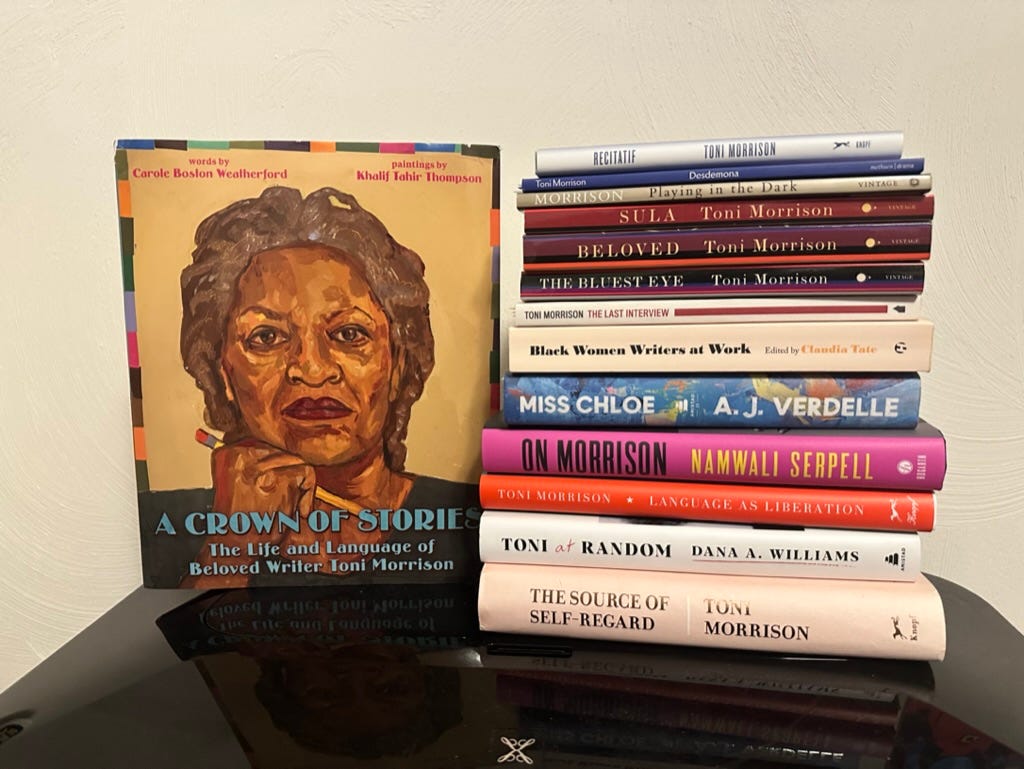
Toni Morrison’s second takeaway from “The Work You Do, The Person You Are” is the one that sticks with me the most: “you make the job; it doesn’t make you.” I was so bent out of shape trying to defend the creative and intellectual work I do as labor, when I realized I might’ve been focusing on the wrong things.
Leaving the university didn’t make me any less of a teacher. My neighbors who I read with every week know that. My friend who I am doing a year long study of contemporary Black writers with knows that. The many folks I work with in the workshop space know that.
Ignoring my training doesn’t make me any less of a thinker or a reader. It didn’t un-make my skill. I’m reading better than I ever have, and I think part of it is freeing myself from having to meet certain expectations. I can follow my interests where they lead me.
Choosing not to publish me doesn’t make me any less of a writer. I’m writing whether or not it goes anywhere because this how I make sense of the world, and I will share it on my own because I know there are folks who value thinking things through alongside me.
My value does not come from where I work. I am delighted to say I am the same person with or without a private university affiliation. Accolades and institutions have never been or never will be the most interesting thing about me. What I actually spend my time doing, and what I find value in, is learning, processing, and sharing what I know. And I am skilled at sharing knowledge in so many beautiful ways: through writing, through craft, through art, through teaching…Those are the things that make me.
These institutions didn’t make me so they can’t un-make me.
My mother made me.
My father made me.
My grandparents made me.
Suffolk made me.
Seemingly endless acres of Virginia country side on Sundays after church made me.
I was baptized in the James.
I made me.
I don’t need to be legible to you. I am legible to the only person to whom it matters: myself.
If you’re new here and you don’t want to do all that clicking to find out what I’m about: I’m Dr. Ravynn K. Stringfield, a writer, editor, artist and former Peanut Fest Queen from Suffolk, Virginia. I am the author of two novels for young adults, Love in 280 Characters or Less (Feiwel & Friends, 2025) and Love Requires Chocolate (Joy Revolution, 2024). I am a product of Virginia public schools (Suffolk Public Schools) and universities (University of Virginia), all the way up to my PhD in American Studies from William & Mary. I’ve been published in a variety of venues for the last six years—book collections, magazines, scholarly journals—but most importantly, I’m a life long reader and a maker of beautiful things.
No posts
Comments
Nothing yet. Say the first thing.
Sign in to join the conversation.