
Imagine driving through a city and every street sign suddenly disappears.
That’s what the death of the third‑party cookie feels like for marketers accustomed to following users across the web.
The old habit of buying or scraping data has gone from questionable to illegal. Pre‑checked boxes and vague privacy policies no longer count as consent.
If you allow me to list the chllanege, this knock‑on effects precisely include:
Loss of third‑party targeting. Behavioral retargeting, audience expansion, and frequency capping are fading away.
Increased compliance complexity. Businesses must document how they collect and use data, honor requests to delete data, and face severe penalties for missteps.
Demand for value exchange. People are reluctant to share information unless they see a clear benefit.
But don’t worry!
The right answer to this is not to collect less data, it’s to collect the right data, data that your potential customers willingly share.
First‑party data, information your audience gives you through direct interactions, becomes the gold standard. It’s accurate, compliant, and rooted in consent. To succeed, you must build a privacy‑first ecosystem.
And here’s how to do it…
Offer a real value exchange. Create useful tools, exclusive content, or membership programs that make people want to share their details. A good rule of thumb, if you wouldn’t sign up for your own form, neither will your customers. The value proposition has to be strong.
Invest in a Customer Data Platform (CDP). Fragmented data is a barrier. A CDP pulls data from your CRM, website, support channels, and ecommerce platform into a single profile. It offers you a holistic view which is the foundation for any personalization and measurement.
Make transparency your superpower. Clear, friendly privacy policies and granular consent options build trust. Think of transparency as a feature, not a legal disclaimer.
Explore privacy‑preserving tech. Contextual advertising (showing ads based on the page content rather than user history), secure data clean rooms, and analytics tools that respect anonymity allow you to continue targeting and measuring without crossing privacy lines.
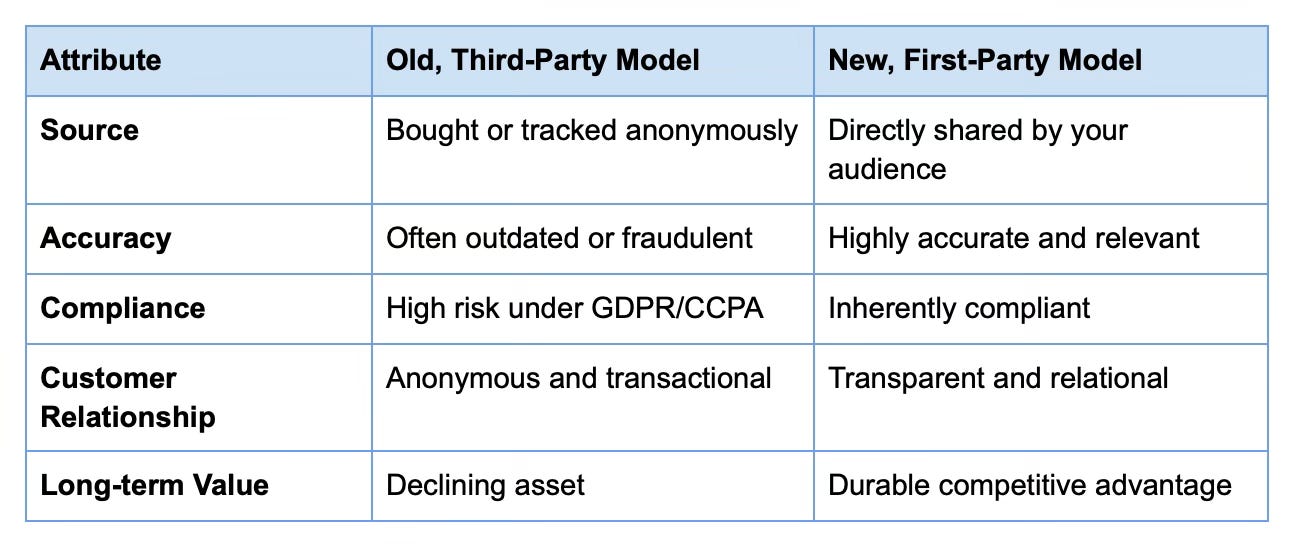
Here’s a simple comparison to illustrate why first‑party data is worth your focus:
The best part?
When privacy is a core value, people trust you more.
They become more willing to share meaningful data. They see you as a partner, not a stalker. That’s a shift from sneaking into someone’s backyard to being invited through the front door.
Key takeaways
Third‑party cookies and lax consent rules are ending.
First‑party data collected through genuine value exchange is the new currency.
A unified data infrastructure (CDP) is essential.
Radical transparency and privacy‑preserving technologies build trust and differentiation.
In the next post, we’ll explore how to use this consent‑based data to deliver hyper‑personalized experiences without falling into the common traps.
No posts
Comments
Nothing yet. Say the first thing.
Sign in to join the conversation.