
“SHAAAAAAMMMMMEEEEE!!!!”
Brussels Sprouts, who prefers to be referred to as Madame des Bruxelles, trills from the green frosted plains of her hometown. Her comically high-pitched voice carries over the crisp winds of January, alarming a group of pink-footed geese who warbled off pitch tunes as a direct result of the musical affront. The head of the chevron gargled insults at his flying mates in a rich baritone voice.
“SHAAAAAAAAAAMMMMMEEEE!!!!”"
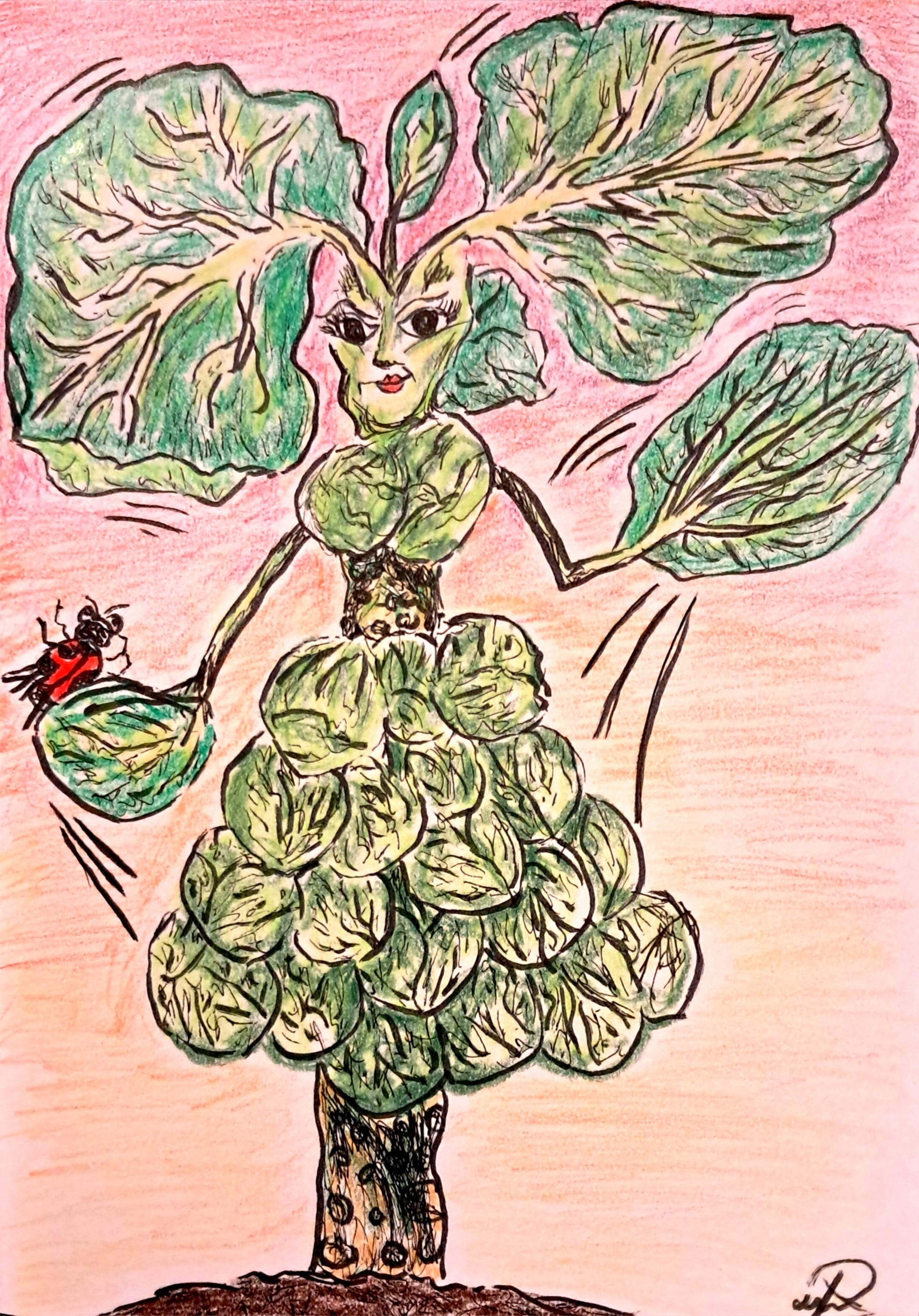
Madame des Bruxelles screams again, this time her head tilts upwards, her eyes close and her faint lips quiver in ruminating self pity. She spreads her leafy palms as widely as her herbaceous arms would allow and attempts to ruffle her waxy sprouting heads around her rigid stem, but the little cabbage-like heads on her wouldn’t move. These are buds of the brassica Gemmifera plant, a congregation of heads with tiny leaves so tightly wound to themselves and each other. Every firmed up bud stubbornly attaches to her wood-like stem, refusing to budge even a hundredth of an inch.
“Such a shaaame. The winter months have betrayed me yet again, both in 2025 and 2026. What did they say?” Madame Bruxelles’ voice rings out the question to a field of 10 other brassicas like her.
“That frost would kill them all!” Each plant screams out at a slightly different pitch to Madame, but all voices sound almost united in shrillness.
“But we’ve had two frosts. And no, they are STILL HEREEEE!!!!! AAAAARRRGGHHHH!!!!!!” Madame shouts out.
“AAAAAAAAAAAAaaaaaAAAAAAAAaaaaArgghhh!!!!” The brassicas echo Madame’s thoughts.
“Pass me one more of those bugs, Madame!” a high-pitched voice shrieked out, interrupting the ongoing lament.
A particularly worn down brussel sprout tree yelled out this command. In response, Madame des Bruxelles hoists herself above ground, but this time stretching out every single paddle-shaped leaf on her head and body. She twists her body towards a damp and dead tree bark lying right by her shallow roots. She uses her strongest leaf to lift the bark, revealing a frightened cluster of ladybirds who scuttled around aimlessly in utter alarm at the intrusion. She deftly scoops out one beetle with a single motion. It lifted the ladybird half a metre above ground.
Cupping the now half awake beetle with one leaf, Madame flings it upwards into the air and follows up with a very sharp movement leftwards with a stretched out leaf. Like how a paddle would hit a ball, Madame’s leafy backhand bats the beetle into the horizon. This projectile motion is stopped when another brassica stem, with her glove-like leaf, catches the poor outflung insect with expert ease.
The confused ladybird is then pressed against the blackening sprout buds on the plant. The beetle rushes across the little cabbage heads and instinctively gnashes at the swarm of greyish aphids that emerge from each tightly would inner leaf of the brussels sprouts. The ladybird then moves around, inspecting each cabbage head only to find hundreds of aphids letting out tiny shrieks. It continues on with this surprise buffet it is rudely awakened to, still half asleep from the biting cold in the winds that rush past its exposed wings under its shell.
“How long will he last?” The receiver plant asks Madame in desperation, appearing to be slightly relieved from the burning itch it earlier felt from its sprouts — parts where aphids eviscerated the cabbage heads from the insides of their wound up leaves. Another brassica plant screams out in frustration, requesting Madame for another ladybird to relieve its infuriating itch that also emanated from the hidden leaves of its own group of tiny cabbage head sprouts. Madame ignores this request temporarily, since moving around had made her waxy joints slightly bruised.
“He will last a day, maybe a week, if you are lucky. He looks young and fat, I think he might outlast the last one I gave you,” Madame answers with a slight whimper from her bruised and now painful joinery, which was aggravated by the recurring itch she experienced from her own aphid-infected sprout heads.
Madame des Bruxelles is rightfully frustrated with the current state of affairs in her brassica patch. Owned and managed by a garrulous old man, the small group of brussels sprout trees had a difficult winter season since it began in October 2025.
The old man decided erroneously in late March to plant the sprouts as he envied the success of his neighbouring commune’s patch of healthy harvest from the previous year. Holding a sprout he stole from their patch (instead of giving them recycled cooking oil as barter) with his index and thumb, he peered into its green-yellow bottom, angling his knifepoint from above. “Maybe I’ll make a bit of cash next year,” he mumbled to himself as he criss-crossed the sprout. “I mean, how hard could it be if those commies could do it,” he giggled to himself, amused by his own observation.
But alas, trouble began for this man’s cumbersome project as most of his seeds struggled to grow during the summer months, let alone sprout successfully when the cold arrived early in 2025. Out of the 100 seeds sowed, he managed to raise less than half of seedlings which began seriously dwindling since the start of the first frost in December, a time when the sprout trees were expected to continue maturing to become harvest-ready for Christmas.
The old man thought he was clever. He used a decades-old bottle of a pesticide called Bravado which contained the now-banned component called imidacloprid to spray the seedlings earlier that year. Yes, the sprays staved off slugs and flea beetles attacks, but as the sprouts themselves began developing, a few surviving green-grey aphids managed to lodge themselves deep within their premature cores. Aphids have been particularly ferocious in 2025 as colder countries in the Northern hemisphere experienced significantly warmer temperatures.
And unbeknownst to the old man, his furious Bravado-spraying have kept away the aphids’ natural predators, the dainty yet aggressive ladybirds. As ladybird babies kept failing to mature on the sprout patch, the local ladybird Counsel advised his kinspeople to avoid the area at all costs. “They have poisoned us. Let us go to back to the commune. Our extended relatives are still there, waiting eagerly for our return,” the Counsel spoke one day in mid-May. One rebellious ladybird protested this sudden exit plan, but it was immediately shot down with the Counsel’s dark, ominous, unblinking stare, the effects of which multiplied across its thousands of compound eyes.
The old man then attempted to spray the pesticides directly into each sprouting cabbage-like bud, instead of layering each plant with a haphazard amount. This action temporarily reduced the aphid count. But all it took was one warm spell in the winter to bring some of the hardiest survivors out, who emerged heroically even deeper from each of the maturing bud’s innermost folds.
Despite a tumultuous year, 11 Brussels sprout trees survived the 2026 New Year, thanks to a surprising discovery made by a certain Madame des Bruxelles.
Not all the ladybirds fled. A small congregation of rebellious beetles had decided to take refuge underneath a tree bark which was decaying quite rapidly thanks to an unexpected period of wetter winter days. These insects appear to flock around one another in anticipation of colder days, but the inconsistency of British weather had kept them partially awake and metabolically active.
Madame observed one day that the old man inspected the tree bark next to her by flipping it over. This disturbance caused a stir among the underneath inhabitants, which led to a flurry of hurried exits. Amongst some of the escaping denizens, which were mostly woodlice, Madame noticed that a number of bright red and black ladybirds had also crept out of the crevices. She instinctively picked one up with her then younger and more flexible leaf arms, and balanced it on her array of itching cabbage-head sprouts.
To her astonishment, the ladybird went on to attack the aphids that resided within the sprout heads. The hungry beetle even went to the extreme of biting off the tightly bound sprout leaves themselves to make its way into the aphid clusters. And magically, within days, Madame’s unbearable itching was relieved.
However, due to the small amounts of the pesticides still present on the plant and the aphids themselves, this buffet brought upon body-weakening effects on the ladybird. It made the ladybird voluntarily leave the plant in physical and mental exhaustion. This phenomenon made Madame even more eager to inspect the itch-relieving effects of these colourful insects. And thus, she began her routine bark inspections, using her stronger stems and leaves as levers to attempt a flip. But the heaviness of the bark prevented her from ever succeeding, but even creating a successful opening between the bark and the soil bore fruit. She had spent weeks gathering these beetles this way since, occasionally batting some of the ladybirds over to her neighbouring plants upon request.
“All I am wishing for is a peaceful New Year,” Madame sighs, still bothered by her bouts of aphid-induced itching now perforating her undersides. “We are running out of the bugs. We are losing the remedy. I am losing my mind from these horrible bloodsuckers on me,” she complains to her crowd.
“We need more frost,” one plant suggested.
“We need more bugs,” another cried.
Madame looked at all of her patch neighbours with mild frustration and defeat. “WE NEED TO BE HARVESTED. WE ARE GETTING OLD!” she wailed out into the ether.
The old man had given up on the patch in its entirety, since harvesting the sprouts now would give him so much less cash than he had originally anticipated. Plus, his neighbours had been hearing about his “failing sprouts” since November, and the news spread around like wildfire across the local pub. He posted on his Facebook about the remaining sprouts. He gathered some sympathetic likes from old friends, but there were no willing takers. Especially not ones from his neighbourhood.
His neighbours also decided to stop talking to him as they began getting tired of his strange antics and occasional garden trespassing, especially at the commune’s patch. Just before Christmas, the commune dwellers had also caught him with his woollen hat filled with strawberries he had sneaked out of their greenhouse.
“I should plant these beauties instead,” he mused, sipping his tea whilst holding one of the glistening red strawberries between his index and thumb.
No posts
Comments
Nothing yet. Say the first thing.
Sign in to join the conversation.