

This Week, Those Books links the big international story to the world of books and has a few thousand followers on every continent except Antarctica. We aim to provide, in roughly five minutes, crucial context – from fiction and non-fiction – to the shouty, doomscroll news cycle..
The Scottish capital is putting on the Edinburgh Fringe, the world's biggest arts festival, as well as The Royal Edinburgh Military Tattoo, a celebration of the marching and musical skills of army bands. Both draw participants and audiences from around the world.
The Edinburgh Fringe was established in 1947 as an unofficial offshoot to (and on the "fringe" of) the Edinburgh International Festival.
It is now said to be surpassed only by the Olympics and the World Cup in terms of global ticketed events.
The Royal Edinburgh Military Tattoo, officially began in 1950 and now has performances by army bands from Britain, the 56-member Commonwealth of Nations and other countries.
TWTB heard in Edinburgh that the Tattoo’s temporary grandstand, for some 9,000 spectators, takes three months to erect.
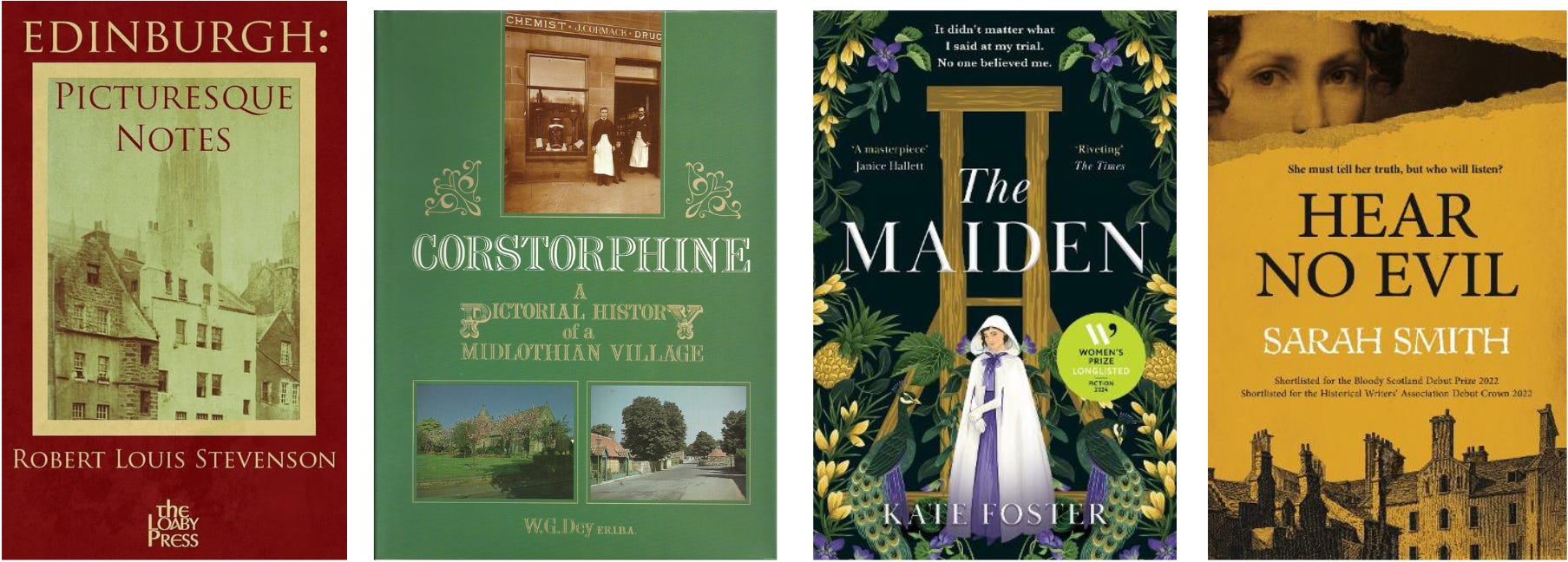
Edinburgh: Picturesque Notes
By: Robert Louis Stevenson
Publisher: Loaby Press Kindle Edition
Year: Originally published in 1878
One of Scotland’s most famous sons offers readable and entertaining essays on different parts of the city in which he lived. Nearly 150 years after it was first published, Robert Louis Stevenson’s city guide is still useful, especially his depiction of Edinburgh as a city of contrasts – old and new; rich and poor.
It’s a measure of Stevenson’s readability and pull that a new edition of this 19th century book recently became a publishing hit. That too, as a first book, released by a small indie publisher!
I confess I did not get Manderley Press’s hardback edition of Stevenson’s book, but it must be a wondrous thing. That new version has an introduction by Alexander McCall Smith (of No. 1 Ladies’ Detective Agency fame) and artwork by award-winning illustrator Iain McIntosh. Like Stevenson, both men live in Edinburgh.
Choice quotes:
“[T]he delicate die early, and I, as a survivor, among bleak winds and plumping rain, have been sometimes tempted to envy them their fate. For all who love shelter and the blessings of the sun, who hate dark weather and perpetual tilting against squalls, there could scarcely be found a more unhomely and harassing place of residence. “
“…like her [Edinburgh] whimsically, if you will, and somewhat as a virtuoso dotes upon his cabinet. Her attraction is romantic in the narrowest meaning of the term. Beautiful as she is, she is not so much beautiful as interesting. She is pre-eminently Gothic, and all the more so since she has set herself off with some Greek airs, and erected classic temples on her crags. In a word, and above all, she is a curiosity.”
Corstorphine: A Pictorial History of a Midlothian Village
By: W.G. Dey (Editor)
Publisher: Mainstream Publishing Company, Edinburgh
Year: 1990
Corstorphine, now a busy suburb of Edinburgh filled with rushing traffic, was originally a village dating to the 12th century.
Even when it was annexed by the city of Edinburgh in 1920, Corstorphine was largely untouched by industrialisation though it had a horse drawn bus service since 1881. Architect and Corstorphine local W G Dey’s history is full of fascinating detail about life at a slower pace.
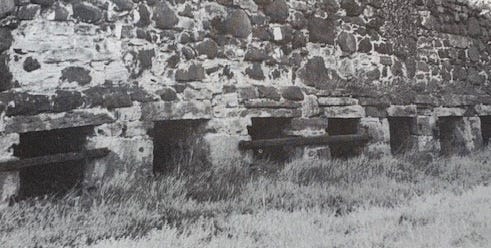
For instance, the beewall was built in the 18th century near the candlemaker, who was blessed in having his raw material – beeswax – close to hand. The beewall eventually became part of Corstorphine’s petrol station.
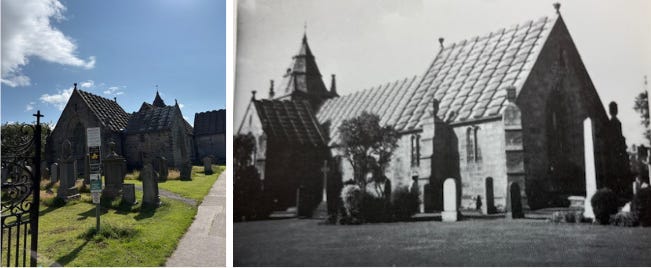
TWTB visited Corstorphine to get a sense of aspects of the past that live on. Certainly, the 15th century church looks pretty much the same despite changes over time.
The Maiden
By: Kate Foster
Publisher: Mantle
Year: 2023
The events described in this historical thriller are inspired by a real-life story that occurred in Corstorphine.
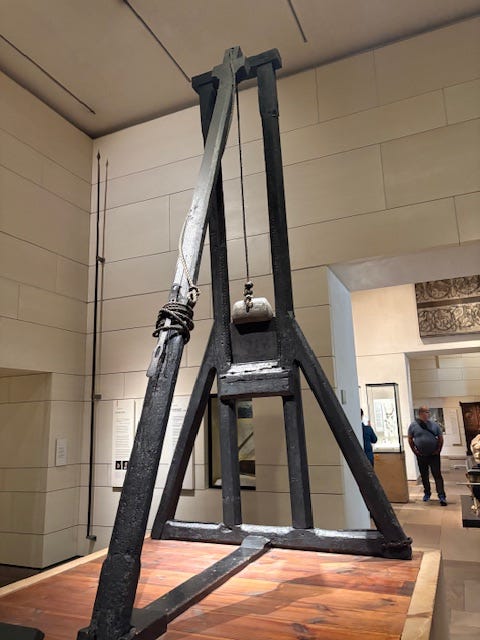
The author, who grew up in Corstorphine, reprises the 1679 arrest of Lady Christian Nimmo for murdering her lover, Lord James Forrester. She was eventually condemned to death and the device used was the Maiden, a guillotine built of oak and now on display at the National Museum of Scotland in Edinburgh.
Centuries later, her ghost, known as the White Lady, was said to haunt Corstorphine. Today, a pub called The White Lady stands on Corstorphine’s main street.
Writer Kate Foster has said she tried to give Lady Christian a voice, having read court reports and heard stories that she was no more than “a godless woman: a whore, an adulteress”.
This debut novel won the Bloody Scotland award.
Hear No Evil
By: Sarah Smith
Publisher: Two Roads (Hachette)
Year: 2022
This moving novel, about a deaf woman accused of throwing her baby into a river, is based on a landmark case in Scottish legal history. In the fearsome Tolbooth prison of 19th century Edinburgh, Jean Campbell sits silent, no one able to get her side of the story. Except for a talented teacher from the Deaf and Dumb Institution. He coaxes Jean’s account from her and is able to interpret it for the court.
This is crime fiction with a focus on ensuring justice is served.
Tolbooth prison has been gone for 200 years and deaf people are no longer regarded as mentally inadequate. This novel gives us a sense of how much has changed – and remains the same.
Email: thisweekthosebooks@substack.com
Connect on: LinkedIn | Twitter | Bluesky | Facebook | Threads | YouTube

Comments
Nothing yet. Say the first thing.
Sign in to join the conversation.