
A couple weeks ago I put out a call on Substack for advice on how to support my nine-year-old daughter’s interest in creating comic books, and I got a surprising volunteer.
Kevin Bankston is a tech policy lawyer and non-profit leader. We met in DC when I was working at the U.S. Treasury Department and he was running a think tank called the Open Technology Institute at New America. He’s advocated for privacy and free expression at a raft of other tech nonprofits over the past two decades and also spent several years at Meta where he founded their AI policy team. Now he’s back again in the nonprofit world as the senior advisor on AI governance at a place called the Center for Democracy & Technology.
He’s also a later-in-life dad to two little girls: a three-and-half year old and an eight-month old.
And, it turns out, between work and kids and his new Substack newsletter about AI and media, Converger, he has been learning how to make comic books.
So I talked to him about kids and comics, his navigating AI as a parent, and about how to “engineer wonder” for yourself and for your kids.
How did you start making comics?
I’ve loved comics since I was about ten years old. I was a big Marvel kid and in college I devoured DC’s mature readers line, Vertigo. And although there have been stretches of years where I’m not regularly reading them I’ve always eventually come back to the medium.
My last return to the comics world was a year ago, after my then two-and-a-half year-old daughter fell in love with Spider-Man, and Spider-Woman aka Ghost Spider, when I let her watch the Spiderverse movies at far too young an age.
I discovered there was actually a comic store just a quick bike ride from our house and so I brought her in May to the annual Free Comic Book Day, which, well, is what it says. There’s lots of free preview comics to try to get folks in the door and into the habit.
My kid was ecstatic to get all these free comics, while I was ecstatic to find all kinds of new work on the shelves that jived with my tastes in storytelling. In particular, in the years I’d been away, elevated horror comics had become a big thing–and I just happened to have been knocking around a few big horror ideas in my creative writing at the time, one of which has actually gotten me a development meeting during the pandemic with master of horror John Carpenter of Halloween and Escape from New York fame. But that’s a story for another time.
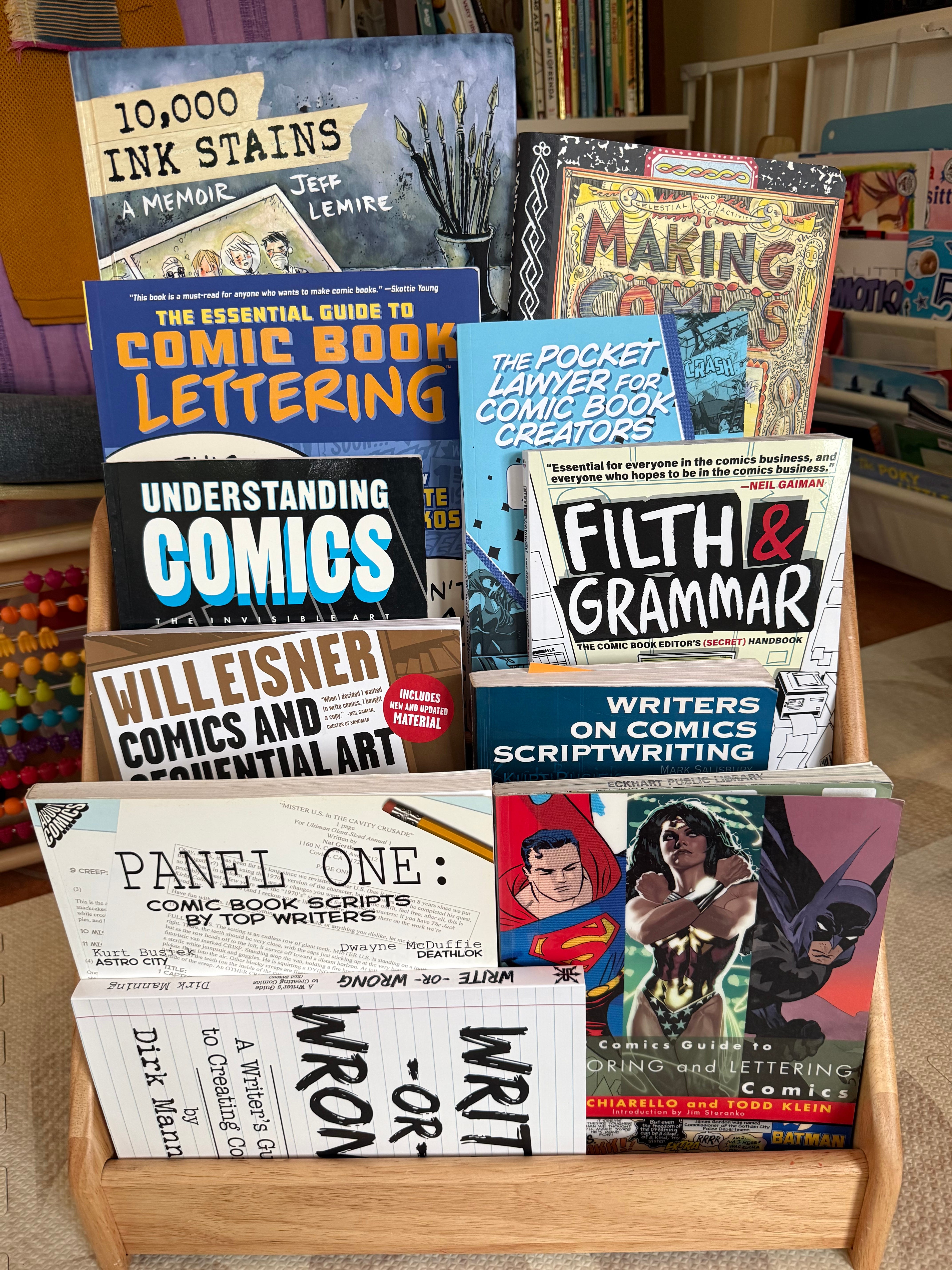
Anyway, I started devouring books about making comics and writing for comics, and learned how writing pitches works in that world–you actually need to partner with an artist to make the first few pages of your comic book to show it around. And I was reading an interview in one of these writing books, Words for Pictures, with this legendary editor, Diana Schutz. If you’ve seen 300 or the Hellboy or Sin City movies then you’ve seen adaptations of classic comics that she edited back in the day.
Diana now teaches making comics at Portland State, and in the interview she was talking about how it’s important for editors to see that you can complete a self-contained comics project which is why one of the three major projects for the semester is the completion of a stand-alone eight-page minicomic. And I just suddenly had this brain spark of: I’m gonna do that! I’m gonna take myself to comics school. I’m gonna budget time and money like I’m taking a semester of college and put together three professional level pitches using the story ideas I’ve already developed and I’m gonna do it before Comic-Con in New York in October!
And I didn’t come close to meeting that goal! But I did follow through, and I did finish one of them before New York so I could shop it around to editors there, and I’m now finishing the third and final one this month.
So you’ve made three comics now?
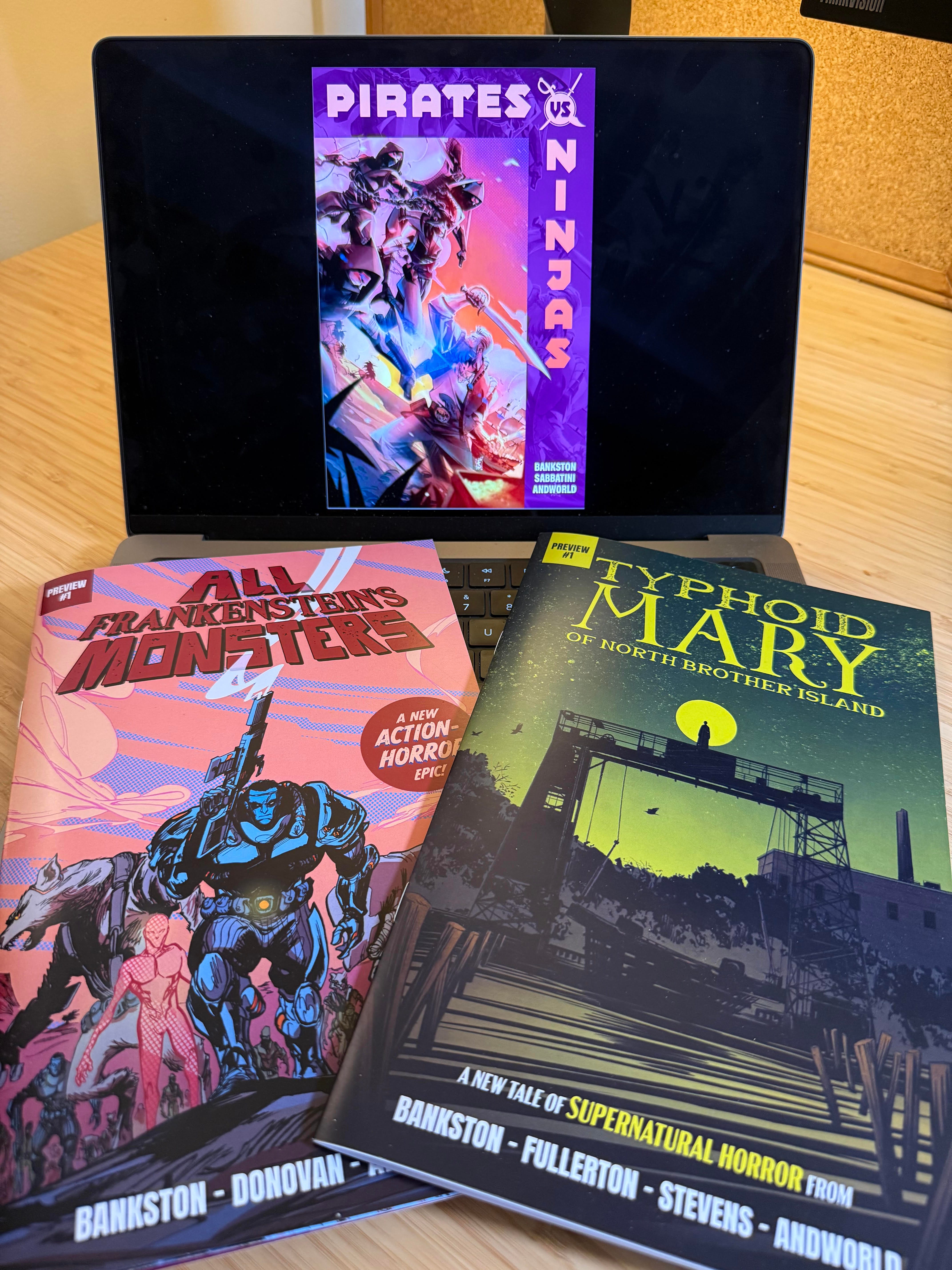
Yes! I built three different teams with artists, colorists, letterers and the all-important editor for three different comic ideas–an action-horror, a supernatural horror, and a swashbuckling action-adventure–and made three different “ashcans” [prototypes of a comic] with covers and logos and the first five to ten pages of each story, and with making-of materials at the back explaining the overall story and characters and world. And now I’ve learned how to write for this medium, how to project manage a comic production, how to network in the comic convention space, how to pitch to editors at the comic publishers, how to deal with comic printers, and more.
No publisher has bought a pitch yet and I may end up Kickstarting the first issue of one of them myself, but that was never really the point. The point was to invest in myself and follow my joy and learn something new and at the end of it have these physical manifestations of story ideas I’d been chewing on for years. And although I’m making a real go of it–I want to actually publish, and make back the money I spent, and then publish again–I think the money will have been well spent even if I don’t, because of how much I enjoyed and learned from the process.
Particularly as a new dad with two young girls and an intellectually demanding job and in the midst of crazy turbulent times in our country, I really just needed a project that was only for me, to stay sane, rather than just doomscrolling or watching Netflix.
And Sophie, I gotta say: other than getting married and having kids, it’s literally been the most fun I’ve had in my entire life.
So for the adults, I would just say: Figure out what makes you feel like you’re twelve years old again and do it. Invest in your joy and it’ll be the best money you ever spent. And the generative creativity that you spark will spill over into the rest of your life.
I later read an article by tech and productivity writer Cal Newport who described this kind of project as “engineered wonder” and it really captured what I was trying to do: pursue something I was intellectually and creatively curious about, just for the childlike play of it, without expectation of some career or capital return. And I cannot recommend it enough. For me, the wonder was in comics–and it sounds like it might be in comics for your daughter too!–but I’m sure every one of your readers has at least one specific wondrous thing they’d love to play at doing.
So–go do it.
So where should my daughter start, if she wants to make comics? She’s interested in doing both writing and art.
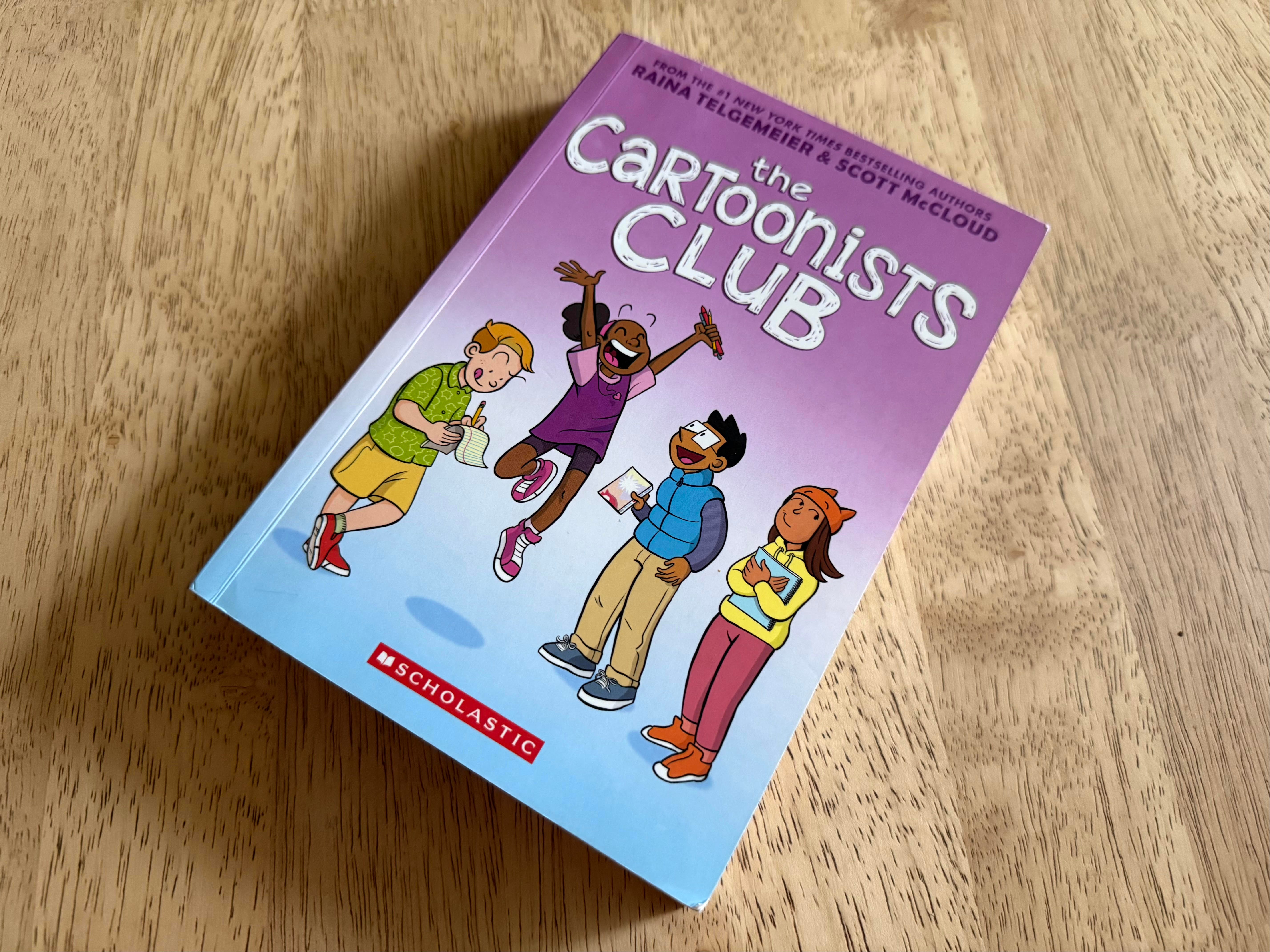
Ah, then she is a cartoonist! For your daughter, she absolutely must read The Cartoonist’s Club. It’s a little graphic novel for younger readers by Raina Telgemeier, who, other than Dog Man, is like the hottest thing in the Scholastic Book Fair.
So Telgemeier teamed up with Scott McCloud, who is the preeminent theorist of cartooning. He wrote the book on comics, Understanding Comics–actually a comic about how comics work. They recently did a graphic novel together about some middle school kids starting a cartoonist club and learning how to make mini comics, which basically involves just making a small eight-page comic book by folding two sheets of regular paper. It teaches all the basics of comics theory and comics production in the context of a story about kids actually doing it themselves. It’s super-inspirational and I wish I’d had it when I was your daughter’s age.
I’d also recommend for young people Lynda Barry’s Making Comics, a funny little workbook of exercises meant to help both kids and adults unlock their cartooning creativity in a playful way. For children of all ages, as they say. And for children of just plain children-age, I’d recommend the somewhat more practical but age-appropriate Let’s Make Comics! by Jess Smart Smiley.
For the older or more advanced comics-curious writers or artists–or your daughter after she’s read Cartoonist’s Club and wants more–I actually have a big Google doc of books and resources on creating comics that I’m happy to share.
Did you see the Substack newsletter in the past weeks about how Dog Man is “stupid” and we should just say so to the kids? In your world, do you have the equivalent of the “poptimists” versus the “rockists”–internecine fighting among music enthusiasts about hierarchies of cultural value.
Any nerddom has that. Speaking generally, the comics direct market, which is the market where publishers ship directly to this network of comic book stores, it’s its own weird market. There are 2,500 comic stores in the country. At this point, it’s mostly supported by older people like me–but that means that the community is so excited by things like Dog Man, the explosion of manga, and the fact that graphic novels are replacing middle grade books in terms of what kids are actually reading. Because that’s bringing kids into this other world. There’s all this talk in industry circles of “the Dog Man generation” that’s going to save the direct market as kids come in and look for new stuff.
There’s concern about the idea that the rise of the graphic novel is merely a symptom of children’s inability to read at a sophisticated level or pay attention to complex, long stories. What do you make of that?
My brother, what finally motivated him to read was the X-Men, you know? That sort of dismissive attitude toward comics goes back to the 1950s and the idea that comics promoted juvenile delinquency, and I think it’s just moral panic nonsense.
Is it also important for children to develop skills to read complex straight prose products? Yes. Am I worried that comics are encouraging people not to do that rather than giving them the tools that can help them do that? No.
My observation then is that the publishing industry had discovered the visual language and storytelling structure of comics as an “early reader” genre. And that was incredibly fruitful and beneficial to that genre.
Have you seen the Toon Books series? The art director of The New Yorker has created this early reader series with high-end creators from the adult comics world that is designed to be these staged entries into literacy for young people.
[Kevin looks up Toon books on his laptop] So I’m going to be buying a lot of these! I’ve been struggling with the fact that my daughter’s gotten interested in superheroes–but superheroes are so fascist! And all about resolving problems through physical violence. It’s been a real challenge finding sequential art content for her that has heroic themes, but is not, “Now Spider-Man is going to punch Hobgoblin.”
One of my beliefs is that we’re just lucky that as an accident, comics got popular enough that they took off for “early reader” publishing.
I don’t think there was a top down idea that the actual dialogue-based, realistic phrases approach of comics was a better way to teach people than the stilted sentences of the early reader books.
My hypothesis is that some creators, like Mo Willem, had the sequential art style and proved that it could be very popular among young people.
Simply the adoption in children’s books of the speech balloon?
That’s what I’m saying! The speech balloon inadvertently caused the publishing industry to fix a mistaken belief in early readers: That what’s hard for children is sentence variety. They can handle sentence variety, because they talk! Real people use sentences without a subject, or say just one word.
Switching gears: You are uniquely positioned to hold forth and make personal decisions as a parent about how you let children interact with AI. So my first question is, what would you not be caught dead letting your kids do with AI now?
One thing that’s overemphasized is AI literacy. “We need to teach these young kids AI literacy” is often the excuse for putting this stuff in kids hands–but the tools are pretty easy to use and they’ll be able to learn them when they need them.
It’s much more about what is necessary or helpful to children’s development. I just don’t see how a little kid with much less self-regulatory control than I have would deal with some of the more habit-forming elements of this technology and the cognitive offloading that can happen, which all of us with much better developed forebrains are continually struggling with ourselves.
The thing that really alarms me is how much we’re seeing hallucinated mistakes entering what previously were high reliability areas, like academic publishing or legal filings.
One that really struck me: there was a study last year showing a significant non-trivial percentage of papers that were submitted to the NeurIPS AI conference–i.e, the academic community most familiar with the risks of AI, including this risk. They found one hundred hallucinated sources between all the submitted papers.
If even that community, which is as sensitized as any community can be to this risk, succumbs to that, then you know there are some pretty deep cognitive biases behind that. I’m not sure any of us can meaningfully combat that kind of mistake creeping in through our AI use without better and more architectural backstops in the products themselves.
Can I switch you to the sort of the optimist side of the realist-optimist in you. With AI, what works in developing their intellectual and creative lives alongside these technologies? Could you give people a syllabus of a few things to read or watch that can open our imaginations to how a relationship with AI for a child or teenager might work in a positive way?
The one that leaps to mind also has a caution at the heart of it: Neil Stephenson’s Diamond Age. About an AI-driven technology tablet that tailors itself to the young user to teach them everything.
But the thing is, in the book there was a human performer that was a part of the educational loop of that device. And so it was more of a technology-enabled foster parenting or or teaching relationship, rather than a wholly artificial one. I think that was important in the story.
The equivalent would be you want to use these technologies with the children rather than having the children use them alone–or, more to the point, rather than having the technologies use them.
A lot of it simply comes down to not parental supervision, but parental interaction with the child and the tool. So that it’s always parent and child together working on something, so that you can give feedback about where the tool makes sense or not. And ensuring they’re not going down the AI equivalent of a YouTube rat hole.
Traditional media did not have as many risks as digital technology. My kid might read a book that has edgy ideas or sexual or violent content in it that I don’t love, and I’m okay with that. I read some pretty risqué and radical stuff when I was too young and I’m fine—but I did not have every creepy weird screwed up thing possible at my fingertips.
This is a hard one for me as well as a civil libertarian. Most schemes to try to protect children online turn into “and, therefore, adults are going to have to prove who they are to be able to look at anything.” And then we’re going to by default have a sort of non-anonymous internet where you can’t interact with a risky idea without your name on a log somewhere. And I think the negative externalities from that are pretty profound, especially in a political climate and under a political regime like the one we’re enduring now.
But at the same time, as a parent, I understand the concern about untrammeled access by very young children to every weird thing that adults can come up with online. I don’t have great answers here, other than: Do it with them. Spend as much time with them as you can.
There are so many fun things you can do with kids and AI. I sat with my daughter and we made a coloring book that stars our family. It was not only fun, but it also resulted in something off the computer that we could play with as well. And it was something that sort of expanded her horizons and used her imagination rather than just being something she watched or that watched her.
So speaking of being a civil libertarian: Non-state actors, like the family or companies have a huge role to play in ensuring AI is a positive force for children. Are there companies you look at now and can say “These people are taking the high road with respect to AI and kids.”
I have yet to see an AI product well designed for child consumption.
I’m less worried about kids talking to in-home assistants right now because they’re still pretty rudimentary. We basically just ask our Siri homepod to tell us the weather and play NPR, and my daughter doesn’t think there’s a magical person inside it; she gets it’s just a machine. But that is going to change as they all become LLM-driven. So you should look at what settings might exist to limit who can talk to your assistant, or to review the logs, so the kids can’t start having unsupervised interactions with it.
How about the digital footprint that the kids are creating interacting with AI. What do you do personally to prevent child surveillance? Or do you imagine doing in the next few years?
I mean, the main thing is we don’t post about our kids. We’re not making choices about their online footprint without them.
To the extent we occasionally use a tablet with our child, it’s media that we have vetted on devices where we can very easily restrict her movement around the device. And we’re always there when she’s doing it, which is basically just in the car or on airplanes.
Will you tell us about your Substack newsletter?
Ah yes, this is another example of me trying to engineer some joy, and get closer to the things that fascinate me the most. The newsletter is called Converger, which is a reference to how we used to talk about media convergence. The idea that digital technology is, not flattening, but combining into one digital substrate.
The internet has made the cost distribution for any and all types of content other than live performance approach zero.
And now with AI, the cost of production is approaching zero as well.
So the newsletter is focused on the often contested borderlands between old media and new technology in that new, infinite-content world.
That includes covering fights over copyright, which are particularly valent around AI. But also debates and developments around the role of AI in human creative processes, whether we’re talking about writing or making movies or creating images.
I’m especially interested in the video generation field and how that’s going to transform how we both create and consume video content.
Some representative topics: The one I just published today, the top story was about how YouTube is drawing (or failing to draw) the line around what is inauthentic content on YouTube that should be demonetized or kicked off the platform, versus what is authentic content that merely uses AI as part of its generation.
We are seeing a lot of people who I would characterize as legitimate creators who are spending a great deal of human creativity working with AI tools to generate content for YouTube that the automated censors on YouTube are demonetizing.
And I think that’s a problem. It’s a bit hypocritical as well, considering Google provides one of the best video generation models available from a U.S. lab right now.
So they’re basically promoting using this technology on the one hand, and yet in a very poorly targeted way are right now discriminating against people who use that technology on their video platform.
This is especially notable because Youtube, as I talk about in this issue’s second story, has proven to be a really crucial pipeline for new creators moving from the internet into traditional creative lanes like feature films. I talk about how there are like a dozen people who started by making short horror films and comedy content on Youtube that now have moved into the realm of making feature films, primarily horror films, because that’s a low budget entry point for new directors. So Youtube has become a key pathway for creative people to move from being viral content makers to moving into traditional culture industries. If we now start systematically disadvantaging the people who are using the newest technology to try to embody their ideas, then we might be breaking that pipeline and wouldn’t that be sad?
I go from that sort of digital Hollywood stuff to more wonky things, like the law and policy around Internet scraping for the training of AI models, and to what extent is that legal or copyright-infringing? What are the impacts on the information ecosystem when you start having the websites that used to rely on an implicit bargain with Google that they were going to get a bunch of referral traffic suddenly are getting swamped by bot traffic and losing their human traffic to AI? How do we resolve that issue without basically ending up in a world where all the best information is locked behind a paywall and all the free information is disinfo, misinfo, and AI slop?
What do you do with your kids to make their lives more interesting?
Spending a lot of time outside. We’ve been going on long bike rides through the park. Feeding the ducks, looking at different flowers, learning the names of all the animals.
And crafts–whenever you can make something with them that turns mundane into something kind of magical. This week my wife and child were painting rocks and leaving them around the neighborhood. It sprinkles a little magic where it would otherwise just be… rocks.
One other thing that I do is I make up songs for the kids. And then I record them on the Tonie so they can listen to me sing their personalized songs any time, whether it’s the new baby’s favorite lullaby, or our older kid’s going-to-school song that I sing in the mornings, or whatever.
Did you have a person who was a mentor to you when you were a child or a teen, professionally or artistically, that stands out?
I was lucky that my grandmother was a watercolorist. It was always like, “Yay, I get to go paint with Grandma.”
No posts
Comments
Nothing yet. Say the first thing.
Sign in to join the conversation.