
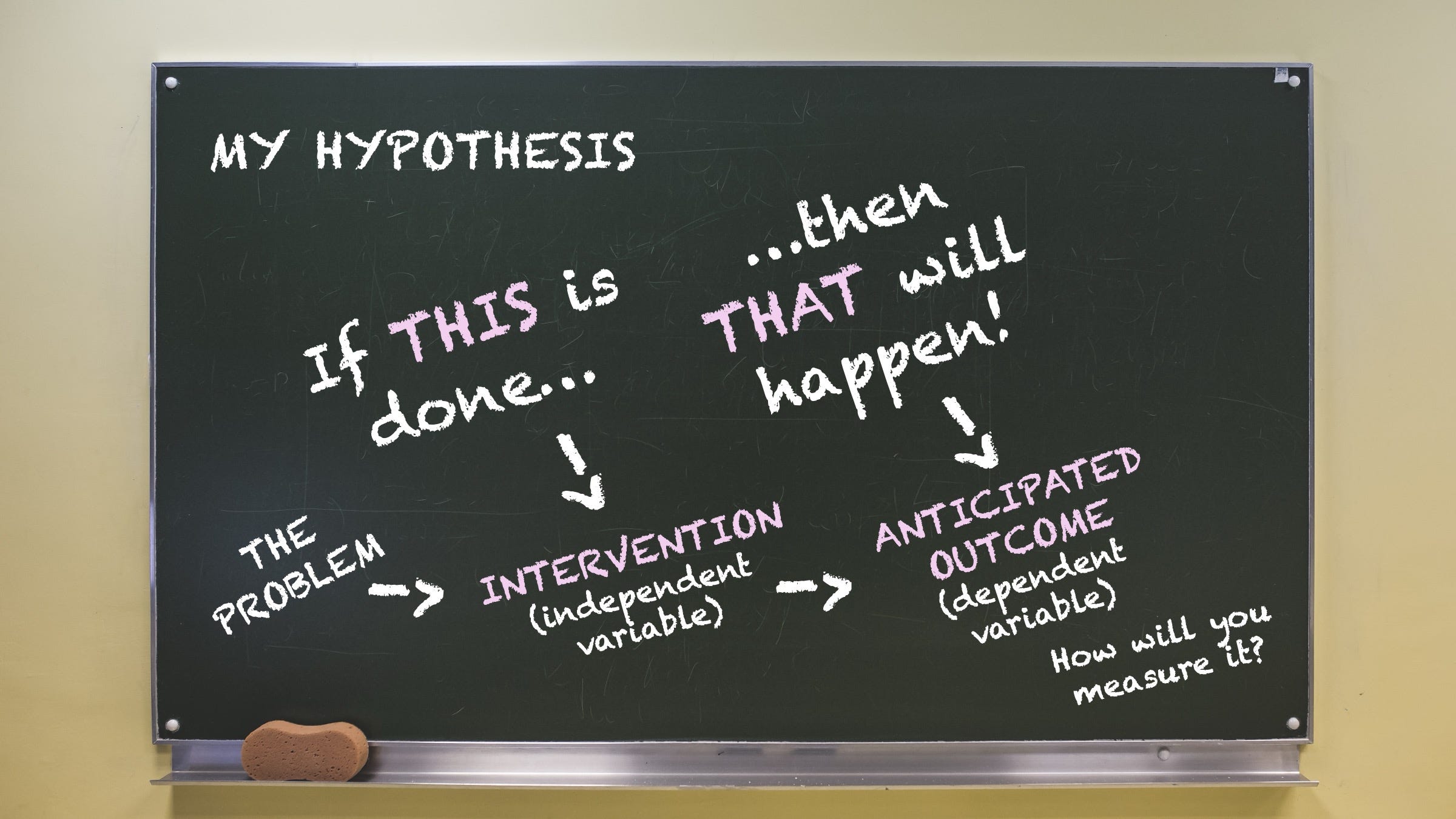
Embarking on a Doctor of Ministry program is an exciting journey of growth and discovery. As a D.Min. student, a crucial task lies ahead: identifying a significant problem or question within a specific ministry context, proposing an intervention to address that issue, and defining the variables you will measure to determine whether the intervention worked. The next step brings all of that together: envisioning the expected outcome and expressing it in a single, testable statement.
That statement is your hypothesis.
All of the above — your problem, your intervention, your variables, your anticipated outcome — must be distilled into one concise sentence that will serve as the cornerstone of your entire project. This guide aims to simplify the process of crafting that essential statement.
Important Note: Approaches can vary from seminary to seminary. Always check with your specific institution for their guidelines and requirements, as these may differ from guidance offered here.
A hypothesis is an educated, informed prediction about what will happen in your ministry project. It is not a guarantee, and it is not a conclusion — it is your best answer, stated in advance, to your research question. Think of it as saying: “Based on what I know, here is what I expect to happen.”
The key word is testable. A hypothesis must be written in a way that allows you to look back at the end of your project and say, with evidence, whether it was supported or not. That is why the variables you named in the previous step are so important here. Without clearly defined variables, a hypothesis cannot be tested — it can only be asserted.
Here is a simple template that incorporates everything you have been building toward:
If [intervention] is implemented with [specific participants] at [ministry context], then [dependent variable(s)] will [increase / decrease / improve / emerge] as measured by [assessment method] over [specified time period].
Let’s break this down element by element:
Intervention — This is your independent variable: the program, training, initiative, or practice you will design and deliver. It should be specific enough that someone reading your hypothesis knows exactly what you did.
Specific participants — Who will take part in the intervention. Define them by role, age, affiliation, or whatever characteristic is relevant to your research question.
Ministry context — Where the intervention will take place. This is your specific church, organization, or ministry setting.
Dependent variable(s) — What you expect to change as a result of the intervention. This is the outcome you are measuring.
Direction of change — Will the variable increase, decrease, improve, or emerge? Choose a word that reflects the direction you expect the change to go.
Assessment method — How you will measure the dependent variable. This is the operationalization step: a survey, attendance records, pre/post assessment, interview themes, or some combination.
Specified time period — The window within which you expect to see the change. This gives your hypothesis a clear endpoint for evaluation.
You may notice that this template includes one element that hypotheses often lack: "as measured by."
That addition is not decorative. It is the step that forces you to move from aspiration to research design.
Consider the difference between these two hypotheses:
Version A: “If a prayer formation program is implemented with the congregation at Grace Fellowship Church, then spiritual depth will increase over eight weeks.”
Version B: “If a prayer formation program is implemented with the adult congregation at Grace Fellowship Church, then participants’ self-reported prayer frequency and confidence will increase as measured by a pre- and post-program survey over eight weeks.”
Version A is technically a hypothesis, but it lacks the element of testing. How will you know whether “spiritual depth” increased? What instrument measures that? Version B answers those questions before the project begins — and that means the student can walk into the instrument design phase knowing exactly what the survey needs to measure.
Writing “as measured by” in your hypothesis is a commitment. It binds your hypothesis to your methodology and your methodology to your hypothesis. That coherence is what makes a dissertation defensible.
Note that some seminaries may not require the “as measured by” element to be explicitly stated in the one-sentence hypothesis statement; however, the means of measurement must be stated somewhere in association with the hypothesis.
Consider a project aimed at helping teenagers stay engaged in school and church. The hypothesis, using the updated formula, might look like this:
“If a mentoring program is implemented with at-risk high school students at City Community Church, then participants’ school attendance rates and self-reported sense of belonging will improve as measured by school attendance records and a pre- and post-program belonging survey over one academic semester.”
In this example:
Intervention: The mentoring program (independent variable)
Specific participants: At-risk high school students
Ministry context: City Community Church
Dependent variable 1: School attendance rates (measurable quantitatively through records)
Dependent variable 2: Self-reported sense of belonging (measurable through a survey instrument)
Direction of change: Improve
Assessment method: School attendance records and a pre/post belonging survey
Specified time period: One academic semester
This is what you control. It is your independent variable — the cause you are introducing into your ministry context. Being specific here protects you from scope creep and gives your project a clear identity.
These define the boundaries of your study. What works in one context may not transfer to another, so naming your participants and setting honestly is both a methodological requirement and an act of intellectual integrity.
This is how you will know whether your hypothesis was supported. The dependent variable must be something real and observable, and the direction of change must be something you are actually predicting — not just hoping for. If you cannot specify a direction, your hypothesis may not yet be focused enough.
The assessment method is the bridge between your hypothesis and your instruments. Naming it here, at the hypothesis stage, means your surveys, interviews, and focus group protocols will be designed with a clear purpose from the beginning. Students who skip this step often discover late in the process that their instruments do not actually measure what their hypothesis predicted.
This gives your project a clear endpoint and sets realistic expectations. It also matters ethically: you are not claiming that your intervention will produce permanent, lifelong change — only that it will produce measurable change within a defined window.
Recall that Pastor Sarah’s original hypothesis, developed in the first article of this series, read:
“Implementing an eight-week young adult ministry initiative that combines weekly Bible study groups and two community service projects will increase the average weekly engagement of adults aged 18–30 in church activities and lead to positive self-reported spiritual growth among participants.”
That is a solid hypothesis, and it contains most of the elements we have discussed. But notice what it is missing: it does not tell us how engagement or spiritual growth will be measured. Using the updated formula, Sarah might revise it to read:
“If an eight-week young adult ministry initiative combining weekly Bible study groups and two community service projects is implemented with adults aged 18–30 at Oakville Community Church, then participants’ weekly church activity engagement will increase and participants’ self-reported spiritual growth will improve, as measured by attendance records and a pre- and post-initiative spiritual growth survey, over the eight-week project period.”
Now Sarah knows exactly what instruments she needs before she begins — attendance tracking and a spiritual growth survey. Her hypothesis has done the work of pointing her toward her methodology.
When you sit down to draft your own hypothesis, work through these steps in order:
Name the intervention. What, specifically, will you implement? (Independent variable)
Identify your participants. Who will be involved?
Specify your context. Where will this happen?
Name the dependent variable or variables. What do you expect to change? Keep it to one to three outcomes that are central to your research question.
Choose a direction. Will the variable increase, decrease, improve, or emerge?
Define the assessment method. How will you measure whether the variable moved?
Set the time period. How long will the project run?
Assemble those answers in the template, and you have a working hypothesis. It may need refinement as you develop your proposal, but it will give you something concrete to build on.
Remember: a hypothesis is a best-informed prediction, not a promise. It is perfectly acceptable — and academically honest — for your findings to complicate, qualify, or even contradict it. That is not failure. That is research.
Your hypothesis is the sentence that holds your entire project together. It names what you did, who you did it with, what you expected to change, how you planned to measure that change, and how long you gave it. When it is written with that level of precision, it becomes more than a statement — it becomes a research plan.
Take the time to get this right. Revisit it as your proposal develops. And let it do what a good hypothesis is designed to do: keep you focused and keep your research moving in a clear direction.
References
Myers, W. R. Research in Ministry: A Primer for the Doctor of Ministry Program. Wipf and Stock Publishers, 2000.
Sensing, T. Qualitative Research: A Multi-Methods Approach to Projects for Doctor of Ministry Theses. Wipf and Stock Publishers, 2011.
Vyhmeister, N. J., and T. D. Robertson. Quality Research Papers: For Students of Religion and Theology, 4th ed. Zondervan Academic, 2020.
No posts
Comments
Nothing yet. Say the first thing.
Sign in to join the conversation.