
In mid-July as the Canadian wildfires burned, I went to Boston for my nephew’s birthday. We bowled candlepins which was harder than I remembered, a reminder of the years’ costs. We saw a truly great Dylan concert. Dylan at 85 offered the wisdom of Menaleus, a reminder that with the years not all is lost.

I walked Harvard Yard, the scene of my katabasis—my descent—remembering imagined wounds I suffered from long-ago ghosts. The takeaway: Achilles’ reminder (in Homer’s Odyssey, not Nolan’s) that any day above ground is worth an eternity of glory beneath. Harvard Yard and its professors may have disappointed me (Harvard English was at a low ebb in my years there; none thought improvisation a worthy topic for a dissertation), but I am proud of my determination then and since to make sense of improvisation as a cultural force.
I’m back to my writing aerie in NYC but my return—my nostos—felt like my version of the Odyssey was a climate catastrophe movie. Scylla and Charybdis were the Canadian fires, Polyphemus the smoke. Circe provided the rainstorms. The Phaeacians, lords of the winds, was United Airlines who delayed, then cancelled my flight after getting within sight of Newark, returning back to Logan Airport. The Sirens and Calypso: the Ritz where I stayed the extra night. The breath of fresh air the Phaeacian games represent in Homer: Spain’s win in the World Cup. My sardonic doorman from Belarus: Eumaeus, Odysseus’s blind herdsman. Getting home in time for that game was my Ithaca.

All my Odyssey lacked was a Penelope.
Christopher Nolan’s Odyssey has a great Penelope in Anne Hathaway. What Nolan lacks is the Odysseus I know. Great-great grandson of Hermes, Odysseus is the closest thing we have to a human version of the god Hermes. Hermes has no role in Nolan’s Odyssey. But what I miss more than Hermes is Odysseus the Trickster.
Like Hermes Odysseus is cunning. Among the gods in the classical record, only Hermes is described as polytropos (polytropic), which literally means many-turning, but is variously translated: cunning, much traveled, shapeshifting.
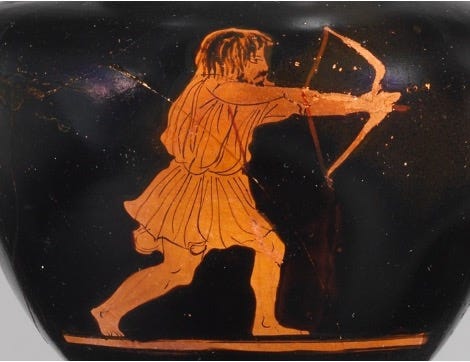
Among men in the classical record, only Odysseus is called polytropic. Occurring in the first line of the epic, polytropos was controversially translated “complicated” by Emily Wilson, the poem’s first woman translator. To my ear complicated is perfect: from com- (meaning “with”) and plicare, meaning “folded together or rolled up.” Both god and man—Hermes and Odysseus—are many layered. Nolan’s Odysseus is complicated perhaps, but to my mind, there are important layers missing. He’s not Trickster enough.
One complication Nolan gets mostly right is Odysseus as traumatized war survivor. Nolan’s hero suffers from guilt. My friend VA psychiatrist Jonathan Shay, whom I met at the 1994 Tulane conference celebrating Ron Ridenhour’s My Lai letter (see David Anderson, Facing My Lai: Moving Beyond the Massacre), argues that Odysseus, like many veterans of Vietnam and our other foreign misadventures, suffers from PTSD (see Odysseus in America: Combat Trauma and the Trials of Homecoming). He is hypervigilant, determined not to be caught out again by trauma’s return. For Shay, the trauma Odysseus carries on his back is the trauma of moral injury, perpetrated by Agamemnon and the Greek commanders by leading men into a war based on false terms. Nolan spells out the terms: it’s about who will control the trade routes.
The Iliad presents Achilles’s tragic response to the moral injury that is triggered by Agamemnon’s theft of Achilles’s war prize, the Trojan woman Briseis. In high school Latin class Dr. Romeo used to chide Achilles for his exaggerated response to this theft. Just as the first line of Homer’s Odyssey invokes the hero’s polytropic nature, the first word of The Iliad is menis (μῆνις), Achilles’s anger that drives the epic poem: “Of the anger of Achilles, sing heavenly muse.” Menis is a special kind of anger, attributed in ancient Greece only to the wrath of the gods. So, yes, Achilles’s response is over the top.
Dr. Shay comes along to explain that, though war prizes may make modern minds uncomfortable, it was part of the honor code that drove men in war, and in this case to war: Agamemnon’s theft of Briseis echoes Paris’s theft of Helen. Stealing Briseis, Agamemnon loses the moral high ground and undermines the casus belli for the Trojan War. Leaders owe their men good causes for putting their lives in mortal—and moral—jeopardy.
Nolan’s ominous version of a tall, black-armored, speechless Agamemnon (as if in Darth-Vader-drag) captures some of this. Agamemnon is as much a monster as the giant Lestrygonians whose armor echoes his in Nolan’s film. The Lestrygonians kill many of Odysseus’s men as they retreat, then heave huge boulders at his ships destroying all but Odysseus’s.
But Nolan’s war veteran Odysseus (Matt Damon) doesn’t just suffer from Agamemnon’s moral injury that brought him to ten years of war. Nolan’s Odysseus suffers guilt. And not guilt for the death of all his men, deaths caused in Shay’s persuasive close-reading by his bad leadership poisoned by hubris, caused in Shay’s telling by the moral injuries he suffered in Troy. About the death of those 400 Ithacans Nolan’s film doesn’t bother too much. No, what is sending Odysseus to the confessional of interior monologues is guilt for using trickery—the Trojan Horse—to defeat Troy.
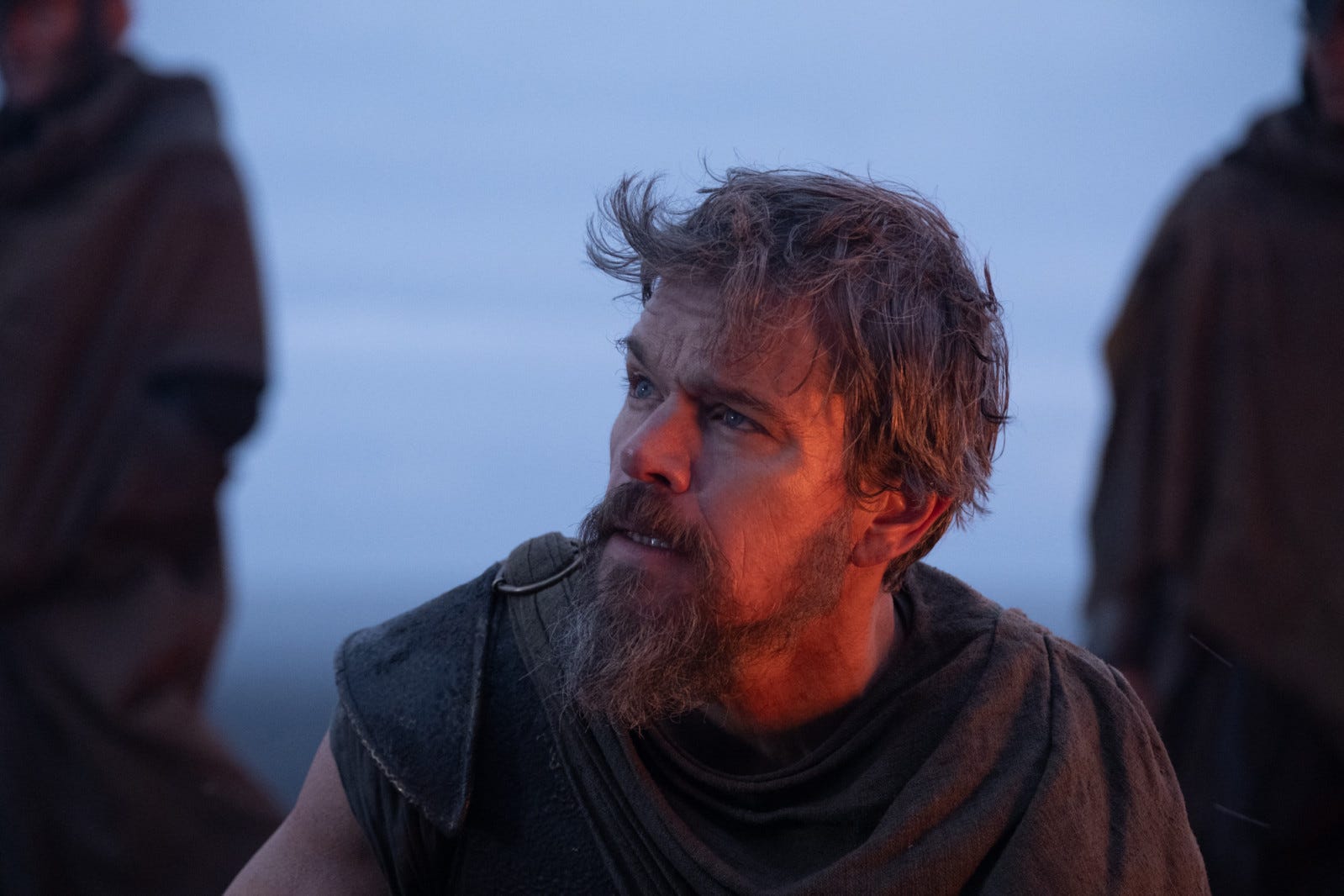
Nolan attributes this guilt of Odysseus’ to the archaic notion of xenia—Zeus’s law that would have us treat guests as if they might be gods. Guests were under the same restriction: they must treat their hosts with equal honor and kindness.
Making that the spring of all the action, climaxing in Odysseus’s righteous slaughter of the abusive suitors, gives the film the kind of unity Hollywood films require.
But the idea that Odysseus’s trick pony—the Trojan horse—is a sin against xenia is absurd on its face. Has Nolan not heard the proverb, that all is fair in love and war? It was coined by John Lyly in his 1578 book Euphues: The Anatomy of Wit. Here Nolan’s ignoring Odysseus’s Trickster nature is telling. Trickster never regrets his tricks.
Instead, Nolan chooses the traumatized survivor over the cunning Trickster as his mono-theme. I applaud his portrait of the traumatized warrior. Clearly Nolan has our treatment of veterans returning from our endless wars in mind. The soldiers we send to fight in our name upon their return are ignored and ill-treated in our VA system. Nolan is teaching us to listen to our suffering warriors. Trauma is the intrusion of the unexpected, what life has not prepared you for. “Traumatic events,” writes Judith Herman in Trauma and Recovery, “are extraordinary not because they are rare, but because they overwhelm the ordinary human adaptations to life, the sense of control, connection, and meaning.”
But the question is not just to pity the damaged warrior but to model healthy recovery: to restore a healed self.
Trauma psychologists today like Judith Herman and Jonathan Shay argue that restoration comes first from understanding the trauma—what happened and its causes—and most importantly, finding a listenership who can hear your story without harm.
Trauma breaks the life narrative—the story we tell ourselves to make sense of our lives. It makes no sense that family members should abuse children, or that leaders could be self-serving: like George Bush and Dick Chaney with their “weapons of mass destruction.” Or Agamemnon’s theft of Briseis. Or Odysseus’s hubris.
Uberto Pasolini’s The Return (2024) didn’t get the box-office or create the stir that Nolan’s Odyssey has garnered. Yet, stripping the epic down to an earthy, visceral reality, Pasolini focuses not only on the heavy psychological toll of war, but the challenge of restoration. Beginning with Odysseus washed up naked on the shores of Ithaca, The Return is Nolan’s traumatized survivor without the monsters.
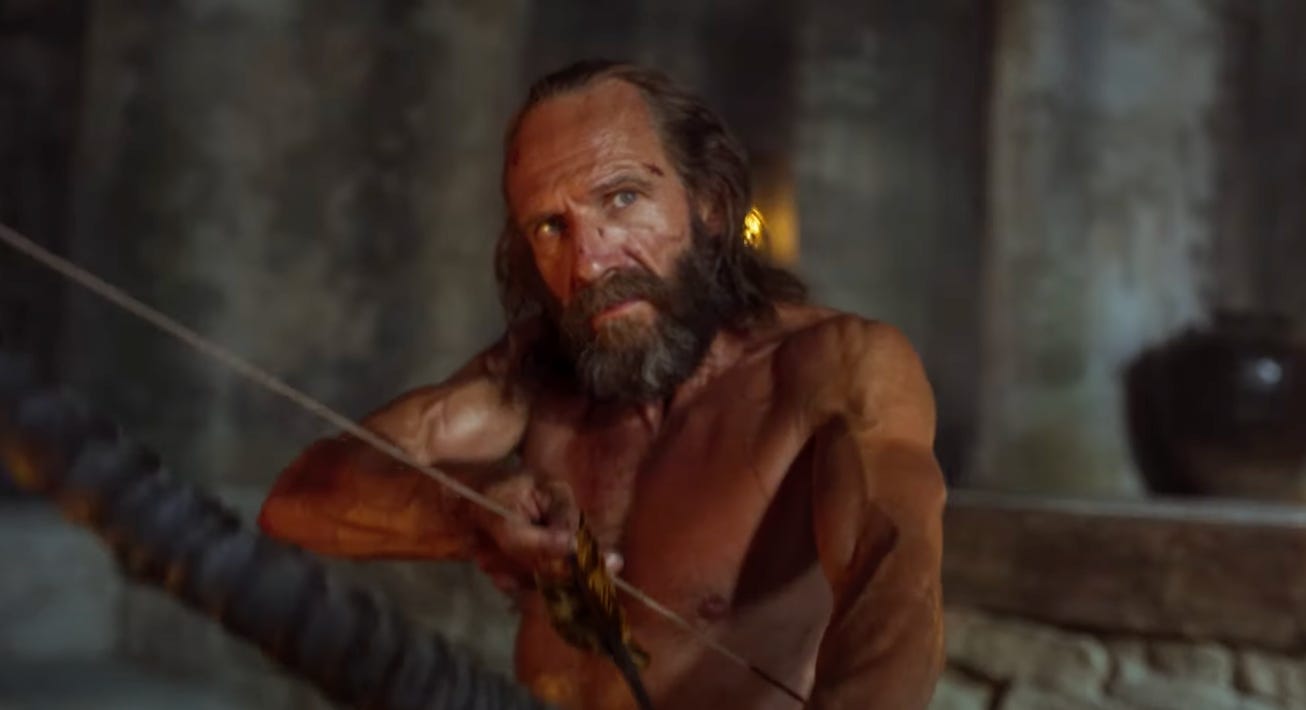
Most important, The Return offers a psychologically adept restoration. The trauma survivor, plagued by his memories, must not forget. S/he must forgo the lotus blossoms that Odysseus is fed by Calypso (Charlize Theron), or the drugs or alcohol that many of our returning veterans succumb to. Instead they must recall the trauma in all its detail. To do so he needs to rely on more than his memories which have been distorted by the trauma. He must rely also on a community of listeners who can listen, psychologists tell us, without harm but moved by the survivor’s narrative.
Reunited after the slaughter of the suitors that has horrified his wife, but for Odysseus was just a return to his experience of the slaughter in Troy, Penelope lovingly bathes him, removing the gore that covers him. With elegant economy Pasolini then offers us this true nostos:
Penelope: There is so much I do not know.
Ulysses: You do not want to know.
Penelope: I need to understand.
Ulysses: You cannot understand…. I cannot understand.
Penelope: We will. Your past will be my past. And mine yours.
Ulysses: Better to forget.
Penelope: We will remember. And we will forget together. And then we will love. And we’ll grow old. Friends, again. Together.
Penelope offers to listen and to understand. She promises not to be harmed by the traumatic narrative and to grow with Odysseus.
Nolan’s Penelope and Odysseus, reunited but with none of this work done, sail off into the sunset, perhaps to stumble upon new monsters. Nolan’s Odysseus does not accept his crown but gives it to Telemachus (Tom Holland).
Nolan has every Hollywood right to adapt his source. Heaven knows what honor Hollywood lends to writers. Adaptation means not only leaving out but changing emphases. Nolan is a lot truer to Homer than the Coen brothers’ comic Odyssesy O Brother, Where Art Thou? which is great in its own way even though the Coen brothers admitted they’d only read the Classics Illustrated comics version. I can live with an Odyssey that deemphasizes Trickster in favor of the wounded, traumatized warrior. But if Nolan shows us a traumatized warrior, he must also show us his real, psychological nostos, his return to a restored self, not one traipsing off like Tennyson’s Ulysses into the sunset, and this one romantically with Penelope in tow.
The glory of Homer’s Odyssey is that it manages to give us both Odysseus the Trickster, the cunning, much-traveled man, and the traumatized war survivor.
Liked this post? I’d be grateful if you’d give the ❤️ a tap.
Please share this post with your friends who love democracy.
No posts
Comments
Nothing yet. Say the first thing.
Sign in to join the conversation.