
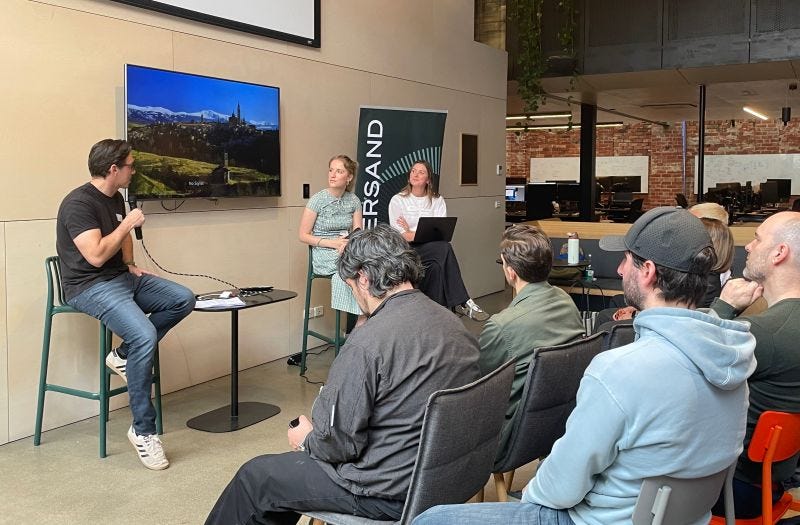
(L-R: Rampersand’s (and Culture Amp founder) Rod Hamilton hosts Anthropic's Carly Ryan and Mia Carroll at last weeks Rampersand Product Counsel)
This week, we hosted Anthropic at Rampersand for a Product Counsel session. Carly Ryan and Mia Carroll’s headline insight: harnesses, not foundation models, are now the bottleneck in AI-assisted development. The model isn’t the problem. The thing around the model is.
For the tech crowd, that’s the whole game. AI’s economic dividend already feels banked. The upside seems limitless. Anthropic’s submission to the Australian parliamentary productivity inquiry this week put a number on it: widespread adoption of current-generation AI could lift annual labour productivity growth by “approximately 1.0–1.8 percentage points per year over the next decade.” For anyone who lives inside Claude Code or ships with agents daily, that feels conservative.
For most corporate workers, it’s theoretical. They’ve tried ChatGPT twice. Their organisation has a “policy.” Nothing about how they spent Tuesday has actually changed.
That’s the diffusion gap. As Anthropic told Capital Brief this week, the productivity gains are “real at the task level,” but the aggregate payoff depends on closing the gap between what AI can technically do and what organisations are actually using it for.
Capability isn’t the bottleneck. Organisational change is. And it comes from two directions.
Top down: the Shopify mandate
Tobi Lütke said the quiet part loud last year. Before any Shopify team requests headcount, they must demonstrate why AI cannot do the job. Not a suggestion. A mandate.
It shifts the default from “hire a person” to “try AI first” in one line of text. Most executive teams aren’t close to that clarity, and without it, middle managers quietly protect the status quo. Mandates only land when there’s execution capacity behind them. For large organisations, that means forward-deployed engineers: technical people embedded alongside procurement, claims, or finance teams, asking the most underused question of this cycle: how can AI do this? Google DeepMind’s recent partnerships with the big consultancies to deliver agentic transformation “at speed and scale” is the same instinct, industrialised. You can’t ship a model into a Fortune 500 and expect it to find its way to the P&L on its own.
Bottom-up: tools that travel
Top-down urgency dies in the middle if individuals don’t have tools they can actually use.
This is where vertical software is winning. The most powerful adoption stories I see aren’t “we rolled out an AI policy.” They’re “I started using this thing and now I can’t work without it.” That’s the transition that matters at the individual level — moving one person from thinking ChatGPT “doesn’t really work well” to “I use this ten times a day.”
Two of our portfolio companies are living this thesis. Parachute sits inside SME law firms, not asking lawyers to change their workflow but quietly transforming pricing, delivery, and margin from within the tools they already use. Restoke is doing the same for hospitality operators: recipe costing, supplier management, the unsexy operational work that actually moves the P&L. Neither is asking customers to “adopt AI.” Both are ten-xing the outcome of work the customer was already doing.
The landscape is shifting fast
Everywhere you look, startups that identified real whitespace are watching the incumbents scramble to close it. Salesforce’s Agentforce. Canva AI. Figma Make. Each one is an incumbent saying “we have an AI-native story,” which gives buyers permission to stop shopping for something more native. That’s the startup opportunity and the startup challenge in one sentence.
One eye on the landscape, one on the customer
The diffusion gap isn’t just a problem for incumbents to solve. For an early-stage founder, it’s where the opportunity lives.
Keep one eye on the landscape. Have a genuine perspective on how it evolves and where you have a real right to win as the incumbents move. Keep the other firmly on your customer. Meet them where they actually are today, not where your roadmap wishes they were. Earn the right to move them up the maturity curve as your product deepens.
If you have a product your first users can’t put down, and a sharp view on where you’ll own a piece of the evolving landscape, I’d love to hear from you.
xAI’s $60B Option on Cursor: The Frontier Lab Distribution Play
What happened: xAI announced an option to acquire Cursor, the AI-native code editor, for $60B later this year, or pay $10B to formalise a partnership if the acquisition doesn’t close. The deal lands as Cursor was already preparing a $2B private round at a $50B valuation — up from $2.5B in January last year, per TechCrunch.
The strategic logic is sharper than the headline number. Cursor sits inside developers’ daily workflows, exactly where Anthropic’s and OpenAI’s own coding products want to be. Cursor still resells Claude and GPT, making it both a customer and a competitor to every frontier lab. xAI brings Colossus, its million-H100-equivalent training cluster, in exchange for the most enterprise-ready distribution channel in AI coding. Two of Cursor’s most senior engineering leaders moved across to xAI last month. Both now report directly to Musk.
Why this matters: This is the loudest signal yet that the frontier labs see distribution as the next moat after model performance. For founders building tooling on top of any frontier lab’s API, the question is straightforward: are you a distribution layer the lab eventually wants to own, or a workflow the lab can never replicate?
Takeaway: If your product is “best-in-class wrapper over GPT/Claude,” you are priceable. If your product is “the workflow our customers can’t extract from,” you are defensible. The Cursor outcome is a great one. But only because the founders held distribution.
A Common Herbicide and the Mystery of Early-Onset Colon Cancer
What happened: A new Nature Medicine paper from José Seoane’s lab at the Vall d’Hebron Institute of Oncology has identified the agricultural herbicide picloram as a significant new risk factor for early-onset colorectal cancer. Cancer rates in adults under 50 have roughly doubled since the late 1980s. One in five colorectal diagnoses now occurs in someone under 55, up from one in ten in 1995.
The team built weighted methylation risk scores: DNA methylation patterns used as molecular records of lifetime exposure. They then triangulated three lines of evidence. A methylation signature for picloram is elevated in young patients’ tumours. The signal replicates across nine independent cohorts. And across 21 years of US county-level data, higher picloram use tracks higher early-onset CRC incidence even after adjusting for income, education, and other pesticides. Picloram-linked tumours show a distinct molecular profile (74% APC mutations versus 90% in low-exposure tumours), suggesting these cancers follow a different biological pathway from classical CRC.
It is not a closed case. Independent analysis notes that Germany recorded zero picloram sales for 16 consecutive years even as early-onset CRC rose there. Causality needs more work. But the methodological breakthrough is real: epigenetic fingerprints can now serve as a reverse-engineered record of what someone was exposed to and when.
Why this matters for founders: Exposome science just got a tractable computational tool. The cost curve on methylation analysis is dropping, and the same signal-extraction methods are starting to work for environmental exposures, microbiome composition, and metabolic state. There is a category of “molecular twin” companies waiting to be built, turning DNA, methylation, and exposure history into ongoing risk signal rather than a one-off test.
Takeaway: For founders in biotech, environmental health, or computational biology, the next decade’s opportunity is moving from one-off testing to reverse-engineered exposure profiling. Read the methods sections, not just the press releases.
Inside the Anthropic × Rampersand Product Counsel: Four Takeaways from Mia Carroll and Carly Ryan
Rod Hamilton hosted Anthropic’s Mia Carroll and Carly Ryan in Melbourne this week for two hours of unfiltered conversation with founders and product leaders. His full recap is on LinkedIn. Four takeaways worth pinning:
The harness is the new battleground. Models keep getting more capable, but that capability is being left on the table by teams without strong scaffolding around it. The teams pulling 10x aren’t just using better models. They’re building better harnesses around them.
Pricing AI products is unsolved — including by Anthropic. There is no magic packaging silver bullet. If you are wrestling with token economics, you are on the frontier with everyone else.
Evals are a silent killer. Most startups run one-shot evals against multi-step agents. That is not measurement. That is hope.
The 10x team gap is as much cultural as technical. Mia’s list of what makes AI-fluent teams hum: curiosity, low ego, emotional resilience. Same traits, different framing, third time this issue.
A story from Walter Isaacson’s Musk biography that resurfaced this week, courtesy of @amritwt. SpaceX wanted Bülent Altan. Altan didn’t want to move to Los Angeles because his wife worked at Google in San Francisco. Musk got on the phone with Larry Page, arranged for her to be transferred to Google’s LA office, then called Altan back with a single question: “What are you going to do now?” Altan joined.
You don’t need to be Elon Musk to apply the principle. The point isn’t the call to Larry Page. It’s that the candidate’s hesitation got a creative response, fast, with a level of urgency that signalled how much the role mattered. Most founders, told a candidate’s spouse has the wrong job in the wrong city, would say “tough” and move on. The founders who build great teams treat that obstacle like a problem to solve. They make recruiting special, because every key hire is.
Takeaway: For your next critical hire, ask: what did I actually do this week to recruit them that they would tell their spouse about over dinner? If the answer is “sent a follow-up email,” you’re not recruiting hard enough.
“Experience Is Now a Tax” — Jaya Gupta on Why Senior Judgment Is Cracking
Jaya Gupta wrote the sharpest founder essay we read this week. Her thesis: judgment and taste, the qualities senior operators reach for when defending their place at the top, are doing a lot of quiet work to protect old advantages that AI is dismantling. Three decision-making algorithms have been rewired in the last eighteen months:
Try new vs stick with what works. The cost of trying just collapsed. A PM who took three weeks to build a competitive memo can ship five versions by end of day. The structural reason organisations didn’t explore before was never just cost. It was that senior people had more to lose from a failed experiment than to gain from a successful one. Bias toward sticking used to have a structural excuse. Now it is personal.
Carry vs offload. Being “smart” used to mean having the right analogy to reach for. Retrieval was the moat. AI is closing that gap fast. The new scarce skill is structuring knowledge: what to externalise, how to organise it, when to pull it back. That has almost nothing to do with years of experience.
Commit vs reverse. For a growing class of decisions, reversal is a revolving door, not a one-way one. The skill isn’t weighing every option. It is choosing fast and not attaching your identity to the last version of yourself who chose. Senior operators have spent careers learning that public reversal is expensive. Young people have not.
Gupta’s closing line lands hardest: “If you are in that kind of environment, leave. The comparative advantage of being young is not that you are smarter or more talented, but that you can still think clearly, without a filter, because no one has taught you not to yet.”
Microsoft Commits A$25B to Australian AI Infrastructure — Its Largest-Ever Investment in the Country
What happened: Satya Nadella, alongside Prime Minister Anthony Albanese, announced Microsoft’s largest-ever Australian investment: A$25 billion (USD 18B) in digital infrastructure and AI capacity by the end of 2029. The package extends well beyond data centres. It includes a partnership with the new Australian AI Safety Institute, a major expansion of the Microsoft–ASD Cyber-Shield programme into additional government agencies, and a commitment to give three million Australians workforce-ready AI skills by 2028.
Why this matters: Pair this with Anthropic’s recent MOU and Dario Amodei’s Canberra visit, and a clear pattern emerges. Two of the AI companies most serious about safety and enterprise are simultaneously betting on Australia as their Asia-Pacific anchor. For ANZ founders, that has compounding implications: better access to compute, deeper enterprise pipelines, and a federal government increasingly willing to position itself as an AI-friendly jurisdiction.
Takeaway: When the two AI giants most aligned with safety and enterprise both choose Australia as their major regional commitment, the cost of building here drops in real and durable ways. Compute, talent, distribution. ANZ founders should be planning around it.
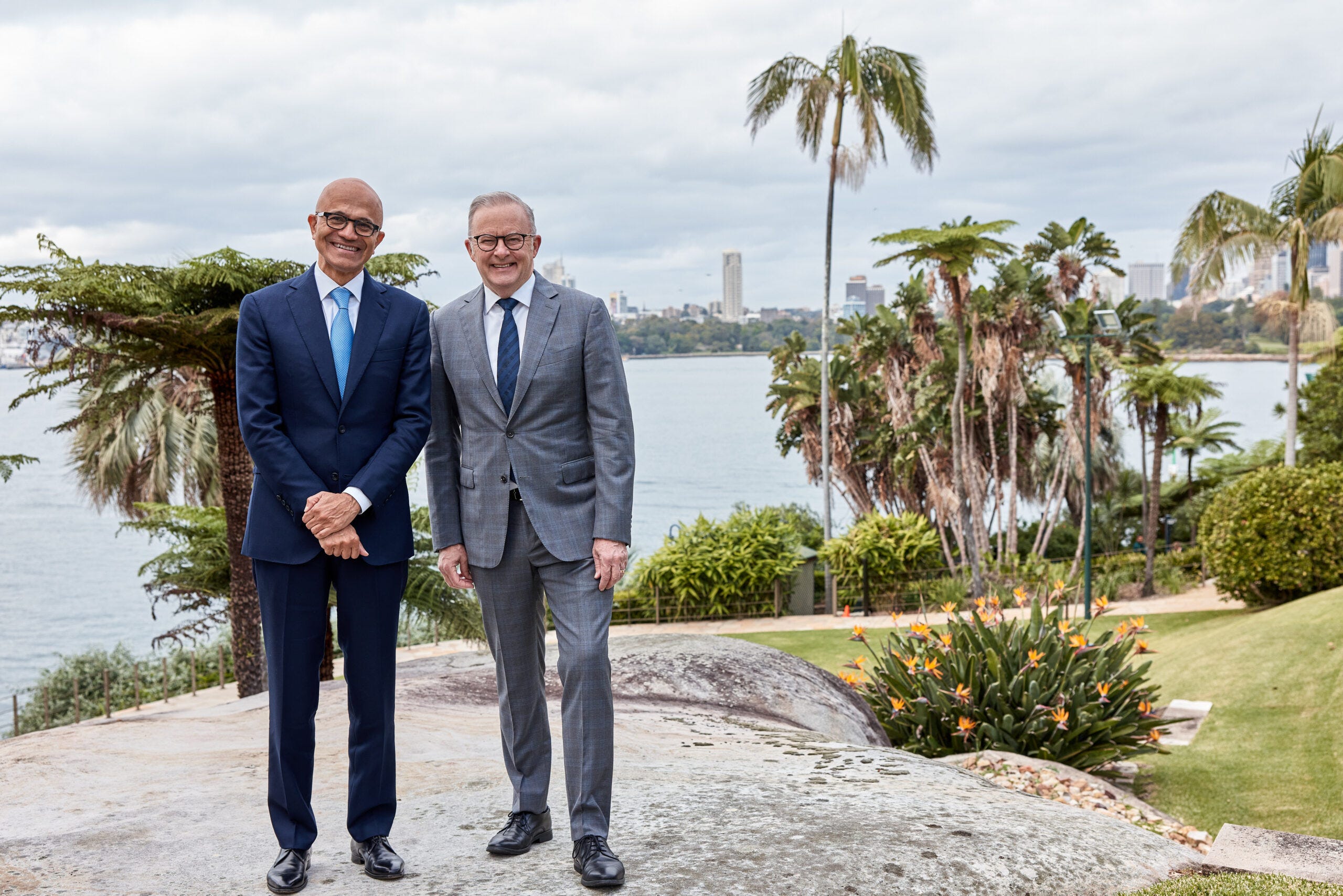
(L-R: Microsoft CEO Satya Nadella with Australian Prime Minister Anthony Albanese in Sydney. Microsoft's A$25B commitment is its largest-ever Australian investment)
Charlie Gearside Launches “Build Australia”
What happened: Charlie Gearside, co-founder of Eucalyptus, has launched Build Australia, a platform for essays, data visualisations, and software projects designed to push the cultural Overton window on what Australia is willing to attempt. His opening salvo was sharp: “Australia has grown fat and comfortable over the last 30 years. We have stopped valuing the hard stuff.”
It is part essay collective, part action platform. Tools and dashboards that make a positive, build-focused future legible. Houses, companies, products, films, infrastructure: whatever it is, the bet is that Australia needs more of it shipped, faster, with less apology.
Why this matters: This sits alongside a small but growing cluster of founder-led civic projects across ANZ. It is distinct from the formal lobbying of the Tech Council and StartupAUS, pointed at a different audience: the people who would build, not the people who would regulate. The diagnosis (we have stopped valuing the hard stuff) is one many ANZ founders agree with privately. Saying it publicly, with a brand and a platform behind it, is the move.

Cuttable Coffee Club Sydney: 75 Founders, Operators, and Customers Show Up
Following the inaugural Melbourne Coffee Club in March, Cuttable brought the format to Sydney — and 75 attendees turned up: customers, e-commerce operators, marketers, and members of The Commons. The event has quickly become one of the more interesting recurring gatherings in the Sydney creative-tech scene, and a window into how Cuttable is using community as a top-of-funnel motion alongside its product growth.
Takeaway: Two cities, two sold-out Coffee Clubs, in two months. Community-led growth still works — when the people running it are genuinely good at the social side of the job.
Quantum Brilliance CTO at Materials Research Society Spring Meeting. Quantum Brilliance Co-Founder and CTO Marcus Doherty is presenting at the Materials Research Society Spring Meeting on 29 April. His talk explores quantum sensing technologies and their applications in materials research — the kind of frontier-science stage that signals where QB is positioning for its next phase of customer development.
Customer Success Manager at Restoke
Location & type: Port Melbourne, Australia, full-time
What they do: Restoke is the AI operations platform for hospitality — recipe costing, supplier management, and the back-of-house workflows that move margin in restaurant groups.
What you’ll do: Own the customer relationship from onboarding to expansion. Work directly with hospitality operators to embed Restoke in how they run, and translate field signal back into product priorities.
Do you have a job you’d like us to promote? Add it to Hatch and share the link with us.
See all jobs across the Rampersand Portfolio.
Andrew will be also attending Sunrise in Sydney and events on 29th and 30th of April. Reach out to grab a coffee.
📍 SYDNEY — Apr 29, 2026 (TONIGHT)
100 builders, 11 hours, $200K+ USD in prizes, and the build challenge drops on the day. Hosted at UTS Startups in Ultimo, organised by Gabriel Chua and Thomas Jeng. Rampersand Partner Andrew Poesaste is on the judging panel.
🔗 RSVP here. | Andrew’s LinkedIn announcement
📍 SYDNEY — Apr 30, 2026
Blackbird’s annual festival of creativity, technology, and ambition returns to Carriageworks. Not a business conference — a cultural celebration where founders, operators, and creatives gather to stretch the edge of what feels possible. Andrew Poesaste will be attending.
Thanks for being part of the Rampersand Community! You can stay updated with even more news and info on our LinkedIn and X/Twitter pages.
No posts
Comments
Nothing yet. Say the first thing.
Sign in to join the conversation.