
For over a century writers on Sikh history were working with only half the archive.
The better known sources are the janamsakhis, court chronicles, later Persian histories and the writings of European travellers.
What has received less attention are the private records kept far from Punjab at places most historians of the Gurus rarely visit.
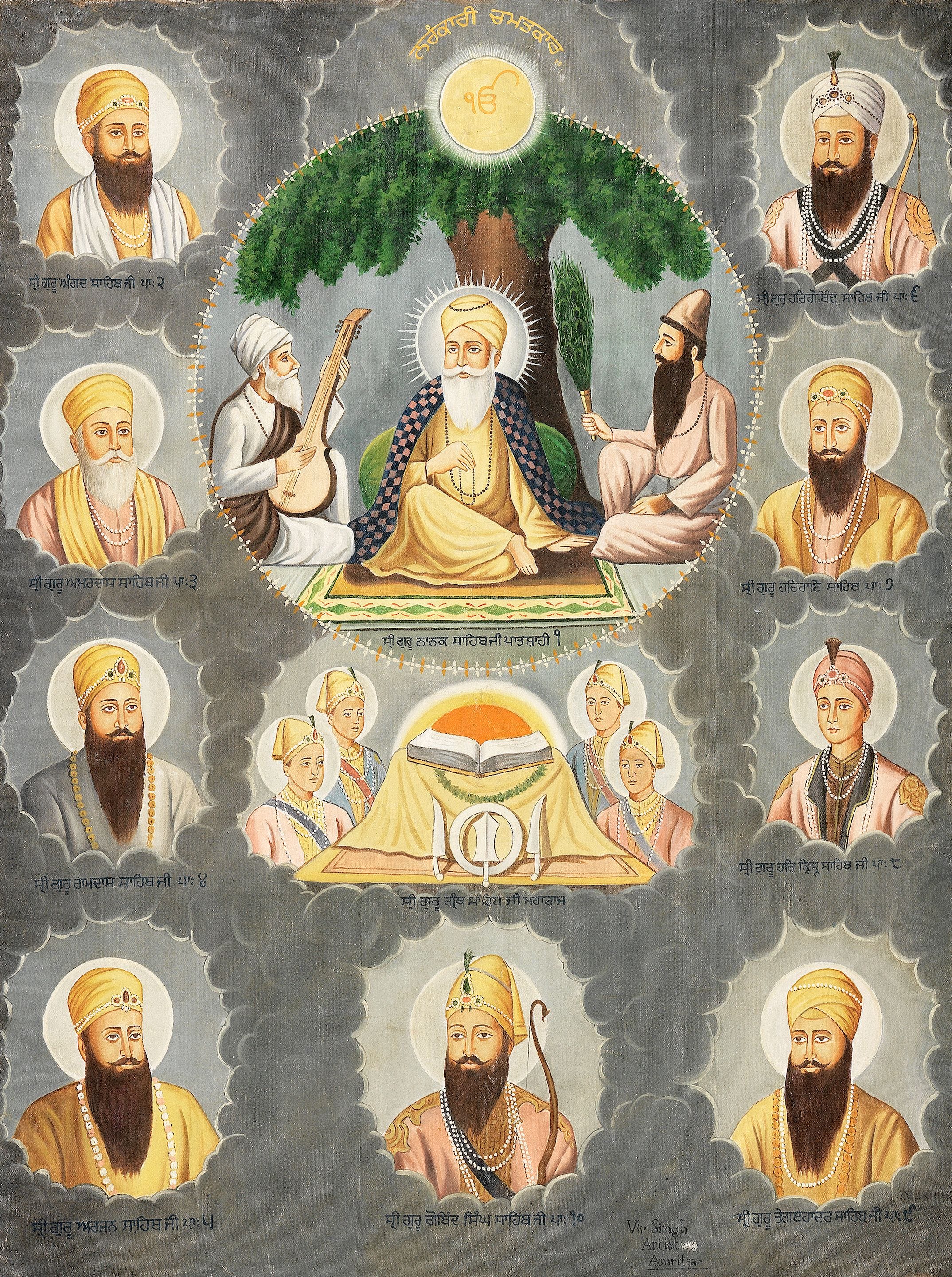
These are the Panda Vahis, the genealogical registers maintained by professional priests at Hindu pilgrimage centres and they may hold some of the earliest written traces linked directly to the Sikh Gurus and their families.
The records list births, deaths and lineages, connecting the Gurus to groups such as Bedi, Bhalla and Sodhi. They suggest that even as Sikh philosophy developed its own distinct path, Sikhs still moved within the wider social world around them.
It is worth distinguishing the Panda Vahis from a related but separate tradition, the Bhatt Vahis. Readers may be more familiar with the Bhatt Vahis, since the well-known Guru Kian Sakhian by Swaroop Singh Kaushish is largely based on their entries.
Where the Panda Vahis were kept by Brahmin priests stationed permanently at pilgrimage sites and updated only when families arrived to perform rituals, the Bhatt Vahis were maintained by wandering bards and genealogists who travelled to their patrons’ homes to record births, weddings and other occasions as they happened.
The Bhatts were poets as well as record-keepers, and their scrolls often mixed verses honouring their patrons with genealogical and historical data, written in their own script known as Bhattakhri.
Both sets of records have been used by historians. For instance, Dr Fauja Singh drew on both Panda and Bhatt Vahis in his Guru Tegh Bahadur: Martyr and Teacher (1975) to reconstruct details about Guru Hargobind and Guru Tegh Bahadur.
However, both sets of records represent different angles of observation: one fixed at the sacred site, the other moving with the family.
This article is concerned with the first tradition, the Panda Vahis, and the untapped potential they hold for early Sikh history.
At first glance the Vahis look unremarkable. They are working notebooks kept by Brahmin priests at sites such as Haridwar, Allahabad, Kurukshetra and Varanasi. Pilgrims arrived to make ritual offerings and the priests recorded their names, castes, lineages and locations.
Yet as Madan Jit Kaur shows in A Study of the Panda Vahis as Source Material for the History of the Sikh Gurus (1978), generations of Sikh families also passed through these pilgrimage towns and left signatures, dates and biographical details that place the Gurus firmly within a wider north Indian religious world.
More importantly for historians like myself, it opens up a tantalising new source of historical material.
The paper highlights striking examples. One folio from Panda Ram Kishan at Allahabad contains two entries that have long been the subject of debate among scholars.
The first records Guru Tegh Bahadur writing in 1719 that the guruship had travelled through the Sodhi family line from Guru Arjan to Guru Har Rai and then to himself.
The second carries what the Panda insists are the signatures of Guru Gobind Singh Ji made while travelling towards Anandpur.
The entries give genealogical detail, identify their caste as Sodhi Khatri, locate their ancestral home near Lahore and direct descendants and Sikhs to honour the family priests at the site.
A second folio from Kurukshetra preserves the names of Mata Gujari and Mata Sundari visiting Haridwar with the adopted son Ajit Singh.
Just a quick aside, this Ajit Singh was not Sahibzada Ajit Singh, the eldest son of Guru Gobind Singh, who had been martyred at the Battle of Chamkaur in 1704. This Ajit Singh was a boy adopted by Mata Sundari in Delhi after the loss of all four Sahibzade, named after her late son on account of his resemblance to his namesake.
The Mughal Emperor Bahadur Shah later treated the adopted Ajit Singh as Guru Gobind Singh's heir, but his story ended badly: he grew arrogant, was disowned by Mata Sundari and was eventually executed by the Mughal authorities in 1725.
The rest of this article is for paid subscribers.
The Panda Vahis may preserve signatures linked to Guru Tegh Bahadur and Guru Gobind Singh, as well as a record of Mata Gujari and Mata Sundari travelling with the adopted Ajit Singh.
But the real significance of these registers is larger than any one entry.
They complicate the way we think about early Sikh identity, pilgrimage, family networks and the wider social world in which the Gurus lived. They also raise an uncomfortable possibility: that some of the most important material for Sikh history may still sit in private records that historians have barely examined.
Once the Sikh History at the World Cup series is complete, paid subscribers will also get deeper articles on Sikh and British history, alongside the research, sources and fuller stories behind each country in the series.
Comments
Nothing yet. Say the first thing.
Sign in to join the conversation.