
The Ministry of Finance’s recent Nepal’s Current Economic Situation Report (hereafter, the Report) sets out to present a realistic assessment of the economy and to provide a basis for policy direction. That objective is both timely and important. Economic policy must begin with diagnosis, and a well-documented report is a necessary foundation for that process.
This commentary is written in a spirit of constructive hope. I have welcomed this government and have argued elsewhere that Nepal may have an opportunity to begin a stronger phase of economic takeoff under its watch. I continue to wish it every success. But success requires clarity. Problems must be stated accurately before policies can be designed effectively. This note is offered in that spirit—as a complement to the Report and as a contribution to the shared goal of Nepal’s economic transformation.
The value of any diagnostic exercise depends not only on the data it presents, but also on how that data is interpreted. In this regard, the Report leaves room for a more careful reading. In some cases, its presentation of evidence risks creating an impression of stronger economic performance than a more structured analysis would support. In others, important facts are presented without being fully articulated into a coherent economic story. A short report cannot do everything, which makes prioritization even more important: the main trends must be identified clearly, and the most consequential evidence must be brought to the surface.
This note has five objectives. First, it examines how aspects of the Report’s data presentation may create a misleading impression. Second, it suggests that the Report does not state Nepal’s long-term growth underperformance forcefully enough. Third, it argues that the diagnosis is broadly in the right direction, but that its central message is often buried under too many indicators. Fourth, it notes that some indicators important for economic takeoff—especially those related to productivity, investment quality, and the effective use of infrastructure—are left out. Finally, while the Report is more concise than many government documents, several sections could still have been condensed so that the main economic story emerged more clearly. Taken together, these issues point to a broader concern: the Report contains many of the right elements, but does not organize them in a way that clearly reveals the underlying weakness in Nepal’s growth process.
This note focuses on growth, investment, trade, energy use, regulation, remittances, and fiscal structure because these are not isolated indicators. Together, they form the core channels through which an economy either moves toward structural transformation or remains trapped in low-productivity expansion. The purpose is not to cover every issue raised in the Report, but to bring its central economic story into sharper focus, strengthen the interpretation of key indicators, and add a few missing dimensions that are especially relevant for assessing Nepal’s growth prospects.
The Report would also have benefited from a clearer presentation format. Much of the evidence is already provided in the appendix, yet many figures are repeated densely in the main text rather than organized through charts, tables, or concise summary indicators. As a result, important patterns are harder to see, and the central message is sometimes diluted. A report intended to guide public understanding should not merely reproduce data in prose; it should help readers interpret what the data mean.
Although the Report mostly covers 2016 to 2025, this note uses data from 2006 onward where available. In the line charts, the period covered by the Report is shaded. The longer horizon makes it possible to compare the recent decade with the previous one and assess whether Nepal’s economy has truly shifted onto a stronger path.
At the heart of this issue lies a basic but critical distinction: the difference between nominal expansion, measured in current prices, and real progress, measured in inflation-adjusted terms. The Report frequently highlights increases in Gross Domestic Product (GDP), trade, and government revenue in current prices, sometimes expressed in US dollar terms. These figures do show substantial increases. However, nominal values are influenced by inflation and exchange rate movements. If the price of a good doubles while the quantity produced remains unchanged, its nominal value also doubles, even though real production has not increased. What matters for economic performance and living standards is real progress, not nominal expansion.
Appendix Table 1 illustrates the problem. The Report shows Nepal’s GDP at current prices rising from Rs 2.6 trillion in 2016 to Rs 6.1 trillion in 2025, more than doubling in nine years. But for comparisons across time, GDP should have been converted into 2025 prices and reported in real terms. Presenting only real values would have shown the actual increase in output without allowing inflation to exaggerate the change. On that basis, GDP rises from about Rs 4.1 trillion in 2025 prices to Rs 6.1 trillion. The same applies to GDP per capita. Instead of showing a nominal rise from US$888 to US$1,496, the Report should have shown the inflation-adjusted rise from about US$1,065 to US$1,496. The point is not intention, but proper presentation: for judging economic progress over time, official reporting should use constant-price values, not current-price values.
A more meaningful assessment requires a shift in perspective: from levels to rates, from nominal values to real indicators, and from isolated statistics to structural relationships.
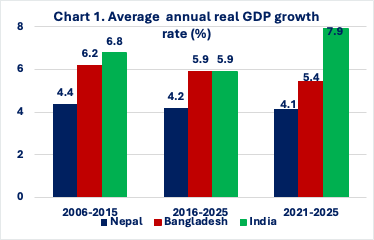
Nepal’s economic growth over the past decade has remained modest and has not accelerated. Real GDP growth has hovered around four percent, with fluctuations but no sustained upward shift in the trajectory. For an economy at Nepal’s stage of development, this should be a concern. Countries at similar levels typically experience phases of rapid expansion driven by structural change, rising investment, and deeper integration into global markets. That pattern is not evident here.
A regional comparison reinforces this point. India and Bangladesh have achieved higher and more sustained growth over comparable periods (Chart 1). The gap may appear small in any given year, but it compounds over time into significant differences in income, productivity, and opportunity. The divergence is even more striking in recent years. Over the last five years, India’s growth rate has been substantially higher—nearly double Nepal’s. The fact that India’s decade-average growth is not much higher than Nepal’s reflects the large negative shock from COVID-19, which affected more globally integrated economies more severely. Nepal, being less integrated, experienced a smaller disruption. This makes the recent divergence more meaningful, not less.
Despite its importance, growth does not receive sufficiently forceful treatment in the Report. Economic growth is the single most important indicator of long-term prosperity, yet it is discussed only briefly and without strong emphasis on Nepal’s relative underperformance compared to comparators. Moreover, the Report does not fully situate Nepal’s performance in a comparative context. If neighboring economies facing broadly similar global conditions consistently grow faster, that should be treated as a warning signal.
Source: World Bank
The concern is greater when viewed alongside the conditions that supported growth. The past decade saw rising public borrowing, large and sustained remittance inflows, and a still-favorable demographic structure. These factors should, in principle, have supported stronger growth. If growth did not accelerate despite these advantages, it suggests that Nepal’s underlying growth engine remains weak.
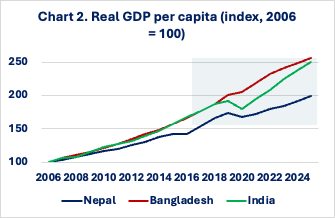
To understand how living standards have changed over time, total GDP is not the right measure. What matters is income per person, GDP adjusted for population. Because population continues to grow, per capita income rises more slowly than total output. This makes it the more relevant measure of economic progress. Measured in real terms and indexed over time, Nepal’s GDP per capita has increased steadily, but only gradually. The trajectory is upward, but the slope is modest. When placed alongside India and Bangladesh, the divergence becomes increasingly clear (Chart 2).
This matters because development is ultimately judged by improvements in living standards. On that measure, Nepal has been falling behind. Its per capita income remains significantly lower than that of its neighbors, and the gap has widened over time. In 2025, Nepal’s per capita income of US$1,496 is about 53 percent of India’s and 56 percent of Bangladesh’s. Two decades ago, Nepal’s income stood at roughly three-quarters of Bangladesh’s and two-thirds of India’s.
The implication is clear. Living standards in Nepal are improving, but not fast enough to keep pace with comparable economies. In relative terms, Nepalis are not catching up—they are falling further behind. If the Report had presented Nepal’s per capita income alongside its regional peers, this reality would have emerged more clearly and more forcefully—prompting a more urgent reassessment of the policies shaping growth, investment, education, health, infrastructure, technology, and trade.
Source: World Bank
If growth has remained modest, part of the explanation lies in investment. Investment—spending on machinery and equipment, industrial facilities, infrastructure, energy, and technology—is the main channel through which economies expand productive capacity and raise efficiency. Periods of sustained acceleration are almost always associated with rising and effective investment.
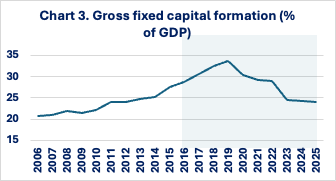
The Report documents recent movements in investment and notes its decline. That observation is important. Investment as a share of GDP increased for much of the past decade, reaching relatively high levels by the late 2010s (Chart 3) and suggesting the possibility of stronger growth. However, this momentum has not been sustained. In recent years, investment has fallen, indicating that capital formation is no longer sufficient to support faster growth.
The broader implication, however, receives less emphasis in the Report. The issue is not only the decline in investment, but also the weak conversion of savings into productive capital. Nepal does not appear to face a simple shortage of resources. While domestic savings are limited, national savings are supported by large remittance inflows. Yet a significant portion—about one-third—does not translate into investment. Instead, it appears to flow into consumption, real estate, idle balances, or other low-productivity uses. This points to a structural weakness that the Report touches on only indirectly.
There is also a qualitative dimension that is largely absent from the Report’s discussion. The efficiency of investment appears to have weakened, with more capital required to generate a given increase in output. In the last five years, Nepal needed roughly $10 of investment to generate $1 of additional GDP, while India required only about half that amount. This points to broader constraints—implementation delays, regulatory complexity, weak project selection, and low productivity of capital—that reduce the effectiveness of investment. In this sense, Nepal’s investment challenge is not simply to raise the investment rate, but to improve the environment in which investment is converted into output.
The implication is clear. Nepal’s investment problem has three dimensions: too little investment, too much saving left outside productive use, and too little output from the investment that does occur. Recognizing all three is essential if investment is to play the role the Report assigns to it in supporting future growth.
Source: World Bank and the Report of Ministry of Finance, Nepal
A related factor behind both weak investment and the rising capital-output ratio is the regulatory environment. The Report recognizes that weak governance, transaction costs, and policy uncertainty obstruct growth, and its broader spirit is supportive of private-sector participation. Yet it does not sufficiently address private-sector concerns, including how excessive, poorly designed, or discretionary regulation weakens incentives for entry, expansion, formalization, and risk-taking. Delays in approvals, uneven enforcement, and high compliance costs do not only discourage investment; they also reduce the productivity of investment that occurs. In this sense, regulation affects both the quantity and the efficiency of investment.
This is why the investment problem cannot be solved simply by calling for more investment. Nepal must also improve the conditions under which investment is converted into output.
The Report also highlights progress in physical infrastructure, noting that blacktopped roads have expanded significantly over the past decade and that electricity generation has increased more than fivefold to exceed 4,000 megawatts. These are important achievements and should be recognized. But their interpretation requires care. Such investments are already reflected in overall GDP growth, which, as shown earlier, has remained modest. Scale also matters. An increase of roughly 1,000 kilometers of paved roads per year may be meaningful, but it must be assessed against Nepal’s geography, population, connectivity gaps, and the large public resources devoted to roads. The relevant question is not only whether the road network expanded, but whether the expansion generated value for money and raised productivity.
The more important issue is energy use. The Report notes that electricity generation capacity has exceeded 4,000 megawatts and again reminds readers of Nepal’s large hydropower potential. That is a real achievement, but it is not the same as economic transformation. Nepal remains one of the lowest energy-consuming economies in the world. Even within that low level, roughly two-thirds of energy use still comes from traditional sources such as firewood, agricultural residue, and animal waste, while electricity accounts for only about 10 percent of total energy consumption. The Report does not confront this issue.
Real transformation requires modern energy, especially electricity, to be used widely in factories, farms, transport systems, businesses, and households. In a context where domestic electricity use remains so limited, exporting power is a sign of economic weakness, not strength. Nepal’s challenge is not simply to generate electricity, but to build an economy that uses it productively.
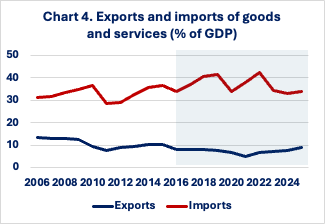
For a small economy like Nepal, the external sector is central to growth and rising living standards. Nepal’s exports remain low and relatively stagnant as a share of GDP, reflecting limited integration into global production networks and weak competitiveness in tradable sectors. Imports, by contrast, remain consistently high. The resulting trade deficit is large and persistent (Chart 4). It is not a temporary fluctuation, but a structural feature of the economy. In simple terms, Nepal consumes more than it produces. The Report provides useful trade data, but it does not present this long-term imbalance clearly enough.
The Report’s treatment is also incomplete because it focuses only on goods trade and makes no mention of services trade. This is a significant omission, and Chart 4 addresses it by including both goods and services. For an economy like Nepal, services, especially tourism and related activities, are an important source of foreign exchange and should be analyzed alongside goods. This gap matters because the dynamics of services trade have changed. Nepal once benefited from a surplus in services, supported mainly by tourism. More recently, however, services trade has moved into deficit, as spending by Nepalis abroad, including education and travel, has outpaced earnings from foreign visitors. This shift has further weakened Nepal’s external earning capacity and deepened the overall imbalance.
Source: World Bank and Nepal Rastra Bank, Quarterly Economic Bulletin
The recurrent problem of nominal reporting also appears in the presentation of goods exports. The Report notes, both in the main text and in the appendix, that exports increased in nominal terms from about Rs 70 billion to Rs 277 billion over the past decade. On the surface, this appears substantial. But the more relevant question is whether exports have increased relative to the size of the economy. Expressed as a share of GDP, exports show little sustained improvement. The rise in nominal values therefore does not, by itself, indicate stronger competitiveness or deeper integration into global markets. There is also a risk in emphasizing a single-year outcome. The most recent export figure appears unusually high relative to previous years and may not be sustained. For structural assessment, longer-term trends provide a more reliable guide than one exceptional data point.
The Report also states that Nepal’s trade is India-centric. That is true, but it is not the central problem. The deeper issue is that Nepal exports too little everywhere: to India, to China, and to the rest of the world. Concentration in one market matters, but weak export capacity matters more.
The bottom line is that the Report does not provide a complete picture of Nepal’s trade sector. It relies too heavily on nominal and absolute values, gives insufficient attention to persistent trade deficits, and leaves services trade out of the analysis altogether.
One factor behind Nepal’s weak export performance is the appreciation of the real exchange rate. At first glance, the Nepali rupee appears to have depreciated sharply: when Nepal fixed its exchange rate with the Indian rupee in the early 1990s, one US dollar exchanged for about Rs 49; today it exchanges for roughly three times that amount. But the nominal exchange rate does not tell the full or correct story. What matters for competitiveness is the real exchange rate, which adjusts for inflation differences between Nepal and its trading partners. On that measure, over the last decade compared to the mid-1990s and early 2000s, Nepal’s currency vis-à-vis the US dollar has appreciated by about 79 percent. This has made Nepali goods and services more expensive relative to foreign competitors and weakened export competitiveness.
The Report mentions exchange-rate issues only briefly, but this deserves much greater attention. If Nepal is serious about reviving exports, it cannot ignore real exchange-rate appreciation, domestic cost pressures, and productivity gaps. Export revival will require not only better infrastructure and simpler regulation, but also a careful assessment of whether Nepal’s price competitiveness has been steadily eroded.
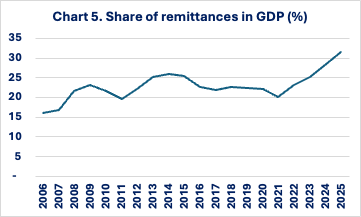
The Report recognizes remittances as a stabilizing force in the external sector, but it does not sufficiently acknowledge that they are also part of the problem. Remittances help sustain the persistent trade deficit by financing imports and supporting domestic consumption. Over time, these inflows have risen sharply, now exceeding 30 percent of GDP (Chart 5). In an economy with a flexible exchange rate, such large inflows would typically lead to currency appreciation. In Nepal’s case, with a fixed exchange rate and limited policy adjustment elsewhere, the burden of adjustment has fallen on the real economy—through weakened domestic industry, job losses, and increased migration.
Trade deficits and remittances should therefore not be seen as separate issues. They are closely linked, each reinforcing the other. The analysis would have been stronger had it connected remittances more directly to Nepal’s weak production structure. External balance is maintained, but not through production. That is the central point.
Source: World Bank and the Report of Ministry of Finance, Nepal
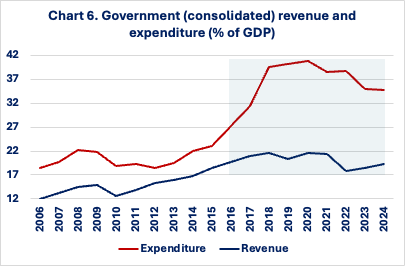
The Report rightly identifies several fiscal concerns: expenditure has risen, revenue collection has weakened in recent years, tax revenue depends heavily on goods and import-related taxes, and a large informal sector remains outside the tax net. These concerns are valid. But the fiscal story is not simply one of low revenue. Government expenditure rose sharply over the past decade, at times reaching close to 40 percent of GDP. It has since declined, but still remains above one-third of GDP (Chart 6). Revenue, by contrast, has remained around 20 percent of GDP and has softened only modestly in recent years. This suggests that fiscal pressure has come not only from weak revenue mobilization, but from expenditure growth that has outpaced the government’s sustainable revenue base.
This distinction matters. By regional standards, Nepal is not a low-tax economy. Its tax-to-GDP ratio appears higher than India’s and far above Bangladesh’s in recent years. The deeper problem is a narrow productive base, heavy reliance on import-related taxes, and spending commitments that have expanded faster than the economy’s ability to finance them. Bringing more informal activity into the tax framework is important, but the answer cannot simply be higher tax rates. If anything, the priority should be better compliance, a broader base, and more efficient spending.
The Report also leaves an important presentation gap. Its appendix provides revenue data for both the federal government and all three levels of government, but does not provide a comparable consolidated expenditure series for all three levels. This matters because provincial and local governments account for 30 percent of public spending. Without consolidated expenditure, it is difficult to assess the full fiscal position. The chart below attempts to fill that gap.
Source: Various Economic Survey of Ministry of Finance, Nepal and the Report
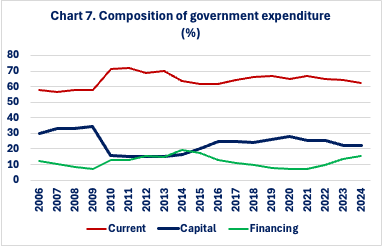
The composition of spending is equally important. A large share of public expenditure goes to current spending, while capital expenditure remains limited (Chart 7). Current spending may be necessary, but it does not by itself expand productive capacity. Capital expenditure, by contrast, supports infrastructure, productivity, and private investment. One of the reasons of low investment that we showed above is due to low capital expenditure.
Source: Various Economic Survey of Ministry of Finance, Nepal and the Report
The fiscal problem, therefore, is not only the size of spending, but its structure. Nepal’s fiscal policy has become more consumption-oriented than investment-oriented. That weakens the state’s ability to support long-term growth. In this sense, fiscal policy has not fully complemented the broader objective of economic transformation.
The Ministry of Finance Report presents a wide range of data across multiple sectors. Much of this information is valuable and relevant. However, the Report often remains descriptive, presenting individual indicators without fully integrating them into a coherent analytical framework. In some cases, the data are also not consolidated or complete in ways that allow readers to see the whole picture.
Key relationships between investment and growth, external flows and domestic production, and expenditure patterns and fiscal sustainability are not consistently drawn out. The Report provides information, but stops short of converting that information into a clear diagnosis of the economy. The issue is not simply data availability. The necessary elements are largely present. The challenge lies in consolidation, prioritization, and synthesis: identifying the most important patterns and explaining how they interact to shape economic outcomes.
A more integrated approach would help clarify the central issue: Nepal’s economy has expanded, but it has not yet evolved into a pattern of sustained structural transformation comparable to what its regional peers have achieved.
Nepal’s economy has expanded, but it has not transformed. That is the central message that emerges from a closer reading of the data. Growth has continued, but it has not accelerated. Income has risen, but slowly relative to regional peers. Investment has weakened, and a significant share of savings is not being translated into productive capital. Exports remain thin, while remittances sustain consumption and external balance. Public spending has increased, but remains tilted toward current expenditure rather than capital formation. These are not signs of crisis. But they are not signs of takeoff either.
The Report contains many of the right data points, and in several places its diagnosis moves in the right direction. Its weakness is that the central story is not stated sharply enough. The issue is not that Nepal lacks resources, but that it does not use them productively. The economy has not built the productive capacity, competitiveness, and domestic absorption needed to convert resources into sustained growth. Nominal numbers can make expansion look impressive. But the real test is structural change—whether the economy is becoming more productive, more competitive, and more capable of generating opportunity at home. On that test, Nepal still falls short.
The task ahead is therefore not merely to grow, but to grow differently: to convert savings into investment, investment into output, energy into productivity, and remittances into domestic opportunity. That is the difference between expansion and transformation.
No posts
Comments
Nothing yet. Say the first thing.
Sign in to join the conversation.