
Nepal’s 2082 proportional vote is significant not only because it changed the relative standing of parties, but because it reveals a broader shift in the country’s political balance. Over the past two decades, Nepal’s electoral landscape was shaped largely by competition among the Left, the Nepali Congress, and, more recently, newer challengers. The latest result suggests that this balance has now changed in a significant way. The long-dominant Left has lost much of its earlier electoral weight, the Nepali Congress has also weakened, and the Rastriya Swatantra Party has emerged as the largest force in the proportional vote. Taken together, these numbers point to a major realignment in the preferences of Nepal’s voters.
The chart below accompanying this article captures that movement over time. For many years, parties carrying communism or socialism in their names occupied a large share of Nepal’s political space. They did so through different organizations, alliances, and splits, but together they formed a powerful electoral bloc. In most elections, there were at least seven to eleven communist parties in the field in one form or another.
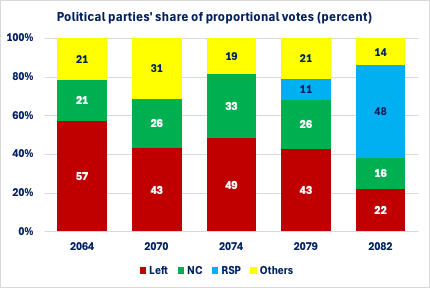
Years are in Bikram Sambat (BS), Nepal’s official calendar, roughly 56–57 years ahead of the Gregorian calendar depending on the month; thus, the election held on 5 March 2026 appears as 2082. Left includes all parties whose names contain communist, Marxist, Leninist, Maoist, or socialist, along with Rastriya Janamorcha and Nepal Majdoor Kisan Party. In each election, there were roughly 7 to 11 such parties. Abbreviations: NC = Nepali Congress; RSP = Rastriya Swatantra Party; Others = all remaining parties contesting the election.
Seen over time, the trend is striking. In the first Constituent Assembly election of 2064, the combined vote share of the Left stood at 57 percent, the highest point in this series. In the second Constituent Assembly election of 2070, that figure fell to 43 percent. Then, in 2074, after the Constitution of 2072, the two largest fractions, UML and Maoists, entered the election as a coalition with a common manifesto, and the Left share rose again to 49 percent. In the 2082 election, however, the Left’s combined vote fell to 22 percent. Compared with 2064, that is a decline of 35 percentage points over eighteen years. Whatever interpretation one brings to it, this is a substantial change in the political weight of the Left in Nepal’s electoral system.
The Nepali Congress (NC) has also seen a notable decline in its share of the proportional vote. Its strongest showing in this series was 33 percent in 2074. In 2082, its share fell to 16 percent, 17 percentage-points lower than that peak. This suggests that the latest election was not only a story of reduced support for the Left, but also one of weakening support for another long-established national party.
The most striking movement in the chart is the rise of the Rastriya Swatantra Party (RSP). In 2079, RSP received 11 percent of the proportional vote. By 2082, that figure had climbed to 48 percent, an unusually large gain within such a short period. At the same time, the remaining 14 percent of the vote is spread across more than twenty smaller parties, with even the largest of them receiving only around 3 percent. The collective share of these smaller parties also fell noticeably in the latest election.
Taken together, these numbers suggest that voters did not simply drift away from the traditional parties into a fragmented field. Instead, a substantial portion of that support appears to have consolidated around one newer political force.
One way to understand the result is to look at the broader balance between political traditions. If the Nepali Congress and the Rastriya Swatantra Party are grouped together as parties broadly situated within a liberal democratic tradition, their combined vote in 2082 comes to 64 percent. By contrast, the combined vote of the Left stands at 22 percent. On that basis, support for the broad liberal democratic camp is now nearly three times as large as support for the Left. That does not mean every voter is thinking in ideological terms, nor does it mean every vote should be read as a doctrinal statement. Elections are shaped by many factors, including leadership, performance, public mood, and the desire for change. Still, numbers of this scale do suggest a meaningful shift in the country’s political center of gravity.
The main point, then, is not to overstate one election, but neither is it to understate it. Nepal’s 2082 proportional vote appears to mark a major electoral realignment. The Left, once the dominant force in popular vote terms, has seen a steep decline. The Nepali Congress has also lost ground. And the Rastriya Swatantra Party has emerged as the principal beneficiary of this changing political landscape.
Even on a strictly factual reading, the result is significant: Nepal’s electorate has redrawn the balance among its major political forces. Whether this shift proves temporary or enduring will become clearer only over time. But a larger question remains. If this electoral shift also proves to be an ideological one, Nepal’s Left will have to confront an uncomfortable truth: much of this damage was self-inflicted.
No posts
Comments
Nothing yet. Say the first thing.
Sign in to join the conversation.