
After publishing Ambition Without Arithmetic—which you can read here on Substack—I received a thoughtful question from an international development practitioner who works on Nepal’s economic policy. His question was simple: if countries elsewhere have achieved 7 percent growth or more in earlier decades, why should Nepal not do the same? This note is my response.
It does not repeat the earlier essay; rather, it extends the argument with new material, additional clarification, and supporting charts.
The charts below are meant to ground that debate in structure rather than aspiration. They show why Nepal’s challenge is not merely to set ambitious targets, but to build the economic and institutional machinery needed to turn savings into investment, investment into productivity, and potential into sustained growth. My argument is not that Nepal cannot grow faster, but that sustaining 5 percent annual growth over the next five years would itself be a major structural achievement—and a more credible foundation for aiming higher thereafter.
The question is framed in terms of aggregate GDP growth, but my paper uses GDP per capita growth, which is the better measure of how fast average income is actually rising. In Nepal today, the difference between the two is limited because population growth has been close to zero. With a broadly stable population, 7 percent GDP growth is effectively very close to 7 percent per capita GDP growth. That is why I examined how often Nepal has historically reached the 7 percent per capita threshold.
However, this is not the central point of the paper. My intention was to illustrate how sporadic and rare it has been for Nepal to reach such levels of growth in a sustained manner. Many of the high-growth episodes—particularly in 2017 and 2018—were reconstruction-driven, reflecting a temporary rebound from capital destruction following the earthquake rather than a structural acceleration in productive capacity. Some other episodes likely coincide with the completion of large hydropower projects, which create one-time increases in output. Though important, they do not necessarily represent a self-sustaining growth process that can be easily replicated as a long-term strategy.
Moreover, in economies that experience natural calamities and political disruptions, it is analytically more appropriate to examine three-year moving averages rather than single-year observations, which can be volatile and episodic. I did not fully implement that approach partly due to the need to produce it quickly after all four parties’ manifestos were released. That said, the broader point remains unchanged: Nepal does not yet have a sustained history of repeatedly achieving such high growth rates.
You are correct that if one looks at GDP growth, there are more individual years to note.
I will revisit the Growth Commission Report and the countries you cited later in this note.
You raised several important questions in this section. Specifically, you asked:
(1) whether the investment number I used refers to public investment, private investment, or both; (2) whether I considered possible “crowding-in” effects of public investment on private investment; and (3) whether the required financing could come from sources such as excess banking liquidity, public debt, foreign reserves, or diaspora investment.
The investment requirement presented in the paper refers to total investment—public and private combined—since both ultimately contribute to expanding productive capacity. I did not separately model crowding-in or crowding-out effects; rather, I worked with the aggregate investment number without imposing assumptions about its precise composition or financing source.
Before addressing the financing channels you mentioned, it is useful to look at Nepal’s saving–investment structure over time.
Here is the core structural issue as shown in chart below. Domestic saving in Nepal is approximately 6 percent of GDP. National saving—largely driven by remittances—is approximately 36 percent of GDP, while total investment is only about 24 percent of GDP. This implies that roughly one-third of national saving is not translated into domestic productive investment. Instead, these resources remain in bank deposits, gold holdings, land speculation, or potentially exit the productive system altogether, including through capital flight (I have discussed this issue in more detail in a recent op-ed, https://myrepublica.nagariknetwork.com/news/investment-nepals-broken-link-to-prosperity-51-78.html).
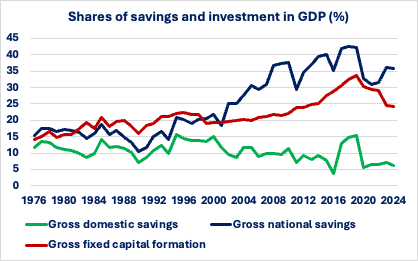
This also speaks directly to your question regarding excess liquidity in the banking system. In principle, excess liquidity could finance higher investment. In practice, however, the constraint appears not to be the availability of funds but the absence of sufficiently bankable and credible investment opportunities. Despite historically low interest rates, borrowing for productive investment has remained weak, reflected in the widening gap between national saving and actual capital formation.
What about external borrowing? Certainly, Nepal could borrow in international markets, and its current debt levels remain manageable by international standards. However, the recent experience raises an important concern. Since 2015, Nepal’s debt-to-GDP ratio has nearly doubled—from approximately 24 percent to 44 percent—implying an annual increase of roughly 19 percent (see the chart below). Yet, during the same period, per capita GDP growth has remained modest, as discussed earlier.
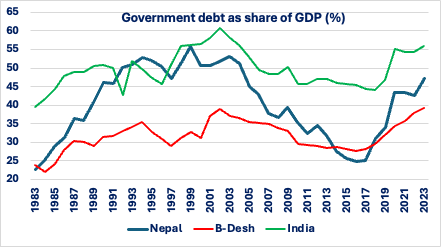
This suggests that the issue is not simply access to borrowing, but the effectiveness with which borrowed resources are deployed. Borrowing can support growth if it finances productive investment that expands future income. However, if borrowing is used primarily to support consumption or low-return activities, it increases liabilities without strengthening the economy’s productive capacity. Its growth impact depends entirely on the strength of the conversion mechanism that translates financial resources into sustained productivity and income growth. That remains the central challenge for Nepal.
Regarding foreign reserves, Nepal is one of the few countries with the highest foreign reserve–to–GDP ratios—currently around 50 percent. I have not been able to verify whether this is among the highest globally, but it would certainly place Nepal in a very small group of countries. However, these reserves are largely used to finance imports, predominantly consumption goods. Because exports finance only a small fraction of imports and viable large-scale domestic investment opportunities remain limited, these hard-earned foreign exchange reserves are primarily used to sustain the consumption base rather than expand productive capacity.
As for diaspora financing, I believe its potential is significant but not yet fully realizable. Even as the Nepali diaspora accumulates financial and human capital, investing in Nepal requires confidence in the domestic institutional environment. This includes the rule of law, predictable regulatory frameworks, and protection against corruption and arbitrary policy shifts. The diaspora has natural advantages—familiarity with the country’s geography, culture, and economic landscape—but these advantages alone are not sufficient. Converting diaspora resources into productive investment requires a credible and reliable investment climate.
More broadly, all the sources you mentioned—bank liquidity, foreign borrowing, foreign reserves, and diaspora financing—represent potential channels of investment financing. The binding constraint, however, is not the availability of financial resources, but the presence of an economic and institutional environment capable of channeling those resources into productive investment. At present, that environment remains incomplete.
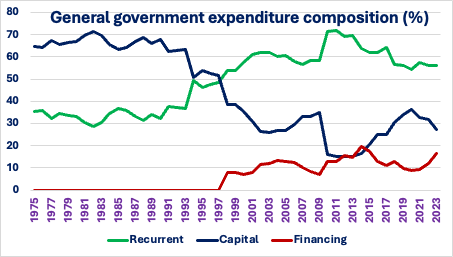
If you wish to examine the potential role of public investment as a catalyst—what you referred to as the crowding-in effect—the chart below is instructive. The blue line represents public investment (capital expenditure). Increasingly, a large share of government revenue is absorbed by recurrent expenditure, leaving limited fiscal space for sustained capital investment. This constrains the government’s ability to play a catalytic role in stimulating private investment.
You correctly noted that the Growth Commission Report highlighted exports as a central driver of sustained high growth. In that context, you raised several important questions: (1) whether exports can play that role in Nepal; (2) whether Nepal can develop comparative advantage and leverage its geographic position between two large economies; and (3) whether Nepal should expand its export base through natural resource development. The answers, in principle, are “yes,” “yes,” and “yes.” However, it is important to examine the current structural reality.
First, regarding potential, there has recently been some growth in software and IT-enabled service exports, and there is understandable optimism surrounding this development. However, for exports to have a meaningful macroeconomic impact in an economy of nearly 30 million people, expansion must occur at a much larger scale. Whether such scaling is currently underway remains uncertain.
Nepal’s external structure presents clear constraints. Currently, exports are approximately 8 percent of GDP, while imports are approximately 33 percent of GDP. Net exports are therefore structurally negative. In the national income identity, Y=C+I+G+(X−M), the contribution of X− M is negative. This implies that growth must rely disproportionately on domestic consumption and investment. As discussed earlier, investment itself faces structural conversion constraints.
This imbalance, as shown in the chart below, results in a large and persistent trade deficit, financed primarily by remittances rather than export earnings or sustained capital inflows. While remittances provide important foreign exchange stability, they do not substitute for an export base capable of sustaining productivity-driven growth.
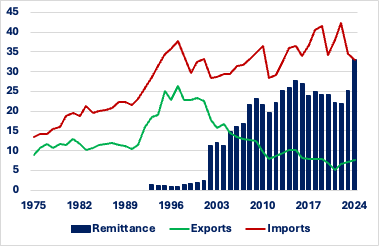
Historically, economies that achieved prolonged high growth relied heavily on export expansion to achieve scale, absorb domestic production, and sustain rising investment. In Nepal’s case, expanding exports would require substantial improvements in competitiveness, infrastructure reliability, regulatory predictability, and production scale. The potential exists, but realizing it requires structural changes that go beyond identifying export sectors, it requires building the institutional and economic conditions necessary for sustained export growth. Nepal is a country where exports finance only one-fifths of exports.
Similarly, attracting export-oriented FDI is an important objective. However, it requires a credible ecosystem—policy stability, reliable infrastructure, contract enforcement, and deeper market integration. These conditions can certainly be built, but they cannot be assumed to exist automatically or immediately. Nepal does possess natural resource potential, particularly in hydropower. However, that potential has existed for decades. Without improvements in governance, project implementation, and policy consistency, it is difficult to assume that FDI mobilization will accelerate simply because the potential exists. Resources alone do not attract investment; credible and predictable systems do.
I fully agree with your reference to the Growth Commission Report. The experience of countries such as Korea, China, and Singapore shows that sustained high growth is possible—but it also demonstrates the scale of structural transformation required, particularly in investment, export expansion, and institutional effectiveness.
The central argument of my paper is not that high growth is impossible for Nepal, but that achieving it requires structural changes in different aspects. Every country operates within constraints; our task as economists is to understand those constraints and relax them where feasible.
If Nepal were able to ease its structural constraints, raising annual per capita growth from 1.9 percent (the average of the last five years) to around 5 percent would already represent a major acceleration—more than doubling recent performance. Sustained at that rate, income would rise by roughly 26 percent over five years, laying the foundation for even stronger gains thereafter.
However, Nepal is not there yet. The challenge is whether the new government can build what I describe as the “conversion mechanism”—the institutional and economic system that translates saving into investment, investment into productivity, and productivity into sustained income growth. At present, this mechanism remains weak.
Even basic structural indicators raise concern. Nepal’s overall energy use remains among the lowest in the region, and only about 10 percent of total energy consumption comes from electricity, with nearly two-thirds still derived from biomass. When an economy remains at such a stage of energy use and structural transformation, it is difficult to confidently project sustained 7 percent annual per capita growth. I sincerely hope I am proven wrong.
I share your optimism that Nepal can accelerate growth with better reforms, stronger governance, and a credible economic strategy. The current political transition may indeed offer an opportunity to reset expectations and policies. The purpose of this note is to keep that discussion grounded in arithmetic and structure, so that ambition is matched by a realistic understanding of the conditions required to sustain it. Targets matter. But without mechanisms, they risk becoming slogans. My argument is not against ambition; it is for ambition that rests on a coherent and achievable growth framework.
Nepal is not without potential. It has human capital, substantial remittance inflows, financial depth, geographic proximity to two major economies, and underused opportunities in hydropower, tourism, and services. The question is not whether faster growth is possible, but whether the institutional system can convert these endowments into sustained productivity gains.
In my view, Nepal’s core challenge is not the absence of savings or ambition, but the absence of a robust conversion mechanism: one that translates savings into productive investment, investment into sustained income growth, export potential into export capacity, energy production into widespread energy use, and labor migration into productive domestic employment supported by skills. If Nepal can build these conditions, I would be among the first to revise my assessment. Even a sustained rise to 5 percent per capita growth would represent a major structural shift. A sustained 7 percent trajectory would be transformative—but the roadmap must come before the promise.
I hope this exchange contributes to a broader, evidence-based policy discussion on Nepal’s economic future. I remain optimistic that the current political moment can still be used to move in this direction and to place Nepal on a more credible path toward sustained per capita growth of around 5 percent.
No posts
Comments
Nothing yet. Say the first thing.
Sign in to join the conversation.