
In a still from her film Tashan (2008), Kareena is stepping out of the ocean, a lime green bikini glinting off her pale skin. Her taut abdomen and toned thighs and arms—and, at close glance, a few ribs—were testament to what had already been immortalized by the national news: Kareena’s new ‘size zero’ figure.
‘It was exactly at that time that I was looking at myself and thinking, “Oh my god, I look very ugly.”’ Like myself and several other young Indian women, this girl was ‘maturing’ at the time—realizing how crucial her body was to how she was perceived in the world.
I was fifteen and weighed 79 kilograms when Tashan came out. A year and a half later, I weighed 54 kilograms. Male friends would try to kiss me soon after. Being desirable to men, I was told, is good. Being untouched by them somehow—even better. What a confusing country and set of norms.
For this triumph, I had run, counted calories, cut out all sugar, and eaten no carbs but fruit; when I stopped getting thinner after all of this, I ran even more and replaced a lunch of one roti, salad, and veggies with raw tomatoes.
This is the thing about disordered eating in India: it is hard to be named as such. It can get rewarded as discipline, as dedication, as ‘being careful.’
The generation of women that grew into calorie-counting apps, YouTube workouts, and the creep of Western body ideals into Indian family kitchens absorbed a great deal of damage without a vocabulary for it.
Women’s bodies are everyone’s business but their own. They belong to the family’s gaze, to flippant comments from relatives, the prospective husband’s family’s inspections.
What you absorb, growing up, is a sort of permanent self-surveillance. The body becomes a site of moral judgment, coming from caste-class factors, before it is seen as a source of personal truth and experience.
Now you have more awareness, through Instagram carousels and the rise of wellness and self-care and self-love industries, but those too are subsumed under capitalism, inseparable from every other visual we’re inundated with at once today.
“It is no measure of health to be well-adjusted to a profoundly sick society.” — Jiddu Krishnamurti
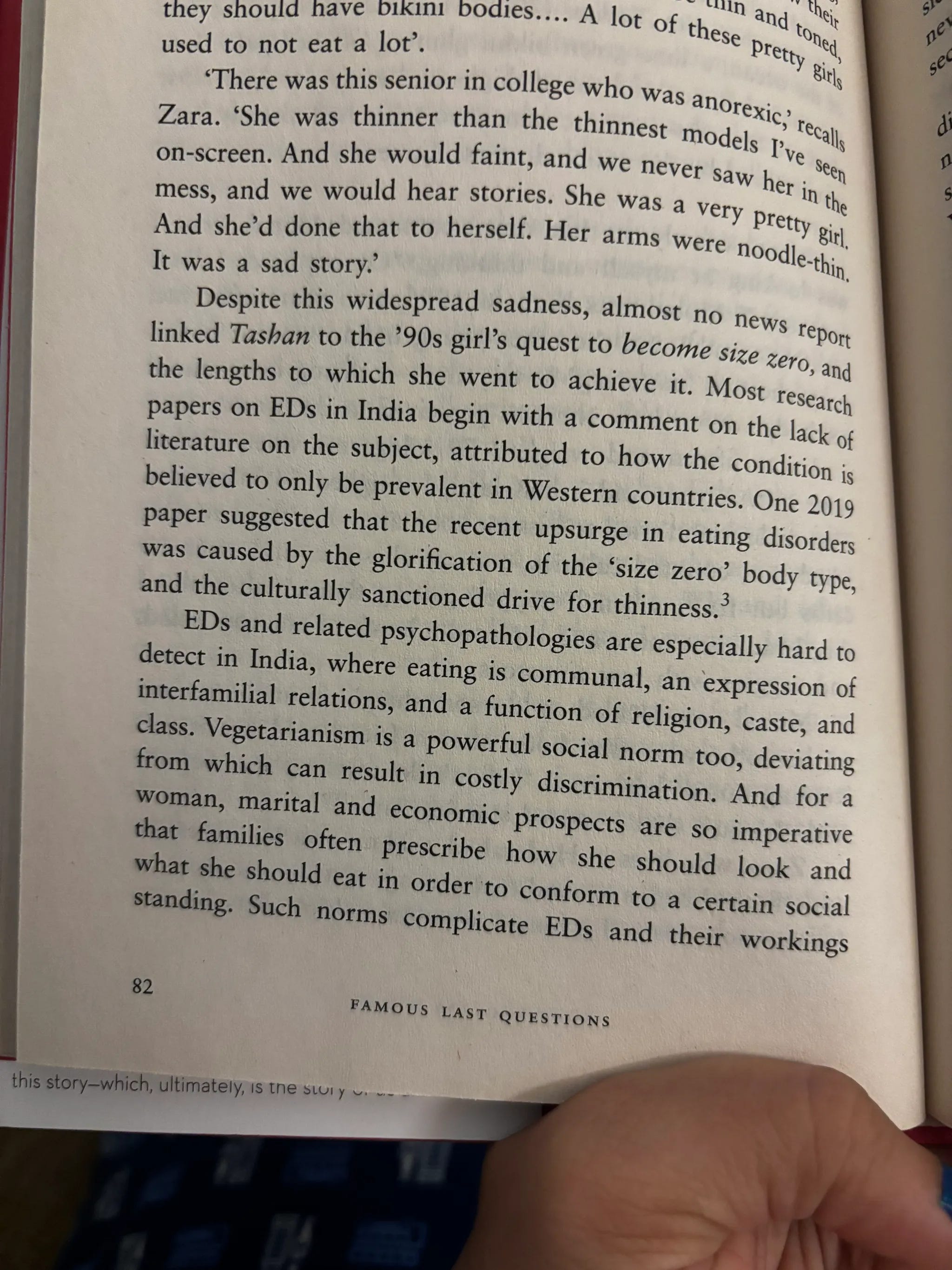
Read the full essay—on the connections between eating disorders and body image, Bollywood, caste, class, gender, age, and everything else honestly—in Chapter 3 of Famous Last Questions. In case you haven’t yet, please also leave a review on Amazon and Goodreads.
No posts
Comments
Nothing yet. Say the first thing.
Sign in to join the conversation.