
Two supervisors in Larry Krasner’s office filed a July 20th motion in federal court claiming that their boss had threatened them with “consequences” if they blew the whistle on an ongoing cover up in the D.A.’s office allegedly ordered by Krasner himself.
But the two DAO supervisors went ahead and blew the whistle anyway.
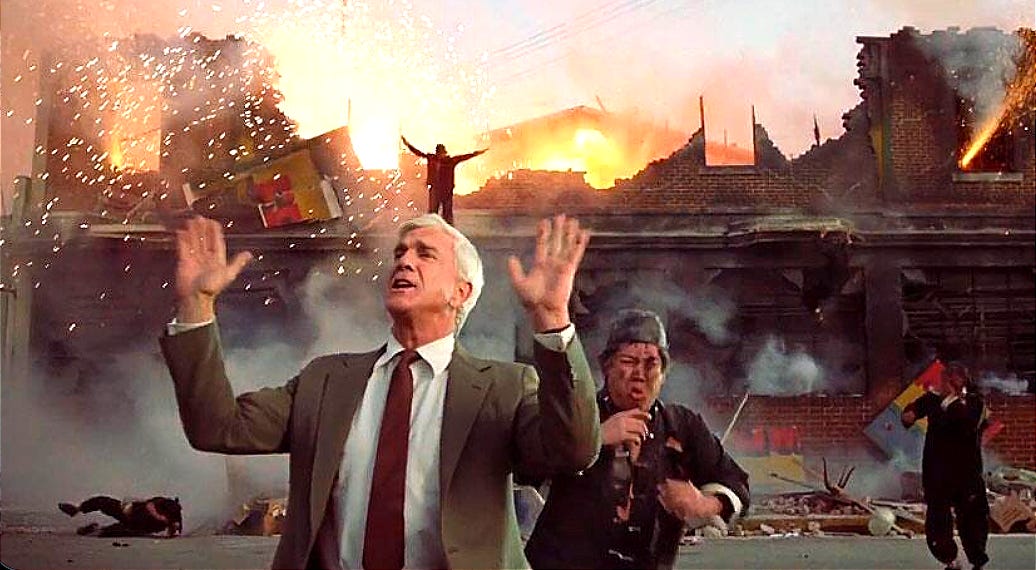
Yesterday, Krasner filed a motion in court responding to those charges. And in that motion that he signed, Krasner channeled Detective Lt. Frank Drebin of Naked Gun fame, by essentially telling U.S. District Court Judge Paul Diamond, “Nothing to see here.”
In an 11-page “Response to Notice Conflict,” Krasner claimed that the original “Notice of Conflict” from his two supervisors was “inappropriately filed, filed without authorization from the DAO, and is ill-informed.”
Then, Krasner went a step further.
In the latest motion filed in court, Krasner claimed that a July 25th meeting at the D.A.’s office where the D.A. allegedly made his threat was a confidential meeting.
And that the two supervisors who ratted him out, ADAs Katherine Ernst and Steven Wildberger, were not authorized by Krasner to tell the judge about how the D.A. behind closed doors was allegedly threatening them not to reveal a cover up.
The “Response to Notice Conflict” signed by Krasner and ADA Thomas Gaeta states that “The preliminary deliberations ADAs Ernst and Wildberger participated in and relied upon in their ‘Notice of Conflict’ are confidential and protected by the deliberative process privilege.”
Sorry Lawrence, but the deliberative process privilege doesn’t extend to fraud.
On top of that, ADA Gaeta has already tried to pull an official DAO veil of secrecy over the corruption in Krasner’s office, and failed miserably.
At an evidentiary hearing on July 17 before Judge Diamond, ADA Gaeta tried to assert that DAO emails and memos in the possession of whistleblower Jaclyn Mason were confidential attorney work product.
Diamond promptly overruled the objection. The judge then told ADA Gaeta that the records that former ADA Mason brought to the witness stand would not only be used in court, but would also be made part of “the public record.”
In his new motion, Krasner never addressed his alleged threat of “consequences.” Nor did he ever get around to denying that he had directed a cover up.
It’s going to be hard for Krasner to claim the D.A.’s office wasn’t running a cover up.
That’s because on April 21st, ADAs Ernst and David Napiorski appeared at a hearing before U.S. District Court Judge Gerald Pappert in a similar case involving Krasner’s attempts to spring Lavar Brown, another convicted killer, out of prison.
And at that hearing, according to a court transcript, ADAs Ernst and Napiorski essentially told Judge Pappert a fairy tale.
About how the two ADAs had allegedly reformed Krasner’s Law Division, which handles appeals, by issuing new written policies that did away with Krasner’s corrupt former practices that judges had objected to.
And, Ernst told the disbelieving judge, Krasner had nothing to do with any of it. Ernst told Judge Pappert that she acted on her own, and that Krasner had supposedly given her carte blanche to overhaul the Law Division.
Judge Pappert, however, wasn’t buying it.
‘And I’m finding it hard to believe that you were just given the discretion to change whatever policies and practices you want,” Judge Pappert told Ernst. “And there wasn’t a fulsome discussion with Mr. Krasner about any of this. That’s difficult to believe.”
“I have no recollection of any such discussion,” Ernst told the judge, while continuing to cover up for Krasner.
At the July 17th evidentiary hearing, whistleblower Jaclyn Mason told the judge about how ADAs Ernst and Napiorski wanted her to pull the same routine with Judge Diamond.
Admit fault, Mason said that Ernst and Napiorski told her, and assure Judge Diamond that we’ve fixed everything.
Regarding the snow job Ernst and Napiorski gave Judge Pappert, Mason told Judge Diamond, “I can’t believe they did it.”
In their motion, ADAs Ernst and Wildberger told Judge Diamond that they believe the DAO has an institutional conflict of interest.
Why? Because they’re trying to cover up prosecutorial misconduct by another supervisor, ADA Matthew Stiegler, who’s the supervisor of Krasner’s so-called Conviction Integrity Unit.
Although Mason signed a response brief contaminated with false facts, a response brief that attempted to win a new trial for convicted killer Dennis Johnson, it was ADA Stiegler who actually wrote that brief, Mason told Judge Diamond.
“I was Matt’s pawn,” Mason testified.
But once again, Krasner told the judge about that alleged institutional conflict, “Nothing to see here.”
As the motion filed by Krasner and Gaeta declares, “After much internal deliberation, including consultation with a number of ethics experts, the DAO determined that it is not burdened by an institutional conflict of interest.”
At this point, it’s comedy to think that any judge should believe Larry Krasner when he’s trying to get a convicted killer out of prison.
Other lawyers following the case thought Krasner’s take was indeed laughable.
“The D.A. here says that the office had much deliberation over whether the DAO had an institutional conflict and consulted with a number of ethics experts on this,” wrote Mark Zecca, a former senior attorney in the city solicitor’s office.
“And after all of that deliberation the DAO concluded that the DAO did not have an institutional conflict,” Zecca wrote.
“The reason so much consultation was needed is because the institutional conflict is obvious,” Zecca wrote.
“This case cries out as an institutional conflict. The D.A. was involved. High level supervisors were involved and ADA’s are accusing each other of lying in the record.”
“This is a crisis in the D.A.’s office of a totally unprecedented nature,” Zecca wrote. “The idea that the D.A. does not have an institutional conflict is ridiculous.”
But according to Krasner’s motion, his office has taken “extraordinary measures” to make sure that the underlying case that caused all the trouble that’s now being probed in Judge Diamond’s courtroom, the DAO’s attempt to win a new trial for convicted killer Dennis Johnson, is currently being investigated by a newly hired ADA.
Krasner’s newest ADA is Jean Peters-Baker, who according to Krasner’s motion, has over 25 years of experience as a prosecutor, and was elected three times as D.A. of Jackson County, MO.
According to Krasner, Peters-Baker is going to review the Johnson case, and decide whether he deserves a new trial.
Apparently Krasner forgot that in a June 5th motion filed by four DAO supervisors, the four supervisors concluded that Johnson wasn’t entitled to a new trial.
Zecca took a dim view of Krasner’s new hire.
According to Zecca, the institutional conflict in Krasner’s DAO “can’t be remedied by Krasner picking a new lawyer to represent the office in the case because that lawyer reports to Krasner.”
In his most recent motion, Krasner argues that nobody should listen to ADAs Ernst and Wildberger. Why? Because, according to Krasner, those two supervisors were walled off from participating in the Johnson case after they formally withdrew their appearances on July 25th.
According to Krasner’s motion, “ADAs Ernst and Wildberger are disqualified from filing or speaking on behalf” of the DAO regarding the Johnson case.
So the two supervisors weren’t authorized to file that motion that revealed Krasner’s threats of “consequences” if they told Judge Diamond about the cover up allegedly ordered by Krasner.
What so many supervisors are trying to cover up at the DAO is that when ADA Stiegler oversaw the faulty response brief that sought a new trial for convicted killer Johnson, that brief was the result of collusion.
In the Johnson case, the fix was in.
According to former ADA Mason, before she even got assigned the case, Stiegler had colluded to free Johnson with the Pennsylvania Innocence Project, and federal defenders.
What Stiegler didn’t want the judge to know was that in Johnson’s appeal, the DAO didn’t do any independent investigation to determine whether any of the claims of Johnson’s advocates and lawyers were true or not.
As Mason told Judge Diamond, Stiegler kept telling her, “If it’s good enough for the Innocence Project, it’s good enough for me.”
So Stiegler fraudulently passed off to judges the work of Johnson’s advocates and defense lawyers as the DAO’s own work product. Without bothering to check out any of it.
And, in a related development, Jean Peters-Baker isn’t the only new lawyer in this case.
David Smith, Krasner’s longtime personal attorney, has entered his appearance on behalf of ADA Matt Stiegler.
Smith represented Krasner when former homicide prosecutor Carlos Vega sued the D.A. for alleged age discrimination after Krasner fired Vega.
Vega lost the case.
Smith also represents Krasner in the false and malicious prosecution case filed against the D.A. by Police Staff Inspector Joseph Bologna.
In Judge Diamond’s courtroom, Smith will no doubt be looking out for Krasner’s best interests as he defends Stiegler.
Judge Diamond hasn’t yet set a date for a second evidentiary hearing, where he has summoned four Krasner ADAs to testify about the faulty filing in the Dennis Johnson case — ADAs Ernst, Napiorski, Wildberger and Peter Andrews.
But several lawyers following the case have made a similar prediction.
In yesterday’s motion, Krasner took the unusual step of signing his name to it.
By doing that, lawyers following the case say, Krasner has dramatically upped his chances in Judge Diamond’s courtroom of being called to the witness stand.
No posts
Comments
Nothing yet. Say the first thing.
Sign in to join the conversation.