
According to the whistleblower testimony of former Assistant D.A. Jacyln Mason, the D.A.’s office under Larry Krasner has a cozy relationship with the Pennsylvania Innocence Project.
That’s the legal nonprofit that seeks to exonerate the wrongly convicted.
While testifying on July 17th at an evidentiary hearing in front of U.S. District Court Judge Paul Diamond, whistleblower Mason explained what happened before she was even assigned to review the appeal of convicted killer Dennis Johnson.
According to Mason, her boss, ADA Matthew Stiegler, had already worked out a deal with the Innocence Project and Johnson’s federal defenders, to grant a DAO concession that would give Johnson a new trial.
As Mason testified, Stiegler kept telling her, “If it’s good enough for the Innocence Project, it’s good enough for me.”
Soon after, Mason found herself on Zoom conferences with officials from the Innocence Project and Johnson’s federal defenders, working out the details of the DAO concession to benefit Johnson.
A concession that the DAO subsequently submitted to a U.S. Magistrate and a U.S. District Court judge.
A concession that according to the testimony of both Mason and Stiegler, was granted without anybody at the DAO doing anything to independently investigate whether the claims of Johnson’s advocates were true.
Krasner’s legal guardian
Mason’s whistleblower testimony was more bad news for the fortunes of the Innocence Project, which under Larry Krasner, has been enjoying unprecedented access to the D.A.’s office.
Just a month before, on June 16th, the state Supreme Court, in a majority opinion, appointed the state attorney general as Krasner’s legal guardian, whenever the D.A. seeks to grant future concessions to convicted felons such as Johnson.
In that same opinion, a majority of the justices on the state’s highest court condemned Krasner for issuing “highly problematic” concessions on appeals to 110 convicted killers.
After those setbacks, a couple of officials from the Innocence Project have gone on the offensive, trying to mitigate the PR hit they took in their crusade to free the wrongly convicted.
But their arguments are not only self-serving and intellectually dishonest, but also just plain wrong.
Looking under the hood
In a July 15th opinion piece for Krasner’s longtime publicists at The Philadelphia Inquirer, Zane Memeger, a former U.S. Attorney who’s now the executive director of the Innocence Project, claimed that the state Supreme Court’s decision to saddle Krasner with a legal guardian will make it harder to free the wrongly convicted.
In his essay, Memeger implied that the state’s highest court, as well as the A.G., were out to get poor Krasner:
While I am not in a position as the executive director for the Pennsylvania Innocence Project to comment on the animosity that appears directed at the district attorney, I do know from experience that some prosecutors and law enforcement officers conceal evidence . . .
Memeger then talked about the other 66 counties in Pennsylvania where local D.A.’s don’t have a legal guardian looking over their shoulder:
In Philadelphia County — where police and prosecutorial misconduct are historically known to have resulted in the convictions of innocent men and women — both the Supreme Court and the attorney general appear to support a world in which looking under the hood is a bad thing and needs to be curtailed.
Yo Zane. Perhaps you didn’t read that 109-page majority opinion of the state Supreme Court. Because here’s the bad news: a majority of the justices, with the assistance of the A.G., actually did take a look under the hood to see how Krasner was achieving his so-called reforms.
And a majority of justices on the state’s highest court found that in granting “highly problematic” concessions to 110 convicted killers, Krasner’s “prosecutors” were routinely:
— lying to and misleading judges;
— presenting false evidence to the courts while withholding real evidence;
— conducting shoddy investigations, while dodging required evidentiary hearings.
Yo Zane. It was’t animosity that prompted a majority of justices on the state Supreme Court to appoint a legal guardian for Krasner.
It was their objections to Krasner’s “prosecutors” routinely breaking the law and engaging in unethical conduct in their crusade to empty the prisons of convicted killers!
Wrongful convictions
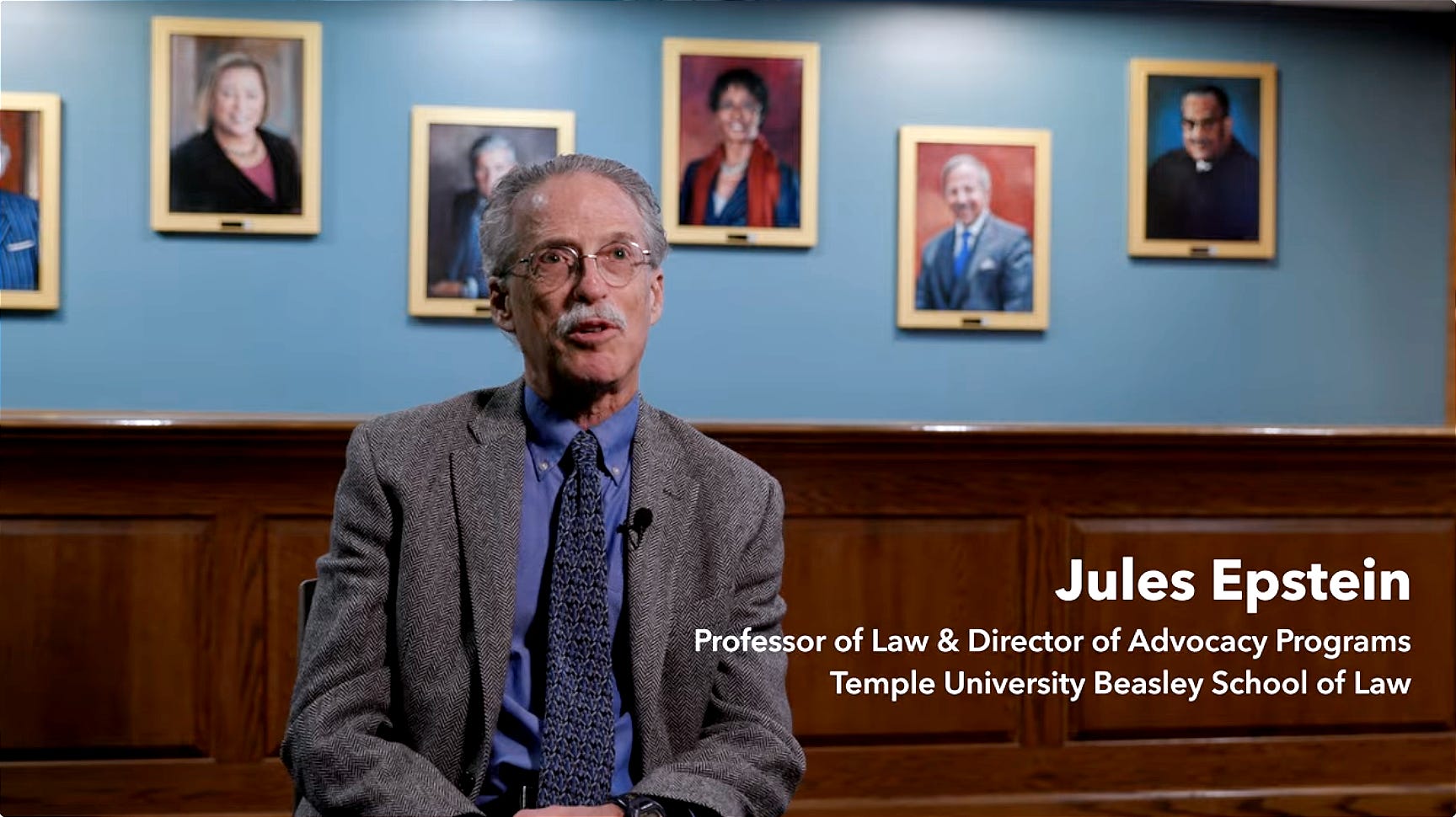
In the next phase of the propaganda campaign being waged by the Innocence Project, Professor Jules Epstein of the Beasley School of Law wrote an Aug. 6th commentary piece in The Legal Intelligencer entitled “Problematic Lawyering and Wrongful Convictions.”
In an essay that went out to the entire legal community, Epstein disingenuously stated that “This writer has worked in criminal law and wrongful conviction litigation for decades.”
More on that topic later.
Professor Epstein then proceeded to discuss the alleged facts in the case of convicted killer Dennis Johnson that’s currently the subject of ongoing evidentiary hearings in Judge Diamond’s courtroom:
Can I say with assuredness that Dennis Johnson is clearly innocent? No — I have not met with or heard the new witnesses or the store employee who has now changed his testimony and claims that Johnson was not the shooter after all. But just with the DNA and the egregious error at trial, this conviction shouts “wrongful.” One can’t be confident that the right person is behind bars.
While he was reviewing the facts in the Johnson case in his commentary, Professor Epstein somehow forgot to mention that four supervisors in Krasner’s DAO have already done just that.
And those four Krasner supervisors have already admitted in writing that after reviewing the record, the DAO’s concession granted to Johnson that was overseen by ADA Stiegler contained factual “misstatements.”
Namely, the four Krasner supervisors wrote in a motion to withdraw, the faulty concession got four key facts wrong regarding the trial testimony of the main eyewitness in the case, a store clerk who testified that he saw Johnson shoot Kenyatta Smith to death.
For the Innocence Project, the story gets worse.
Two of those DAO supervisors have subsequently filed another motion in court, claiming that Krasner threatened them with “consequences” if they blew the whistle on an ongoing DAO coverup.
What’s Krasner trying to cover up?
According to the testimony of whistleblower Mason, in the Johnson case, it’s the collusion between the DAO and officials from the Innocence Project, and federal defenders!
Collusion? What collusion?
In his commentary, Professor Epstein tried to explain away the whistleblower’s charge of collusion:
“Collusion” is not discussing a case, analyzing errors, and talking about which claim or claims would be the most supported and lend themselves to the most expeditious just resolution of the case. Cooperation does not mean that either party gives up their independent views of a case. What is required is an independent assessment by the prosecution of the merits.
Yo Professor Epstein. According to the testimony of whistleblower Mason, that’s precisely what was missing in the Johnson case — “an independent assessment by the prosecution of the merits.”
According to Mason, her boss, ADA Stiegler, told her, “If it’s good enough for the Innocence Project, it’s good enough for me.”
And that’s why the DAO was willing to fraudulently pass off to a U.S. Magistrate and a federal judge, the theories of the Innocence Project and Johnson’s federal defenders as the DAO’s own work product.
Without anybody at the DAO doing any “independent assessment by the prosecution of the merits” of the claims being made by Johnson’s advocates!
A history of wrongful convictions
Professor Epstein then tackled the topic of problematic lawyering:
Was there “problematic” lawyering in the prosecution’s office? That needs to be addressed, and the federal court will do that.
Sorry, professor, but four supervisors in Krasner’s office have already signed their names to a motion to withdraw that states that in the Johnson case, there indeed was problematic lawyering on behalf of Krasner’s DAO.
Problematic lawyering that resulted in the facts from the trial transcript being twisted so badly that the four supervisors concluded that Johnson no longer deserves a new trial.
Undaunted, Professor Epstein falls back on his firm belief about Philadelphia having a “history of wrongful convictions:”
But problematic or not, nothing should be done to discourage or limit case review — because Philadelphia has a history of wrongful convictions that continue to leave people imprisoned. And stories like Johnson’s need to be heard and remembered.
Sorry professor, but in the future, if you’re going to get more convicted killers out of prison, thanks to the decision of the state Supreme Court to appoint the AG as a legal guardian over Larry Krasner, you’re going to have to do it the old-fashioned way.
By holding evidentiary hearings, which, according to the state’s highest court, Krasner’s “prosecutors” have avoided like the plague.
Evidentiary hearings where you’re going to have to present evidence in court, and witnesses. And submit your arguments to the traditional adversarial form of justice.
So you’re going to have to do is prove in court that somebody was wrongly convicted. Before another jury verdict from decades ago is undone. And before a judge lets another convicted killer out of prison.
Failure to disclose
Here’s how Epstein is identified at the end of his commentary in The Legal Intelligencer: Jules Epstein is the Edward D. Ohlbaum Endowed Professor of Law at the Temple University Beasley School of Law.
Here’s what Professor Epstein didn’t disclose:
Besides being a professor of Law at Temple University’s Beasley School of Law, Epstein, by his own admission, has been deeply involved with the Innocence Project since before its inception.
He’s also appeared in court many times on behalf of the Innocence Project, testifying as an expert witness.
In 2013, according to the Inquirer, Epstein appeared in court as one of two lawyers representing the Innocence Project and their efforts to spring convicted killers Eugene Gilyard and Lance Felder.
Thanks to the efforts of the Innocence Project, both convicted killers were released later that same year.
When Krasner freed convicted killer Dontia Patterson during his very first exoneration, in 2018, the Innocence Project in a press release credited “Professor Jules Epstein [who] provided an expert report on problems with the crucial evidence offered in the case against him [Patterson].”
An expert witness
In a May 24, 2018 faculty commentary for Temple Law, Epstein explained his participation in the exoneration of Patterson:
I was asked by the Pennsylvania Innocence Project to review Mr. Patterson’s case to see whether, based on the science of eyewitness perception and memory, it was possible that an innocent man had been convicted.
In a case where the crime took only a few seconds and the witnesses were well over 100 feet away, that possibility was high.
A review of the trial transcript showed that Mr. Patterson’s own lawyer never demonstrated that the eyewitnesses could not have seen the shooter. A trip to the scene — apparently never undertaken by defense counsel — made this clear . . .
A visit to a crime scene
In the case of convicted killer LaFaye Gaskins, according to an Oct. 8, 2025 memorandum in U.S. District Court that freed Gaskins, Professor Epstein served once again as an expert witness for the Innocence Project:
Gaskins presented additional testimony from a Pennsylvania Innocence Project Investigator, John Butler (Butler), and an expert witness, Professor Jules Epstein . . .
Epstein was accepted as an expert in eyewitness identification and presented testimony regarding certain estimator and system variables that raise the risk of misidentifications.
Epstein testified that these variables would have negatively impacted [a witness’s] ability to identify Gaskins. Epstein further testified that certain system variables could negatively impact the ability of [another eyewitness] to testify accurately as well.
In 2023, the PCRA court granted Gaskins’ petition and vacated his murder conviction.
The go-to person
On May 13th, the officials at Innocence Project thought so much of the contributions made by Professor Epstein over the years that at its 17th Anniversary Celebration at the Fairmount Water Works, they gave Professor Epstein the 2026 Maureen Rowley Award.
On a video spotlight posted on youtube, Epstein explained, “My first interaction with the Innocence Project was when it was an idea. I watched it get built from the ground floor in Pennsylvania.”
Epstein said he welcomed his role in the Innocence Project as a way to help deserving individuals. But he also saw a higher purpose — “to go beyond the individual case and talk about system reforms that would reduce the risk of wrongful convictions.”
On the video, several people lauded the contributions that Professor Epstein has made to the Innocence Project.
“I don’t think there’s a way to put into words the impact that Jules Epstein has had on our work here at the Innocence project,” said Nilam Sanghvi, the Innocence Project’s legal director.
“He [Epstein] has supported us in every way,” Sanghvi said. “From representing clients, helping us with moving the law in the right direction through impact litigation strategy, serving as an expert witness.”
Sanghvi also credited Epstein with “helping us to think through our own case strategies” and “teaching our interns on all sorts of issues.”
“Everything he does is aimed towards achieving justice for everybody,” said Marissa Bluestine, former executive director of the Innocence Project.
According to Bluestine, Epstein seeks justice for “not just the ones that can afford it, but especially the ones who truly deserve it.”
“He’s the go-to person on a lot of issues in criminal justice,” agreed David Rudovsky, co-founder of the Innocence Project.
I sent a couple of emails to Professor Epstein, asking why, in his essay in The Legal Intelligencer, he didn’t disclose his longstanding involvement with the Innocence Project.
But I didn’t hear back from him.
Editors at the Legal also didn’t respond to requests for comment.
A Big Fat Lie
While crusading to free the wrongly convicted, the Innocence Project has had some prominent misfires. Faulty so-called exonerations that have not only cost city taxpayers millions of dollars, but also one man his life.
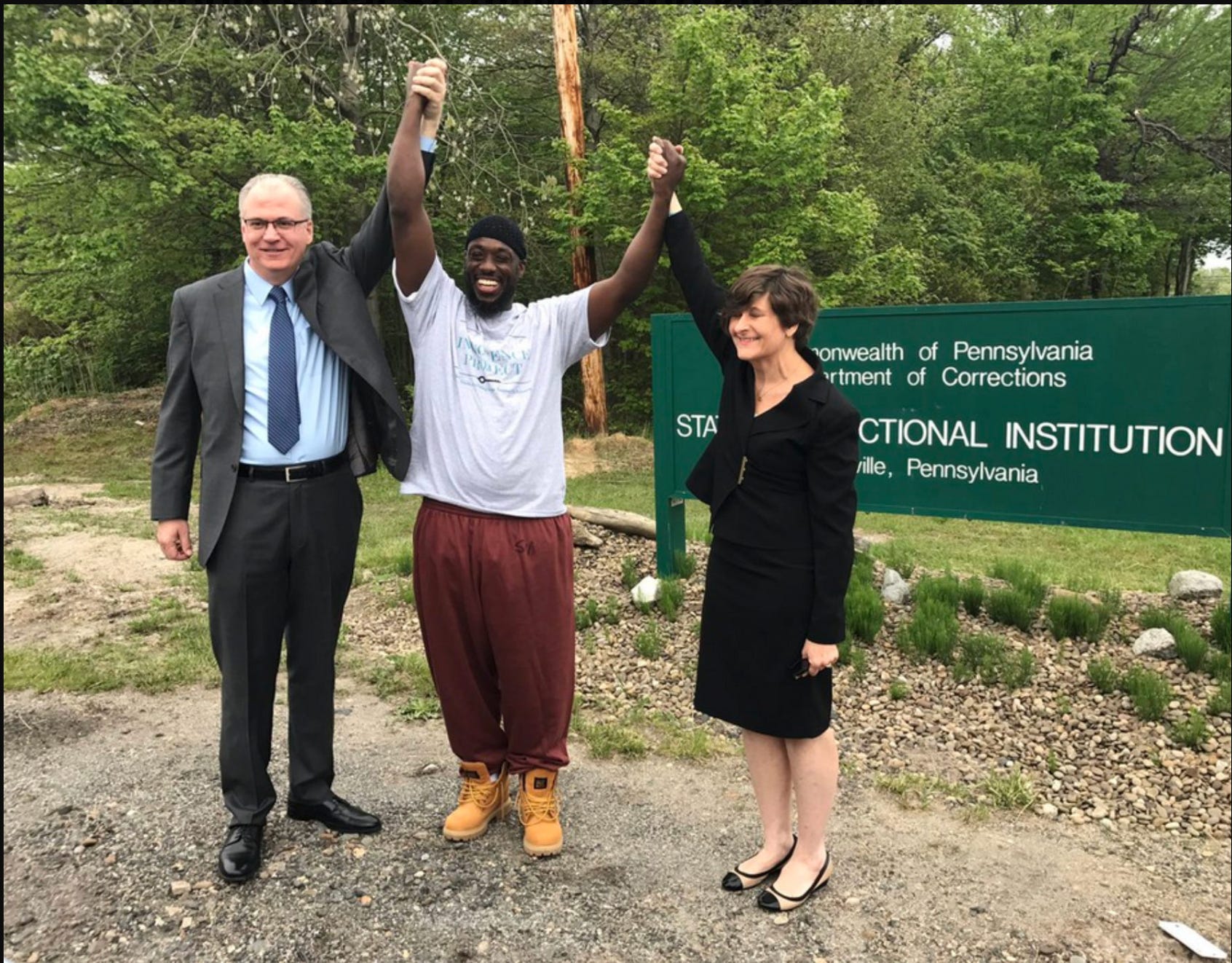
In 2016, lawyers at the Pennsylvania Innocence Project were convinced that Shaurn Thomas, pictured above, a convicted killer doing life without parole, should get out of prison, because of a supposedly air-tight alibi.
On the morning of Nov. 13, 1990, the Innocence Project lawyers argued, Thomas could not have robbed and killed 78-year-old Domingo Martinez in North Philly, as a jury had convicted him of doing.
Why? Because that morning, his lawyers claimed, Thomas, then just 16, was being interviewed at the Youth Study Center, after he got arrested the night before for attempting to steal a motorcycle.
At the D.A.’s office, then D.A. Seth Williams asked Assistant D.A. Mark Gilson, the head of Williams’s one-man Conviction Review Unit, to investigate Thomas’s alleged air-tight alibi.
And what did Gilson find — old police records that he told Big Trial conclusively proved that Thomas’s allegedly air-tight alibi was” a big fat lie.”
In an old filing cabinet, a police officer discovered a mug shot of Thomas on the day he was arrested, as well as a police log book.
The handwritten notes on the log book, Gilson said, showed that Thomas was arrested, processed and released for attempting to steal that motorcycle “at least 24 hours before the [Martinez] murder on Nov. 13, 1990.”
Gilson also told Big Trial that letting Thomas out of prison was a mistake, because Thomas was a “stone-cold killer.”
A stone-cold killer who, because of his advocates from the Innocence Project [seen above], not only got out of prison, but also hit the lottery.
After Thomas was freed, he sued the city of Philadelphia for being wrongly incarcerated for 24 years. And in 2019, Thomas collected from taxpayers $4,150,000.
But the stone-cold killer didn’t change his ways.
On Jan. 3, 2023, shortly after noon on the 3500 block of Germantown Avenue, Thomas accosted Akeem Edwards, a neighborhood drug dealer who owed Thomas $1,200 for a bag of coke.
In an incident caught on surveillance video, Thomas pulled a 9 mm gun out from under a pizza box, and fired three bullets into Edwards’ chest. Less than an hour later at Temple University Hospital, Edwards was pronounced dead.
Thomas was re-arrested and sent back to prison. He pleaded guilty to third-degree murder and was sentenced to 33 to 66 years behind bars.
“Egregious prosecutorial misconduct”
In 2018, with much fanfare in the media, District Attorney Larry Krasner announced his first so-called “exoneration” of Dontia Patterson, a convicted killer.
The newly emancipated Patterson subsequently sued the city for being wrongly incarcerated, and collected from taxpayers $1.7 million.
Krasner claimed that Patterson deserved to be freed because two former prosecutors, Beth McCaffery and Richard Sax, had allegedly committed “egregious prosecutorial misconduct.”
According to Krasner, the two prosecutors had repeatedly withheld from defense lawyers so-called exculpatory evidence that would have aided in Patterson’s defense.
As would turn out to be his practice, Krasner’s claims weren’t tested by an evidentiary hearing.
On Dec., 9, 2020, former ADA Beth McCaffery filed a Right-to-Know request, seeking her old files from the Patterson homicide case.
If produced by the D.A.’s office, McCaffery claimed, those files would prove that she had meticulously documented — with faxes sent to defense lawyers and fax confirmation pages that they sent back — how she had turned over to defense lawyers every piece of exculpatory evidence that Krasner had accused her of withholding.
The D.A.’s office, however, declined McCaffery’s request, claiming that those files were “privileged, confidential and constitute criminal investigative records.”
What followed was an epic, five-year battle in the courtroom of Common Pleas Court Judge Anne Marie Coyle over an appeal of the D.A.’s denial of McCaffery’s RTK request. Where for years, Krasner’s prosecutors claimed in court that McCaffery’s old files were either missing or lost.
The battle climaxed last year with an evidentiary hearing where Assistant D.A. Anthony Voci, Krasner’s former head of homicide, was called to the witness stand.
‘Virtually nothing’
Under oath, Voci admitted that when he filed the motion claiming that Patterson should be freed because of “egregious prosecutorial misconduct,” he hadn’t even read that motion before he signed it, under penalty of perjury, to verify that the allegations were true.
When asked by McCaffery’s attorney what he had done to verify the accusations of egregious prosecutorial misconduct, Voci replied, “Virtually nothing.”
Before he left the stand, Voci admitted that he had only signed the motion and presented it in court because he was ordered to do so by his superiors. And that the allegations he made in court against McCaffery weren’t true.
Judge Coyle concluded that Krasner’s prosecutors had most likely destroyed McCaffery’s old homicide files. So she fined Krasner’s office $120,000, plus court costs.
The judge also ordered all 300 of Krasner’s lawyers to take a remedial course on the Rules of Professional Conduct for lawyers. Especially, the judge said, the rules regarding “candor toward the tribunal.”
Birds of a feather
While freeing the wrongly incarcerated may be a good idea in theory, it’s clearly been proven to be a mistake to go along with Krasner’s concessions, as state and federal judges, the A.G., and justices on the state’s highest court have finally come to realize.
Because Larry Krasner has a proven track record over eight years of achieving his so-called reforms by routinely breaking the law, and engaging in misconduct.
It’s also clearly been a mistake for Krasner’s DAO to be so cozy with the Innocence Project. Because when ideologues share the same mindset, and the adversarial form of justice goes out the window, clearly abuses can happen, and did happen.
Especially when Krasner’s so-called exonerations were being relentlessly sold to the public by a third set of social justice warriors, the progressive journalists at The Philadelphia Inquirer.
Three sets of social justice warriors all operating with the same shared beliefs, and the same identical set of blinders.
So sorry Mr. Memeger and Professor Epstein, but since the state Supreme Court appointed the A.G. as a legal guardian over the DAO, Larry Krasner’s Freedom Train for convicted killers may finally be coming to an end.
And so’s your free ride on that train.
No posts
Comments
Nothing yet. Say the first thing.
Sign in to join the conversation.