
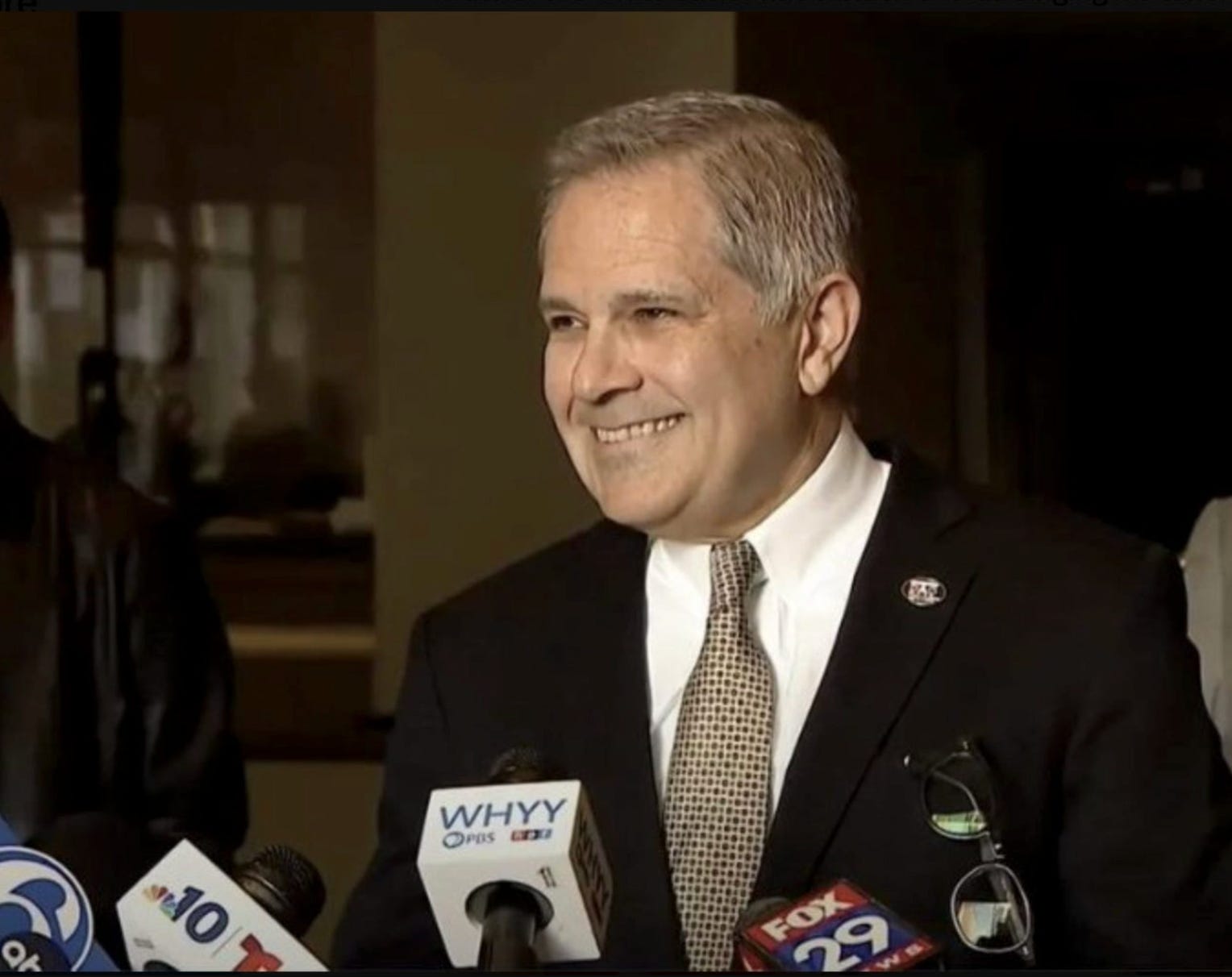
Two of Larry Krasner’s assistant DAs have disclosed in federal court that Krasner ordered them to stage a cover up to “protect the office.”
In a “Notice of Conflict” filed in federal court this week, ADAs Katherine Ernst and Steven Wildberger stated that Krasner warned that there would be “consequences” for anyone who broke ranks and tattled about the cover up to U.S. District Court Judge Paul Diamond.
There was good reason for both ADAs to take Krasner’s threat seriously.
A third ADA, Jaclyn Mason, acted as a whistleblower in testifying before Judge Diamond during an evidentiary hearing held last week.
Since ADA Mason resigned on June 2nd, however, rather than join the cover up, Krasner has personally targeted her as a scapegoat to cover up the corruption in his office that he doesn’t want Judge Diamond to hear about.
The plot against the whistleblower
At a June 15th press conference, I asked Krasner if any DAO supervisors bore any responsibility for the false facts contained in a response brief that sought to grant a new trial to Dennis Johnson, a convicted killer.
A response brief flagged by Judge Diamond, because it contained four false statements of fact.
“Someone immediately quit,” Krasner replied. “I guess you have noted that.”
The DAO’s scapegoating operation and cover up then went to its next phase.
On June 5th, the DAO filed a motion to withdraw the previous faulty response brief. The motion to withdraw was signed by four DAO supervisors, including ADAs Ernst, Wildberger, David Napiorski, and Peter Andrews.
In that June 5th motion to withdraw, the four supervisors singled out former ADA Mason, who signed the faulty response brief, as being responsible for the false facts that were written into it.
The motion to withdraw also implied that former ADA Mason resigned because her supervisors had caught her engaging in prosecutorial misconduct, namely by filing a response brief that contained false facts.
“They did that to malign me,” Mason told Judge Diamond.
The real culprit that Krasner’s protecting
Contrary to the June 5th motion, however, Mason testified to the judge that the faulty response brief was the work of ADA Matthew Stiegler, Krasner’s current supervisor of his so-called Conviction Integrity Unit.
Stiegler’s the same guy who, according to the Notice of Conflict filed by ADAs Ernst and Wildberger, had advised Krasner to stage the cover up to “protect the office.”
At the evidentiary hearing before Judge Diamond, former ADA Mason outlined how, at a May 29th meeting at the D.A.’s office, two of her supervisors, ADAs Ernst and Napiorski, explained the cover up that they wanted her to join.
“We have to protect the office,” Mason recalled Ernst telling her. “This is what we did in the Lavar Brown case to avoid sanctions.”
According to Mason’s testimony, ADA Ernst was referring to a snow job she and ADA Napiorski apparently pulled on U.S. District Court Judge Gerald Pappert.
Regarding that snow job, Mason told Judge Diamond, “I can’t believe they did it.”
The whole purpose of the cover up, as whistleblower Mason explained to Judge Diamond, was that Krasner and Stiegler didn’t want the judge to know how the DAO arrived at its decision to grant relief to convicted killer Johnson.
By Stiegler conspiring with the Pennsylvania Innocence Project, as well as Johnson’s federal public defenders. To fraudulently pass off to judges the work of Johnson’s advocates and lawyers as the work of the DAO.
As Mason repeatedly testified, Stiegler kept telling her, “If it’s good enough for the Innocence Project, it’s good enough for me.”
Even though none of Stiegler’s so-called “progressive prosecutors” bothered to check out whether any of the defense claims in the Johnson case were actually true, or not.
The con job pulled on Judge Pappert
Today, we’re going to look at that snow job, as recounted in an official court transcript.
And we’re going to show how ADAs Ernst and Napiorski carried out Krasner’s orders to run a cover up in Judge Pappert’s courtroom, “to protect the office.”
And how those two ADAs deceived Judge Pappert.
Not only to carry out the cover up, but also to insulate and protect D.A. Krasner from being exposed as the director of that cover up.
To explain the cover up, we’re going to have to get into other travesties of justice that Krasner has perpetrated on the courts.
It’s amazing what Krasner’s gotten away with for the past eight and a half years. But now it appears that it’s all finally catching up to him.
On April 21st, Judge Pappert convened a hearing to decide how to respond to a motion filed by the D.A. to withdraw a joint stipulation that the DAO had previously entered into with defense lawyers to grant a new trial to Lavar Brown, a twice-convicted killer.
A joint stipulation is when the D.A. agrees with defense lawyers to advocate on behalf of a defendant, in this case, Lavar Brown the two-time convicted killer.
That meant that in court, all the lawyers argued on behalf of the rights of the twice-convicted killer. While nobody represented the rights of Brown’s two murder victims.
A matter of ‘immediate importance’
That glaring injustice prompted the families of Brown’s two murder victims to file a rare King’s Bench petition that was accepted by the state Supreme Court.
In Pennsylvania, the state Supreme Court has the power to consider any case pending in a lower court when it sees the need to address an issue of “immediate public importance.”
In the King’s Bench petition, the issue of immediate public importance was Larry Krasner’s corruption of the criminal justice system.
In response to the King’s Bench petition, the state’s highest court issued a 109-page majority opinion last month that condemned Krasner’s practice on appeals of passing out like get-out-of-jail-free cards “highly problematic prosecutorial concessions” to 110 convicted killers.
In that majority opinion, the state’s highest court appointed the state attorney general to act as Krasner’s legal guardian whenever he makes any future concessions to convicted felons, to restore the adversarial form of justice.
Over the years, the courts have repeatedly objected to the joint stipulations that Krasner frequently enters into to free convicted killers. Why? Because it does away with the adversarial form of justice that’s been the standard in American courtrooms for 250 years.
“This is the case, as everyone knows, where the state Supreme Court, in unmistakable language, said that the district attorney’s office couldn’t do what the district attorney’s office was trying to do in conceding relief on a particular claim,” Judge Pappert told the two ADAs.
He was talking about the joint stipulation in the Lavar Brown case that Krasner had entered into with defense lawyers.
“But the [D.A’s] office then came right back into this court and attempted to do the exact same thing in this court that the state Supreme Court said you couldn’t do,” Judge Pappert lectured the two ADAs.
“And that is in May of 2021, [the DAO] tried to jointly stipulate for sentencing relief on the exact same claim the state Supreme Court said you couldn’t do this on. Okay?” the judge reminded the two ADAs.
“Yes,” ADA Napiorski replied. “I think the answer to why would we file a joint stipulation to try and concede this case, I -- that position was taken by my superiors at the time.”
The blame game
The judge asked ADA Napiorski who his superiors were when he signed the joint stipulation in the Lavar Brown case.
Napiorski replied that ADAs Matthew Stiegler and Paul George were his superiors.
“So let’s not — let’s not blame Mr. Stiegler and Mr. George,” the judge said.
And then the judge asked ADA Napiorski a blunt question about the joint stipulation in that case.
“Were you compelled to sign this?” the judge asked.
“I honestly don’t remember,” ADA Napiorski replied in an answer that the judge simply could not believe.
“You don’t remember?” the judge incredulously asked.
“I probably was not compelled to sign it,” ADA Napiorski replied.
“Ok,” the judge said. “So you signed it anyway.”
The judge decided to drill down.
“Did you ever, as the lawyer who was going to put his name on a paper filed in federal court,” the judge began, “say to your superiors, hey guys, I don’t think we can do this? Did you ever have that discussion?”
“I do not recall,” Napiorski said, “but I don’t believe I did.”
“Well, that’s a discussion you’d remember,” the judge said. “Don’t you think?”
“Most likely, Your Honor,” was Napiorski’s reply.
“OK,” the judge said. “So were you forced to sign this?”
“I do not believe so,” Napiorski said.
And then ADA Napiorski launched into a tap dance.
Napiorski covers for Stiegler
“I, from reviewing my records in preparation for this hearing, I know what my role was in preparing this,” Napiorski said about the joint stipulation in the Lavar Brown case.
“Which was, I was asked to assist at the end of the process, and help basically check citations and check for typos,” Napiorski told the judge. “I was line ADA at the time and I did that.”
“I don’t remember why I’m the one who signed and filed it,” Napiorski continued.
“I cannot for the life of me remember why I was the one who was asked to do that,” Napiorski claimed. “But I do not believe that I was compelled to do that.”
Here, Napiorski’s role in the Lavar Brown case sounded suspiciously similar to the role former ADA Mason testified that she played in the Dennis Johnson case.
In her testimony, former ADA Mason explained to Judge Diamond that when ADA Stiegler was her supervisor, as head of Krasner’s Federal Litigation Unit, he had a well-known practice in the office of basically writing the briefs that aimed to spring a convicted killer out of prison.
And then, rather than take responsibility for his own work, ADA Stiegler’s practice was to get an underling to sign that brief.
Like former ADA Mason signed the response motion in the Dennis Johnson case.
Like ADA Napiorski signed the joint stipulation in the Lavar Brown case.
Stiegler’s most outrageous stunt
In the most outrageous example of this practice, in the case of Daniel Gwynn, another convicted killer “exonerated” by Krasner, Stiegler had worked on the Gwynn case as a private lawyer, as well as a federal public defender, for at least 14 years.
But when Stiegler first joined the D.A.’s office in 2021, the Gwynn case apparently came over with him.
The D.A.’s office, which for more than a decade had been absolutely opposed to granting any relief to convicted killer Gwynn, suddenly did a 180.
And then the D.A.’s Federal Litigation Unit, of which Stiegler was the supervisor at the time, adopted many of the same arguments that Stiegler had used as a private lawyer to argue for a new trial for Gwynn.
And when Gwynn was “exonerated” by Krasner in 2024, Stiegler claimed on social media and a podcast that he supposedly had nothing to do with springing Gwynn out of prison.
And that somehow miraculously, Krasner’s “prosecutors,” as if by osmosis, had suddenly came to the same conclusions that Stiegler had done 15 years earlier, as a private defense lawyer.
Since Gwynn was exonerated, however, former ADA Mason has testified about how ADA Stiegler used her as his “pawn” in the Dennis Johnson case, by getting her to sign the response brief that he wrote.
And then ADAs Ernst and Wildberger have filed a motion that stated to cover his tracks, ADA Stieger, whom they said had a conflict of interest, advised Krasner that instead of coming clean about collusion in the DAO, that Krasner should institute a cover up.
So why should we believe anything ADA Stiegler has to say?
Oh, by the way, in the Daniel Gwynn case, guess who signed the concession brief that got Gwynn out of prison, the concession brief that ADA Stiegler claims he supposedly had nothing to do with — ADA David Napiorski.
An audit of open cases
At the motion hearing before Judge Pappert, the judge asked ADA Napiorski if he was familiar with the state Supreme Court’s criticism of Krasner’s DAO for doing away with the adversarial form of justice.
“I am,” Napiorski replied. “Sure, Your Honor. Thank you.”
“We filed this, as you pointed out, this motion for leave to withdraw in October after we — my colleague sitting to my right, Katherine Ernst and I, had kind of assumed leadership roles within the law division,” Napiorski told the judge.
“And we’re doing an audit of open cases, and these kinds of stipulations and joint motions that we still had pending before the Eastern District of Pennsylvania,” Napiorski said.
Napiorski told the judge that were four such joint stipulations filed by the DAO “hanging out there” in federal court, joint stipulations that judges had objected to.
“We have gotten, I think, pretty clear signals from the courts that they don’t want us to proceed in this manner,” Napiorski said.
That’s when ADA Ernst spoke up about the new written policies that she supposedly had instituted at the DAO.
New policies that she sought to convince Judge Pappert had done away with many of Krasner’s corrupt practices that other judges had objected to.
Reforming the DAO
“I spoke to the D.A. when I took over as the head of the law division,” Ernst explained.
“And I told him [Krasner] that there were policy changes that I would like to make,” Ernst told the judge, adding, “I don’t think I ever specified what they [the changes] were.”
“And he [Krasner] generally trusts me and has faith in me,” ADA Ernst told Judge Pappert. “And so he [Krasner] didn’t really ask questions or in any way suggest I shouldn’t make any changes. So I just did it.”
“When I took over, there were not much in the way of written policies at all” at the DAO, Ernst explained.
That’s because at Larry Krasner’s DAO, the boss fired most of the senior prosecutors who knew what they were doing.
So as a consequence, Krasner’s poorly trained “prosecutors” that he hired often fly by the seat of their pants.
That gives Krasner maximum opportunity to meddle, and micro-manage on the few types of cases that he cares about.
Such as any case where he’s indicting a cop. Or any case where Krasner’s trying to get a convicted killer out of prison, or off Death Row.
“Policies were communicated orally” in Krasner’s DAO, ADA Ernst told the judge.
“And I felt that that was not helpful to ADAs,” Ernst said. “Because, obviously, if someone does something that you don’t like, but you don’t have a document you can point to that’s going to say this told you not to do this.”
Ernst protects Krasner
Up on the bench, the judge didn’t seem to buy what Ernst was peddling.
“Yet, you would have me believe that Mr. Krasner was not involved in that,” the judge said about the process of instituting ADA Ernst’s alleged new policies to allegedly reform the DAO.
“That Ms. Ernst said, oh, he [Krasner] just trusts me when I wanted to change policies and practices and I just did it. Is that what you’re telling me?” the judge asked.
“Yeah, yeah,” ADA Napiorski said.
“That’s what happened,” ADA Ernst chimed in. “That’s truly what happened.”
Really?
Up on the bench, Judge Pappert talked about how for years, Krasner’s DAO had been doing joint stipulations.
“It’s been the subject of court opinions, media articles, state Supreme Court criticism, disciplinary proceedings against higher-ups in the office,” the judge said.
But, the judge said, according to Ernst, she simply told Krasner, “We want to change all that.”
“And you — he [Krasner] never discussed with you in any specificity any of this?” the judge asked.
The judge doesn’t believe Ernst
“I did say to him something along the lines of if I’m going to take over the Law Division, there are polices I want to put in place,” Ernst replied.
“I want to take things in a different direction,” she said. “And he [Krasner] obviously knew the reason was, whether it was explicitly stated or not, was everything that you [Judge Pappert] just said.”
“But you never talked about that specifically,” the judge asked incredulously.
“You just said I want to change policies. I mean, that could have been, you know, you can no longer use . . . the lunchroom microwave,” the judge said.
“I mean you just said, oh, I want to change some things,” the judge said again. “And he [Krasner] never specifically discussed with you, Ok, what would you like to change?”
“I’m the district attorney,” the judge said, referring to Krasner. “My name’s on everything. I want to know exactly what you’re going to do. He never had that discussion with you?”
“I have no recollection of any such discussion,” Ernst replied. “And I’m remembering the discussion that I’m describing. No, that didn’t happen.”
“Uh-huh,” the judge replied.
‘That’s difficult to believe’
The judge talked about how entering into joint stipulations “was something that was very important to the district attorney and has been used countless times.”
“And was the subject of discussion at Capital Case Review [Committee] meetings [at the DAO] for seven or eight years,” the judge said.
“And your change in policy and practice was a 180 on what would appear to many courts a major initiative of the district attorney’s,” the judge said, His Honor was again referring to the joint stipulations routinely entered into by Krasner, the alleged reform D.A.
“And I’m finding it hard to believe that you were just given the discretion to change whatever policies and practices you want,” the judge told Ernst. “And there wasn’t a fulsome discussion with Mr. Krasner about any of this. That’s difficult to believe.”
In response, Ernst stated that D.A. Krasner was aware of all the issues that the judge had raised.
As she continued to protect the boss.
“And so what I’m saying is I never had a meeting with him in which I laid out point by point, you know, exactly what I want to put in this policy document,” she said.
“And so he [Krasner] was fully aware that we wanted to shift the practice to comport with what the court has been indicating they want us to do,” Ernst told the judge.
It continues to snow in Judge Pappert’s courtroom
The judge had a hard time believing what Ernst was telling him.
“Yet you’re telling me that you brought proposed changes to Mr. Krasner in 2025, give or take, and he just trusted you?”
That was her story, Ernst said, and she was sticking to it.
The judge asked Ernst if the D.A.’s office would have a problem with His Honor asking the state attorney general to intervene again in the Lavar Brown case as a friend of the court.
No problem, Ernst said.
“And so, generally speaking, we don’t oppose the A.G.’s office participating if they’re taking a different view of the case than we are,” Ernst told the judge.
Even though former ADA Mason testified to Judge Diamond that in the Johnson case, her boss, ADA Stiegler, had advised her in writing to avoid the “danger” of having the A.G. enter into that case, because that might bring about an evidentiary hearing.
Where Stiegler would have had to back up his theories about why a convicted killer should be released with hard evidence.
The judge still couldn’t believe what he was hearing.
“You know, you’ve already tried to concede this [case] once,” the judge told ADA Ernst.
“You’ve talked about now you’ve changed your policy,” the judge said.
“Why shouldn’t I be concerned given the history in my case and across 100 plus others [cases where Krasner made concessions] that you’re still not going to have your heart in this,” the judge said.
“And it’s still going to be a goal or objective of the district attorney to concede relief or to get Mr. Brown what he wants at some point, because that’s the history,” the judge said.
The judge seemed to be saying how can I trust the DAO when Krasner’s still running it.
The judge asked about the disciplinary proceedings that had resulted in ADA Paul George, the former assistant supervisor of Krasner’s Law Division, being disbarred from practicing law in federal court.
And the disciplinary proceedings that had resulted in ADA Nancy Winkelman, the former supervisor of Krasner’s Law Division, having her license to practice law in the federal courts suspended for three years.
In the case of Robert Wharton, a convicted killer that Krasner was trying to get off Death Row, both ADAs George and Winkelman were disciplined for repeatedly lying to federal judges
“Was that ever something that was discussed within the district attorney’s office or a subject of discussion between you and anyone else to include or not include Mr. Krasner?” the judge asked about the discipline handed out to ADAs George and Winkelman.
The judge apparently was still looking for a logical reason to explain the flip-flop in the D.A.’s office beyond the nonsense that ADA Ernst was peddling to him.
“I don’t know when I became aware that there was some sort of disciplinary” proceedings against the two supervisors, ADA Ernst replied.
“I did not, Your Honor,” ADA Napiorski replied. “Until quite recently, I believe it was under seal. And I didn’t have very many details about what was going on.”
The cover up wins
In the end, the judge bought it.
“Ok, I’m going to grant your motion,” Judge Pappert ruled.
“I’m going to grant your motion for a number of reasons, but I think principally because I think the motion that I am allowing you to withdraw was improper,” the judge said about the joint stipulation filed by the DAO in the Lavar Brown case.
“It never should have been filed,” the judge said.
“So I’ll allow you to withdraw it,” the judge said. “And I will accept your representations that the case will be litigated in a normal adversarial fashion, as it should have been all along. As all of these cases should be all along, and hopefully will be from here forward.”
I don’t know, judge. If Larry’s been running a crooked show for eight and a half years, and granting 110 concessions to 110 convicted killers by lying and cheating, I have my doubts about anything changing.
Even though ADA Ernst, with her new written policies, has allegedly reformed the DAO.
But on this day in Judge Pappert’s court, the cover up succeeded.
Whether it will continue to work in Judge Diamond’s courtroom, however, is another matter.
Especially with three ADAs having already ratted out Larry!
Judge Diamond still has to schedule a second evidentiary hearing in the Johnson case, expected to be in mid-August.
Where Judge Diamond has ordered all four of Krasner’s supervisors who signed the June 5th motion to withdraw — ADAs Ernst, Napiorski, Wildberger and Andrews — to appear in court and testify under oath about the cover up and collusion inside Krasner’s DAO.
And after the judge gets through hearing from the four supervisors, you have to wonder if Larry Krasner be the next witness called upon to testify.
No posts
Comments
Nothing yet. Say the first thing.
Sign in to join the conversation.