
A pharmacist named Dana once told me about the worst three seconds of her week. A regular caller — she knew his voice, his prescriptions, his impatience — was mid-sentence on the automated refill line: “I need my metfor — “ when the system, certain it had heard enough, cut in with “Did you say Metformin, 500 milligrams?”
He hadn’t finished. He wanted 1000. He hung up and drove to the pharmacy instead, muttering about robots. Nothing crashed. No error was logged. The system worked exactly as designed. It just didn’t know how to listen.
That gap — between “technically functioning” and “actually usable” — is the entire story of adding voice to an AI agent system. And it catches almost everyone off guard, because voice looks like chat’s easy cousin. Same intents, same backend, same LLM. Just… spoken.
It isn’t. It’s a different discipline wearing the same badge.
With text, you have forgiveness built in. A user can pause mid-message, edit before hitting send, or take thirty seconds to think — the system waits, patiently, forever.
Voice has no such mercy. Every silence is a decision point: is the caller done talking, or just breathing?
Humans resolve this in about 200 milliseconds — the average gap between one person finishing a sentence and the next person starting, a number that holds up remarkably consistently across languages in conversational-linguistics research. Your system has to make the same call, in the same window, with a microphone instead of a brain.
That means the required mindset isn’t “make the bot smarter.” It’s “treat every second like it’s rationed.”
You’re not building a feature anymore — you’re building a real-time system with a latency budget, where recognition, reasoning, and speech generation all have to fit inside a window a human won’t consciously notice, but will absolutely feel if you miss it.
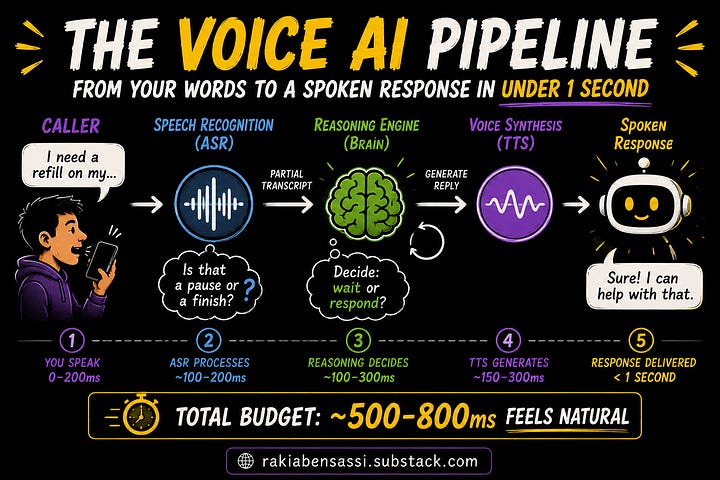
It’s not just phone trees:
Comments
Nothing yet. Say the first thing.
Sign in to join the conversation.