
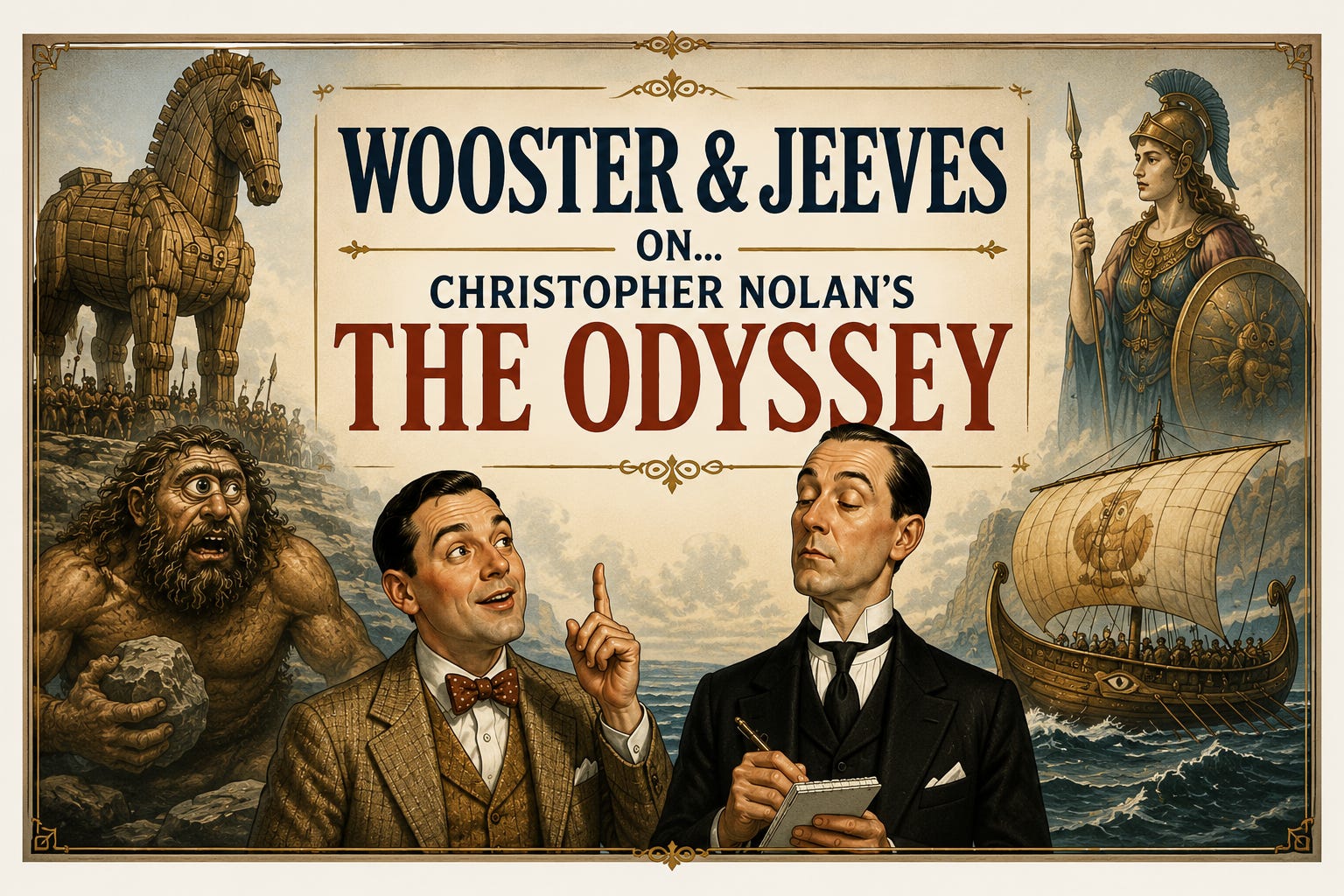
An affectionate contemporary homage to P. G. Wodehouse and his immortal creations, Bertie Wooster and Jeeves.
“Jeeves.”
“Sir?”
“There was considerable discussion at the Drones yesterday about a chap called Nolan.”
“Mr Christopher Nolan, sir?”
“That’s the fellow. Makes films. Complicated films, apparently.”
“Mr Nolan’s work has occasionally been described as intellectually demanding.”
“Catsmeat said confusing.”
“Mr Potter-Pirbright’s opinion may not be entirely representative, sir.”
“Apparently he made one which starts at the end and works backwards.”
“Memento, sir. The central character is unable to form new memories, so the story repeatedly takes him and the audience backwards.”
“Seems a little hard on both.”
“That is one way of putting it, sir.”
“Then another where a chap goes into space for a twenty-minute spin, comes back, and finds his daughter is old enough to be his grandmother.”
“Interstellar, sir. Relativistic time dilation.”
“Of course. That was easy to understand. And another where some chaps are going forwards through time while others are going backwards.”
“Tenet, sir.”
“Does Nolan have something against time proceeding in the normal direction?”
“I don’t believe so, sir.”
“Odd, because he does seem determined to interfere with it.”
“Time is a recurring interest in Mr Nolan’s work, sir.”
“Well, I could have told him something about it. Sixty seconds to the minute, sixty minutes to the hour, twenty-four hours to the day. Perfectly good system. I don’t see why the man can’t leave it alone.”
“Quite, sir.”
“And when he finally does, he turns his attention to sleep. Chaps dreaming inside other chaps’ dreams.”
“Inception, sir.”
“That’s the one. Chap goes to sleep, somebody else goes to sleep inside his sleep, and before anybody knows where he is there are four or five dreams going on. Tuppy said watching all this sleeping had such a profound effect on him that he went to sleep too.”
“That would presumably constitute an additional level, sir.”
“At the Drones, if a chap falls asleep in an armchair, somebody generally throws a bread roll at him.”
“A less ambitious narrative structure, sir.”
“What I don’t understand, Jeeves, is why Nolan makes everything so dashed complicated.”
“It is perhaps part of his artistic vision, sir.”
“Well, I’ve devised a few plots myself. Plans for extricating myself, Bingo, Gussie and assorted Drone members from extremely sticky situations. Simple, direct, effective. No backwards time. No dreams inside dreams. Straightforward Wooster formula. Works every time.”
“Your recollection of the outcomes is perhaps more favourable than my own, sir.”
“Details, Jeeves. The point is that I could have taught Nolan a trick or two. Anyway, he has now made The Odyssey. And according to Tuppy, he hasn’t left time alone here either. Keeps jumping between past and present.”
“There appear to be two parallel narrative strands, sir. However, they converge towards the end.”
“Nolan should realise people have wised up to him, Jeeves. If he really wants to surprise everyone, he should tell the story in linear time for once.”
“A radical departure, sir.”
“And he seems to have taken the title dashed literally himself, someone mentioned. Heavy artillery equipment, miles of celluloid, carting the whole bally circus from one end of the map to the other—the full works.”
“Mr Nolan has indeed undertaken an unusually ambitious production, sir. Large-format IMAX film cameras and extensive location filming have been employed.”
“You are repeating what I said, Jeeves.”
“In substance, sir.”
“Yes. Large-scale affair, was the general view at the Drones. Ships, swords, Mediterranean scenery, people looking grimly at the horizon. I thought I might take it in myself and participate more meaningfully in future discussions on the subject.”
“An excellent idea, sir.”
“Precisely. The difficulty is that I thought I ought to know what an Odyssey was before attending an Odyssey.”
“A prudent precaution, sir.”
“That’s where you come in, Jeeves. Enlighten me on the story of this fellow. Start at the beginning.”
“That may prove difficult, sir.”
“Why?”
“Greek mythology has several beginnings.”
“Let us simplify matters. Who is Odysseus?”
“King of Ithaca, sir. A Greek hero renowned for intelligence, cunning and persuasion.”
“Ah. One of the brainier ones. Double-dummy bridge calibre.”
“Very much so, sir.”
“And the film is about him trying to get home?”
“Broadly, sir. Odysseus has been away fighting a long war and is attempting to sail back to Ithaca, where his wife Penelope and son Telemachus await him.”
“Tell him what?”
“Telemachus, sir. His son’s name.”
“Ah. These Greeks. Carry on.”
“The journey home takes ten years.”
“Ten years. Was he rowing with a spoon, Jeeves?”
“No, sir. He had oarsmen, as well as a sail.”
“Far be it from me to knock a chap who is universally regarded as a master intellect of the ancient world, Jeeves, but the fellow’s navigation leaves something to be desired. An absolute genius at the wooden mammal game, I grant you, but his route planning was pure bally chaos. So how do you explain the fellow taking ten years to get home?”
“There were mitigating circumstances, sir.”
“Such as?”
“Gods, monsters, enchantresses, storms, shipwrecks and several other impediments.”
“Sounds like a poorly organised trip.”
“One might describe it so, sir.”
“But before we get to all that, let us do a Nolan, Jeeves, and go back in time. Why had this bird been away from home in the first place?”
“He had been fighting in the Trojan War, sir.”
“And what started that?”
“Helen of Sparta, sir, later Helen of Troy. Celebrated in literature as possessing ‘the face that launched a thousand ships.’”
“Must have been an impressive face, Jeeves.”
“She was considered the most beautiful woman in the world, sir.”
“A thousand ships just for a beautiful woman?”
“There was rather more to it. It began at the wedding of Peleus and Thetis. All the gods were invited except Eris, the goddess of discord.”
“The Greeks had a goddess of discord?”
“They did, sir.”
“How many gods and goddesses did these people have?”
“The twelve Olympians formed the principal pantheon, sir, though there were many lesser deities.”
“So twelve on the main board and an army of subsidiaries?”
“One might put it that way, sir.”
“And they still found room for a goddess whose specific job was to cause trouble? Extraordinary. At the Drones we manage it perfectly well without appointing anybody.”
“A tribute to the members’ natural abilities, sir.”
“Quite. And they left this specialist in discord off the wedding guest list?”
“Deliberately, sir.”
“Sensible.”
“In principle, sir. Eris arrived anyway and threw a golden apple among the guests, inscribed ‘To the fairest.’”
“And?”
“Three goddesses present at the wedding each claimed it.”
“Which three?”
“Hera, goddess of power, Athena, goddess of wisdom and victory, and Aphrodite, goddess of beauty and love.”
“Three goddesses fighting over who was the prettiest?”
“Essentially, sir.”
“And nobody thought of ordering three apples?”
“The Greeks tended towards drama rather than conflict resolution, sir.”
“Who was made to pick the winner of the beauty pageant?”
“Paris, Prince of Troy, sir.”
“You mean Troy, Prince of Paris?”
“No, sir. Paris is the gentleman. Troy is the city.”
“They might have made more of an effort with the naming conventions, Jeeves.”
“Ancient nomenclature can occasionally challenge the modern reader, sir.”
“So Paris has to choose the most beautiful of three goddesses.”
“Each goddess attempted to influence him.”
“Tampering with the judge? In those days too? I’ve witnessed attempts of that sort at the Drones.”
“Inducements, perhaps.”
“Ah. What did Paris go for?”
“Aphrodite, sir. She had offered him the love of the world’s most beautiful woman.”
“I can think of at least six fellows at the Drones who would have done the same.”
“The choice has proved popular through the ages, sir.”
“Giving up wisdom and power for a girl?”
“For the prospect of Helen, sir.”
“Bingo Little spent his entire bachelorhood doing it for any girl, Jeeves. This Paris fellow would have fitted in splendidly at the Drones.”
“There are certain temperamental similarities, sir.”
“And Helen was available?”
“That presented the principal difficulty. She was already married to Menelaus, King of Sparta.”
“Many what?”
“Menelaus, sir. His name.”
“Ah. These Greek names do keep one on one’s toes.”
“Indeed, sir. Menelaus invoked an oath to make Odysseus join the effort to recover Helen.”
“So Odysseus spends ten years at war because of an oath?”
“Essentially, sir.”
“Remind me to be more careful what I swear to.”
“A policy I have long advocated, sir.”
“And Paris takes her to Troy?”
“The traditions differ, sir. In some she elopes; in others she is taken against her will. It would be injudicious to blame the lady.”
“Quite right. She has already had a thousand ships blamed on her. No need for us to pile on.”
“A generous view, sir.”
“It is the Code of the Woosters, Jeeves. Never bandy a lady’s name.”
“A most honourable principle, sir.”
“So Paris takes Helen to Troy, and Europe goes to war.”
“Greece and Troy, sir, but the broad sequence is correct.”
“How long does the war last?”
“Ten years.”
“And our man then spends another ten years trying to get home?”
“Correct.”
“Twenty years away from his wife because another fellow attended an ill-advised beauty contest.”
“When expressed in those terms, sir—”
“Jeeves, I have occasionally wondered whether remaining unmarried represented a failure of nerve on my part.”
“Indeed, sir?”
“I withdraw the thought. It was foresight.”
“Your encounters with Miss Bassett, Miss Craye and others might support the proposition, sir.”
“Exactly. One broken engagement here, an Aunt Agatha there, and before a chap knows where he is somebody has launched a thousand ships.”
“A risk you have thus far successfully avoided, sir.”
“And I intend to keep it that way.”
“Very good, sir.”
“There was another chap Catsmeat mentioned. Great warrior. Something wrong with his foot.”
“Achilles, sir. Heel, not foot. His mother Thetis dipped him in the River Styx when he was an infant, to make him invulnerable.”
“And?”
“She held him by his heel, sir, so he remained vulnerable there.”
“Elementary childcare error, Jeeves. She should have changed hands halfway through.”
“The thought has presumably occurred to others, sir.”
“And somebody eventually gets him there?”
“Paris, sir, with an arrow.”
“Why the fellow wasn’t wearing shoes on the battlefield is difficult to imagine, Jeeves, but continue.”
“An understandable observation, sir. The war, however, remains unresolved until Odysseus devises the stratagem of the Trojan horse.”
“Ah! I know the story very well, Jeeves. The only thing that puzzles me is why the Trojans simply carried this enormous, uninspected timber mammal straight into the town square. No security clearance? No chap with a clipboard saying, ‘Before we park the forty-foot wooden pony next to the Town Hall, perhaps we ought to look inside’?”
“There were individual objections, sir. A priest named Laocoön warned against it.”
“Good man.”
“He was promptly devoured by two giant sea serpents, sir, which rather stifled further debate.”
“Remind me never to raise an objection at a Drones Club committee meeting, Jeeves. We shall get Tuppy to do it.”
“A prudent delegation of responsibility, sir.”
“Right. Troy falls. Odysseus gets into his boat. Home for tea.”
“That was presumably the intention, sir.”
“But?”
“He incurred the wrath of Poseidon, sir, who placed a curse upon him.”
“Who is Poseidon?”
“God of the sea, earthquakes and horses, sir.”
“Rather a mixed portfolio.”
“Divine portfolios were not allocated on modern administrative principles, sir.”
“And why does Poseidon dislike Odysseus?”
“Odysseus blinds his son, Polyphemus the Cyclops.”
“Was he a parrot?”
“No, sir. Polyphemus was a one-eyed giant.”
“Odd name for a giant. Suggests to me some delicate feathered bird sitting on a perch. But why did our hero convert him from a one-eyed giant to a zero-eyed giant?”
“To escape, sir. Polyphemus had trapped Odysseus and his men in his cave and begun eating them.”
“Spare me the details, Jeeves.”
“Very good, sir. Odysseus eventually blinds him with a well-aimed thrust.”
“Good man. Reminds me of the year I won the darts championship at the Drones.”
“The circumstances were perhaps somewhat different, sir.”
“Only in scale, Jeeves. Accuracy under pressure is accuracy under pressure.”
“Quite, sir. Poseidon, however, took a less sporting view and resolved to make Odysseus’s journey home exceedingly difficult.”
“Ah. That would explain the ten years.”
“To a considerable extent, sir. Poseidon’s hostility ensures that the voyage proceeds badly. Odysseus loses his ships and men and encounters a succession of hazards.”
“Such as?”
“They encounter Circe, an enchantress who turns some of his men into pigs.”
“I have seen some Drones members turn to pigs, Jeeves, while feasting during festivities.”
“Thereafter they survive the Sirens, sir, mythical hybrid creatures who lure sailors to death with their hypnotic, enchanting song.”
“How, Jeeves?”
“Odysseus makes the crew put wax in their ears, and gets himself tied to the mast and listens to them.”
“Golly, Jeeves. Enjoys it all by himself!”
“Yes, sir. Then they have to sail between Scylla and Charybdis—a multi-headed monster and a deadly whirlpool.”
“They survive?”
“They lose some men, sir. Then he gets detained by Calypso the nymph on her island for seven years.”
“Good Lord. Anything else?”
“A number of storms, shipwrecks and lesser inconveniences, sir.”
“Sounds less like a journey home and more like a badly managed package tour.”
“An unconventional itinerary, certainly, sir.”
“And he survives all this?”
“With considerable difficulty. Eventually Athena, who has long favoured Odysseus, intervenes to assist his return to Ithaca.”
“Ah. Finally, someone useful. Who is Athena? I heard Spider-Man’s wife is playing her.”
“If by Spider-Man you mean the actor Mr Tom Holland, sir, yes. His wife, Ms Zendaya, plays Athena.”
“That’s the one.”
“Athena is the daughter of Zeus, goddess of wisdom and warfare, and Odysseus’s principal divine protector.”
“Another mixed portfolio. The American President could have used her advice. Who was her mother?”
“Metis, sir. Zeus swallowed her while she was pregnant, having been warned that her child might threaten his supremacy. Some time later he developed an excruciating headache, his head was split open, and Athena emerged fully grown and armed.”
“Jeeves, are you absolutely certain you’ve got the myth right?”
“Quite certain, sir.”
“This Zeus fellow seems to crop up rather often.”
“King of the gods, sir. Married to Hera, goddess of marriage and family, and one of the twelve Olympians.”
“Faithful?”
“Not notably, sir.”
“Good Lord. I am beginning to understand why Greek mythology has several beginnings.”
“Quite, sir.”
“Tell me something about Tell-Him-something, our hero’s son.”
“Telemachus, sir. He was an infant when Odysseus left. By the time his father returns, he is a young man, with Athena assisting him against the suitors occupying the family home.”
“And Odysseus finally gets back?”
“He does, sir. Disguised as a beggar; Penelope arranges a contest involving Odysseus’s bow; he reveals himself, joins forces with Telemachus, and disposes of the suitors.”
“Disposes?”
“Permanently, sir.”
“Understandable. Twenty years of strangers drinking one’s wine would test any man’s hospitality.”
“Homer appears to have taken a broadly similar view, sir.”
“Jeeves.”
“Sir?”
“Let me see if I’ve got this straight.”
“By all means, sir.”
“A snubbed goddess bowls an apple into a wedding reception. Three other goddesses immediately start scrapping over the piece of fruit, stage a beauty contest, and rope in a Trojan prince—who isn’t a place with an Eiffel Tower, nor, apparently, a chap burdened with much moral backbone—to adjudicate. The fellow turns down political clout and high-level brainpower and, displaying precisely the judgement one associates with the bachelor Bingo Little, chooses another fellow’s wife. Result: a thousand ships and ten years of war.”
“Then there’s Achilles, the greatest warrior in Greece, who eventually gets done in through the one square inch of himself his mother forgot to waterproof.”
“Odysseus, meanwhile, stuffs a regiment into a wooden mammal, wins the war, sets off for home, converts a one-eyed giant into a zero-eyed giant, and thereby gets on the wrong side of the giant’s father, who unfortunately runs the sea department. He then spends ten years being blown about the Mediterranean, while his men are turned into pigs, much like certain Drones members during drunken festivities; voluntarily listens to lethal pop music while tied to a pole; gets detained on a tropical island for seven years by a nymph; and negotiates assorted multi-headed objects and whirlpools that turn his shipping lanes into something resembling the Strait of Hormuz.”
“Finally, he receives tactical support from a goddess who hatched out of her father’s cranium in full battle armour, and pops home disguised as a decrepit beggar to shoot everyone who’s been swilling his wine, courting his wife, and generally treating his home as a branch of the Drones. Have I left anything out?”
“A considerable amount, sir, but nothing that would materially improve the summary.”
“And this Nolan is putting all this into one film?”
“One assumes a degree of selectivity will be exercised, sir.”
“How long is the film?”
“I do not believe the final running time need concern us at present, sir.”
“Jeeves, the original journey took ten years.”
“A fair point, sir.”
“Pack sandwiches.”
“Very good, sir.”
“And Jeeves?”
“Sir?”
“Sit next to me. Because if Zendaya hatches out of anyone’s forehead mid-film, I shall require immediate moral support.”
“I shall be at your elbow throughout, sir.”
“That is all I ask, Jeeves. That is all I ask.”
A Note from Rajeev Beotra
Wooster & Jeeves On… is an occasional companion to my regular Chronicles from Mehra World. If you enjoyed this exchange, you may enjoy Arvind Mehra’s adventures there too.
Chronicle 1: What Retirement Did to My Brain
Chronicle 2: What My Personal Trainer Didn’t Tell Me
Chronicle 3: When My Retirement Became My Driver’s Problem
Chronicle 4: When Rivalry Threatened To Enter My Home
Chronicle 5: Wooster & Jeeves Visit Mehra World
Chronicle 6: Two Arvind Mehras for The Price of Half
Chronicle 7: When I was Upgraded to Version 2.0
No posts
Comments
Nothing yet. Say the first thing.
Sign in to join the conversation.