
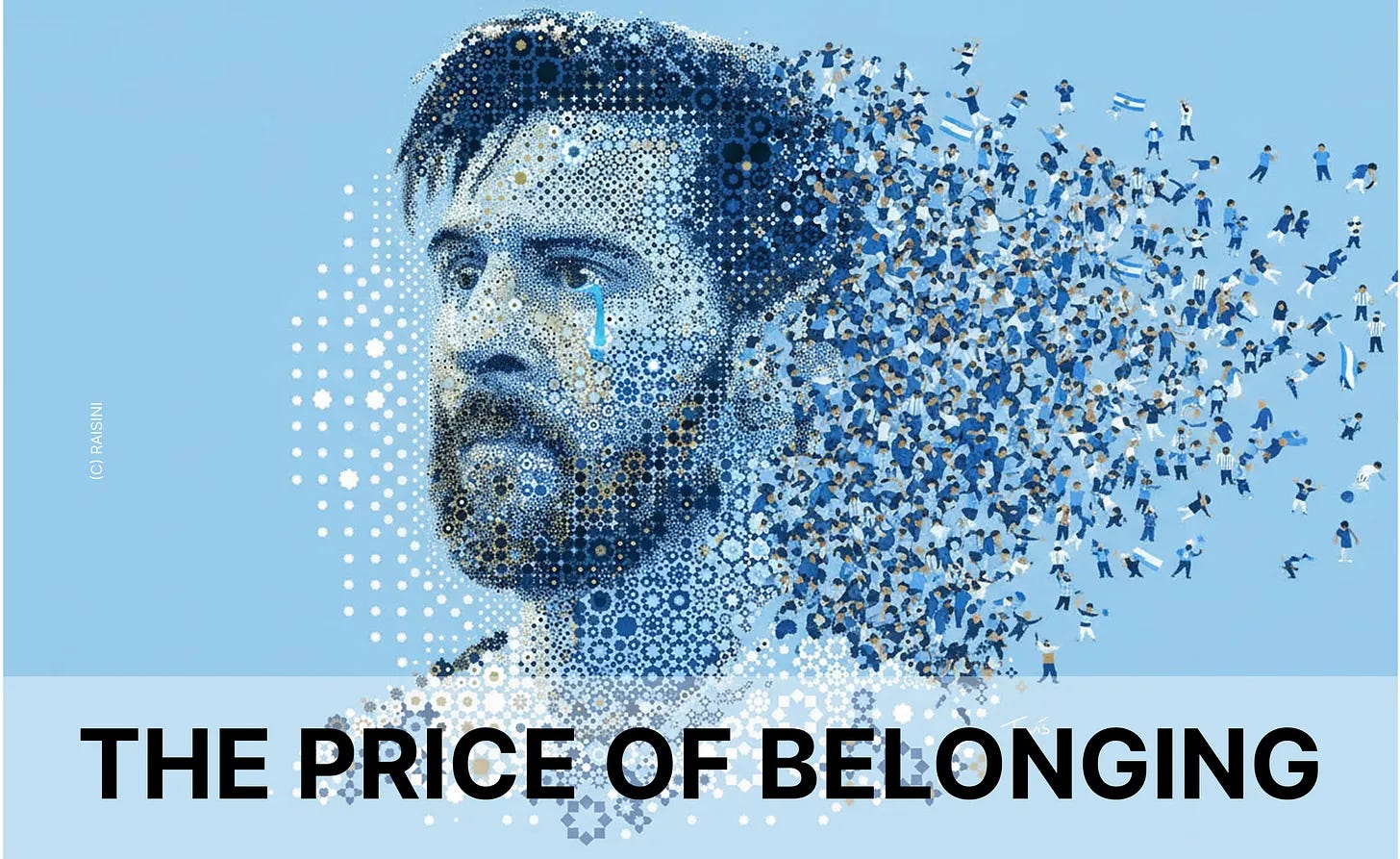
Welcome to this week’s issue of RAISINI.
Every week, I write about understanding how reality actually works - from human nature and decision-making to power, wealth, entrepreneurship, investing, health, and the invisible systems that shape our lives. This isn’t theory. It’s what I’ve lived. Let’s keep going.
If you want access to private chats, live events, workshops, and more, consider becoming a paid or founding member.
Last Sunday the 19th, the Fifa World Cup came to an end.
For some supporters, the disappointment had arrived weeks earlier. Their nation’s journey ended in the group stages, the knockout rounds, the quarter-finals or the semi-finals. For my team and others, the dream continued until the final moments.
Argentina's dream of winning back-to-back World Cups ended there. Only Italy (1934, 1938) and Brazil (1958, 1962) have won back-to-back Fifa World Cups.
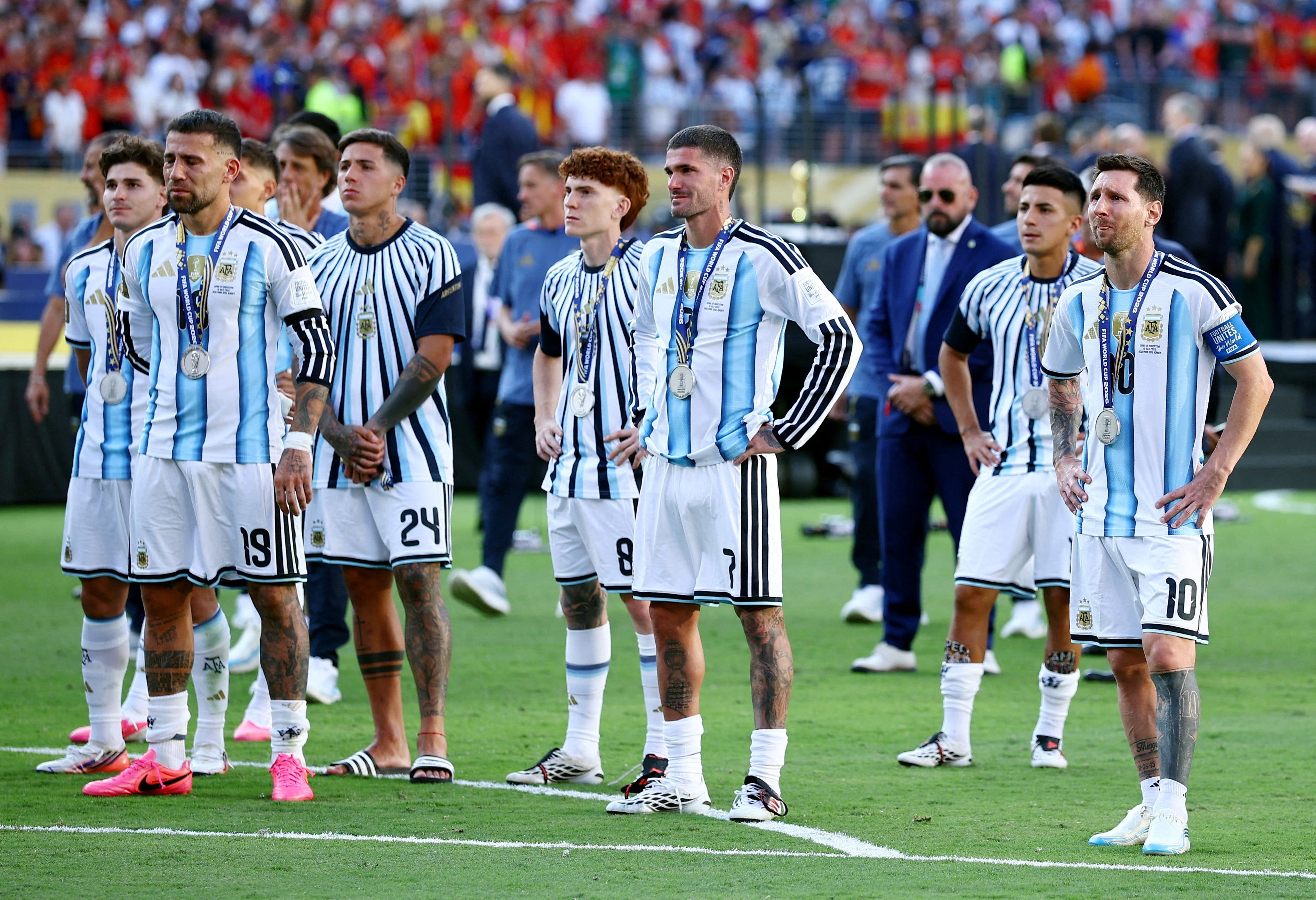
By the following morning, millions of Argentina and Messi supporters, around the world woke carrying a disappointment that was difficult to explain. Some replayed moments from the match before they had even left bed. Others found themselves distracted during ordinary routines, returning to the same missed opportunity, the same decision, the same moment when an entire story changed direction. Conversations that normally began with work, family or daily responsibilities began instead with football. Yet nothing in their own lives had actually changed.
Their families were still there. Their work remained the same. Their homes, responsibilities and ambitions had not disappeared overnight. The result of a football match played thousands of miles away had altered none of the material conditions of their lives. And still, for many, the day felt different. The disappointment was real. It felt personal, even though they had never stepped onto the pitch, never touched the ball, and never had any influence over the outcome.
This reaction is not unique to football. It appears whenever human beings become emotionally connected to something outside themselves. People celebrate the victories of strangers and grieve the defeats of people they have never met. Entire communities experience moments together despite having no control over what happens next.
We usually accept these feelings without questioning them. We call it passion, loyalty or simply being a supporter.
But beneath that familiar experience is a deeper question.
Why can something we never controlled have the power to hurt us so deeply?
The strange thing about disappointment is that sometimes the world around you continues exactly as normal.
The morning after the final, I found myself disinterested in everything. The usual tasks were still waiting. The same responsibilities existed. Nothing had changed in any practical sense, yet my attention kept returning to the same place. The defeat. The moments that decided it. The feeling that something had ended differently from the way millions of people had imagined.
My thoughts kept returning to Lionel Messi. Not only because of the result, but because of what he represented. For many people, Messi was not simply a footballer reaching the end of his career. He represented years of expectation, frustration, hope and patience. His journey had become connected to the stories people had built around him, often without realizing it.
Knowing all of this, I also knew something else. The feeling made little logical sense.
I had not played in the match. I had no influence over the result. My life had not changed because a football team lost. Yet the disappointment was real. And that was the part that interested me.
If millions of people across the world could feel something so deeply after an event they never controlled, perhaps football was revealing something much older than sport itself.
Perhaps it was showing something fundamental about the way human beings attach meaning to the world around them.
Most attachments in life are not created through a single decision. They develop gradually, often without us noticing the process taking place. A person does not usually wake up one morning and decide that a particular place, team, idea or community will become emotionally important to them. Instead, meaning accumulates through years of memories, experiences and associations until something that was once external begins to feel connected to who they are.
My relationship with Argentina began in that way.
I was a child watching the 1986 World Cup, at an age when the world is experienced less through analysis and more through impressions and i barely remember fragments of this world cup seeing my siblings supporting Argentina because of Maradona.
Certain moments become permanently attached to memory because they are connected not only to what happened, but to who we were when they happened. For millions of people around the world, that tournament became inseparable from the image of Diego Maradona. He was not simply a footballer performing at an extraordinary level. He became the symbol of a moment in time, a representation of possibility and imagination.
At that age, I did not understand tactics, statistics or the wider history surrounding football. What remained was something simpler: the feeling of witnessing something unusual. The memory was not stored as information. It was stored as an experience.
After the final loss of 1990 World Cup and Maradona’s subsequent ban from the 1994 World Cup in USA, i lost interest in football as the pain was unbearable. Years passed, as they always do. The intensity of childhood interests changes as life introduces new responsibilities. Business, travel, work and personal ambitions became more central. Football moved into the background. The world became larger, and the time available to follow every match, every competition and every development became smaller.
Yet something interesting happens with certain attachments. Distance does not always remove them. Sometimes it simply places them quietly in the background until another moment activates them again.
For me, that moment was Messi.
When Messi first emerged, he was not immediately connected to the same emotional history as Maradona. He was a young player with extraordinary ability, someone who appeared different from everyone else on the pitch. But over time, he became something more than a footballer. He became connected to another chapter of the same long story.
The interesting part was not that I consciously decided to invest emotionally in Argentina again. I did not sit down and choose to rebuild an attachment that had existed decades earlier. The process happened naturally. A player appeared. A team created new memories. An old connection was reactivated.
Looking back, the attachment had been forming for much longer than I realized.
The child watching Maradona in 1986 and the adult watching Messi decades later were not separate people observing unrelated events. They were connected by time. The football matches were different, the players were different, and the circumstances were different, but the underlying experience was similar: witnessing a story unfold and allowing that story to become part of personal memory.
This is why certain sporting moments remain powerful long after the result has disappeared into history. The event itself may last ninety minutes, but the meaning attached to it can last decades. A match becomes connected to childhood, family, friendships, places, conversations and different versions of ourselves.
That is also why the eventual disappointment carried more weight than the result of one match should logically have carried.
The loss did not only represent a football result. It represented the ending of a story that had existed across generations. A story that began with Maradona, continued through years of frustration and expectation, and reached its final chapter with Messi.
The attachment was built long before the pain arrived.
And that is the first important observation about belonging:
we often discover the depth of our connection only when something threatens to take it away.
Human beings rarely experience life as a sequence of unrelated events.
We remember through connections, patterns, and narratives. A family is not remembered as a list of birthdays, addresses, and conversations. A civilization is not remembered only through dates and political transitions. A company is not remembered only through revenue figures and quarterly results. What remains is the story that connects those events together: the moments of ambition, struggle, failure, transformation, and survival.
This is one of the reasons stories have such a powerful influence on human memory. They provide structure to time. They allow individuals and societies to understand where they came from, what they experienced, and why certain moments mattered. Facts provide information, but narratives provide meaning. They turn isolated events into something that feels connected.
Football, despite being a game measured through goals and trophies, operates within this same human tendency. Supporters do not remember tournaments as independent competitions. They remember eras. They remember the players who represented those eras, the disappointments that shaped them, and the moments when everything appeared to change.
Argentina’s football history is powerful because it is not simply a history of victories and defeats. It is a long narrative of expectation. It is a story that began before Lionel Messi, continued through him, and became connected to generations of people who saw their own lives passing alongside the journey of the national team.
The first major chapter of this story began in the World Cup 1978 hosted on home soil.
Argentina’s first World Cup victory was not only a sporting achievement. It represented national arrival. Hosting the tournament and winning the final against the Netherlands created a moment of collective significance, and Mario Kempes became the player associated with that transformation. His goals and performances made him the symbol of Argentina’s first global triumph.
Kempes represented something important in the formation of national sporting identity. A country does not only celebrate that it won; it creates a memory around the person who carried the victory. Years later, when people looked back at 1978, they did not simply remember the scoreline. They remembered Kempes, the player who embodied that moment.
This is how sporting figures become connected to collective memory. They become representatives of periods in history rather than simply individuals who performed during them. A player becomes attached to emotions, circumstances, and shared experiences that extend beyond the field.
Eight years later, Argentina experienced an even greater transformation.
The 1986 World Cup elevated Diego Maradona from an exceptional footballer into a cultural symbol. His performances in Mexico were extraordinary, but the importance of Maradona was not only technical. He represented the idea that one person could carry the hopes of millions and transform uncertainty into belief.
The quarter-final against England became one of football’s most analyzed moments because it contained layers beyond sport. It included history, politics, identity, and emotion. The famous goals were remembered not simply because they were technically remarkable, but because they became symbols attached to a much larger national story.
Maradona’s legacy demonstrates an important distinction between achievement and mythology. Many athletes achieve extraordinary things. Only a small number become symbols. The difference is that symbols become connected to the imagination of society. They represent something people recognize beyond statistics.
Nations do not simply remember victories. They remember the people who came to represent them.
Maradona became the standard through which future Argentine players would be evaluated. His success created pride, but it also created an inherited expectation. Future generations were not starting from zero. They were entering a story that already had a hero, a standard, and an unfinished question: who would carry the next chapter?
When Maradona eventually left international football, the expectation remained.
This is one of the most difficult aspects of inherited greatness. The next individual does not inherit only the achievements of the previous generation. They inherit the emotional weight attached to those achievements.
Argentina’s next decades were defined by that weight.
The 1990 World Cup final represented the beginning of a different chapter. Argentina returned to the final, again with Maradona leading the team, but this time the ending belonged to West Germany. A controversial late penalty, widely criticised as a soft decision and still debated today, decided the match. Many argued the challenge occurred at the edge of the penalty area, while repeated replays appeared to show Rudi Völler going to ground too easily, leaving Argentina with the experience of reaching football's highest stage but falling short.
The defeat mattered because it created a gap between expectation and reality. Argentina knew what victory felt like. It had already experienced the highest achievement in football. The problem was that once a nation reaches that level, returning there becomes the new expectation.
The years that followed created a long period of waiting. Argentina remained a football powerhouse, producing talented players and competitive teams, but the World Cup final remained distant. The memory of previous greatness continued to influence every new generation.
Then Messi arrived.
The comparison between Messi and Maradona was almost unavoidable because Argentina was not simply searching for another talented player. It was searching for someone capable of completing a story that had remained unresolved for decades.
Messi did not choose this responsibility. He inherited it.
This distinction matters. Great individuals often become responsible for expectations created before they entered the stage. The public sees continuity; the individual experiences pressure. Messi was judged not only against opponents but against history itself.
The 2014 World Cup created the possibility that the story might finally reach its conclusion. Argentina reached the final against Germany, and for many supporters, the tournament represented the return of a dream that had been delayed for twenty-four years.
But again, the ending remained incomplete.
Germany’s extra-time victory through Mario Götze extended the wait. Messi had reached the final, but the image of him lifting the World Cup remained only an imagined possibility.
The same pattern continued in continental competitions. Argentina reached the Copa América finals in 2015 and 2016, losing both times to Chile, including a penalty shootout defeat in the 2016 final. The disappointment became so significant that Messi temporarily stepped away from international football before returning.
Repeated failure creates a strange psychological effect. It can reduce emotional investment when people lose interest, but when a person or community remains attached, each failure can deepen the importance of eventual success. The story becomes larger because the ending remains unresolved.
Argentina’s football journey was no longer simply about winning a trophy. It became about completing something that had remained unfinished across generations.
This is where sport connects with a deeper aspect of human psychology. People do not only attach themselves to outcomes. They attach themselves to narratives. They want to understand how events connect and where the story is going.
This is why the eventual redemption of 2022 carried such significance.
Argentina’s World Cup victory in Qatar was not experienced as an isolated achievement. It was interpreted through everything that came before it: 1978, 1986, 1990, 2014, the Copa América defeats, and Messi’s years of international disappointment.
The victory had meaning because of the distance travelled.
The same principle explains why the 2026 World Cup represented such a unique moment. For many supporters, it was not only another tournament. It was another chapter in a story that had already lasted decades.
By this point, many people watching Argentina were not the same people who watched Maradona. Some were children when Argentina won in 1986. Others discovered football through Messi. Some had experienced the defeats personally, following every near miss and every moment when success appeared close but disappeared.
Football had become a measurement of time.
A person watching Argentina over decades was not only watching a team change. They were watching themselves change. Childhood became adulthood. Priorities shifted. Careers developed. Families grew. Life moved forward.
Yet every four years, the same question returned. Could this finally be the ending?
The emotional power of the 2026 campaign came from this accumulated history. The matches were not simply viewed as separate ninety-minute events. They were interpreted as parts of a larger narrative.
Every survival increased belief. Every difficult moment strengthened the feeling that the story was moving toward something meaningful. The human mind naturally searches for patterns, and when previous struggles appear to connect with later success, the journey begins to feel inevitable even when the outcome remains uncertain.
Psychologist Bluma Zeigarnik identified a related phenomenon known as the Zeigarnik Effect: unfinished experiences often remain more active in memory than completed ones. The mind continues returning to what remains unresolved because it has not yet reached closure.
Argentina’s journey demonstrates this principle on a collective scale. The losses remained memorable because they were not the end of the story. They became unanswered questions. The defeats against Germany, Chile, and others remained psychologically active because supporters were still waiting to discover whether the final chapter would ever arrive.
This is also why ancient storytelling traditions have always placed importance on struggle before resolution. Aristotle observed that tragedy gains emotional power through tension, uncertainty, and transformation. Joseph Campbell later examined recurring patterns in myths where individuals pass through trials before reaching a new stage of understanding.
Modern sport has inherited many of these structures. The athlete becomes the hero figure. The competition becomes the challenge. The victory or defeat becomes the moment that determines how the story is remembered.
Therefore, when Spain defeated Argentina in the 2026 final, the disappointment was larger than the result itself.
Spain did not only defeat a football team. It interrupted an ending that hundreds of millions of people had already begun imagining.
Human beings constantly create possible futures. We picture moments before they happen. We imagine celebrations, conclusions, and outcomes. When reality contradicts those imagined futures, the emotional impact is greater because we are not only losing what happened; we are losing what we had already mentally experienced.
The defeat revealed the deeper reason Argentina’s journey mattered. It was never only about football. It was about identity, memory, time, and the human desire to see unfinished stories reach their conclusion.
But one question remained. How could one footballer become the person capable of carrying the emotional expectations of millions of people who had never met him?
That question leads to Lionel Messi himself: not only as a footballer, but as a rare example of how talent, history, psychology, and human meaning can combine around one individual.
Human beings have always attached meaning to things beyond themselves. We do not define our identity only through individual achievements, personal possessions, or direct control over outcomes. Much of who we believe we are comes from the groups, communities, and symbols that we associate ourselves with. A person can feel connected to a country they did not create, a company they did not found, an artist whose work they did not produce, or a sports team whose results they cannot influence.
From the outside, this can appear irrational. Why should someone experience pride from an achievement they did not personally accomplish, or disappointment from a failure they did not personally cause?
The answer lies in one of the fundamental mechanisms of human identity: people do not only exist as individuals; they exist as members of larger social systems.
This mechanism was explored through Social Identity Theory, developed by psychologists Henri Tajfel and John Turner. Their work examined how individuals create part of their self-concept through membership in social groups. Human identity contains a personal dimension, shaped by individual experiences and characteristics, but it also contains a social dimension, shaped by belonging to groups that provide meaning and connection. These groups can include nationality, profession, culture, religion, communities, and shared interests. The important point is that group membership is not simply an external label. It can become incorporated into how people understand themselves.
This explains why supporters say, “We won,” even though they did not score the goal, make the pass, or influence the tactical decisions that produced the victory. They are not confusing their personal role with the role of the players. They understand the difference between being a supporter and being an athlete. The language of “we” reflects something deeper: the team has become part of their social identity. The success of the group produces an emotional response because the group represents something meaningful about who they are and where they belong.
Football provides an unusually clear example of this process because it creates strong symbolic connections between individuals and collective identities. A national team is not simply a collection of players competing on a field. It becomes a representation of history, culture, memory, and shared experience. When Argentina plays, supporters are not only observing twenty-two people attempting to win a match. They are engaging with a symbol that represents a larger community. The players become temporary representatives of an identity that existed before them and will continue after them.
This is why Messi’s relationship with Argentina became so emotionally powerful. Supporters were not only attached to his technical ability or his achievements as a footballer. They attached themselves to what his journey represented. He became connected to ideas of national pride, redemption, perseverance, and the continuation of a historical story that began long before him. The emotional connection was not created because supporters believed they controlled his success. It existed because his success had become meaningful within a shared identity framework.
The same mechanism appears in many areas of human life outside sport. An entrepreneur often becomes emotionally attached to a company they create because the company represents more than an economic asset. It represents years of decisions, sacrifices, uncertainty, and personal identity. When the company succeeds, the founder experiences that success as a reflection of themselves. When the company struggles, the difficulty can feel personal because the boundary between individual identity and organizational identity has become blurred.
A parent experiences a similar connection with a child, although the relationship is far deeper and more complex. A child’s achievements can create pride because parents often experience their children as an extension of their values, hopes, and identity. The child is an independent person, but the emotional connection exists because human relationships are built through shared meaning rather than simple separation.
Artists often experience the same attachment to their creations. A musician does not view a song as merely an arrangement of sounds. It can represent years of creativity, personal experiences, and emotional expression. Criticism of the work may feel personal because the creation carries a part of the creator’s identity. The same pattern appears with writers and books, filmmakers and films, and inventors and technologies. The object itself becomes connected to the person who created it.
Citizens experience this mechanism through their relationship with countries. A nation is an abstract concept. It is not a physical object that one person can possess or control. Yet people develop powerful emotional connections to national symbols, histories, and collective achievements. They celebrate national successes and feel collective disappointment because the nation functions as part of their identity structure.
This does not mean people lose their individuality. Social identity does not replace personal identity; it exists alongside it. Human beings constantly move between different layers of identity. Someone can simultaneously be an individual, a professional, a family member, a supporter, and a citizen. Different situations activate different aspects of identity, which is why the same event can have different meanings depending on the person experiencing it.
The importance of this mechanism for Messi’s story is that it explains why millions of people could experience emotional consequences from events they did not control. The attachment was never based on direct influence. It was based on belonging. Once something becomes connected to identity, outcomes affecting that symbol begin to feel personally significant.
This also explains why supporters can remain emotionally invested through years of disappointment. If a team is only entertainment, repeated losses should simply reduce interest. However, when a team represents belonging, history, and personal memories, the relationship becomes much stronger. The supporter is not only following results. They are maintaining a connection with something that has become part of their identity.
The same principle explains why Messi’s international journey carried such unusual emotional weight. His victories were celebrated not simply because a footballer achieved success. They were celebrated because a symbol connected to millions of people’s identities reached a moment of resolution. His journey became a shared story in which supporters could see elements of their own experiences: uncertainty, disappointment, patience, and hope.
Understanding invisible attachment changes the way we interpret emotional reactions to sport and many other areas of human life. People do not need direct control over something to feel connected to it. They need meaning. Once meaning exists, the boundary between the individual and the symbol becomes psychologically less clear. This mechanism - belonging created through shared identity rather than direct participation - is the foundation the rest of this story rests on.
This creates the foundation for understanding why defeat can hurt so deeply. If people can attach identity to something they cannot control, then losing that symbol’s success can feel like losing something personal. The next question is therefore not why people become attached. The deeper question is why the loss of an imagined outcome can create such a powerful emotional response.
People do not need to control something to feel bound to it - once identity is bound to a symbol, that symbol’s outcome stops being neutral. The next question is not why people attach. It is why losing what they attached to can hurt more than winning ever satisfies.
By the time Argentina reached the 2026 final, Messi had long since stopped being only a footballer to the people watching him. He had become the answer to a question Argentina had been asking since 1990. The defeat, when it came, was never just a scoreline. It was the collapse of everything supporters had already invested in that answer arriving.
This is where the concept of loss aversion, developed through the work of Daniel Kahneman and Amos Tversky, becomes relevant. Their research into human judgement and decision-making demonstrated that people generally experience losses more intensely than equivalent gains. However, the important insight is not simply that people dislike losing. The deeper mechanism is that humans evaluate outcomes relative to reference points. We do not experience reality objectively. We experience reality in comparison with what we believed was likely, what we expected, and what we felt was within reach.
A person does not experience losing an investment only as a reduction in money. They experience the loss of security, opportunity, and a future they imagined building. An entrepreneur does not experience a failed company only as a financial outcome. They experience the collapse of a vision, an identity, and years of effort connected to a possible future. The physical object being lost may be one thing, but the psychological loss is often much larger because it includes everything attached to that object.
The same principle applies to sport. Supporters do not begin caring only when a trophy is lifted. Emotional attachment develops throughout the journey. Every victory strengthens expectation. Every survival moment increases belief. By the time the final arrives, the outcome is no longer simply one possibility among many. It has become the expected resolution of a story. This is why losing something that was expected can feel similar to losing something already possessed. The supporter never physically owned the trophy.
Yet the imagined future had become psychologically meaningful, and when reality changes, the person experiences a form of separation from an outcome they had mentally approached.
Neuroscience offers a further explanation for this through the idea of predictive processing, developed most prominently by neuroscientist Karl Friston. Rather than passively recording reality, the human brain constantly generates predictions about what is likely to happen next, comparing those predictions with incoming information as it arrives. Perception itself is an active process of anticipation rather than simple observation.
This means every emotionally significant event contains a gap between prediction and reality. When the gap is small, the mind adjusts easily. When the gap is large and connected to something personally meaningful, the emotional response becomes far stronger - because the disappointment is not caused only by the event itself, but by the sudden correction of a future the mind had already begun preparing for.
By the time Argentina reached the final, the possibility of Messi lifting the World Cup had become more than a sporting outcome. It had become a powerful prediction shared by hundreds of millions of people, built through years of history, comparison, and expectation. A normal final represents the possibility of winning a trophy. This final represented the possibility of resolving a historical question. The emotional weight came from that question, not only from the match itself.
This is why imagined futures matter so much to human emotion. People often assume that only real events can create real feelings, but psychology demonstrates that humans constantly simulate possible futures - conversations that have not happened, achievements not yet reached, failures not yet experienced - and the brain treats these simulations as meaningful information in their own right.
Messi’s international career carried a unique narrative tension. His club achievements had already established him as one of the greatest footballers of his generation. He had collected individual records, trophies, and moments that placed him among the most accomplished players in history. Yet the international story remained incomplete. The World Cup, the one achievement most closely associated with national sporting immortality, remained the missing chapter.
That absence transformed every opportunity that followed. A normal final represents the possibility of winning a trophy. This final represented the possibility of resolving a historical question. Could Messi complete the journey that previous Argentine legends had completed? Could his individual greatness become connected permanently with the national identity of Argentina? Could the player who had spent years being compared with Maradona finally create his own conclusion?
The emotional weight came from these questions, not only from the match itself.
The consequence is that humans can grieve futures that never existed. A person can feel sadness over a career path they never pursued, a relationship that never developed, or an opportunity that disappeared before becoming reality. The loss is not physical, but the emotional response is genuine because the mind had already assigned meaning to the possibility.
For Argentina supporters, the defeat represented the disappearance of a specific imagined future: Messi lifting the trophy, a generation experiencing redemption, a decades-long narrative reaching its final resolution. The supporters were not mourning something they had possessed. They were mourning something they had come to believe was about to exist.
This relationship between expectation, suffering, and meaning is one of the reasons tragedy has remained central throughout human culture, echoing Aristotle’s observations on tension and uncertainty. Tragedy is not simply about sadness. It is about witnessing people pursue something meaningful while confronting outcomes they cannot fully control. This is also why imperfect endings often remain more memorable than perfect ones. A completed story provides resolution, but an incomplete story continues generating questions the mind keeps returning to, trying to understand what happened and why reality moved in a different direction.
The same structure appears throughout history. Greek tragedies, Shakespearean dramas, and many of humanity’s most enduring stories remain powerful because they reflect a reality people recognize: human beings are capable of creating meaning, but they cannot guarantee the outcomes they desire. The emotional power comes from the conflict between intention and reality.
This is also why imperfect endings often remain more memorable than perfect ones. A completed story provides resolution, but an incomplete story continues generating questions. The mind returns to unfinished possibilities because it attempts to understand what happened, what could have happened, and why reality moved in a different direction.
This does not mean humans are attracted to suffering. It means unresolved experiences often remain psychologically active because they contain unanswered possibilities. The mind continues processing what has not been fully integrated into the existing narrative.
The opposite mechanism explains why redemption carries such extraordinary emotional power. A victory after uninterrupted success is an achievement, but a victory after years of uncertainty becomes something more - it carries the memory of every previous failure, and the distance travelled before reaching the conclusion.
This is why Argentina’s journey became meaningful beyond football. The story reflected a broader human pattern. People attach themselves to possibilities, create emotional relationships with outcomes they cannot control, and experience the disappearance of imagined futures as genuine losses.
Defeat hurts because humans do not only lose what exists. They also lose what they believed could exist. And sometimes the most painful part of losing is not the reality that arrives, but the future that reality prevents from ever becoming real.
Human beings often underestimate the relationship between meaning and vulnerability. We tend to think of emotional pain as something that happens when something goes wrong, as if suffering is simply the result of an unfortunate event. However, a deeper examination reveals a different mechanism: pain often exists because something first became valuable. The same attachment that creates belonging, purpose, and identity also creates the possibility of loss. A person cannot experience the pain of losing something that never mattered to them, which means vulnerability is not an accidental weakness of attachment. It is the natural consequence of caring.
Football makes this mechanism unusually visible because it strips away the practical justifications people normally use to explain devotion. From an external perspective, a supporter watching a tournament is observing a competition whose result they cannot influence, involving people they may never meet. Yet millions of people organize their lives around these moments, traveling across countries and investing years of emotional energy into teams and players. Viewed purely through rational calculation, this looks inefficient. Viewed through the lens of belonging, it becomes coherent: the value was never only in the result. It lives in the years of participation that preceded it.
Argentina’s relationship with football demonstrates this across generations. The national team became more than a group of players competing in tournaments. It became a container for memories, hopes, and historical comparisons. Different generations connected to different moments, some through victories, some through defeats, some through the players who represented particular eras. The attachment survived because the meaning was continuously renewed. Each generation inherited not only a team, but a story, and Messi simply became the latest chapter of it.
The same mechanism explains why people remain loyal to organizations, countries, and ideas even when doing so creates difficulty. Human beings do not attach themselves only to successful outcomes. They attach themselves to identities and communities that provide meaning, and continue through years of uncertainty because the thing represents more than its immediate results.
The important point is that attachment always involves accepting uncertainty. People often search for ways to experience meaning without risk, but those two conditions rarely exist together. The moment something becomes important enough to influence identity, it also becomes capable of causing pain. Avoiding all vulnerability requires reducing attachment, but reducing attachment also limits the depth of experience available.
This creates a broader philosophical question: is a life with less pain necessarily a better life? A person can avoid disappointment by refusing to invest deeply, but that same strategy also prevents the strongest forms of connection. The absence of suffering may sometimes represent emotional protection, but it can also represent emotional distance. A person who never allows anything outside themselves to matter may avoid loss, but they also avoid belonging.
Human beings have always accepted this trade-off. They build families knowing they can experience loss. They create businesses knowing they can fail. They pursue ambitions knowing they may never achieve them. They support teams knowing they cannot control the outcome. These choices appear irrational only when viewed through the narrow lens of certainty and control. From the perspective of meaning, they represent something fundamental about human existence: people are willing to risk pain in exchange for participation in something valuable.
The price of attachment is therefore not a flaw in the system of human emotion. It is the cost of caring. The same mechanism that allows people to experience disappointment also allows them to experience pride, connection, loyalty, and belonging. The vulnerability is not separate from the meaning. It is created by the same process.
The opposite of pain is not necessarily happiness. Often, it is detachment. But detachment protects by removing the possibility of being deeply affected. Attachment creates the possibility of suffering because it creates the possibility that something can matter enough to change us.
Human beings often describe themselves as individuals. Modern societies are built around the idea of personal choice, personal ambition, and personal identity. Yet throughout human history, one pattern has remained remarkably consistent: people rarely understand themselves entirely as individuals. They understand themselves through connection. The question “Who am I?” is usually followed, consciously or unconsciously, by another question: “Where do I belong?”
The importance of this becomes clearer when examining moments of collective emotion. A football match appears, on the surface, to be a competition between two teams. But for those involved emotionally, it becomes a meeting point between memory, identity, and belonging. The ninety minutes become connected to childhood experiences, family traditions, national history, and personal memories.
The reason this matters for Argentina and Messi is that their relationship with football was never only about winning games. The national team became a container for collective memory. Messi did not create this mechanism. He entered a system that already existed.
Before understanding why Messi carried such extraordinary emotional weight, it is necessary to understand the human mechanism that allowed that attachment to form. The foundation is not football. The foundation is belonging.
Ancient Tribes, Modern Tribes
The word “tribe” often creates confusion because it is commonly associated with something primitive or belonging only to ancient societies. In reality, the deeper meaning of a tribe refers to a fundamental human pattern: groups of people connected through shared identity, shared symbols, shared stories, and shared goals. Ancient humans gathered around clans, traditions, rituals, and shared myths because survival depended on cooperation and belonging. Modern humans gather around companies, nations, universities, communities, and sporting institutions for many of the same psychological reasons.
Early human groups were not held together only by practical necessity. A group needed a shared understanding of who belonged and which stories explained their existence. Symbols became important because they transformed an abstract idea of belonging into something visible.
Modern societies did not eliminate this tendency. A multinational company can function in ways that resemble older group structures, developing its own traditions and narratives about purpose. A university is physically a collection of buildings and classrooms, but alumni often maintain an emotional connection decades after leaving, because institutions become containers of memory.
Football clubs and national teams create an especially powerful version of this mechanism because they combine identity with ritual and uncertainty. Someone may remember watching matches with a parent, or experiencing a historic victory with thousands of strangers. This is why sporting identity can be inherited across generations. A child may support the same club or national team as their parents without having personally experienced the historical moments that created the attachment. They inherit the memories before they inherit the experiences.
Argentina provides one of the clearest examples of this transformation. Previous generations attached meaning to the achievements of players such as Mario Kempes and Diego Maradona. Later generations attached meaning to Lionel Messi. The individuals changed, but the underlying structure remained the same: a society placing collective meaning onto a group and the individuals representing it.
This is why Messi’s significance cannot be understood only through statistics. A symbol becomes powerful because millions of people project memories, values, and emotions onto it. Messi became meaningful because he existed at the intersection of exceptional ability and collective timing.
Football is therefore not powerful because people irrationally care about a game. It is powerful because it activates one of the oldest patterns in human behavior. It creates a space where individuals who have nothing else in common can temporarily experience themselves as part of the same group, connected through the same symbols and the same story.
The stadium is modern. The mechanism is ancient.
Rituals, Symbols And Collective Meaning
Human societies have always created rituals because rituals solve a problem that exists beyond practical survival. They transform individual experiences into shared experiences. A ritual tells people that they are part of something continuous, something that existed before them and will continue after them.
Modern societies have not abandoned rituals. Graduation ceremonies, national celebrations, corporate traditions, concerts, and sporting events all perform similar social functions.
This was one of the central observations of the sociologist Émile Durkheim, who studied how collective rituals generate powerful social experiences. His concept of collective effervescence described moments when individuals participating in a shared event experience a heightened connection to the group around them.
A football match, particularly a World Cup match, demonstrates this mechanism with unusual clarity. A supporter watching a match alone experiences the event differently from someone surrounded by thousands of others singing, reacting, celebrating, and suffering together. The emotions of the group amplify the significance of the moment.
The same mechanism explains why humans attach meaning to objects that have no inherent value. A football shirt is a piece of fabric. A flag is a piece of material. A trophy is a physical object. Yet people can experience deep emotional reactions to these items because their meaning is not contained within their physical properties.
The object itself is not powerful. The meaning attached to it is powerful.
An Argentina shirt illustrates this perfectly. To someone with no connection to the country, it may simply appear as blue and white fabric. But to supporters, it can represent childhood memories, family traditions, and emotional experiences shared with millions of others. This is also why supporters preserve old shirts, tickets, and photographs connected to important sporting moments - the object becomes a storage device for memory.
When Messi eventually lifted the World Cup, the emotional power did not come only from the trophy. Its importance came from what it represented: decades of expectation, disappointment, and unfinished history.
This is the deeper function of rituals and symbols. They allow humans to transform temporary experiences into lasting meaning.
Football does not create this human tendency. It reveals it.
The World Cup As A Global Ritual: Shared Attention In A Fragmented World
One of the defining characteristics of modern life is that humans have never had more individual choice, yet they have rarely experienced less shared reality. Technology has expanded access to information and communication, but it has also created increasingly personalized environments. The result is a society where individuals are more connected technologically but often more separated experientially.
Shared attention has become increasingly valuable because it has become increasingly rare.
This is one reason events such as the World Cup carry such unusual cultural importance. The tournament creates a temporary interruption in the fragmentation of modern life. For a short period, billions of people around the world focus on the same event, discuss the same moments, and participate in the same unfolding narrative.
Football is particularly effective at creating these narratives because of the structure of the game itself. A single moment can completely change the direction of a match. This uncertainty creates emotional investment because the future remains open until the final moments. The same uncertainty that creates pain also creates attachment.
This explains why sporting memories often survive long after the technical details are forgotten. People remember the atmosphere, the anticipation, and the feeling that something important was happening.
A grandparent who remembers Maradona, a parent who experienced Argentina’s later disappointments, and a child watching Messi’s final international chapter may all experience different moments, but they become connected through the same national story. The team becomes a bridge across time.
A person traveling thousands of miles to attend a World Cup match is seeking proximity to a historical moment - as with the pilgrimages people have always made toward places that carry symbolic importance. The value exists in being able to say, “I was there when this happened.”
The World Cup therefore functions as one of the clearest examples of an ancient human mechanism surviving inside a modern system.
The stadium may hold thousands of people, but the tribe extends far beyond its walls. It exists wherever people are connected by the same story.
Messi As A Cultural Symbol: Heroes, Myth-Making, Historical Timing, And Why One Person Can Carry A Collective Story
Human societies have always transformed exceptional individuals into symbols. The important distinction is that the individual does not become symbolic through achievement alone. Symbolic status requires the interaction of three elements: exceptional ability, collective recognition, and historical timing.
Messi’s story became powerful because all three elements converged. Argentina’s football identity had already been shaped by Kempes and Maradona. When Messi emerged, he inherited this symbolic structure - the challenge was not only performance, but continuation.
Societies often create heroic narratives because heroes simplify complex ideas into recognizable human forms. The psychologist and mythologist Joseph Campbell explored recurring patterns in heroic narratives across cultures, identifying common structures involving departure, challenge, transformation, and return. Human beings are naturally drawn to stories where individuals face obstacles, experience transformation, and eventually return changed.
Messi’s international career contained many elements that resembled this broader narrative structure: extraordinary promise, followed by expectation, criticism, repeated disappointment, and eventually redemption. A victory after immediate success is remembered differently from a victory after years of failure. The struggle changes the meaning.
The same individual moment could therefore carry different meanings for different people. A child seeing Messi lift the trophy experienced a beginning. An older supporter experienced a conclusion. The player was the same. The meaning was different depending on the observer’s relationship with the story.
Messi was not only a footballer who achieved greatness. He became a symbol because an entire generation found its own memories reflected through his story.
The Last Great Tribe: Why Humans Still Search For Belonging
The modern world has changed almost every aspect of human life, creating unprecedented individual freedom. Yet beneath this increasing individualization remains an older human requirement: the need to belong. Technology changed the environment in which humans live, but it did not fundamentally change the psychology that developed over thousands of years.
The tribe creates both sides of the experience. It creates celebration when the story moves in the desired direction. It creates grief when the story breaks.
This explains why football defeats can feel disproportionate when measured objectively. A match is only a match. But humans do not experience symbolic events purely through logic. They experience them through the meanings attached to them, in the same way we’ve already seen attachment carries its own cost.
But the deeper lesson is not about Messi alone. Messi reveals something about humanity. The reason people attach so strongly to athletes, artists, companies, nations, and communities is because humans are meaning-making creatures. We constantly transform experiences into stories and stories into identity.
Football is powerful not because humans are unusually obsessed with sport. Football is powerful because it reveals something ancient about humans. The stadium is modern. The technology is modern. The global audience is modern. But the desire underneath it is ancient.
The last great tribe is not football itself. It is the human need to belong.
The natural conclusion of this is that it was never really about football. Football provided the setting, the characters, and the moments through which these ideas became visible, but the underlying subject was always human attachment.
Human civilization exists because people repeatedly choose to care about outcomes they cannot completely control. Parents cannot control who their children become. Entrepreneurs cannot control markets. Writers cannot control readers. Scientists cannot control discovery. Citizens cannot control nations. Lovers cannot control whether love is returned. Yet people continue investing themselves anyway, because the alternative - controlling for certainty by caring less - was never actually available to them. Football merely makes this ancient pattern visible over ninety minutes, in front of an audience large enough to notice it happening.
Messi’s journey revealed this pattern at global scale. His career became meaningful because millions of people placed their own memories, hopes, and experiences into it - the same way a parent places meaning into a child, or a founder into a company, or a citizen into a nation.
Coda
I began this essay on the morning after Argentina lost, unable to explain why a result I never controlled had followed me out of bed. By now, the explanation is no longer a mystery. The disappointment was never really about the scoreline. It was the bill arriving for something that had mattered to me for forty years.
That is worth sitting with, because it changes what the feeling means. The hurt was not a malfunction. It was not proof that I had taken a game too seriously. It was the accurate cost of having cared about something for four decades. A person who felt nothing that morning would not have been wiser. They would simply have had less riding on it.
But understanding why something hurts is not the same as knowing what to do with the hurt itself. This is where psychology offers something more useful than explanation.
The psychologist George Bonanno, whose research on grief and resilience reshaped how the field understands loss, found that people do not require a fixed process to recover from something painful. There is no universal five-step sequence, no correct order of emotions to pass through. What Bonanno’s work suggests instead is that resilience is far more common, and far more varied, than we assume. Some people process loss by confronting it directly. Others recover by temporarily stepping away from it, redirecting their attention toward the parts of life that remain unaffected. Neither approach is more valid than the other. What matters is that the person is allowed to grieve in whatever form actually works for them, rather than the form they believe they are supposed to perform.
This is closer to what I did, without knowing there was research behind it. I did not rewatch the final. I did not open TikTok or scroll through Instagram reels replaying the same missed moment from ten different angles. I made a quiet decision, without announcing it as one, to stay away from anywhere the defeat would keep finding me. For a week I did not discuss the World Cup with anyone, and I made it clear to the people around me that I did not want to. Instead, I played more golf and more tennis than I had in months ad enjoyed the summer sun sailing in the mediterranean. I spent time with friends on things that had nothing to do with football. None of this was an attempt to forget Argentina, or Messi, or the forty years that had led to that final. It was simply a way of letting the feeling exist without feeding it.
This is, perhaps, the only honest advice a story like this can offer. Grief over something symbolic does not need to be resolved through analysis, and it does not need to be avoided through distraction either. It needs space, and it needs the freedom to be handled differently by every person who feels it. Some will want to talk about it immediately. Others, like me, will want silence and time and something else entirely to focus on until the sharpness fades on its own.
The reason football hurts is the same reason love hurts, the same reason parenthood, ambition, and friendship hurt. Anything that becomes meaningful eventually becomes capable of causing suffering. Removing attachment removes suffering. It also removes meaning.
That is the price of belonging.
And it is a price worth paying, whatever way you choose to carry it afterward.
— Raisini
If you enjoyed this essay, please show your support by donating and help spread this story with a friend to help them find their purpose.
See you next week,
RAISINI
👉🏻 Connect on LinkedIn - LEONIDAS RAISINI
👉🏻 Listen to my music - RAISINI
👉🏻 Work with me - www.LeonidasRaisini.com
Leonidas Raisini is an entrepreneur, investor, writer and electronic music artist. He is the founder of RAISINI Entertainment (1999), RAISINI Records (2003), RAISINI Music Publishing (2011), RAISINI Investments (2023)
Founding Member
You can also become a founding member, where you will get a 15 Minutes consultation call with me, have access to super exclusive stories including access to my new Music before others, meet in person (if we are in the same city), invite to our events. All for $150 per year. [This is also a great option if you happen to have, say, an employer-sponsored reading or education budget.]
Copyright RAISINI 2026. Any illegal reproduction of this content will result in immediate legal action.
Comments
Nothing yet. Say the first thing.
Sign in to join the conversation.