
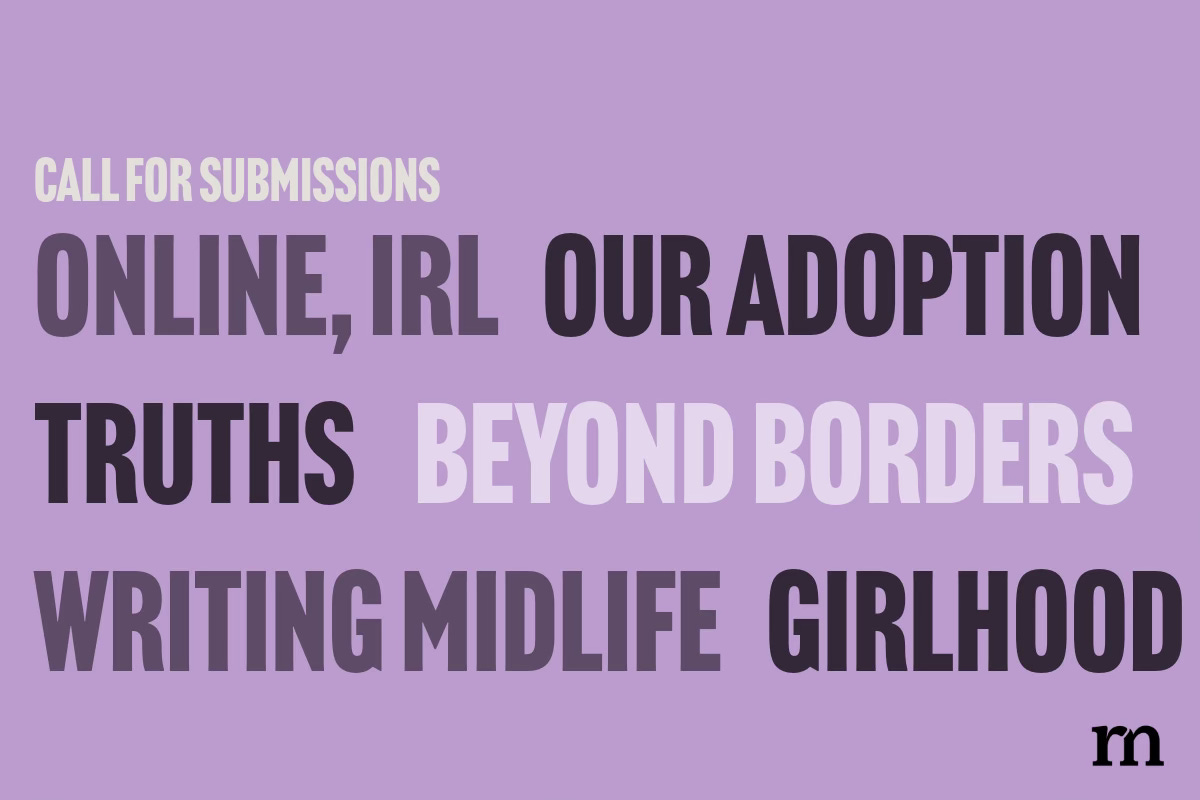
Raising Mothers exclusively publishes the work of writers from the Global Majority.
Quoted from Wikipedia: “Global majority“ is a collective term for people of African, Asian, indigenous, Latin American, or mixed-heritage backgrounds, who constitute approximately 85 percent of the global population. It has been used as an alternative to terms which are seen as racialized like “ethnic minority” and “person of color” (POC), or more regional terms like “visible minority” in Canada and “Black, Asian and Minority Ethnic” (BAME) in the United Kingdom.
Please read our submission guidelines before sending in your work. Refusal to do so will result in immediate rejection of your work.
We are using a new submission form to handle your work. Please make sure to click General Submissions to send your submission.
Over the past decade, internet culture has fundamentally reshaped how we parent, connect, and respond to the world around us—and we want to hear your story. We are seeking powerful, authentic voices from parents of the global majority to share their experiences navigating parenthood in our hyper-connected digital age. Where did you find community when it wasn’t available otherwise? Help us create a sort of time capsule.
Personal narratives, conversations, essays, and reflections exploring how internet culture has influenced your parenting journey. We're particularly interested in hearing from parents whose experiences are often underrepresented in mainstream parenting discourse.
Share your insights on how digital spaces have affected:
Your parenting philosophy and approach
Relationships with your children across different developmental stages
Connections with other parents and chosen family networks
Engagement with your broader community and cultural identity
Response to social justice movements and global events
Navigation of online safety, digital literacy, and screen time
Access to resources, support networks, and parenting information
Parents at all stages — from pregnancy through adult children
Caregivers whose societal responses have evolved — whether becoming more activated and engaged or more withdrawn and protective
Families grappling with how to respond to ongoing global crises, social movements, and community trauma while raising resilient children
we can't wait to read your story
We are expanding our previous exploration of transracial adoption with a dedicated focus on the voices that have been systematically marginalized in adoption discourse. For too long, adoption narratives have centered white adopters, and parents who adopt, in general, while silencing the complex, nuanced experiences of those most directly impacted by adoption systems: adult adoptees, adult adoptees of kinship adoption, first/birth parents, and Black adopters.
We seek to disrupt that paradigm. We want your stories—raw, honest, and unfiltered.
Adult Adoptees from the Global Majority Share your lived experience of being adopted. Tell us about how the seven core issues in adoption and permanency have impacted you (i.e., loss, rejection, guilt/shame, grief, identity, intimacy, and mastery/control). Describe your experience with identity formation, cultural disconnection or reconnection, navigating predominantly white spaces, or the complexity of gratitude narratives. Show what healing has looked like for you. We want to hear about joy, trauma, resilience, and everything in between.
Adult Adoptees of Kinship Adoption Kinship care, informal guardianship, being raised by extended family—your experience is adoption, too. Share your story of growing up in your birth family, yet not being raised by your birth parents. What was it like to be a part of a non-traditional family structure within a community of color? How were you impacted by the seven core issues in adoption and permanency (i.e., loss, rejection, guilt/shame, grief, identity, intimacy, and mastery/control)? What do you want the public to understand about kinship adoption?
First/Birth Parents Your voice matters. Whether you relinquished a child through formal channels or informal arrangements, whether by choice or coercion, we want to understand your experience. Tell us about the circumstances that led to relinquishment, the aftermath, ongoing relationships (or lack thereof), and how adoption has shaped your life.
Black Adopters What does it mean to adopt within your community or across racial lines as a Black parent? How do you navigate adoption systems, support adoptees' identity development, and challenge dominant narratives about "suitable" families?
Personal narratives (up to 5,000 words)
Interviews or conversations between family members or community members
Cultural criticism and analysis rooted in lived experience
Resources and community healing practices
Topics We Welcome:
Connections to the seven core issues in adoption and permanency
Identity and belonging in predominantly white spaces
Interracial/transracial adoption
Cultural preservation and loss
The adoption industrial complex and its impact on communities of color
Transnational adoption and cultural displacement
Reunion experiences (or the lack thereof)
Intergenerational trauma and healing
Community care vs. institutional systems
Religious and spiritual dimensions of adoption
Economic factors in relinquishment decisions
Foster care to adoption pipelines
Chosen family and alternative kinship models
Let's recenter the story of immigration and its impact on us. Have you moved to another country and view yourself as an immigrant? Are you first generation and navigating two or more worlds? Do you feel tethered to a home you don't know? What about language? Culture? Safety? New community? Explore it all.
We are seeking powerful first-person narratives that examine the lived experience of immigration in all its complexity. Your story matters—whether you crossed borders by choice or necessity, whether you carry papers or dreams, whether you left home or home left you.
We want authentic voices that challenge the traditional immigration narrative. We're particularly interested in essays that:
Examine the privilege divide*: What does it mean when some border-crossers are called "expats" while others are labeled "immigrants"? How do race, class, education, and nationality shape these distinctions?
Navigate identity and belonging: How do you define home when you exist between worlds? What does it mean to be first-generation, caught between your parents' homeland and your birthplace?
Explore language as landscape: How has language shaped your experience? The words you've lost, gained, or transformed? The accent that marks you as other? The mother tongue that connects you to memory?
Confront survival and safety: What brought you here—opportunity, escape, or something more complex? How do questions of documentation, legal status, or acceptance affect your daily life?
Build new communities: How do you create belonging in unfamiliar spaces? What does it mean to find your people when your people are scattered across continents?
*We're particularly interested in essays that examine the socioeconomic and racial dynamics behind who gets to be an "expat" versus an "immigrant." If you've been labeled one or the other—or if you've witnessed this divide—we want to hear your perspective. How do privilege, race, class, and nationality determine which border-crossers are welcomed and which are feared?
This call is open to all immigration experiences, but we especially encourage submissions from writers whose stories are often marginalized or overlooked:
Undocumented immigrants and those navigating complex legal statuses
Refugees and asylum seekers
Economic migrants whose moves were driven by necessity rather than choice
Writers from the Global South who've moved to Western countries
Those who've experienced downward mobility after immigration
Indigenous writers whose peoples have been displaced by borders that didn't exist when their ancestors lived freely
Writers exploring the intersection of immigration with other identities—LGBTQ+, disability, religious minorities
Academic analyses or policy papers
Fiction or heavily fictionalized accounts
Essays that appropriate others' immigration experiences
Narratives that center the "American Dream" without acknowledging its exclusions
Stories that treat immigration as a simple success story without examining its costs
When RM started, my eldest was two. Now we're changing together.
We're seeking powerful, honest first-person essays about the intersection of midlife, perimenopause and parenting tweens and teenagers—a phase of life that receives far too little attention despite its profound challenges and transformations.
The early years of parenting are well-documented, supported, and celebrated. But what happens when the intensive guidance of those first five years gives way to the complex navigation of adolescence? What happens when your own body and mind are undergoing their own seismic shifts just as your children are experiencing theirs?
Our Double Transition
What it feels like to guide someone through puberty while experiencing your own hormonal upheaval
How your changing body and emotions intersect with your child's development
The strange synchronicity of two generations transforming simultaneously
Parenting Evolution
How your approach to parenting has shifted from the early years to now
What autonomy looks like—for them and for you
The push-pull of letting go while still being needed
Moments when you've had to completely reimagine your role as a parent
The Wisdom Gap
Whether you're reaching back to seek advice from your elders
What guidance exists (or doesn't) for this phase of parenthood
How cultural attitudes toward both perimenopause and teenage parenting leave you feeling isolated or supported
The stories your own mother or grandmother shared (or didn't share) about this time
The sandwich generation experience
Unspoken Realities
The exhaustion of managing your own sleep disruption while dealing with teenage drama
How brain fog intersects with helping with homework or having serious conversations
The vulnerability of questioning your parenting decisions when your confidence feels shaky
Moments of unexpected connection or understanding between you and your changing child
Girlhood is not a soft or simple story. It is layered and loud, tender and terrifying, sacred and misunderstood. For some, it is braids and laughter on summer porches; for others, it is learning—too soon—how to swallow pain with a smile. We are seeking essays that refuse to flatten those complexities. We want the vivid, unfiltered truth of growing up in a body marked before it could define itself. The quiet negotiations between belonging and survival. The moments you found—or forged—yourself. If you carry memories that still echo in your chest, wisdom inherited or earned the hard way, joy that bloomed even in resistance—we want to hear it.
We want essays that dive deep into the lived experiences of girlhood—pieces that are personal, reflective, and emotionally resonant. We're interested in work that explores:
Identity & Belonging
Navigating multiple cultural identities
The intersection of race, gender, and other identities
Code-switching between home and school, family and friends
Finding your place in communities that may not always see you
Coming of Age
First experiences with racism, colorism, or discrimination
Learning to love your body, your hair, your skin
Generational wisdom passed down from mothers and grandmothers
Moments of self-discovery and awakening
Family & Community
Immigrant family dynamics and cultural expectations
The weight of being "the first" in your family
Protecting younger siblings while still figuring yourself out
Community rituals, celebrations, and traditions
Resilience & Resistance
Finding your voice in spaces that try to silence you
Small acts of rebellion and self-assertion
Creating art, friendship, and joy despite adversity
Healing from trauma while still growing up
Dreams & Futures
What it means to dream when the world tells you to be realistic
Educational journeys and academic pressures
Career aspirations and breaking barriers
Imagining new possibilities for yourself and your community
Comments
Nothing yet. Say the first thing.
Sign in to join the conversation.