
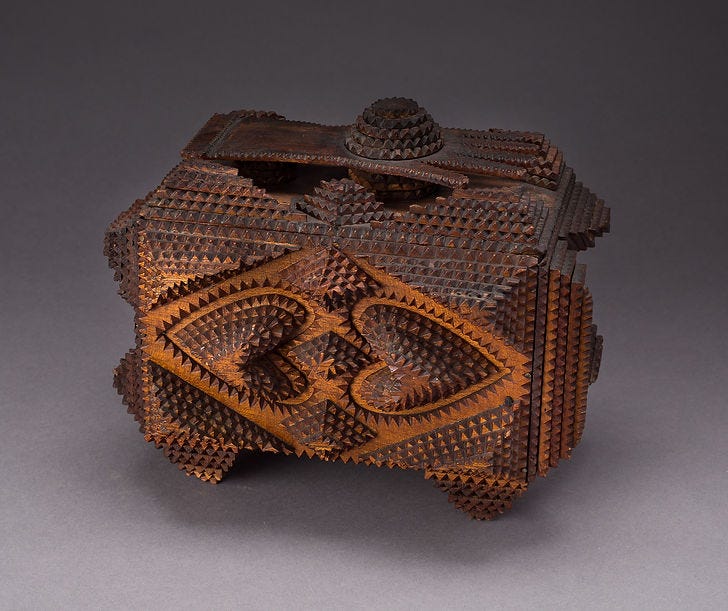
The only way to stop cigar makers from dodging taxes was to force cigars into a standardized box, so in 1865, to pay for the Civil War, that’s what the federal government did. By law, cigars could only be sold in boxes of set quantities and sizes. The boxes had to be made of wood, and they could not be reused. Suddenly, disposable boxes of fine cedar and mahogany were everywhere.
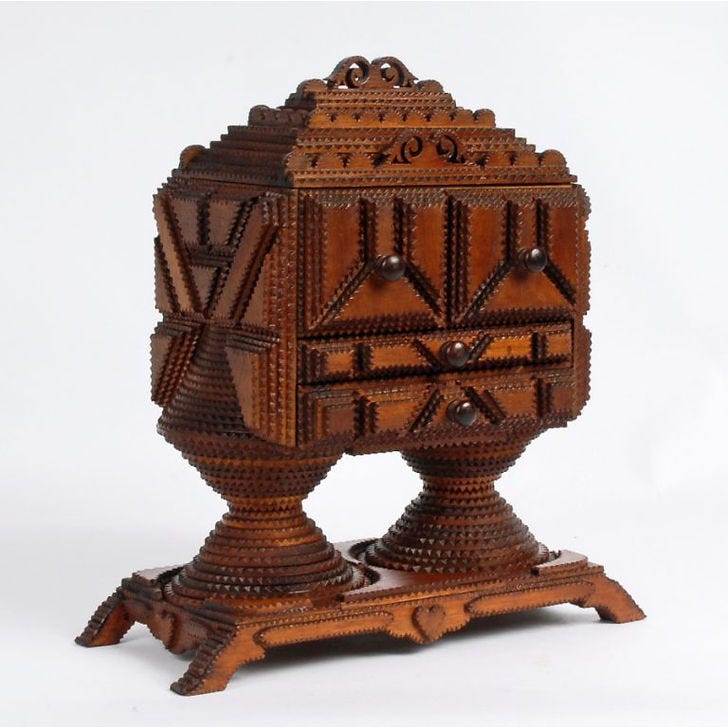
Within a decade, a recognizable genre had emerged of sawtoothed, layered wooden objects made from cigar boxes. The most common types were picture frames and boxes, but they included all kinds of small household goods and religious or patriotic items, and even full-sized furniture. Motifs like hearts, flowers, crosses, and shrines were sincere and heartfelt, a cross-section of love, work, faith, and grief. There was no cynicism with tramp art.
But the name is misleading. All kinds of people made such objects, from the 1870s to the 1940s. As much as we love the romance of a hobo carving a cigar box to trade for a meal, that image was retrofitted onto anonymous works that were mostly made by working- and middle-class men with stable home lives. These crafts were the equivalent of quilting for men; the only requirements were a decent pocketknife, and a desire to take that knife to wood. And time. The best examples are astonishing.
Links:
No Idle Hands: The Myths & Meanings of Tramp Art, 2017 exhibition at the Museum of International Folk Art, Santa Fe, NM
Too many emails? Instructions for receiving a weekly summary can be found here.
This post is part of The American 250, a series featuring 250 words on 250 objects made by Americans, located in America, in honor of the country’s 250th anniversary. Through December 31, 2026.
I’m looking for ideas for this series — have something you’d like me to consider for inclusion? Please feel free to leave a comment! Hi
Comments
Nothing yet. Say the first thing.
Sign in to join the conversation.