
For decades, project management has been built around a familiar formula:
People + Processes + Resources + Time + Budget = Project Delivery
Project managers were responsible for creating plans, coordinating teams, managing risks, tracking deadlines, communicating with stakeholders, and making sure projects moved from an idea to a finished product.
But something fundamental is changing.
AI can now analyze information, create documents, write code, summarize meetings, identify patterns, generate ideas, automate workflows, predict outcomes, and increasingly operate as an active participant in business processes.
That raises a much bigger question than:
“Will AI replace project managers?”
The more interesting question is:
What happens to project management when AI becomes part of the project team?
I believe the answer is not that project managers disappear.
The role becomes more important, but also very different.
Traditional project management often involves coordinating work.
A project manager might spend a significant amount of time asking:
What has been completed?
What is blocked?
Who owns this task?
Is the project on schedule?
What are the dependencies?
What needs to happen next?
What should we communicate to stakeholders?
AI can increasingly help answer many of these questions.
Imagine an AI system that analyzes project management tools, meeting notes, emails, sprint activity and team updates.
Instead of waiting for a weekly status meeting, the system could identify:
“The project is likely to miss the next milestone because the API integration is three days behind schedule and is blocking two downstream tasks.”
That changes the PM’s job.
The project manager no longer needs to spend all their time collecting information.
They can spend more time deciding what to do about it.
And that distinction is incredibly important.
Task Manager
to
Project Orchestrator
to
Decision Facilitator
to potentially
AI Orchestrator
One of the biggest misconceptions about AI project management is that an AI project manager simply needs to understand ChatGPT or know how to use AI tools.
That’s not enough.
Managing AI projects means understanding several interconnected systems.
You still need developers, designers, data scientists, ML engineers, product people, business stakeholders, legal teams and users.
AI doesn’t eliminate organizational complexity.
Sometimes it increases it.
AI projects introduce additional technical considerations:
Models
APIs
Data pipelines
Infrastructure
Evaluation
Monitoring
Security
Integrations
Automation
AI agents
A project manager doesn’t necessarily need to become a machine learning engineer.
But they need enough technical understanding to ask the right questions.
AI depends heavily on data.
That means project managers need to think about:
Where does the data come from?
Is the data reliable?
Can we legally use it?
Is it representative?
How will it be stored?
Who has access to it?
A project can have an excellent model and still fail because the underlying data is poor.
This is where project management remains extremely important.
The goal isn’t:
“Let’s build an AI system.”
The goal should be:
“Let’s solve a meaningful problem using AI if AI is actually the right solution.”
That difference sounds small.
It isn’t.
One of the first questions a project manager should ask is:
Not:
“Where can we use AI?”
But:
“Does this problem actually require AI?”
Suppose a company wants to automate a simple approval workflow.
Maybe a traditional rule-based system can solve it.
There may be no reason to introduce a large language model, AI agent or complex machine learning system.
But perhaps another problem involves thousands of documents that employees need to analyze every day.
Now AI might provide significant value.
The project manager’s job is to connect:
Business Problem → Technology → User → Outcome
rather than:
AI Technology → Find Something To Build
That shift in thinking will become increasingly important.
This is where project management becomes particularly interesting.
Imagine you’re managing a traditional software feature.
The team might have a requirement:
“When the user clicks this button, the system should perform X.”
The outcome can often be relatively deterministic.
The feature either works or it doesn’t.
AI introduces uncertainty.
For example, imagine you’re building an AI customer-support assistant.
You might ask:
How accurate is it?
How often does it hallucinate?
Does it understand different customer intents?
What happens when it doesn’t know the answer?
How should we evaluate its responses?
Can we trust it with sensitive information?
What happens when the model changes?
How much does every interaction cost?
What happens when usage suddenly increases?
Suddenly, “done” becomes more complicated.
An AI feature isn’t necessarily finished simply because it has been deployed.
It needs:
Evaluation → Monitoring → Feedback → Improvement
That creates a completely different project management environment.
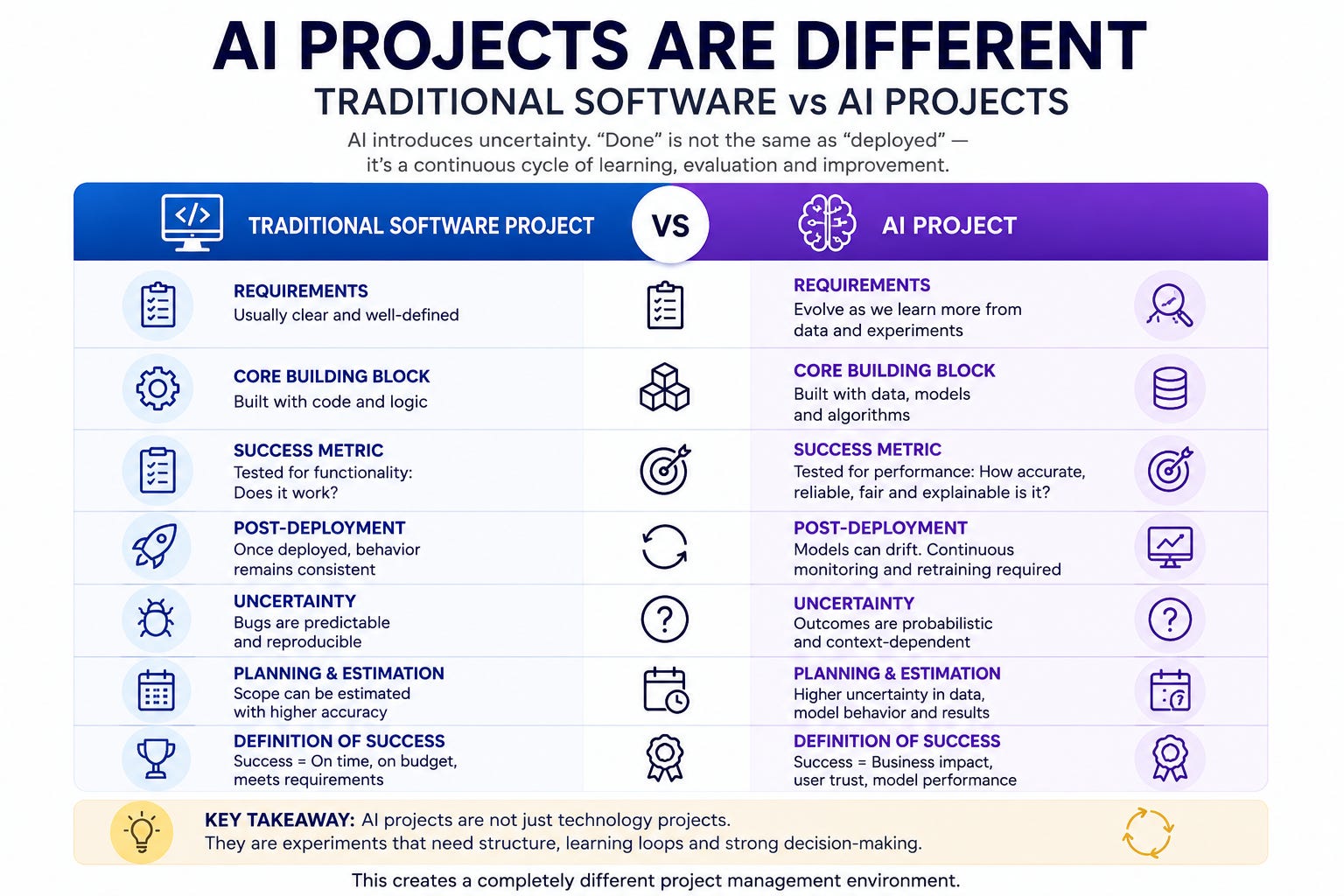
A traditional project might look something like:
Requirements → Development → Testing → Deployment
An AI project can look more like:
Problem → Data → Experiment → Prototype → Evaluation → Iteration → Deployment → Monitoring
And sometimes it loops.
Again.
And again.
And again.
That means project managers need to become comfortable with experimentation.
Not every AI experiment will work.
Some models will perform poorly.
Some datasets will be unusable.
Some assumptions will be wrong.
Some AI features will turn out to provide no meaningful business value.
That isn’t necessarily project failure.
It can be valuable information.
The PM’s responsibility is to make sure the team learns quickly and doesn’t spend six months building something that should have been rejected during week two.
There is another side to this discussion.
AI isn’t only something project managers need to manage.
AI can become a project manager’s own productivity layer.
Think about everything a PM does during a typical week.
Meetings.
Documentation.
Emails.
Reports.
Planning.
Research.
Risk tracking.
Stakeholder updates.
Requirements.
Backlogs.
Status reports.
Analysis.
Communication.
A modern PM could use AI to assist with many of these activities.
For example:
AI can help analyze previous decisions, unresolved issues and relevant documentation.
AI can summarize discussions and extract:
Decisions
Action items
Owners
Deadlines
Risks
Open questions
AI can help generate an initial project structure, identify dependencies and highlight potential risks.
AI can transform project data into stakeholder-friendly summaries.
AI can analyze project signals and identify potential problems before they become obvious.
The objective isn’t to let AI run the entire project.
The objective is to remove repetitive work so the project manager can focus on higher-value decisions.
AI can generate an impressive project plan in seconds.
That doesn’t mean it’s a good project plan.
AI can write a beautiful status report.
That doesn’t mean the underlying project is healthy.
AI can identify risks.
That doesn’t mean it understands the organizational politics behind those risks.
AI can suggest a solution.
That doesn’t mean the organization should implement it.
And this is where human judgment becomes critical.
That distinction is going to define the next generation of project management.
Imagine a project team in the near future.
Instead of only having:
Project Manager + Developers + Designers + Analysts
you may have:
Project Manager + Human Team + AI Agents
One AI agent might analyze requirements.
Another might monitor project risks.
Another might generate documentation.
Another might analyze customer feedback.
Another might monitor project metrics.
Another might assist with testing.
The project manager becomes the person coordinating this ecosystem.
The PM may increasingly ask:
“Which work should humans do?”
“Which work should AI do?”
“Where should humans review AI output?”
“What decisions require human approval?”
“How do we measure whether AI is actually creating value?”
That is a very different form of project management.
This is something I think we should not forget.
Projects don’t fail only because of technology.
They fail because people disagree.
Teams lose alignment.
Stakeholders change priorities.
Users don’t adopt the product.
Communication breaks down.
Budgets change.
Leadership changes direction.
Someone doesn’t understand why the project matters.
AI can help with information.
But humans still need:
Trust.
Leadership.
Negotiation.
Empathy.
Communication.
Accountability.
These are not side skills.
They are becoming even more important.
So what should project managers learn?
I don’t think every PM needs to become a machine learning engineer.
But the PM of the future should probably understand the fundamentals of AI.
A useful skill stack could look like this:
Agile
Scrum
Waterfall
Planning
Budgeting
Risk management
Stakeholder management
Resource management
↓
Generative AI
LLMs
Machine learning basics
AI agents
APIs
Automation
AI evaluation
Data fundamentals
↓
User problems
Product discovery
MVPs
Roadmaps
Prioritization
KPIs
ROI
↓
Privacy
GDPR
Security
Responsible AI
Bias
Human oversight
AI risk
↓
Communication
Decision-making
Negotiation
Change management
Team alignment
This combination could become extremely valuable.
Maybe AI will replace some of the tasks currently performed by project managers.
That’s different from replacing the entire profession.
AI could potentially automate:
Reporting
Documentation
Meeting summaries
Basic planning
Status tracking
Data analysis
Risk signals
Administrative coordination
But the difficult parts remain:
What should we build?
Why are we building it?
Should we continue?
Who needs to be involved?
What trade-off should we make?
How do we handle disagreement?
What happens if the AI system causes harm?
Who is accountable?
Those questions require judgment.
And judgment is where the future value of project management could move.
I don’t think the future project manager will be someone who spends their entire day updating spreadsheets and asking people for status updates.
I think the role is moving toward something more strategic.
The future PM may be:
Part project manager.
Part product thinker.
Part AI operator.
Part business strategist.
Part risk manager.
Part change leader.
And perhaps most importantly:
A person who knows when NOT to use AI.
Because the goal isn’t to put AI everywhere.
The goal is to use technology intelligently to create better outcomes.
The question shouldn’t be:
“Will AI replace project managers?”
I think a better question is:
“How much more valuable can a project manager become when AI handles more of the coordination work?”
That’s the question I’m interested in exploring.
I’m currently spending more time thinking about the intersection of:
AI + Project Management + Product + Automation
because I believe these disciplines are going to increasingly overlap.
The project manager of the future won’t simply manage a project.
They may manage an ecosystem of people, software, AI systems, data and decisions.
And that’s a much more interesting future for project management.
No posts
Comments
Nothing yet. Say the first thing.
Sign in to join the conversation.