
Note: In this post, I am trying something quite different. My goal here is not to trigger or to offend—my goal is simply to share a viewpoint that I think provides food for thought. It may help you see things in a new light, and might even (one day) change your mind… Or, if you write to me, you might change mine! (In my book, I devoted a chapter to “how to have better conversations,” including conversations with people you disagree with.)
My recent post celebrated great inventions of the modern world (“7 nonobvious wonders”). The pessimists out there have been asking a natural follow-up question: what is the worst invention ever created?
The most harmful invention would be one that not only causes harm today, but could harm humanity forever—or even end it. Something that poses a true existential risk. Is it nuclear weapons? Biological superweapons? Something related to AI?
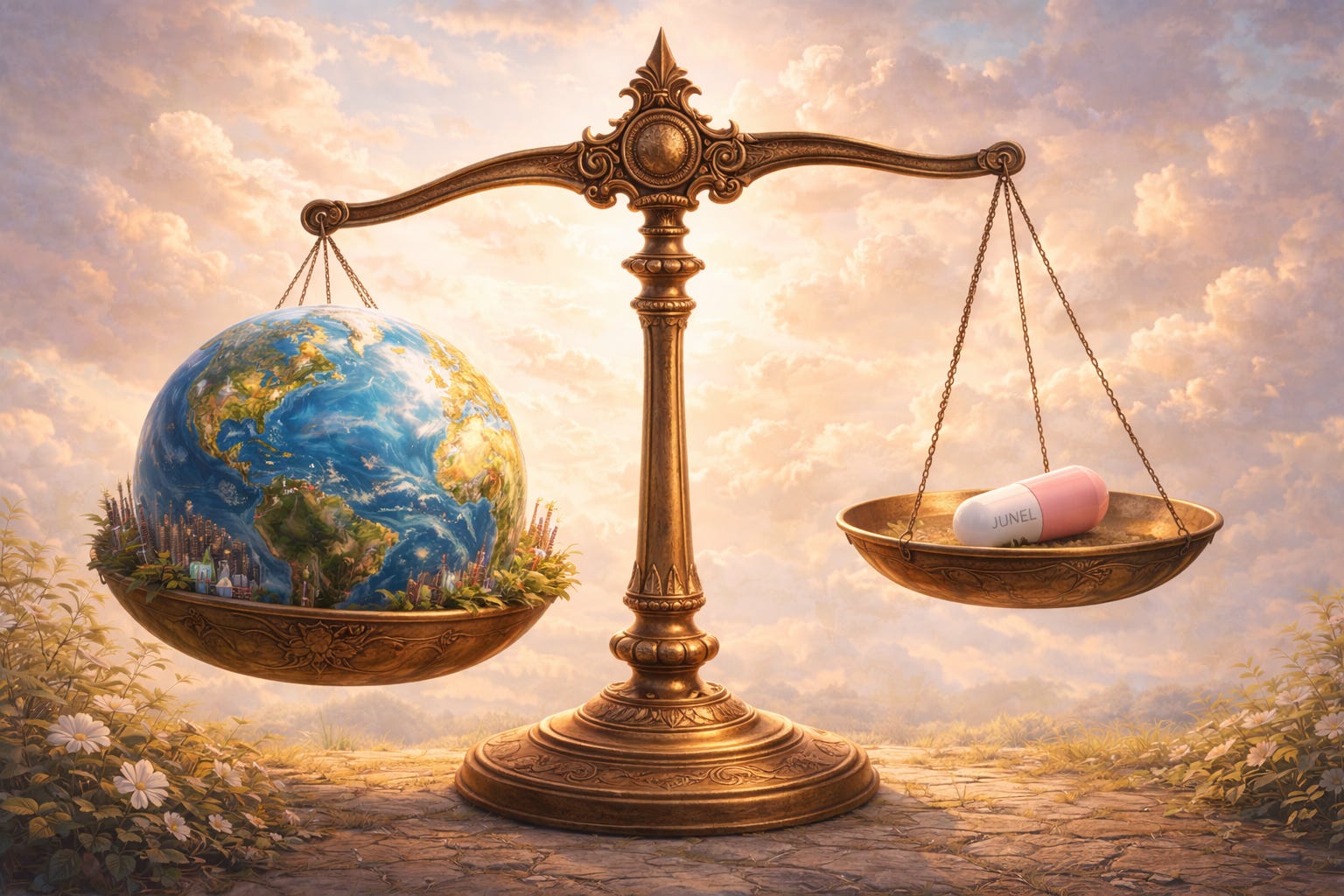
I don’t think so. I think it is the pill: affordable, effective birth control.
Share this knowledge with someone who could use it.
We have, hardwired into us, a powerful instinct to reproduce. Yet by inventing the pill, humans have created a means of separating our biological drive from reproduction.
Yes, birth control existed before the pill, but it was mostly expensive or unreliable. For example, the hassle of using condoms correctly (“user error”) makes them less effective. In those days, if a couple was ambivalent about having children but wanted to have sex, they usually would get pregnant eventually. Having children was an accepted side-effect of sex. So, the population grew.
Whereas having children used to be an “opt out” decision, today it is an “opt in” decision. As a result, population growth is slowing around the world and many countries are on the verge of population decline. For example, if South Korea’s current trend continues, by the end of the century it will have half as many people as now. Most other countries are headed in the same alarming direction.
This video from YouTube’s largest science channel (highly recommended viewing!) gives an overview of the disastrous effects of population decline: not enough working people to subsidize pensions; a “permanent recession”; a worsening loneliness epidemic. There is an even greater potential effect: extinction. (It might sound extreme, but just imagine everyone stopped having kids… in about 100 years, there would be no more humans.)

Many other thinkers have posited possible causes of flattening population curves. They include economic causes such as higher housing prices, not enough paid parental leave, expensive childcare—even mandatory car seats. Yet none explain the decline fully. As one study put it: “We are unable to identify any period-specific social, economic, or policy changes that can statistically explain much of the decline.”
This is also true for potential solutions: granting more benefits to parents, putting more money into education, and hundreds of other top-down policies (that have already been tried in desperate countries like Japan and South Korea) simply haven’t worked.
To my mind, these studies and essays have missed one very obvious cause. In 1960, the U.S. Food and Drug Administration approved the pill as a contraceptive. Take a look at the ensuing birth rate:
Because this post’s argument is controversial, I’m aware it may be misinterpreted. I want to be clear about what I am not saying:
A. “The pill has no upsides” — The invention of the pill has many upsides! It has made it more possible for couples to plan their families. It is also correlated with increased autonomy for women—entirely new life possibilities opened up for women across the globe.
B. “The pill should be banned” — I don’t think that would be ethical, nor do I think it would work. As with any technology, the genie cannot be put back in the bottle.
C. “You shouldn’t take the pill” — Just because something is bad at the societal level, doesn’t mean it’s bad at the individual level. Taking the pill may be the right choice for many, many women. If I were a woman, I might take it, too (at least, until I learned more about its harmful effects - see below).
For more than 60 years, the pill has been marketed to women as a magical solution. Many of its side-effects have been under-discussed, or even supressed. But there has been an increasing body of research in just the past decade about all the ways the pill can harm its users:
1. The pill makes it hard to track your natural cycles, which are considered a “vital sign” because cycle abnormalities can signal other health problems. If you don’t notice these irregularities, you cannot preventively address the health problems.
2. The pill produces an influx of hormones (estrogen and progesterone) that can change your mood, and even your personality. It can also cause depression.
3. The pill stops you from ovulating, yet sex is much more appealing and pleasurable for a woman when ovulating. As a result, women on the pill have less (and less good!) sex.
4. The pill can increase your risk of long-term health issues including stroke, breast cancer, and liver cancer. It may simultaneously reduce risks of some other types of cancer; these are still not well understood.
It feels quite unfair that in today’s society, we place this expectation mostly on women. They are assumed to be responsible for contraception, and to mess with their physical and mental health as a result.
Hopefully, humanity won’t reach literal extinction—or even come close. We are remarkably good at solving problems! But by inventing the means of ceasing our reproduction, we are certainly playing with fire.
No posts
Comments
Nothing yet. Say the first thing.
Sign in to join the conversation.