
I have a new short story in in Issue 4 of the Ubwali! (Finally, I’m inspired to write something here.) I wrote “Closer than a Shadow” during my years as a MFA student. It's the second story from that era (2021-23) to make it out from my laptop to the world. The first was "The Notes They Lost" which appears in Many Worlds (thanks to Cadwell Turnbull, Darusha Whem and everyone else at Many Worlds!)
Sometimes, when I look at the list on my website’s publication page, I can’t help noticing that most of the titles tilt heavily towards the pre-MFA side. I’m still coming to terms with how I feel about this. I’ve grown so much as a writer and I feel this isn’t reflected in the works out there because most of my recent stories are roosting in my laptop and/or in rejection piles. And this is why I'm doubly thankful for the editors that get my writing. When Mubanga asked me send something to Ubwali, I had many stories to chose from but settled on “Closer than a Shadow” because it has a touch of the literary amidst all the speculative elements. I’m so glad it’s found a home.
“Closer than a Shadow” is about a man, his grandchild and the ghost that haunts them. Intrigued? Go read the story and then come back for spoilers.
It all started with a tweet I saw years ago. A Lagosian shared how he paid a woman’s bus fare out of the generosity of his heart. When he got to his stop, he got down and she did the same. He started walking home and realised then she was following him. He ran, she ran after him. He shouted at her, she was unfazed. I took a screenshot that is probably somewhere in my digital storage. There was a story to be found in there. I though, What if that woman was ghost? Then, What if this happened in turn of the 20th century Lagos?
When I started writing “Closer than a Shadow”, it was to be part of several stories interlinked because they are inspired by different decades of Nigeria’s past, present and future. As I kept writing and revising however, I realised that these stories weren’t really set in Nigeria. At least not the country as we know it today. In that other Nigeria, the world was once populated by humans and spirits until Orosen separated the two races. Of course Orosen’s wall only lasted for a couple of centuries and the spirits started to bleed into human life. Does this sound like the world you know and are familiar with?
Initially called “Baba’s Ghost”, this story was my 1920-1950s era tale. I was interested in how colonialism impacted families and family structure in that period. This quote from Ugboajah captures the theme
“In Lagos the Yoruba family compound broke down into smaller residential units rented out to migrants. With renting, control over tenants and social control over the youths tended to diminish. To keep control over their communities both indigenous dwellers and migrant settlers created political, religious, ethnic or neighbourhood associations. It is obvious, however, that most of the local unions were too loosely organised and short of funds to aid more than a small minority of the poor. Social workers also noted the lack of parental control, family disintegration and the harsh discipline in local schools as factors pushing so many children on to the street.” [emphasis mine]
A disintegrated family headed by a self-righteous patriarch, a wife rebelling in her old age, a mysterious baby and a ghost clad in revealing clothes.
My initial blurb for “Baba’s Ghost” goes,
A man who has cut of his past and his culture is followed by a ghost demanding to be heard. I’m imagining the scene in [Bessie] Head’s A Bewitched Crossroads where Mazebe (the grandson of Sebina who excels in Christian school and is ferried away for further education on the Cape) encounters Tumediso (the son of Maraupula who banned his children from going to church). The latter is now a deacon, dressed in a dark suit and holding a Bible.
But as I wrote, it became clear Baba Mumuni was from a Muslim family. I prefer not to have religion in my works but that’s how this one came out and who am I to deny my characters’ realities.
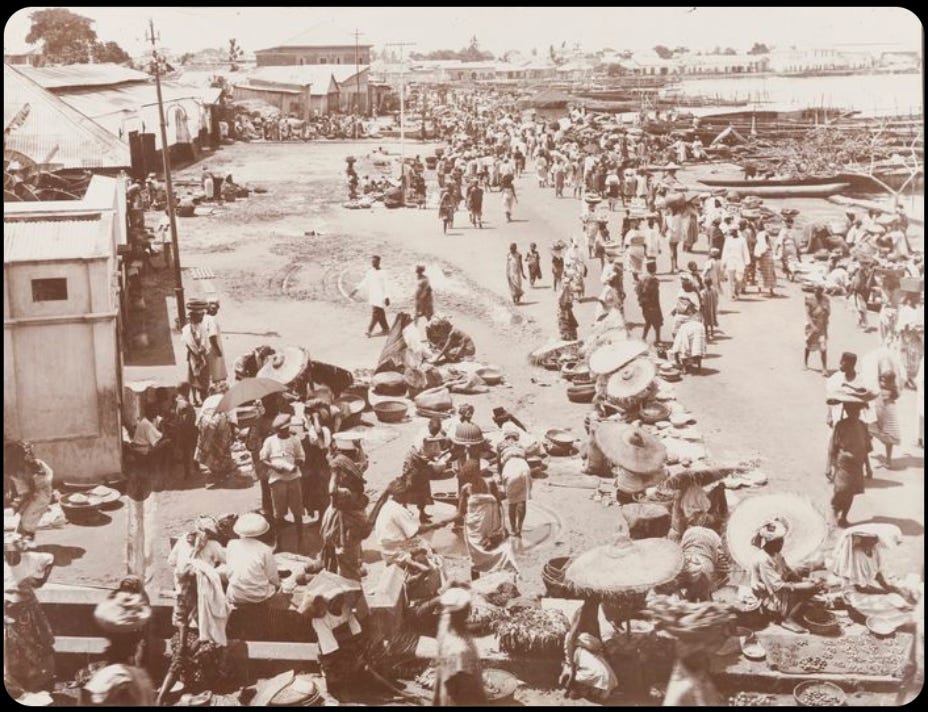
Early colonial Lagos (and the wider southwestern region of Nigeria) saw an increase in crime and “indecency”. Boys ran away from home to pick pockets, gamble, loaf around and pimp. Girls ran away from home to dance with men, smoke and drink. They pencilled their brows, shook their hips in front of men and dressed in “loose” and “carelessly revealing” clothing. I find it interesting how the so-called moral decay is captured along gendered lines but that’s a post for another day. In imagining the ghost, unnamed in “Closer than a Shadow” but called the Lady in the Petite Dress in my outline, I was thinking about these young women that fled to Lagos in the early 1900s. Cyprian Ekwensi’s work came in handy here. He captures the changing Lagos affected by “the excessive aspects of Westernisation” in characters such as Jagua Nana and all the promiscuous people of Lokotown like Sango.
Okay, that’s it for this-is-how-this-story-came-to-be. Thanks for making it this far. I hope you enjoy reading “Closer than a Shadow”!
I’m sharing a list of other things I read in the process of making this story below just because.
The Ondo road Eastwards of Lagos, c. 1870–95 by S. A. Akintoye (to have an idea of the route Baba Mumuni would take to Iya Mumuni)
Tracking ethno-cultural differences: the Lagos steam tramway, 1902 -1933 by Liora Bigon (for setting)
Electricity, Agency and Class in Lagos colony, c.1860s–1914 by by Adewumi Damilola Adebayo (also for setting)
Yaba housing scheme and the colonial ‘replanning’ of Lagos, 1917–1952 by Lanre Davies (SETTING!)
Population pressure, housing and sanitation in West Africa’s premier port-city: Lagos 1900-1939 by Ayodeji Olukoju (S for setting)
Urban planning, colonial doctrines and street naming in French Dakar and British Lagos, c. 1850-1930 by Liora Bigon (I clearly don’t play when it comes to setting)
Islam and Colonial Rule in Lagos by Olakunle A. Lawal (I believe reading this is where I received the name Mumuni)
Prostitution in Colonial Lagos and Accra: Evidence from the National Archives Buea, Cameroon, c.1930s-1950s by Walter Gam Nkwi (for the Lady in the Petite Dress, this one had a list of “known prostitutes in Lagos 1943” showing their ethnicity and the quarters they lived in)
“Their Days are Spent in Gambling and Loafing, Pimping for Prostitutes, and Picking Pockets”: Male Juvenile Delinquents on Lagos Island, 1920s-1960s by Simon Heap (for Banke, the delinquent son)
*Culture-Conflict and Delinquency: A Case Study of Colonial Lagos by Paul K.N. Ugboajah (for the theme)
Comments
Nothing yet. Say the first thing.
Sign in to join the conversation.