
Trigger warnings. Spoiler alerts.
I am curious about moral authority in stories and how it presents itself in openings. Morality is a central function of stories that I find most engaging, in particular, the moral implications surrounding gender-based violence and abuse. I prefer stories that push the boundaries of moral dilemmas. Some questions of morality present as axioms of the human condition; yes, I would agree with this, but there is still a social construction within it, nuances that make it less “truth” than manufactured. The way these moral axioms apply through human consumption and synthesis can become something entirely different, depending on the human, especially when manufactured by privilege. The authors who dare to pose these questions of morality as consumed and synthesized through privilege are often the authors I follow as a reader and writer. As I’ve discussed before, Toni Morrison’s Beloved is perfection for me if there is such a thing as a perfect novel. Beloved questions morality synthesized and told through the eyes of marginalized perspective, which I find necessary and fascinating as a study in craft. I thought you might find it fascinating, too, so perhaps we can be fascinated, together, for a time.
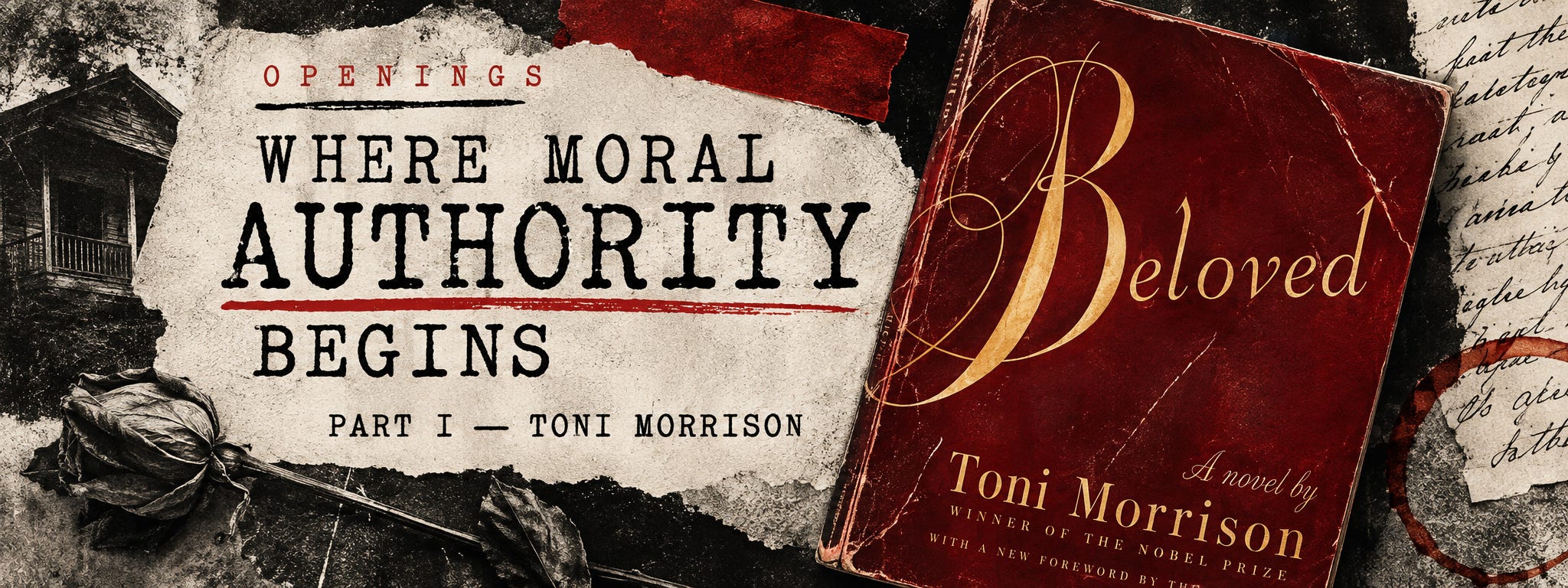
Beloved opens with an omniscient narrator’s personification of a house, a “spiteful” house, named “124.” Set outside Cincinnati, Ohio, 124 is a haunted place where the now deceased grandmother, Baby Suggs was an “unchurched preacher,” whom we will later learn in the novel once tended to a community of runaway slaves and freed people. 124 began as a loving place, a “cheerful, buzzing house” and “way station,” but for some undisclosed reason, 124 grew dark, “spiteful.” And so we open with the narrator’s moral authority and judgement on 124’s “venom”:
124 WAS SPITEFUL. Full of a baby’s venom. The women in the house knew it and so did the children. For years each put up with the spite in his own way, but by 1873 Sethe and her daughter Denver were its only victims. The grandmother, Baby Suggs, was dead, and the sons, Howard and Buglar, had run away by the time they were thirteen years old—as soon as merely looking in a mirror shattered it (that was the signal for Buglar); as soon as two tiny hand prints appeared in the cake (that was it for Howard). Neither boy waited to see more; another kettleful of chickpeas smoking in a heap on the floor; soda crackers crumbled and strewn in a line next to the door-sill. Nor did they wait for one of the relief periods: the weeks, months even, when nothing was disturbed. No. Each one fled at once—the moment the house committed what was for him the one insult not to be borne or witnessed a second time. Within two months, in the dead of winter, leaving their grandmother, Baby Suggs; Sethe, their mother; and their little sister, Denver, all by themselves in the gray and white house on Bluestone Road. It didn’t have a number then because Cincinnati didn’t stretch that far. In fact, Ohio had been calling itself a state only seventy years when first one brother and then the next stuffed quilt packing into his hat, snatched up his shoes, and crept away from the lively spite the house felt for them….(3)
From the beginning, the reader understands that a tragic incident has happened in 124, something whispered but not said outright—”Thou shalt not go up and down as a talebearer among thy people: neither shalt thou stand against the blood of thy neighbour” (Leviticus 19:16). The narrator reveals this incident brilliantly in Chapter 16, but holds it close for such a long time. Why? And how does this withholding of details central to the story and its moral authority serve the story?
From a craft standpoint, Morrison delivers extraordinary dramatic tension through this withholding of details. Just as the reader wants to know what has happened to this family and home, something so terrible that 124 is now haunted, so does the character Paul D., Sethe’s love interest and friend from Sweet Home. One might say that the withholding creates too much of a suspension to warrant the wait, but for the appearance of this strange young woman with the manners of an infant. The reader is enchanted and senses the present catching up with the past in the form of this woman-child magically presented on Sethe’s doorstep. And then there is the history of Sethe’s former life and survival. Sethe’s past, present and future all hinge on this secret the narrator withholds from the reader until Chapter 16. How does Morrison keep the reader reading? Exceptional characterization and a prose style unmatched, of course. But there is something else. She infuses setting, life and love in every word and phrase. An infusion I have always found mesmerizing. For a nobody girl growing up only a few hours from where Morrison, herself, was born, a girl surviving much less than Sethe survived, Morrison was the moral authority for which I was searching. In one book, I found more morality and authority than all my years in the church or its leadership of men and privilege. Morrison’s voice was a woman’s voice, a woman who saw things as they were and spoke in a voice that was real. The voice was altogether Morrison but it was also part of the land, the Ohio I knew. And the voice witnessed more suffering and surviving than any I had read before it: “Freeing yourself was one thing; claiming ownership over that freed self was another” (111).
Sweet Home, schoolteacher and his nephews are certainly presented without moral ambiguity. We learn of Sethe’s abuses at Sweet Home, a plantation as treacherous as it is ironic in name, and her journey to 124. Where the platform of morality is set within the opening, the primary incident in which the moral debate climaxes for the reader has already happened eighteen years prior to the opening of Beloved, when Sethe murdered her infant. And in Chapter 16, when the reader discovers this dark secret through flashback, it is as if living the tragedy in real time.
Schoolteacher is a particularly odious sadist with a name as ironic as Sweet Home. He comes to 124 with the intentions of taking Sethe and her children back to the plantation, which prompts Sethe’s trauma-induced response and infanticide, hence the haunting of 124, and in this Morrison has created the perfect, moral, clusterf***ing storm. We are asking ourselves a question no parent would ever want to ask—what would we do if faced with the same dilemma—damn our children to a life of slavery, rape, abuse, sadistic murder that we barely escaped ourselves or save our children from the horrors?
Morrison’s first lines stage the moral platform for this terrible question, a question that forces a qualification of privilege and marginalization. A privileged reader who has never known socio-political or socio-economic marginalizations might quickly jump to assumptions and judgements about Sethe’s choices, whereas someone less privileged might have a deeper connection to Sethe’s journey and impossible dilemma. Morrison prepares us for this impossible debate in the openings lines with her sons, an effective platform for Sethe’s climactic incident, as her boys, Howard and Buglar abandon her and their sister to the hauntings of 124. A reader who grew up in a privileged home void of poverty or abuse—or hauntings—might see the boy’s choices to abandon their mother and sister as cruel, selfish, foolish, especially at the beginning, before knowing the full weight of 124…. How can a house be so bad a child would choose homelessness? Whereas a reader who grew up in a poor and/or abusive home might connect deeply to the boy’s sense of survival. Sometimes the street is far safer than the home. And sometimes a child prefers the predations of a stranger to the predations of a spirit. Or a family member. Hauntings of a home can come in many forms, especially homes lacking moral authority. And there is great irony in that, too, from a child’s perspective, I think. The kind of irony that can feed many stories.
Morrison, Toni. Beloved, Vintage Books, 2004.
Rae Cline is the author of the story collection The Indefinite State of Imaginary Morals. Her fiction and essays have appeared in The Paris Review, McSweeney’s, North American Review and StoryQuarterly and more. She is the founding editor of Eckleburg and lives in New York City. Precious Ugly, her debut novel, was a finalist for the Curt Johnson Prose Award for Fiction and shortlisted for Craft’s First Chapters Award. Read more at raecline.com.
Comments
Nothing yet. Say the first thing.
Sign in to join the conversation.