
With this post we briefly depart from our usual urgent concerns here at Radical Vitalism, and I allow myself to indulge in a bit of playful experimental theorizing rooted in my own biography. Maybe what I’ve written here will resonate with a few heads at the place where surrealist cinema and holistic health meet.
In a previous piece, I used the analogy of a net to describe the way that holistic practitioners think and act when assessing health and developing plans for care. A net doesn’t rely on the strength of any single strand in order to function. Instead, a net weaves many strands together to create a strong fabric, each thread reinforcing the others. In a similar manner, a well-composed holistic health plan is greater than the sum of its parts.
An example scenario: A client with a traumatic history presents with widespread nervous system activation—restlessness, anxiety, distractibility, chronic pain. My suggestions for this person might include:
Setting a more predictable bedtime and gradually realizing it
An herbal tea for the nervous system that becomes a daily(ish) ritual at around the same time each day
A short once-daily breathing exercise, perhaps as part of wind-down before bed
These might not be all my recommendations for this person, but they illustrate the point. The three elements work in different modes—herbs, breath, sleep timing—but they’re in conversation with each other. Together they conspire to send signals of predictability, regularity, and hopefully safety to a nervous system on the edge. Our nervous systems value predictability, especially when they’ve become accustomed to feeling unsafe, so even small rhythmic beats can be profoundly soothing over time. And of course herbal blends and intentional breathing weave their own medicine into the mix.
To use a different metaphor than a net, the elements of the plan resonate together. They are the poles that create a charged field of coherence that envelops and entrains the bodymind, like how the earth’s magnetic field helps guide the migrations of birds.
Every holistic practitioner learns to place such poles, to weave such nets, to create charged fields of coherence that nudge bodies into new states. My own education in that skill began early, and happened to involve the work of David Lynch.
Picture me as a teen watching Blue Velvet in the late 80’s. The protagonist Jeffrey Beaumont finds a severed ear in an overgrown field, setting in motion the events of the film. Then, at the end of movie, the camera’s view unexpectedly emerges from Jeffrey’s ear as he dozes in the backyard. Why? What’s going on with ears? We’re not told. The meaning is uncertain, but the film purposefully sets up resonance between those two ears, allowing currents of significance to arc between them.
In 2001’s Mulholland Drive, a chain of phone calls early in the film leads to a black phone, beneath a lamp with a red shade, that rings without being answered. When later, in the film’s last act—and in a different storyline—we see the same phone under the same lamp ring in Diane’s apartment, we gasp with recognition. Recognition of what, though? We don’t know exactly, or we don’t know yet. We know that the narrative pulsates with coherence in that moment, coherence bordering on meaning while still falling short of it.
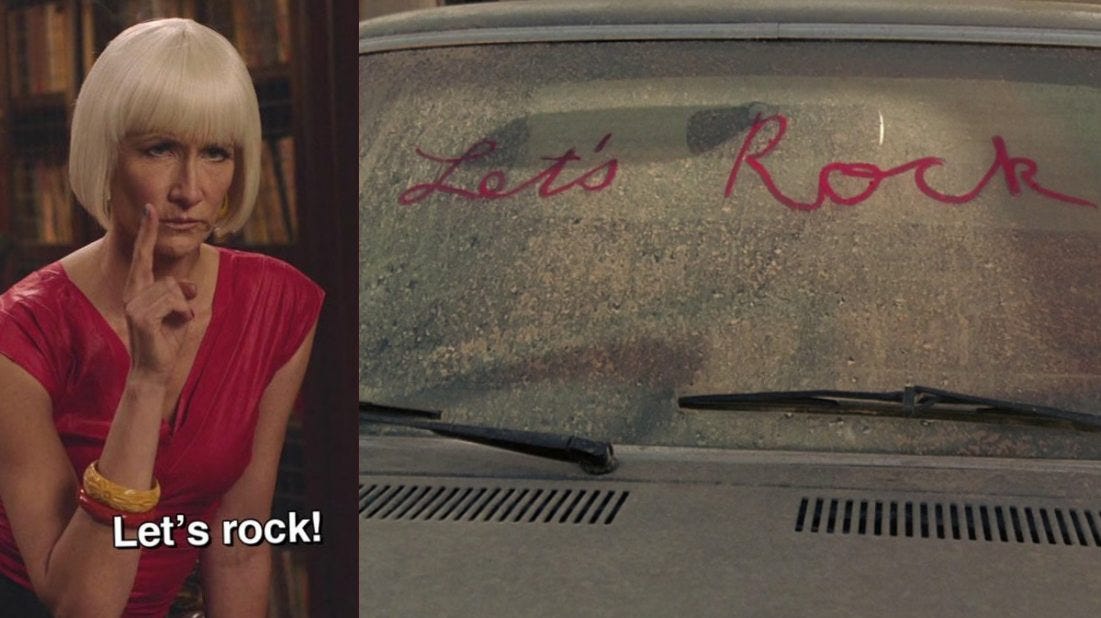
Lynch was a master of these cinematic moves. He showed that placing a handful of visual, auditory, or dramatic callbacks can charge a narrative with potency, subliminally structuring the whole field of meaning in a story, even if the repetitions are unexplained, feel incongruous, and raise more questions than they answer. Lynchheads can easily think of countless such examples: the phrase “Let’s Rock” that echoes ominously through the Twin Peaks universe, or the discordant musical cue that weaves the black lodge and its “convenience store” together with Sarah Palmer’s grocery run in The Return.
The key to the success of these Lynchian moves is that they are not merely arbitrary—not just random associations. Because, to be fair, random associations would produce some effect: the human mind is built for seeing patterns, and we’re easily tricked into seeing something that’s “not really there”—a tendency that carries much higher stakes in medicine than it does in art (more on that in moment). And for sure, Lynch has been accused of just “fucking with us”—tricking us into making sense of nonsense. But his films are powerful because what he’s doing is not nonsense. The echoes feel like clues because they gesture to subterranean currents latent in the tale, even if the ultimate meaning is never fully revealed.
It may be a stretch to imagine this being related to holistic medicine in any way. To draw an important distinction, Lynch worked in an artistic medium, and a surreal one at that. If his resonances fail to cohere, the product might fail as a work of art, but he doesn’t fail a specific person whose health is on the line. In medicine, our protocols are not primarily an artistic expression. They must stand the test of real life, in real conditions, and a higher price is paid for seeing patterns that aren’t there.
I can’t stress this last point enough, especially when my field of herbal medicine is adjacent to a world of ‘alternative health’ where misdiagnoses of, say, candida overgrowth or intestinal parasites are routinely made with no real evidence beyond a vague list of very common symptoms.
So it would be a mistake to over-read the parallel between Lynchian aesthetics and holistic care. But for me, these have always felt like two applications of a similar principle, and learning one helped prepare me for the other. In Lynch, repetition charges the narrative field until it hums with potential meaning. In holistic care, coordinated supports charge the physiological field until it reorganizes toward resilience, stability, or ease. Neither process is imposed from above; both rely on immanent organization—change arising from within the field itself.
In holistic herbal care, we typically don’t rely on the strength of any one intervention. The metaphor of the net says: don’t pull harder—weave wisely. Lynch’s version would be: don’t explain harder—compose resonantly. Both rest on the principle that power lies not in linear force but in patterned coherence.
In both healing and art, resonance itself is therapeutic. A well-placed motif, like a well-chosen herb, doesn’t act in isolation; it participates in a relational network that amplifies its effect. The task of the practitioner or filmmaker is not to determine meaning but to tune the field so that coherence can arise.
And importantly, both rely on a kind of strategic minimalism. Lynch’s resonant motifs and holistic “woven” interventions both share a belief that a few well-placed points, aligned in the right relational geometry, can shift an entire field. The art lies in the placement—knowing where the field is most sensitive to resonance. It’s the same wisdom expressed in acupuncture meridians, in gestalt therapy, in ecological restoration: small interventions at key nodes can reorganize the whole.
To take this parallel to its furthest possible extent, we could even say that just as Lynch’s films approach definitive meaning or interpretation without ever arriving there, in holistic medicine—at least the way I practice it—healing is a direction, not a destination. The goal is not to achieve a final, perfected wholeness, but to sustain a kind of dynamic order: a living, breathing coherence that can adapt, fluctuate, and continue. The vitality lies in the ongoingness, the refusal of closure. We learn to inhabit a liminal field.
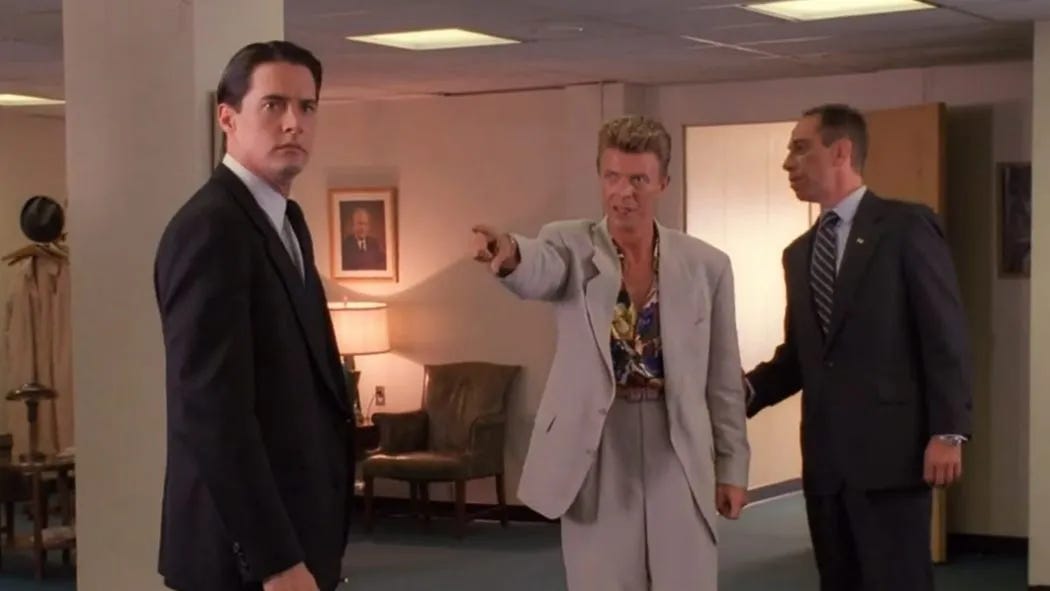
I’m well aware that this comparison might only make sense to me. Everyone follows a different road to learning a craft, and everyone conceives of their work differently. I’m not here to suggest that David Lynch provides something essential that all herbalists must know—not by a long shot. But when I formulate a digestive bitters tincture for a client and include nervines in that formulation—a bitters with Skullcap, with Motherwort, or with Blue Vervain—a bitters that grounds and strengthens the digestion, that activates the vagus nerve, that relaxes nervous tension, that encourages a deeper breath—a bitters that could be the lynchpin of an entire therapeutic strategy, I will, at least sometimes, think of David Bowie as Agent Phillip Jeffries striding into Gordon Cole’s office in Fire Walk With Me, declaring that “We’re not going to talk about Judy” in an inscrutable scene without which Twin Peaks: The Return would not exist. Both the tincture and the scene are potent nodes that pattern an entire field through their relational effects, both waiting to be completed, made real, by the person on the other end: those who receive the transmission and meet it halfway.
✨
Happy birthday, David. Rest in Power.
No posts
Comments
Nothing yet. Say the first thing.
Sign in to join the conversation.